
How to Pay Off $8,000 in Credit Card Debt If You Can Only Pay $200 a Month
A realistic debt-payoff plan for someone carrying $8,000 in credit card debt at a high APR with only $200 a month available, including the real payoff timeline, interest cost, and the exact moves that shorten it.
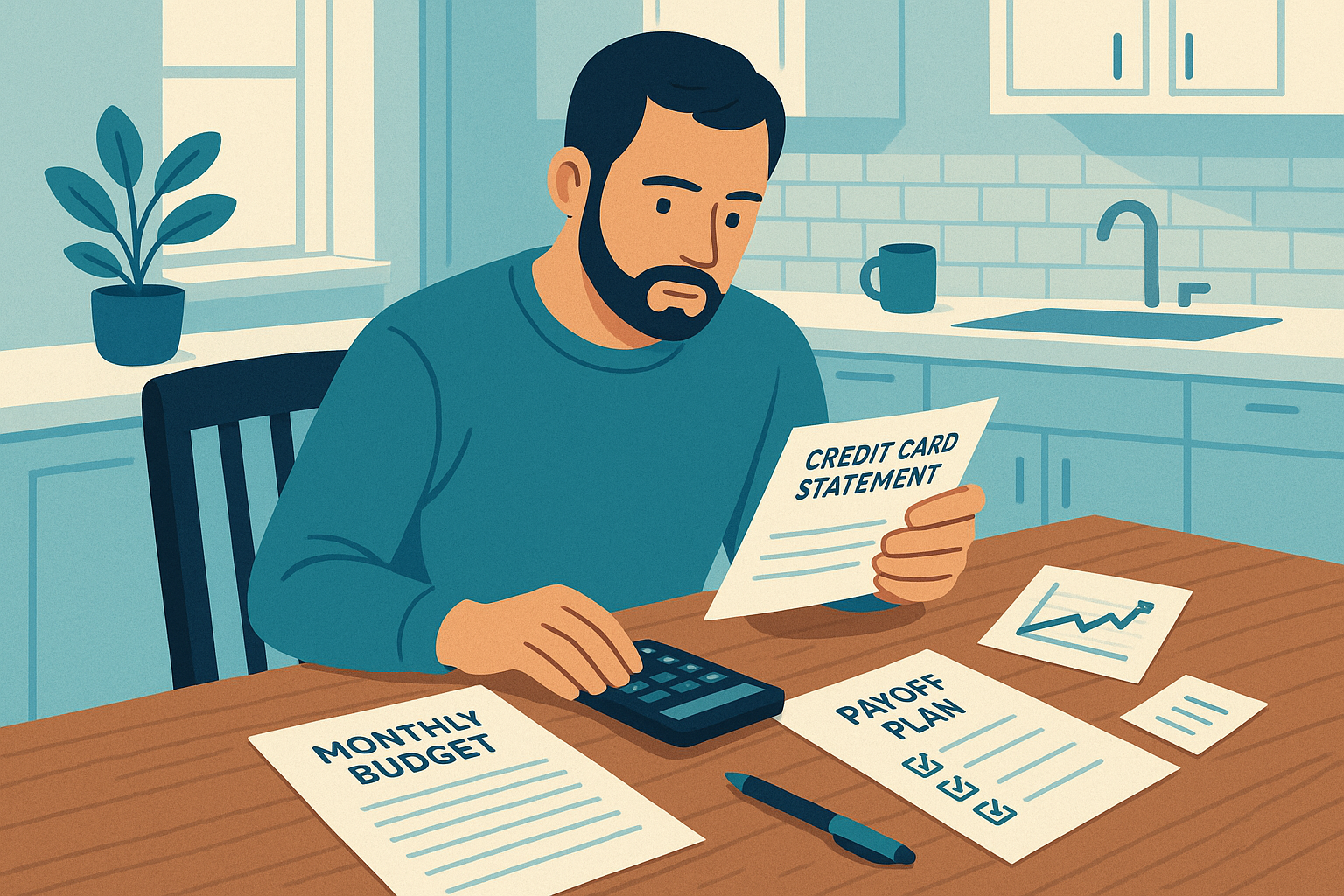
If you only have $200 a month to throw at credit card debt, you do not need generic advice. You need real math and a plan you can stick with.
Here is the blunt version: if you owe $8,000 at 24% APR and can only pay $200 per month, you can get out of debt — but it will take time unless you find ways to raise the payment. In this example, paying $200 a month takes about 82 months and costs about $8,255 in interest.
What $200 a month actually does on an $8,000 balance
At 24% APR, the card is charging about 2% per month in interest. On an $8,000 balance, that is roughly $160 of interest in month one. So your first $200 payment only knocks out about $40 of principal.
That does not mean the plan is pointless. It means you are in the zone where small payment increases matter a lot. The FTC warns that only making minimum-style payments can leave you paying much more in interest over time. The CFPB also notes that when you pay more than the minimum required, card issuers generally apply the amount above the minimum to the balance with the highest interest rate — which is exactly why every extra dollar helps.
First-year reality check: most of your money still goes to interest at first
In the first 12 months of this example, $200 monthly payments add up to $2,400 paid. But only about $536 goes to principal, while roughly $1,864 goes to interest. After a full year, the balance is still around $7,464.
What to do if $200 is truly your ceiling right now
- Autopay at least the minimum. Protect your credit and avoid late-fee damage first.
- Stop new charges completely. A payoff plan breaks if the balance keeps growing.
- Send the $200 as early as possible. The CFPB notes that carrying a balance means interest keeps accruing; earlier payments reduce the balance sooner.
- Sweep irregular money into principal. Tax refunds, overtime, side-gig income, cashback, and gift money matter more than usual when your base payment is tight.
- Check whether you can add just $50. In this example, that one change saves more than two years.
When you should shift from “pay it down” to “change the structure”
If you are current on payments but the payoff horizon feels crushing, the math may be telling you to change the structure of the debt instead of just grinding harder. That can mean:
- a legitimate balance transfer only if you can clear enough principal before the promo ends
- a hardship program from your card issuer if income has dropped
- a personal loan only if the rate is truly lower and the payment fits your budget
What you do not want is a fake “interest reduction” company promising miracle savings. The FTC has warned consumers about deceptive offers in this space.
A practical monthly plan for someone in this spot
| Priority | What to do | Why it matters |
|---|---|---|
| 1 | Lock in minimum autopay | Prevents late fees, credit score damage, and extra stress |
| 2 | Commit the full $200 as a fixed line item | Turns debt payoff into a system instead of a leftover decision |
| 3 | Track every extra payment separately | Small wins are easy to miss unless you see timeline changes |
| 4 | Review progress every month | Lets you increase the payment quickly if cash flow improves |
Where Debt Freedom Planner fits
This kind of debt is exactly where people lose motivation, because the monthly payment feels serious but the balance barely moves at first. Debt Freedom Planner helps you turn that into an actual decision model. You can plug in your balances, APRs, and payment limits, then test what happens if you add $25, $50, or $100, move a due date, or direct a windfall to one card.
Instead of vaguely “trying harder,” you can see the payoff date move before you commit. That is a much better way to stay consistent.
Bottom line
If you can only pay $200 a month on $8,000 of credit card debt, the situation is still fixable — but you need realistic expectations. On a high APR card, $200 is enough to move forward, not enough to move fast. The key is protecting on-time payments, avoiding new debt, and treating every extra $50 like it matters, because it really does.
If you want to see your own numbers instead of relying on averages, run the scenario in Debt Freedom Planner and compare a pure $200 plan versus a plan with occasional extra principal payments.
Sources
- Federal Trade Commission, Minimum Payments on Credit Cards - Personal Finance Tips
- Federal Trade Commission, Paying off holiday credit card debt
- Consumer Financial Protection Bureau, My bill shows different APRs and shows how much of the balance is subject to each interest rate. I cannot figure out how this is calculated. How does that work?
- Consumer Financial Protection Bureau, What is a grace period for a credit card?
0 comments
Ask a question, add context, or share what worked for your household.
Create a free account or sign in to comment, reply, and vote on blog posts.