
Should You Use a Tax Refund to Pay Off Credit Card Debt?
Should you use your tax refund to pay off credit card debt? Here is a practical answer, with break-even math and a realistic payoff example.
Should You Use a Tax Refund to Pay Off Credit Card Debt?
If you are wondering whether you should use a tax refund to pay off credit card debt, the practical answer is usually yes — if you keep a small emergency buffer and stop new card spending.
A tax refund can act like a one-time lump-sum payment that cuts interest, shortens your payoff timeline, and gives you momentum. But it is not automatically the right move in every case. If using your refund would leave you with no cash for emergencies, you may end up sliding right back into debt.
According to the IRS, the average refund in the 2026 filing season was $3,571 through March 20, and more than 80% of refunds were issued in less than 21 days. That means a lot of households are deciding what to do with a meaningful chunk of money all at once.
The CFPB also recommends choosing a deliberate debt-reduction strategy instead of throwing money around randomly. If you want to save the most money, the highest-interest-rate method usually makes the most sense. If quick wins keep you engaged, the snowball method may be easier to sustain.
When using your tax refund on debt makes sense
Using a tax refund to pay off credit card debt usually makes sense when:
- your credit card APR is high
- you already have at least a small starter emergency fund
- you are committed to not running the cards back up
- the refund is large enough to meaningfully lower your balance
This is especially true when you are paying 20%+ APR. At that rate, every month you carry a balance is expensive.
When you should be more careful
You may want to split your refund instead of sending all of it to debt if:
- you have no emergency savings at all
- your income is unstable
- you are behind on essential bills like rent, utilities, or insurance
- you would probably need to use the credit card again next month for a normal emergency
In that situation, using part of the refund to create breathing room can be smarter than making a big debt payment that gets reversed by the next surprise expense.
A realistic example with numbers
Let’s use a simple example.
Assume you have:
- $7,500 in credit card debt
- 24% APR
- $475/month going toward the card
- a $2,400 tax refund
Option 1: Keep the refund and just make normal payments
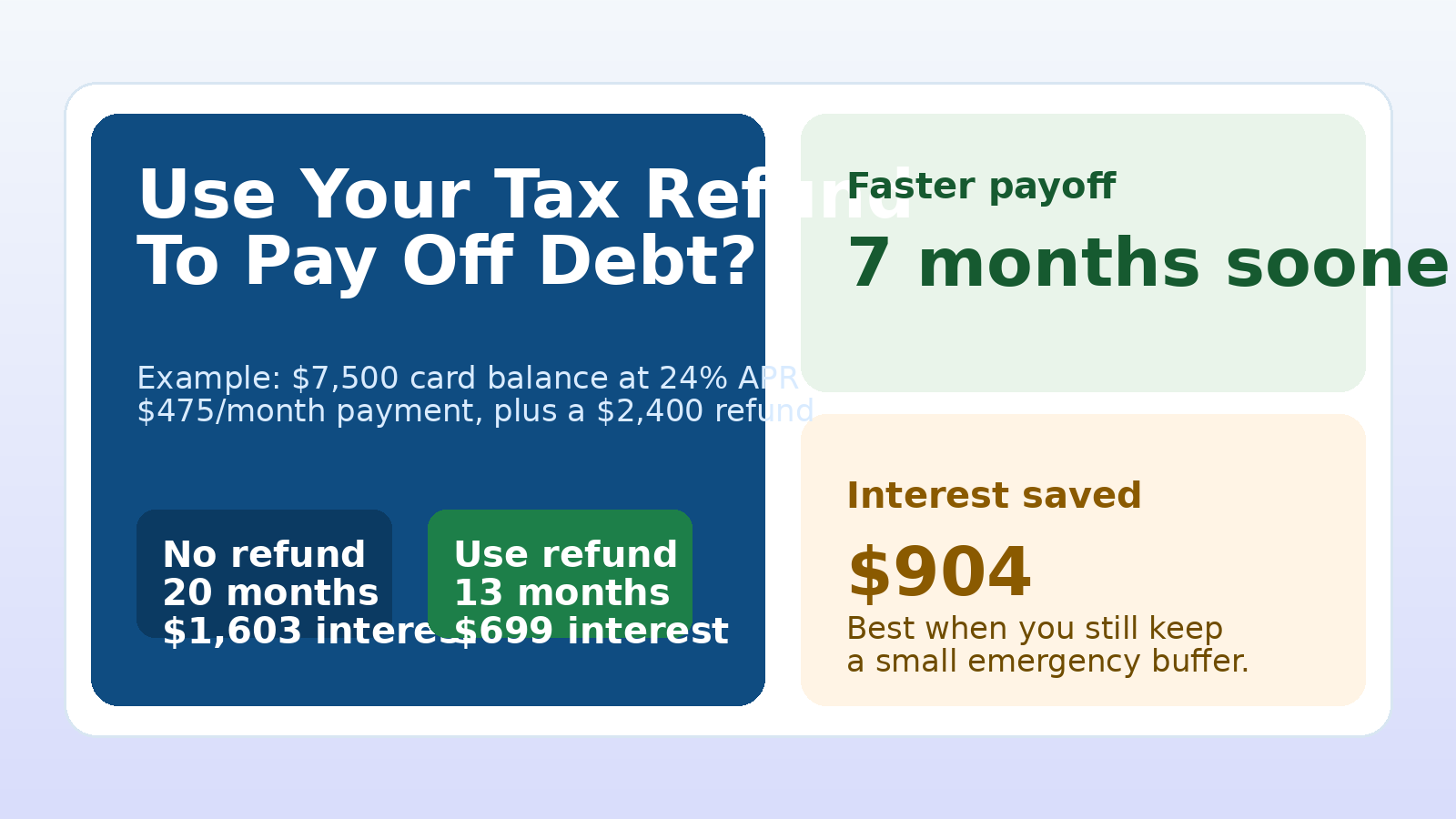
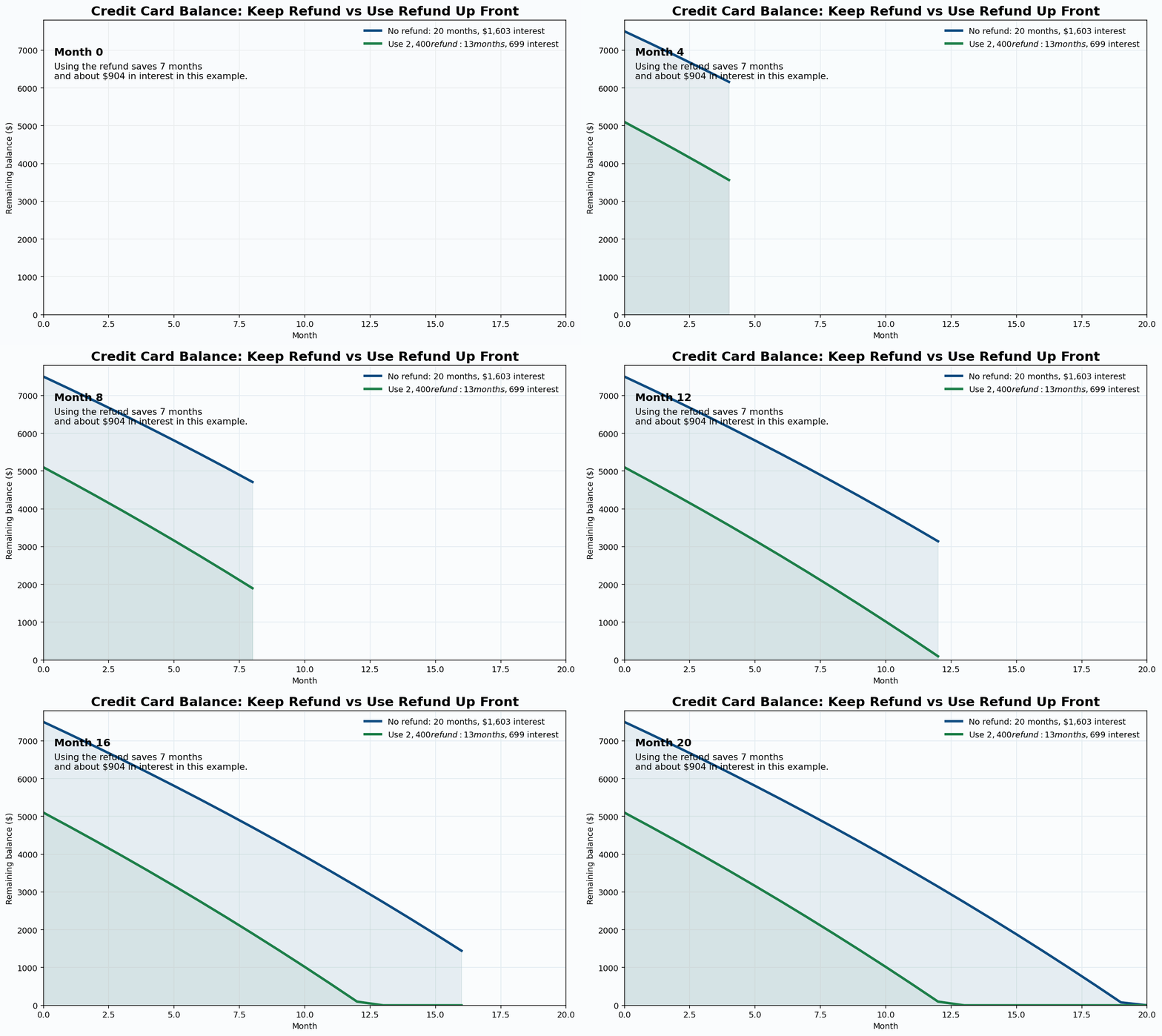
If you do not use the refund on the card, this balance would take about 20 months to pay off and cost about $1,603.35 in interest.
Option 2: Apply the full $2,400 refund right away
If you apply the refund immediately, the starting balance drops to $5,100.
In this example, payoff falls to about 13 months and total interest drops to about $699.24.
That means the refund saves about:
- 7 months of payoff time
- $904.11 in interest
Animated payoff example
The chart below shows how the balance falls month by month with and without using the refund up front.
Why lump-sum payments work so well
A lump-sum payment helps because credit card interest is charged on a much smaller balance right away.
That creates a compounding advantage:
- less principal remains
- less interest accrues the next month
- more of your regular payment goes to principal
- the payoff curve drops faster from there
This is why a tax refund can do more than a few extra monthly payments spread out over time.
Should you use the entire refund?
Not always.
A good rule of thumb is:
- keep enough cash to avoid using the card again for small emergencies
- use the rest on your highest-interest debt first
For example, if you have $0 in savings and get a $2,400 refund, you might keep $1,000 as a starter emergency fund and put $1,400 toward the credit card. That may not be mathematically perfect, but it can be behaviorally stronger if it keeps you out of the debt cycle.
Best order for a tax refund if your finances are messy
If your money situation feels chaotic, this order is usually safer:
- get current on essential bills
- keep a starter emergency buffer
- pay down the highest-interest credit card debt
- avoid spending the rest on lifestyle upgrades
That approach protects your household while still making real debt progress.
Common mistakes to avoid
1. Paying debt but keeping the card active for new spending
If the card balance drops and then goes right back up, the refund did not really change your trajectory.
2. Sending the whole refund to debt with no cash cushion
That can backfire fast if your next repair or medical bill goes onto the card.
3. Splitting the payment across too many debts
If you are using a debt avalanche plan, the strongest move is usually to target the highest APR balance first.
4. Treating the refund like free money
A refund can speed up debt freedom. It can also disappear on random spending in a weekend. A plan before the money arrives is better than a plan after it lands.
Bottom line
If you have high-interest credit card debt, using a tax refund to pay it down is often one of the best one-time financial moves you can make.
The main exception is when sending the whole refund would leave you with no emergency margin and push you right back onto the card.
The best answer for most people is:
- keep a small buffer if you need one
- apply the rest to your highest-interest debt
- keep making focused monthly payments until the balance is gone
If you want to test the exact tradeoff for your balances, APRs, minimums, and refund amount, run the scenario in Debt Freedom Planner. It is the easiest way to see whether putting your full refund on debt — or keeping part of it in savings — gets you debt-free faster without leaving you exposed.
Sources
0 comments
Ask a question, add context, or share what worked for your household.
Create a free account or sign in to comment, reply, and vote on blog posts.