
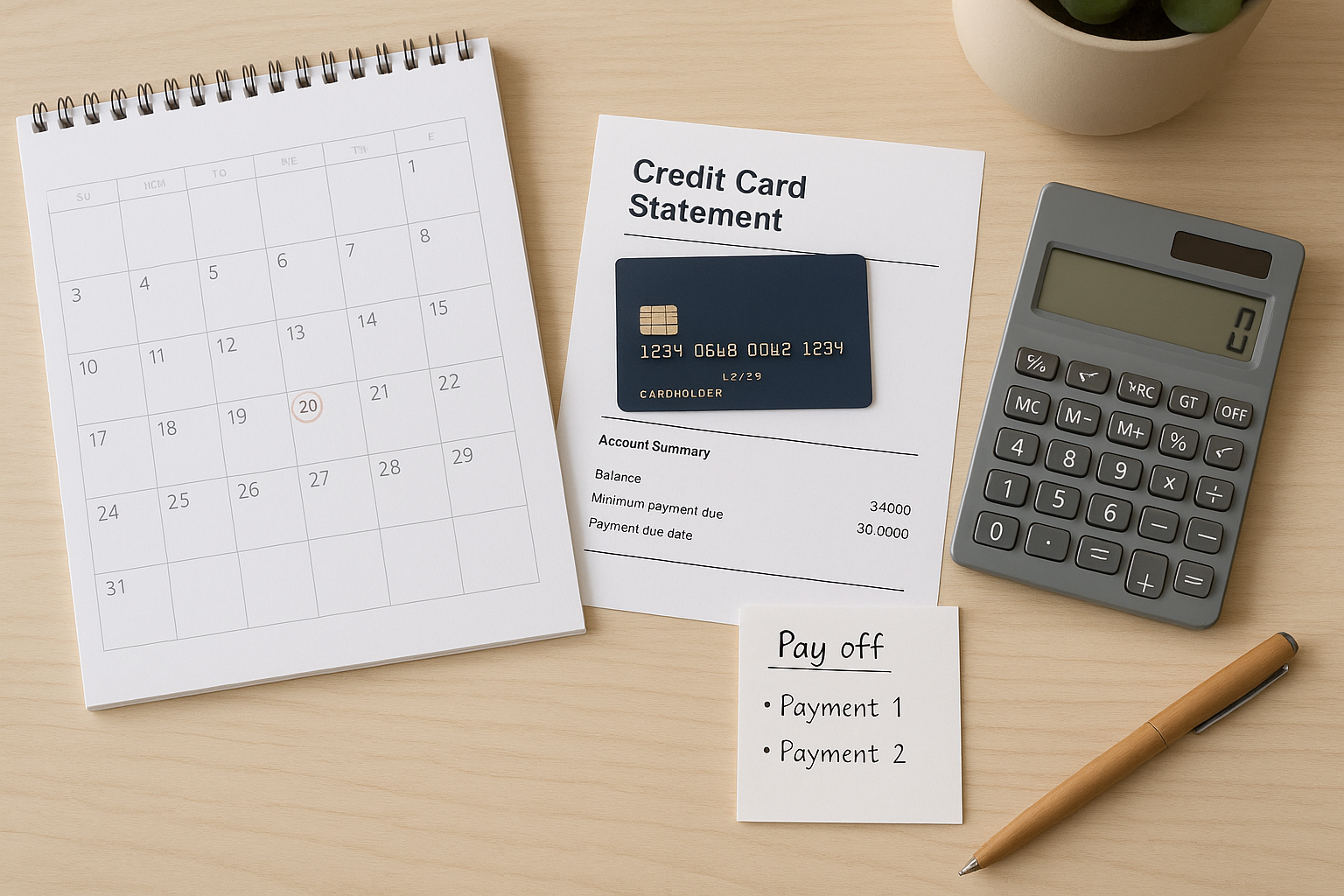
Will Making Two Credit Card Payments a Month Save Interest?
Will making two credit card payments a month save interest? Here is when it helps, when it does not, and a realistic example using average daily balance math.
Will Making Two Credit Card Payments a Month Save Interest?
If you are wondering whether making two credit card payments a month saves interest, the honest answer is: sometimes yes — but only in the right situation.
If you carry a balance from month to month, paying earlier or more often can reduce interest because many card issuers calculate interest using your average daily balance. A lower balance earlier in the billing cycle can mean fewer dollars sitting there accruing interest.
But if you already pay your statement balance in full every month and keep your grace period, making two payments a month usually does not create some magical extra savings. It may still help with budgeting, but the real interest savings usually show up when you are actively trying to get out of revolving credit card debt.
The short answer
Making two credit card payments a month can help if:
- you are carrying a balance
- your issuer calculates interest using the average daily balance method
- one of your payments lands earlier than your usual due-date payment
- you stop adding new purchases faster than you pay them off
Making two payments a month usually matters less if:
- you already pay the full statement balance every month
- you are still charging heavily on the card between payments
- your main issue is not timing but simply that the payment amount is too low
So yes, two payments a month can save interest — but the bigger win is usually paying sooner and paying more, not splitting the payment just for the sake of splitting it.
Why timing can matter on credit card debt
The Consumer Financial Protection Bureau says many credit card companies calculate interest daily, based on your average daily account balance. The CFPB also explains that if you do not have a grace period, paying off all or part of your balance sooner means you will usually pay less interest.1
That matters because credit card interest is not just a once-a-month event in the way many people imagine it. If you are revolving debt, the balance can cost you money every day it stays higher.
The CFPB’s credit card definitions go a step further: under the average daily balance method, the issuer starts with the balance each day, adds new charges and interest where applicable, subtracts payments or credits, and then averages those daily balances across the billing period.2
In plain English: a payment made earlier in the cycle can lower more days of balance than a payment made later.
A realistic numeric example
Let’s say you have:
- credit card balance: $5,000
- APR: 24%
- billing cycle: 30 days
- daily periodic rate: about 0.0658% (24% ÷ 365)
Now compare two simple scenarios.
Scenario A: one $600 payment on day 25
For the first 24 days, the balance is $5,000.
For the last 6 days, the balance is $4,400.
Approximate average daily balance:
- (24 × $5,000) + (6 × $4,400) = $146,400
- $146,400 ÷ 30 = $4,880 average daily balance
Approximate monthly interest:
- $4,880 × 24% ÷ 12 = about $97.60
Scenario B: two $300 payments on day 10 and day 25
For the first 9 days, the balance is $5,000.
For the next 15 days, the balance is $4,700.
For the last 6 days, the balance is $4,400.
Approximate average daily balance:
- (9 × $5,000) + (15 × $4,700) + (6 × $4,400) = $141,900
- $141,900 ÷ 30 = $4,730 average daily balance
Approximate monthly interest:
- $4,730 × 24% ÷ 12 = about $94.60
What changed?
Same total monthly payment: $600.
But the earlier split payment lowered the average daily balance enough to save about $3 that month.
That may not sound huge, but over multiple months — especially with bigger balances or earlier extra payments — the savings can stack up. More importantly, earlier payments also help you get principal down sooner, which makes future interest charges smaller too.
When paying twice a month helps the most
This strategy tends to work best when all of these are true:
1. You are carrying revolving credit card debt
If you roll a balance, interest timing matters. That is where earlier payments can help.
2. You can send part of your payment soon after getting paid
If you are paid every two weeks or twice a month, sending a payment with each paycheck can reduce the balance earlier instead of waiting until the due date.
3. You are focused on one payoff target
If you are making only minimums on every card forever, splitting them will not fix the real problem. This works best when you are already trying to accelerate payoff.
4. You are not running the balance back up
If you make an early payment and then refill the card with new spending, the interest benefit can shrink fast.
When it will not help much
There are also cases where making two credit card payments a month is mostly neutral.
You pay your statement balance in full every month
The CFPB explains that if your card has a grace period, you can usually avoid interest on purchases by paying the balance in full by the due date each month.1
If that is you, a second payment is mostly a cash-flow tool, not an interest-saving trick.
Your issuer rules or timing make little difference
Not every small timing tweak creates meaningful savings. If both payments still happen late in the cycle, the benefit may be tiny.
Your payment amount is the bigger issue
If you are buried in debt, the main driver is usually how much extra you can send, not just whether you split it.
A better way to think about it
Instead of asking only, “Should I make two payments a month?” ask:
- Can I pay earlier?
- Can I pay more?
- Can I stop adding new charges?
- Can I target one high-interest balance aggressively?
Those questions usually matter more than the number of transactions.
A practical debt payoff setup
If you want to use this strategy well, keep it simple:
- Make minimum payments on every card on time.
- Choose one target debt.
- If you get paid twice a month, send part of your extra payment with the first paycheck instead of waiting.
- Keep new card spending as low as possible.
- Re-check your statement to confirm the earlier payment is actually reducing the balance before interest piles up further.
For example, if your normal plan is to send $500 extra once a month, you might send $250 earlier in the cycle and $250 later. That can improve the math without changing your budget.
Where Debt Freedom Planner fits
This is exactly the kind of question that sounds simple but depends on your real balances, APRs, minimums, and payment timing.
Debt Freedom Planner helps you map your debts, compare payoff scenarios, and see how small changes — like sending part of your payment earlier — affect your debt-free date and total interest.
If you want to stop guessing and build a payoff plan around your actual numbers, use Debt Freedom Planner and test the timing for yourself.
Bottom line
So, will making two credit card payments a month save interest?
Usually yes, a little, if you carry a balance and one of those payments hits earlier enough to reduce your average daily balance.
But the real win is not the number of payments. The real win is:
- paying earlier
- paying more than the minimum
- keeping balances from growing again
- following a clear debt payoff plan month after month
That is how you actually get out of credit card debt faster.
Sources
-
Consumer Financial Protection Bureau, How does my credit card company calculate the amount of interest I owe? https://www.consumerfinance.gov/ask-cfpb/how-does-my-credit-card-company-calculate-the-amount-of-interest-i-owe-en-51/ ↩↩
-
Consumer Financial Protection Bureau, Credit card contract definitions https://www.consumerfinance.gov/data-research/credit-card-data/know-you-owe-credit-cards/credit-card-contract-definitions/ ↩
0 comments
Ask a question, add context, or share what worked for your household.
Create a free account or sign in to comment, reply, and vote on blog posts.