

If a Debt Collector Contacts You About a Debt You Already Paid, What Proof Should You Send?
Verify the collector, dispute the claim in writing, and send copies of payment, settlement, and zero-balance records—never your only originals.
If a debt collector contacts you about a debt you already paid, do not pay it again just to make the call stop. First confirm that the collector is legitimate, compare the validation notice with your records, and send a written dispute with copies—not originals—of the documents that show payment. Useful proof may include a canceled check, a bank or credit-card statement showing the payment, the creditor's zero-balance statement, and correspondence confirming a settlement or paid-in-full status.
Act promptly. A written dispute sent within the validation period generally requires a debt collector covered by the federal rule to pause collection of the disputed amount until it sends verification. Keep the claimed balance out of your debt-payoff plan unless the collector's response and your records establish that you actually owe it.

Original Debt Freedom Planner illustration; no real account information.
What proof should you send for a debt you already paid?
Send copies that connect three facts: which account was involved, how much you paid, and what the creditor agreed the payment would accomplish. One document may prove all three facts, but several documents often make the timeline clearer.
| Copy to consider | What it can help show | What to check before sending |
|---|---|---|
| Canceled check or check image | Payee, amount, date, and whether the payment cleared | Both sides if available; match the check number to your register |
| Bank statement | The withdrawal posted and was not reversed | Highlight the relevant line; preserve the original statement yourself |
| Credit-card statement | A card payment to the creditor or collector posted | Confirm the merchant/collector descriptor and posting date |
| Creditor payment history or receipt | The account received and applied the payment | Match the account identifier and amount |
| Settlement letter or email | The amount accepted and the promised account status | Look for conditions, deadlines, and the correct creditor or collector |
| Paid-in-full or zero-balance letter | The creditor treated the account as satisfied | Confirm the letter identifies the same debt now being collected |
The Consumer Financial Protection Bureau's guidance for a debt you already paid specifically points to canceled checks, credit-card statements, and settlement correspondence. It also says to send copies rather than original documents. If you no longer have proof, ask the creditor you originally paid for a payment history or payoff confirmation.
Follow this five-step response
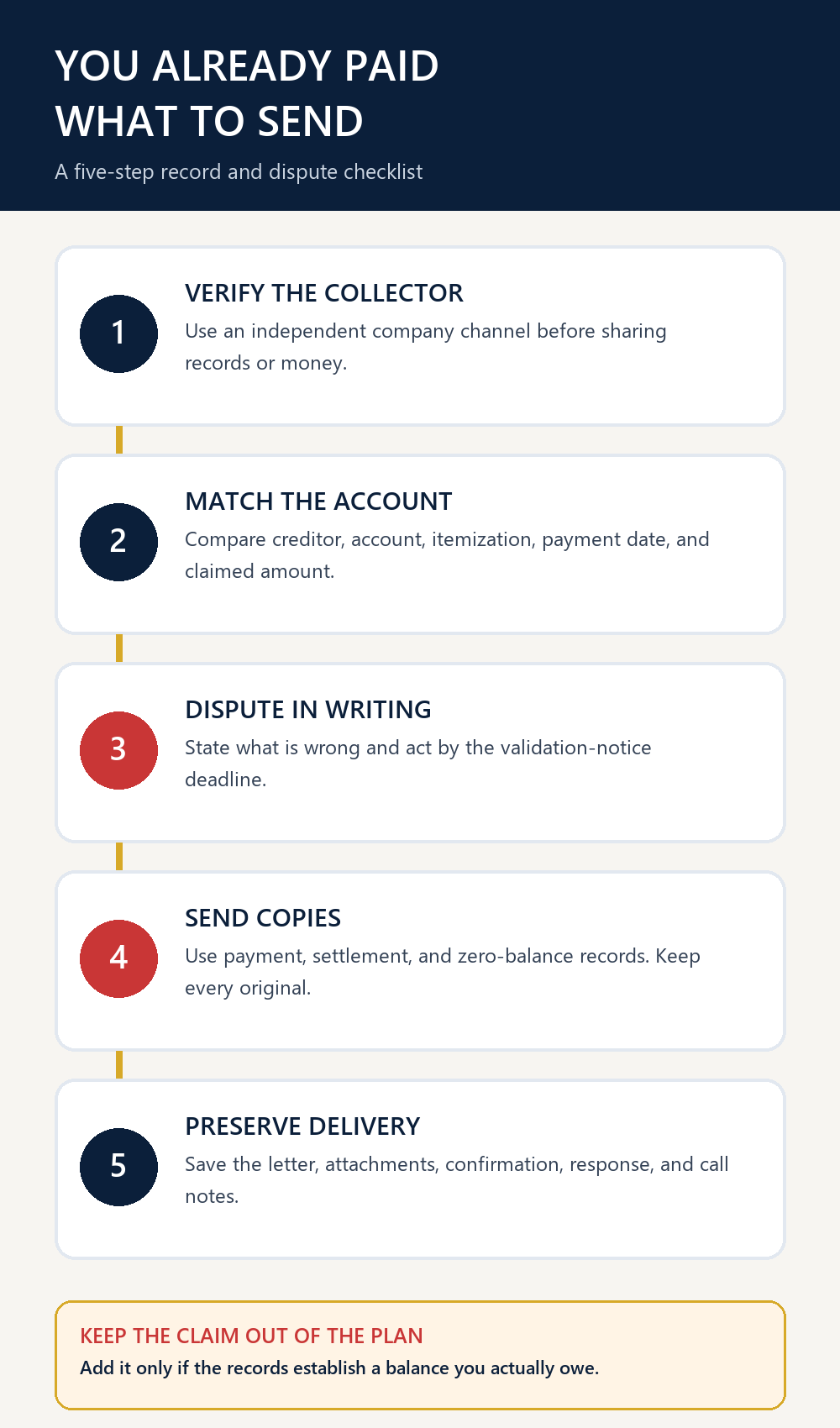
The safest sequence is to verify the collector, match the account, dispute in writing, send document copies, and preserve proof of delivery.
1. Confirm who is contacting you
Do not use only a phone number or payment link supplied in an unexpected call or text. Ask for the collector's name, company, mailing address, telephone number, and validation information. Then compare those details with an independently located company channel and with your creditor's records.
The Federal Trade Commission's current debt-collection scam guidance recommends confirming that the debt is actually yours before paying. A demand involving a debt you remember can still be a scam, a duplicate placement, or a recordkeeping error.
2. Read the validation notice line by line
The notice should help you identify the collector, the creditor, the account, the itemization date, the amount at that date, later interest or fees, payments and credits, the current amount, and the end of the validation period. The CFPB's plain-language validation-notice guide explains the major fields.
Compare that information with your receipt, statement, settlement letter, and payment date. A useful dispute is specific: “I dispute this $900 balance because the enclosed documents show a $900 payment posted on May 12, 2026, and the creditor confirmed a zero balance on May 16, 2026.”
3. Dispute the claim in writing
State that you dispute all or part of the debt and why. Identify the account using only the information reasonably needed to match it. List each enclosed copy. Ask the collector to correct its records and confirm the result in writing.
Under the current Regulation F dispute rule, a written dispute submitted within the validation period generally requires the collector to cease collection of the disputed debt or portion until it sends verification or a copy of a judgment. The rule recognizes mail, an accepted email address or portal, courier delivery, and certain in-person delivery as written methods. Follow the method the notice provides and preserve evidence of when it was sent.
The deadline matters. The CFPB explains that the validation notice gives an end date for the 30-day period. A late dispute can still communicate the problem, but it may not trigger the same pause requirement. If the notice, a lawsuit, or another deadline is unclear, consider qualified legal help promptly.
4. Send copies, not originals
Create a simple packet:
- Your dated dispute letter.
- A list of the enclosed documents.
- Copies of the strongest payment and agreement records.
- A request for written confirmation of the collector's decision.
Keep the original canceled check, statement, receipt, settlement letter, and paid-in-full confirmation. The CFPB recommends retaining the originals as proof. If the collector later says your packet was incomplete, your file should show exactly what you sent.
5. Preserve the delivery trail and response
Keep a copy of the dispute, attachments, envelope or portal confirmation, and delivery evidence. Record calls with dates, times, names, and short notes. The CFPB suggests certified mail and an optional return receipt as one way to document delivery when mailing a dispute.
Watch for a response, account update, new collector, credit-report entry, or court paper. Never ignore a summons; court deadlines are separate from a validation-period dispute.
Worked example: one payment, two records, one dispute
Suppose a collector demands $900 for a store account. Jordan remembers settling it with the original creditor four months earlier. Jordan's records include:
- a settlement email identifying the account and accepting $900 by May 15;
- a bank statement showing the $900 withdrawal posted on May 12; and
- a creditor portal PDF dated May 16 showing a $0 balance.
Jordan independently confirms the collector's contact information, matches the validation notice to the same account, and sends a written dispute before the notice's deadline. The dispute states the claimed amount, payment date, and reason for disagreement. It includes copies of the settlement email, the relevant bank-statement page, and the zero-balance confirmation. Jordan keeps the original files and delivery receipt.
That packet gives the collector concrete, account-linked information to investigate. Regulation F's official interpretation gives a canceled check showing payment as an example of new and material information supporting a later dispute.
What if the collector sends verification anyway?
Read the response rather than treating the word “verified” as the end of the analysis. Ask:
- Does it identify the same creditor and account?
- Does its itemization show your payment or credit?
- Did the payment bounce, reverse, or apply to another account?
- Did the settlement have a condition the creditor says was not met?
- Is the claimed amount a remaining balance rather than the amount you already paid?
Compare the response with the original creditor's records. If you still believe the debt is wrong, the CFPB's dispute guidance says you may continue disputing it and may also dispute inaccurate information appearing on your credit reports. A consumer-law attorney, legal-aid organization, or state attorney general may be appropriate when the dispute cannot be resolved, a lawsuit is filed, or important deadlines are approaching. You may also submit a complaint to the CFPB after trying to work with the company.
Keep an unverified claim out of your payoff math
A payoff plan should contain debts and terms you have verified—not every number someone demands by phone. Otherwise, money meant for a valid obligation can be diverted to a duplicate or incorrect claim.
Here is a transparent hypothetical example using the Debt Freedom Planner payoff engine. It is not a prediction and does not model legal rights or a collection dispute.
| Assumption | Regular path | Faster path |
|---|---|---|
| Verified credit-card balance | $4,800 | $4,800 |
| Fixed APR | 20.99% | 20.99% |
| Monthly payment | $180 | $300 |
| New charges, fees, missed payments, or rate changes | None | None |
| Estimated payoff time | 37 months | 19 months |
| Estimated interest | $1,721.13 | $880.26 |
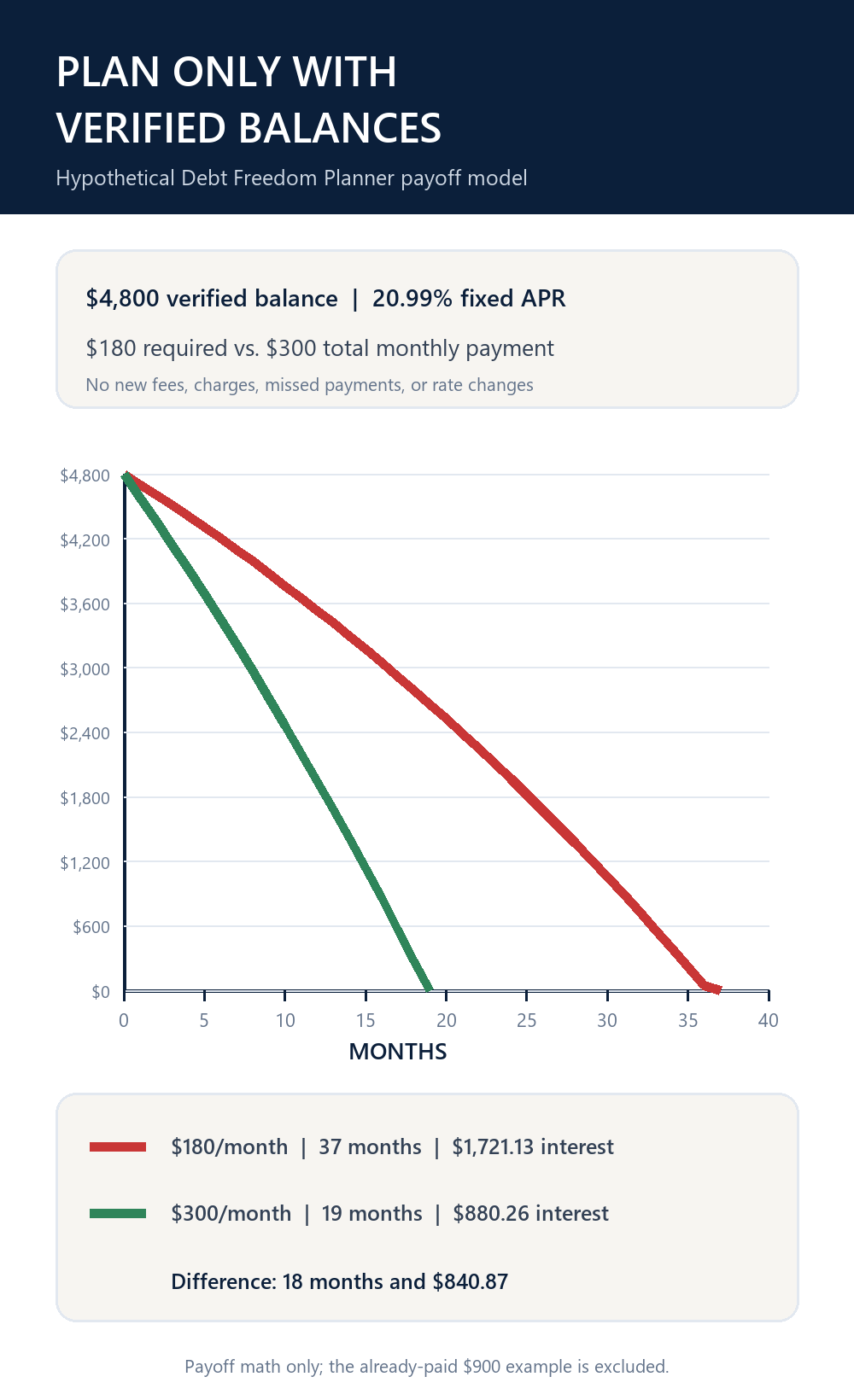
Hypothetical payoff-engine result: adding $120 per month to this verified balance shortens the model by 18 months and reduces modeled interest by $840.87. Actual card terms and payment allocation can differ.
The planning lesson is not “pay the collector faster.” It is verify first, then direct money deliberately. If the $900 claim is confirmed as already paid, it does not belong in the plan. Jordan can use the household's available $300 toward the verified card instead. If the collector establishes that some valid balance remains, Jordan should update the plan with the confirmed balance, APR, minimum, and any written settlement or payment terms.
Rebuild the plan after the facts are clear
Once you know which balances are real, start a Debt Freedom Planner roadmap with each verified balance, APR, and minimum payment. Compare snowball, avalanche, and a custom order, then test an extra monthly amount the household can sustain. The planner can estimate a debt-free date, total interest, payoff order, and month-by-month schedule without asking for bank credentials or full account numbers.
Keep legal and documentary questions outside the calculator. Debt Freedom Planner does not determine whether a collector proved a debt, whether a settlement was legally effective, whether a credit-report entry is accurate, or how to answer a lawsuit. It helps with payoff arithmetic after those facts are established.
Bottom line
When a collector seeks a debt you already paid, verify the collector, read the validation notice, dispute the claim in writing, and send copies of the documents that connect the account to the payment and any settlement or paid-in-full agreement. Keep the originals and proof of delivery. Do not put the claimed balance into your payoff plan—or pay it again—unless the records establish that you still owe it.
This article provides general educational information and hypothetical payoff estimates. It is not financial, legal, tax, credit-repair, or bankruptcy advice. Debt-collection rights, court procedures, limitation periods, and document requirements can vary by debt type, collector, contract, and state. Consider qualified help for advice about your situation.
0 comments
Ask a question, add context, or share what worked for your household.
Create a free account or sign in to comment, reply, and vote on blog posts.