

Can a Debt Collector Garnish Your Wages Without a Court Judgment?
Most ordinary consumer creditors need a lawsuit, judgment, and garnishment order. Verify the case, exceptions, wage limits, and exemption deadlines before changing your payoff plan.
For most ordinary consumer debts, a debt collector cannot simply call your employer and start taking wages. The usual path is a lawsuit, proper notice, a court judgment, and then a garnishment order. Important exceptions exist for taxes, child support, and some debts owed to government agencies, so verify who issued the notice and what legal process it cites. If court papers or a payroll notice arrive, act before the stated deadline; do not treat them like another collection call.

A garnishment threat is a reason to verify the debt, the case, and the issuing authority before changing your household payment plan.
The short answer: usually a judgment comes first
The Federal Trade Commission's current debt-collection FAQ says a collector generally must sue and get a court order—called a garnishment—before taking money from a paycheck or bank account for an ordinary consumer debt. The Consumer Financial Protection Bureau likewise says that most creditors can garnish wages or benefits only after a court issues a judgment saying the debt is owed.
That does not mean every withholding requires an ordinary civil judgment. Federal or state agencies can sometimes collect certain government debts without that court path. Child-support enforcement also follows different rules. Defaulted federal student loans and tax debts can involve administrative collection procedures, although the details and available protections differ.
So the practical question is not just, “Is there a judgment?” It is:
- What kind of debt is this?
- Who issued the notice or order?
- What case, statute, or agency authority does it identify?
- What response or exemption deadline applies?
The usual path for ordinary consumer debt
For a credit-card balance, medical bill, personal loan, or similar household debt being collected through the courts, the sequence normally has several separate stages.
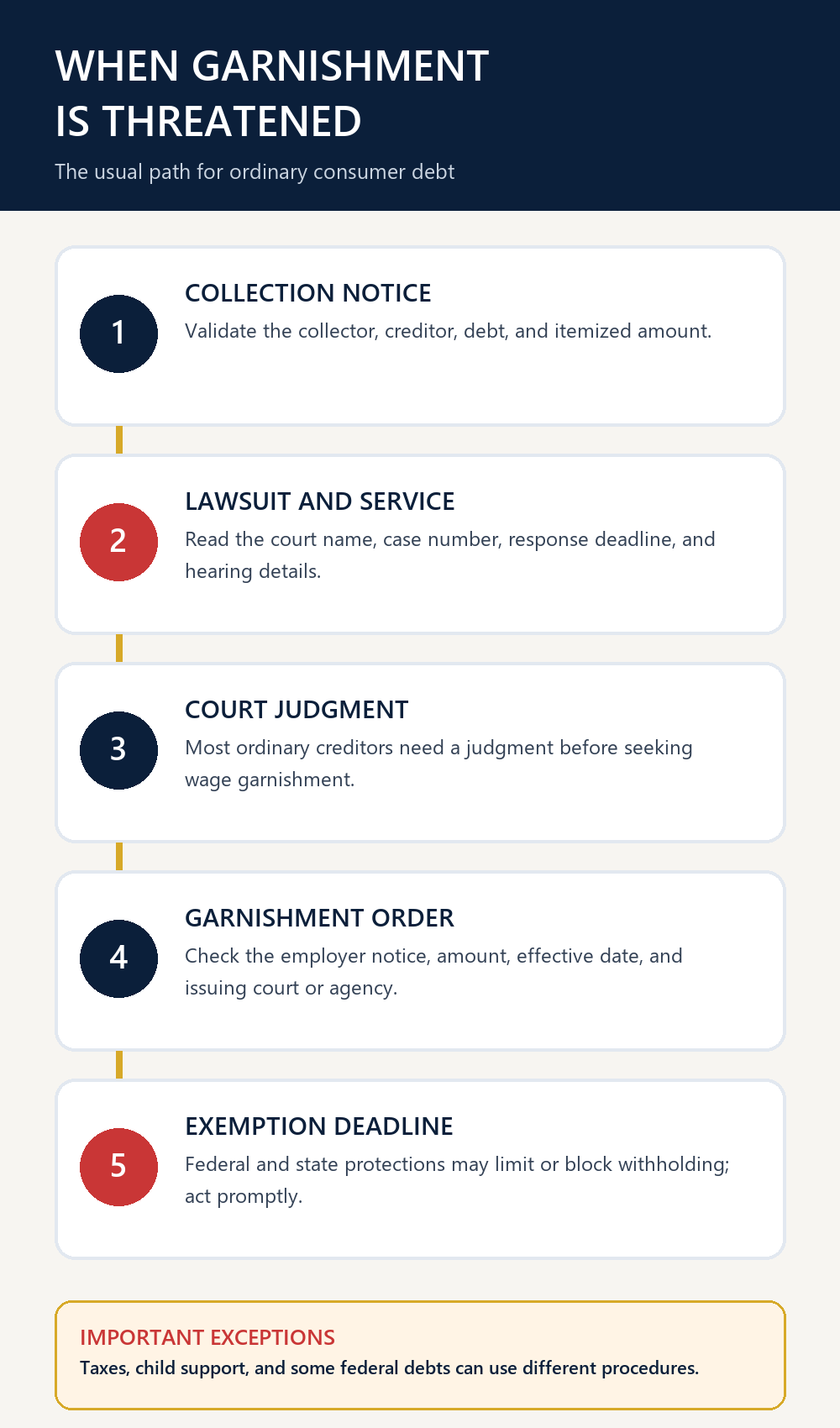
Most ordinary consumer debts follow a notice-to-lawsuit-to-judgment path. Government debts, taxes, and support obligations can use different procedures.
1. Collection and validation
A call, letter, email, or private message is not a garnishment order. The collector should provide validation information identifying the collector, creditor, amount, and dispute rights. Confirm that the account is yours and that the amount properly reflects payments, credits, interest, and fees.
Do not give payroll information, bank credentials, or a rushed payment merely because someone says “garnishment” on a call. The FTC says collectors cannot falsely claim they will take legal action when that claim is not true. A real notice should point to a real process you can verify independently.
2. Lawsuit and service
If a collector files a lawsuit, the court papers should identify the court, parties, case number, and deadline or hearing information. Do not ignore them, even if you dispute the debt or believe the lawsuit is too late. The FTC warns that failing to respond can cost you the chance to contest the requested order.
Use contact information from the court's official website—not a phone number supplied only by the caller—to verify the case. A consumer-law attorney or legal-aid organization can help with defenses, service problems, identity mistakes, limitation periods, and settlement options.
3. Judgment and garnishment order
A judgment is the court's decision that an amount is owed. A creditor may then ask for an order directing an employer or financial institution to withhold money. The judgment amount can include additional interest, fees, or permitted collection costs, so compare the order with the case record rather than relying on an old statement balance.
A wage garnishment and a bank-account levy are not the same thing. Different exemptions and procedures can apply. A notice from payroll may also arrive after the court stage has already happened, which is why immediately locating the case record matters.
A judgment does not make every dollar available
Federal and state laws limit or exempt certain income and property. The CFPB notes that protections may apply to wages, directly deposited federal benefits, and money kept in a bank account. State law can protect more than the federal floor, and some exemptions require a timely claim.
The U.S. Department of Labor's Wage Garnishment Employment Law Guide explains the federal ceiling for an ordinary wage garnishment. In a workweek, withholding generally cannot exceed the lesser of:
- 25% of disposable earnings, or
- the amount by which disposable earnings exceed 30 times the federal minimum wage.
“Disposable earnings” here does not mean whatever remains after every deduction or household bill. The Labor Department defines it as earnings after deductions required by law, such as taxes and required Social Security and Medicare withholding. Voluntary insurance, retirement, or other deductions usually do not reduce the federal disposable-earnings figure.
Worked federal-limit illustration
Assume weekly disposable earnings are $800 and the current federal minimum wage used by the Labor Department's fact sheet is $7.25.
| Federal calculation | Amount |
|---|---|
| 25% of $800 | $200.00 |
| 30 × $7.25 | $217.50 |
| Amount above $217.50 | $582.50 |
| Lesser result—the federal ordinary-garnishment ceiling | $200.00 |
This is a ceiling, not a prediction that $200 will be taken. A state rule, exemption, court ruling, or the order itself may produce a lower amount or no withholding. Different federal limits apply to support orders, and the ordinary limit does not govern every tax, bankruptcy, or federal-debt collection.
The Labor Department also says federal law protects an employee from being fired because wages are garnished for one debt. That protection is narrower than a blanket ban on job consequences from multiple garnishments, and state law may add protections.
Five things to do when a garnishment notice appears
Verify the sender and case
Match the creditor, collector, court or agency, case number, and amount. Contact the court or agency through an independently found official channel. If the debt is unfamiliar, preserve the notice and gather credit reports, account statements, payment records, and earlier validation letters.
Calendar every deadline
Write down the response date, hearing date, exemption-claim deadline, and first withholding date. A collector's voluntary payment deadline is not the same as a court deadline. When the notice is unclear, ask the issuing court or agency what form controls without asking clerical staff for legal advice.
Identify the authority and exceptions
Ask whether the document is based on a civil judgment, tax levy, support order, federal administrative garnishment, or another procedure. That classification determines which protections and challenge process may apply.
Check exemptions before negotiating numbers
Do not assume payroll will automatically know every exemption relevant to your household. Benefits, low earnings, head-of-household status, protected bank deposits, and state-specific property rules may matter. Qualified legal help can explain what must be claimed and by when.
Rebuild the cash-flow plan with verified numbers
Protect housing, utilities, food, transportation to work, insurance, and other priority obligations. Then update debt payments using the amount actually being withheld or the written resolution you reach. Avoid covering the gap with a new high-cost balance unless you have evaluated the full cost and alternatives.
Payoff planning starts after legal verification
Suppose Jordan verifies an $8,000 consumer-debt balance, the valid order or written agreement shows an assumed fixed 18.00% APR, and a $225 monthly payment is required. Jordan has no new charges or fees and wants to see whether adding $175 after essential bills would materially change the payoff path.
Using the Debt Freedom Planner payoff engine's monthly APR ÷ 12 model with currency rounding:
| Hypothetical plan | Payoff time | Modeled interest | Modeled total paid |
|---|---|---|---|
| $225 per month | 52 months | $3,517.96 | $11,517.96 |
| $400 per month | 24 months | $1,582.60 | $9,582.60 |
| Difference | 28 months sooner | $1,935.36 less | $1,935.36 less |
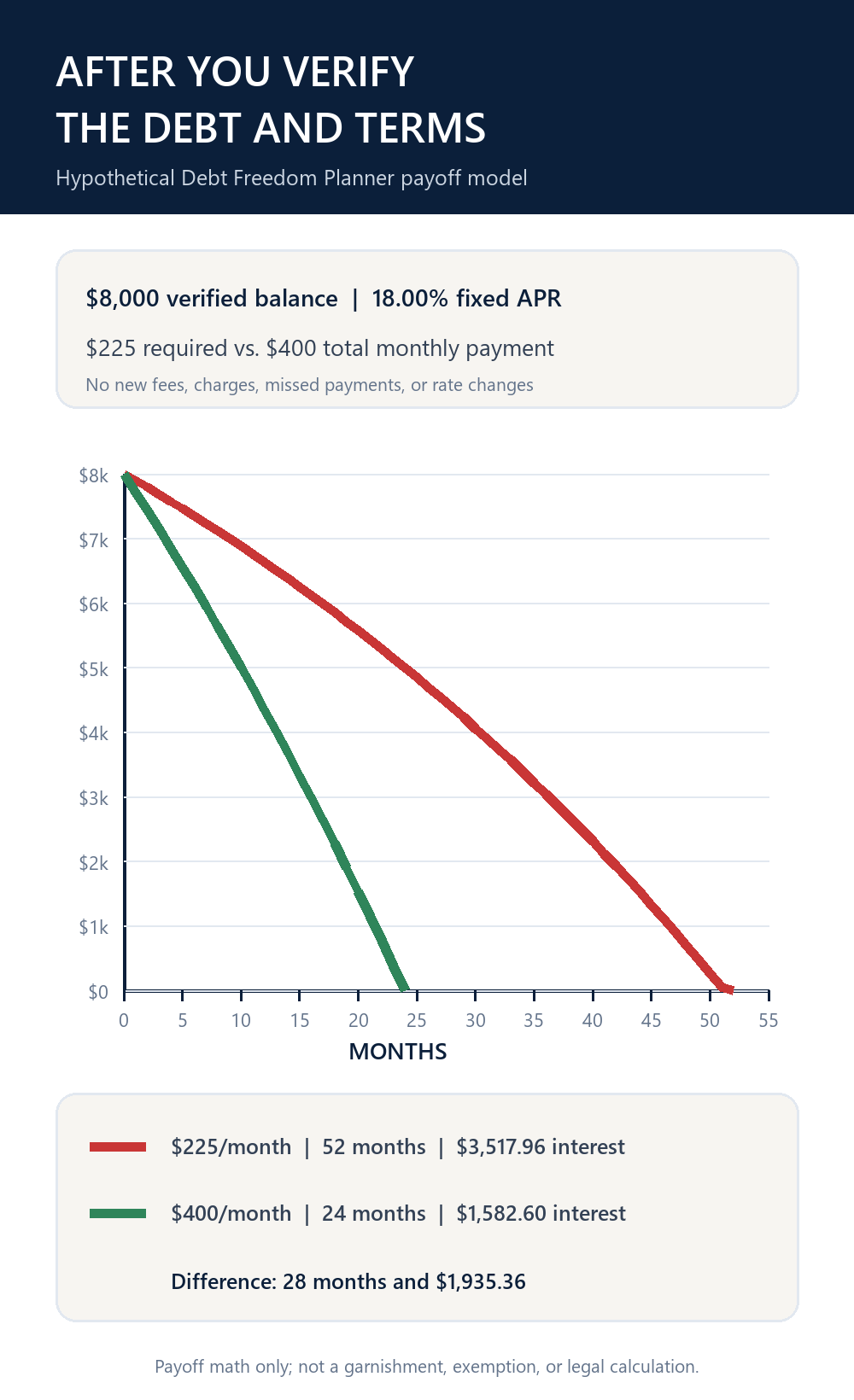
Hypothetical payoff result for a verified $8,000 balance at 18.00% fixed APR. It models debt payments, not wage withholding, exemptions, court procedure, or legal deadlines.
The extra $175 changes the modeled payoff time by more than two years. But the useful monthly amount is the one Jordan can sustain after the legal documents and household cash flow are clear. A payoff model should never replace an exemption claim, a court response, or professional advice about the order.
How Debt Freedom Planner fits
After you verify the balance, APR, required payment, and any withholding that will actually affect your budget, Debt Freedom Planner can place that debt beside your other verified balances. Enter the numbers, compare snowball, avalanche, or a custom order, and test an affordable extra monthly amount. The planner shows an estimated debt-free date, modeled interest, and a month-by-month schedule without connecting to your bank.
Debt Freedom Planner does not verify a collector, search court records, determine whether service was valid, interpret a judgment, calculate a legal garnishment limit, claim exemptions, or provide legal advice. Keep the legal response and the payoff projection as connected but separate tasks.
The bottom line
For an ordinary consumer debt, a collector generally needs to sue, obtain a judgment, and secure a garnishment order before wages can be withheld. Do not rely on a caller's threat or assume silence will make court papers disappear. Verify the issuing authority, respond on time, investigate federal and state protections, and only then rebuild your payment plan around confirmed numbers.
This article is for educational information only. It is not financial, legal, tax, credit-repair, bankruptcy, or individualized advice. Garnishment procedure, exemptions, deadlines, and available defenses vary by debt type, agency, court, state, income source, and case history. For help with a specific lawsuit, judgment, levy, or garnishment, contact a qualified consumer-law attorney or legal-aid organization promptly.
0 comments
Ask a question, add context, or share what worked for your household.
Create a free account or sign in to comment, reply, and vote on blog posts.