

If You Return Federal Student Loan Money Within 120 Days, Can It Reduce Fees and Interest?
A timely federal student-loan return may reduce original principal, interest, and loan fees. Here is how to confirm the 120-day window and rebuild your payoff plan.
Yes. If you return all or part of eligible federal Direct Loan money within 120 days of the date your school disbursed it, the returned amount can be treated as a partial loan cancellation instead of an ordinary extra payment. Under the federal Direct Loan promissory-note terms, you do not have to pay interest or the loan fee on the part returned within that window. Contact your loan servicer first, identify the exact loan and disbursement, and follow its return instructions.

A federal student-loan return is date-sensitive. Confirm the disbursement, loan type, and servicer instructions before sending money.
This is different from simply paying extra after the 120-day window. A normal payment is generally applied first to outstanding accrued interest and then to principal. A timely return can instead reduce the loan's original principal and trigger related interest and loan-fee adjustments.
What the 120-day federal student-loan rule does
The Federal Student Aid Direct Subsidized and Unsubsidized Loan Master Promissory Note says a borrower may cancel all or part of a loan by returning loan money within 120 days of the date the school disbursed it. The Direct PLUS Loan borrower terms contain the same basic right for eligible PLUS disbursements.
For the amount returned on time:
- the original principal is reduced;
- interest attributable to that returned part is eliminated; and
- the applicable loan fee on that part is adjusted.
MOHELA's current federal-loan payment guidance describes these payments as loan cancellation and says they are made effective as of the disbursement date. Its guidance also says this treatment generally excludes consolidation loans.
That last point matters: do not assume every federal loan or every payment qualifies. Check the specific promissory note, loan type, disbursement date, and your servicer's instructions.
Start the clock from the disbursement date
The 120-day period starts when the school disburses the loan money, not when you notice a refund in your bank account, decide you do not need it, or receive your first repayment bill.
A loan can also have more than one disbursement. If a school releases part of an annual loan at the start of each term, each release may have its own date and its own 120-day window. Use the date attached to the particular loan money you want to return.
Do not confuse this with the shorter school-cancellation window. The federal promissory note explains that a school may have a separate period, often 14 to 30 days after it gives notice of the right to cancel, during which the school must process a timely cancellation request. The 120-day route is the borrower's ability to return money to the servicer after disbursement. Your school may still help, but the deadlines and process are not identical.
A five-step check before you send the money
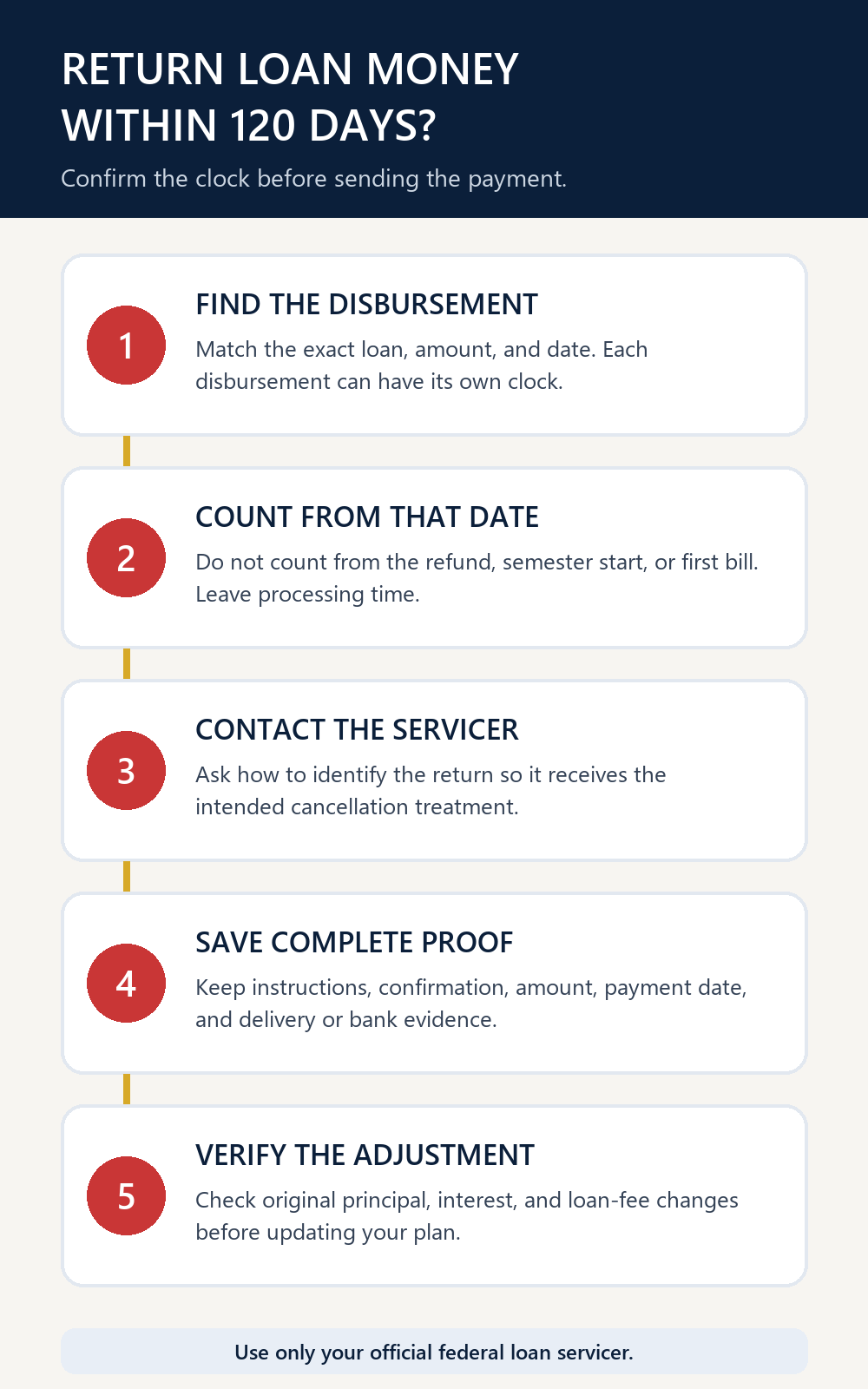
Use the exact disbursement date and written servicer instructions. A generic “extra payment” selection may not document the return the way you intend.
1. Confirm the loan and disbursement
Log in to StudentAid.gov and your servicer's official website. Federal Student Aid's account Dashboard guide says the Dashboard shows your loan balance, interest rate, and servicer, while the loan details provide principal and accrued-interest information. Find the individual loan, its type, and the disbursement date connected to the funds you still have.
If there were multiple disbursements, write each one down separately. “Fall refund” is not precise enough for a deadline calculation.
2. Count 120 days carefully
Use the disbursement date as day zero for planning, then confirm the servicer's actual deadline and receipt requirements. Do not wait until the last day if an electronic transfer, mailed check, or processing step could create ambiguity.
3. Ask the servicer how to mark the return
The promissory note directs borrowers to contact the servicer for instructions on how and where to return loan money. Ask what payment method to use, how to identify the loan and disbursement, and how the account will show that the payment received 120-day cancellation treatment.
Use only an official servicer listed through StudentAid.gov. You do not need to pay a third party to send money back to a federal loan.
4. Save proof of the request and payment
Keep the servicer message, confirmation number, payment date, amount, bank record, and any instructions you followed. If you mail a payment, keep tracking and delivery evidence. A screenshot alone may not show when the servicer received or applied the money, so retain the complete trail.
5. Verify the adjustment before changing your plan
After processing, check that the original principal, accrued interest, and loan fee changed as expected. MOHELA says a qualifying payment may appear as a “Principal Payment” in payment history even though it receives the special effective-date and adjustment treatment. If the numbers do not match the instructions, contact the servicer promptly and reference your confirmation.
Worked example: returning $2,000 from a $10,000 loan
Suppose a borrower receives a hypothetical $10,000 Direct Unsubsidized Loan first disbursed during the 2026–27 award year. Federal Student Aid lists a fixed 6.52% rate for undergraduate Direct Subsidized and Unsubsidized Loans first disbursed from July 1, 2026, through June 30, 2027. Its current interest-rate and loan-fee guidance also explains that Direct Loans accrue interest daily and that a loan fee is deducted from the disbursement even though the borrower is responsible for the amount borrowed.
The borrower realizes that $2,000 is not needed and returns it following the servicer's instructions within 120 days. After the servicer confirms the cancellation treatment, the modeled starting principal for repayment is $8,000 instead of $10,000.
For a transparent planning comparison, assume:
- one undergraduate Direct Unsubsidized Loan;
- a fixed 6.52% APR;
- no later fees, rate reduction, deferment, forbearance, or new borrowing;
- monthly interest modeled as APR divided by 12; and
- level payments intended to repay the balance in about 120 months.
| Planning scenario | Starting principal | Modeled monthly payment | Payoff time | Modeled interest |
|---|---|---|---|---|
| Keep the full loan | $10,000 | $113.66 | 120 months | $3,637.44 |
| Return $2,000; lower payment | $8,000 | $90.93 | 120 months | $2,909.88 |
| Return $2,000; keep paying $113.66 | $8,000 | $113.66 | 89 months | $2,109.50 |
The first two rows show a $22.73 lower modeled monthly payment and $727.56 less modeled interest after the principal reduction. If the borrower keeps the original $113.66 payment in the third row, the model shortens repayment by 31 months and shows $1,527.94 less interest than keeping the full $10,000 balance.
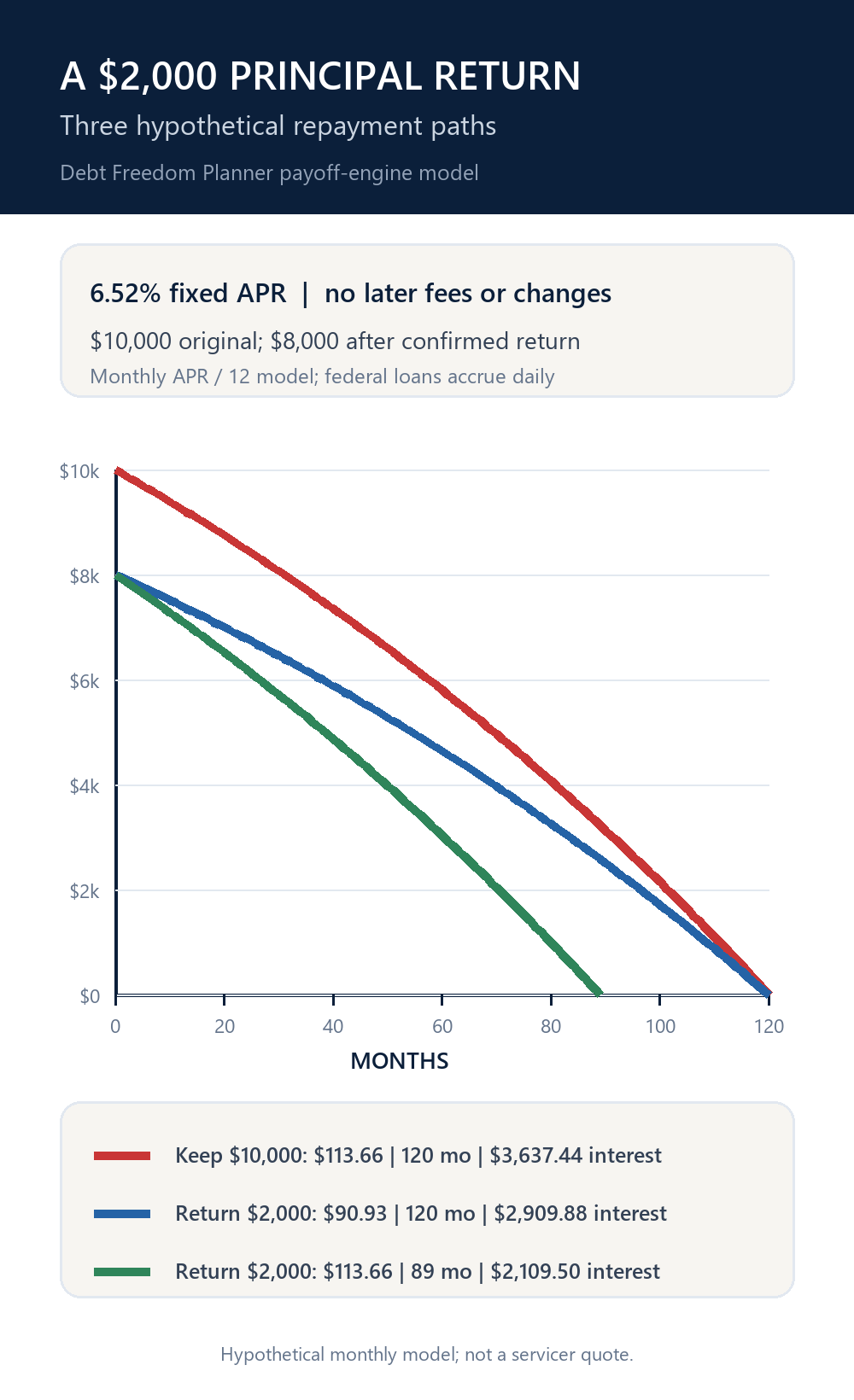
Hypothetical Debt Freedom Planner payoff-engine output. The model uses monthly APR/12 and rounded monthly payments; federal loans accrue interest daily, so a servicer's schedule will differ.
This example does not calculate the exact loan-fee adjustment, interest accrued before the return, a school refund, or the servicer's transaction timing. Those are account-specific. It shows why confirming a lower principal can materially change a forward payoff plan.
What happens if the 120-day window has passed?
You can still generally make an extra federal student-loan payment without a prepayment penalty. But it will normally be a payment, not a partial cancellation.
According to MOHELA's payment guidance, a regular payment is applied first to outstanding accrued interest and then to principal. An overpayment may also advance a due date or be allocated under default rules unless you give permitted payment directions. The special retroactive interest and loan-fee adjustment tied to the 120-day return is the piece you may lose after the deadline.
If you are outside the window:
- ask your servicer for the current payoff and accrued-interest details;
- specify how an extra payment should be allocated if the servicer allows directions;
- confirm whether the payment changes paid-ahead status; and
- keep making required payments unless the servicer tells you otherwise in writing.
The payment can still reduce future interest by lowering principal. It just should not be described as receiving the same cancellation treatment.
How to update Debt Freedom Planner after confirmation
Do not lower the balance in your roadmap merely because you sent the money. Wait until the servicer posts the transaction and confirms the updated principal.
Then open Debt Freedom Planner and update the student loan with:
- the confirmed principal balance;
- the fixed APR shown for that loan;
- the required monthly payment; and
- any extra amount you plan to keep paying.
Compare at least two scenarios: the newly required payment and the old, higher payment you had already budgeted. The example above shows why preserving the old payment after the balance drops can move the debt-free date forward. Debt Freedom Planner uses the figures you enter to create an educational monthly projection; it does not connect to your servicer or change how a federal payment is processed.
Bottom line
If federal student-loan money is still sitting unused, the 120-day rule can be more valuable than treating the same amount as a routine extra payment. Confirm the exact disbursement date, follow your official servicer's return instructions, preserve proof, and verify the principal, interest, and fee adjustments before rebuilding your payoff plan.
This article provides general educational information, not financial, legal, tax, or student-aid advice. Federal loan terms and account facts vary. Confirm your loan's promissory note and instructions with your school, Federal Student Aid, and official loan servicer.
0 comments
Ask a question, add context, or share what worked for your household.
Create a free account or sign in to comment, reply, and vote on blog posts.