

Automatic Debt Payment Debited Twice? Protect Your Account and Dispute the Error
If one automatic debt payment hits your bank account twice, verify both sides, report the incorrect transfer promptly, protect essentials, and recalculate only from settled balances.
If the same automatic debt payment is debited from your bank account twice, verify both entries, contact the creditor or payment processor, and notify your bank promptly that the second transfer may be an error. Do not assume a pending item is final, do not assume the creditor received both payments, and do not rebuild your payoff plan until the bank and creditor ledgers agree.

Two matching withdrawals can look simple on a screen, but the correction depends on what actually posted at the bank and at the creditor.
The immediate job is not to decide who is at fault. It is to protect cash for essentials, preserve the evidence, and describe the transaction accurately. A duplicate debit can be an incorrect electronic fund transfer even when you authorized one payment. That is different from saying every duplicate is an “unauthorized transfer,” a classification that depends on the facts and payment method.
Start by checking two ledgers, not one
Open the transaction history for both the funding account and the debt account. You are looking for four facts:
- Are both bank entries pending, or has one or both posted?
- Do the entries have the same amount, date, company name, and confirmation number?
- Did the creditor apply one payment or two to the debt balance?
- Is a reversal, credit, or correction already pending?
The distinction matters. Two pending bank entries may become one settled debit. Two settled debits may have produced two real credits on the debt. Or the bank account may show two settled withdrawals while the creditor ledger shows only one payment. Those are different reconciliation problems.
Download or screenshot the relevant transaction detail before it changes. Save the payment authorization, confirmation email, statement, chat transcript, and any case number. Redact full account numbers if you send documents through ordinary email.
| What you see | What it may mean | What to verify next |
|---|---|---|
| Two pending bank entries, one creditor payment | A temporary authorization or processing duplicate | Whether both bank entries settle |
| Two settled bank debits, two creditor credits | The creditor may have received an extra payment | Whether one credit will be reversed and how the due date is treated |
| Two settled bank debits, one creditor credit | The second withdrawal may be an EFT error | The trace IDs and which party can reverse it |
| One debit, two creditor credits | A creditor posting error may exist | Whether the extra credit will be removed |
Report the exact transaction error promptly
The current Regulation E error-resolution rule defines an error to include an incorrect electronic fund transfer to or from a consumer account. For covered transfers, notice generally needs to identify you and the account, explain why you believe an error exists, and include the type, date, and amount as far as possible.
That makes a precise report more useful than “my balance looks wrong.” A clear message might say:
I authorized one automatic payment of $450 to this creditor on September 8. My account shows two separate $450 debits. I believe the second debit is an incorrect electronic fund transfer. Please open an error investigation and tell me whether you require written confirmation.
Notify the creditor or payment processor too, because it can explain whether it submitted one debit or two and whether both were credited. But merchant contact should not be treated as a reason to delay notifying the bank. The CFPB's Electronic Fund Transfers FAQs say a financial institution's investigation duty begins after oral or written notice of an error; a bank cannot make prior merchant contact a condition for starting that investigation.
The rule's timing is measured from the periodic statement that first shows the alleged error. Regulation E generally gives a consumer 60 days after the institution sends that statement to provide notice that triggers the rule's procedures. Faster is safer because a duplicate withdrawal can also cause overdraft, nonsufficient-funds, or missed-payment problems elsewhere.
What happens after you notify the bank?
Under Regulation E, the financial institution generally must investigate promptly and determine whether an error occurred within 10 business days. It must report the result within three business days after finishing and correct a confirmed error within one business day.
If it cannot finish within 10 business days, it may take up to 45 days in many cases if it provisionally credits the account within the required period and follows the rule's conditions. Some transactions can have longer time limits. A bank may also require written confirmation within 10 business days after an oral notice; missing that written follow-up can affect provisional credit.
The CFPB's consumer explanation of missing-money and unauthorized-transaction investigations gives a plain-language overview of those timeframes. A duplicate authorized payment is not necessarily an unauthorized transfer, so ask the institution how it is classifying the error rather than assuming every protection works identically.
Do not spend a provisional credit as though the case is final. It can be removed if the institution later concludes there was no error. Keep enough of a buffer to avoid a second cash-flow problem.
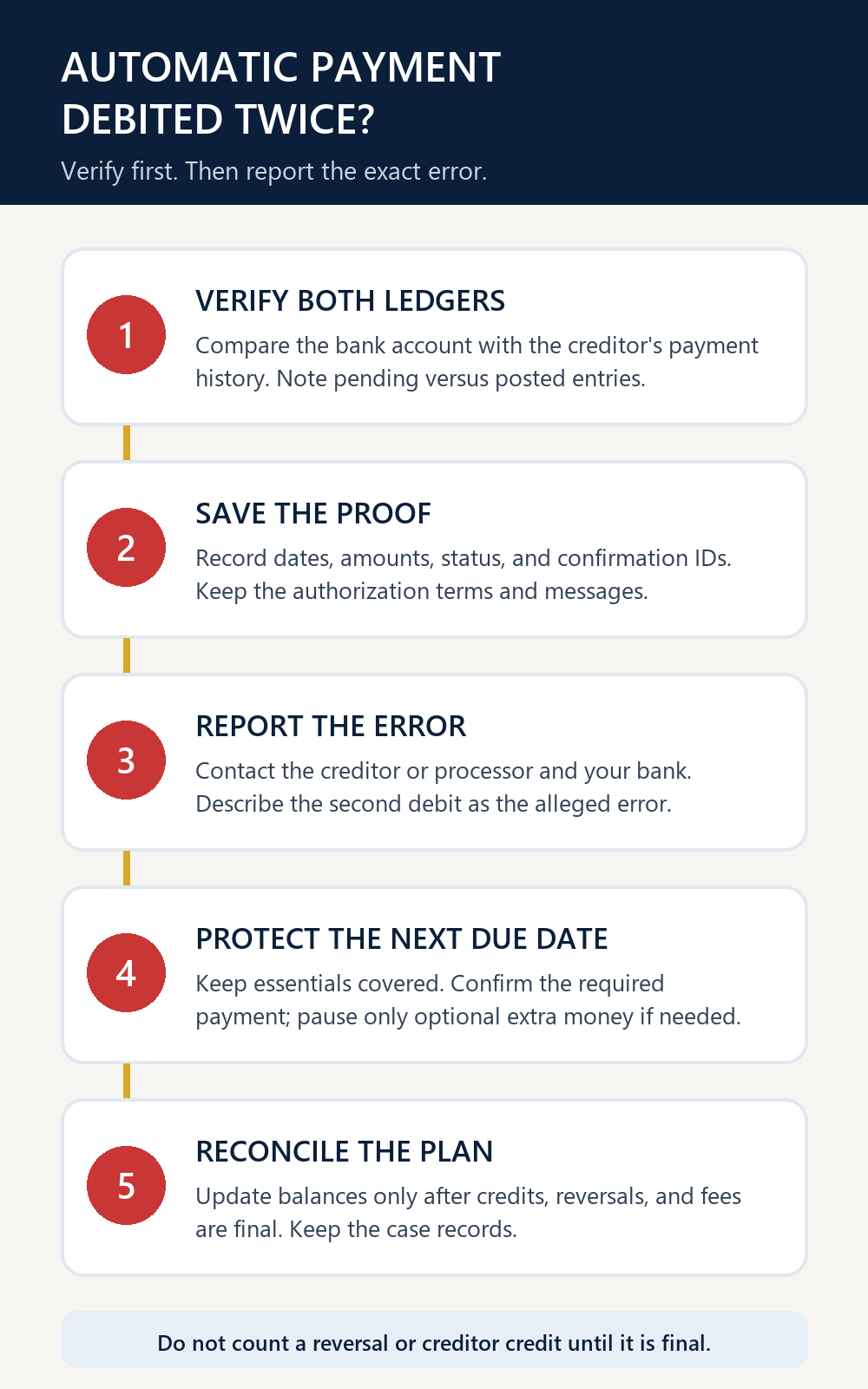
Use both ledgers, preserve proof, report the alleged error, protect the next due date, and update your plan only after the correction is final.
Protect essentials and the next required payment
A duplicate withdrawal can collide with rent, groceries, utilities, or another debt payment. Contact the bank immediately about any resulting overdraft or nonsufficient-funds fee and ask the creditor what it will do with any extra credit. Regulation E's official interpretation says a corrected EFT error can include interest and fees imposed by the institution when applicable, but that does not guarantee every fee from every company will be refunded.
Avoid these common reactions:
- Do not send a third payment simply because the creditor screen has not caught up.
- Do not count a pending reversal as available cash.
- Do not skip the next required payment without confirming how the creditor will treat the duplicate credit.
- Do not borrow at a high cost just to keep an optional extra-payment goal intact.
- Do not delete alerts, receipts, or chat records after the first reassuring answer.
If another automatic transfer is approaching and the debit problem is not contained, ask both the creditor and your bank what will happen next. The CFPB's automatic-payment guide distinguishes a company pulling an automatic debit from a bank's recurring bill-pay service, and the dispute path can depend on which setup you used.
For a future covered preauthorized bank-account debit, Regulation E's stop-payment provision generally allows notice to the financial institution at least three business days before the scheduled transfer. The bank may require written confirmation. Stopping the transfer does not cancel the underlying debt, change the due date, or replace a required payment, so arrange another payment method with the creditor when necessary.
Worked example: pause the optional extra, not the required payment
Suppose a household has one credit card with a $6,400 balance at an assumed 23.99% APR. Its required payment is $300, and the household planned to add $150 each month, for a total of $450.
An erroneous second $450 debit temporarily reduces the checking-account cushion. The household reports the error and keeps the next required $300 payment in the plan, but pauses the optional $150 extra once while the investigation is open.
Using the Debt Freedom Planner payoff engine with monthly APR divided by 12:
| Hypothetical path | Modeled payoff time | Modeled interest |
|---|---|---|
| Keep paying $300 + $150 extra | 17 months | $1,205.48 |
| Pay $300 in month 2, pause the $150 extra once | 18 months | $1,260.48 |
| Difference | 1 month | $55.00 |
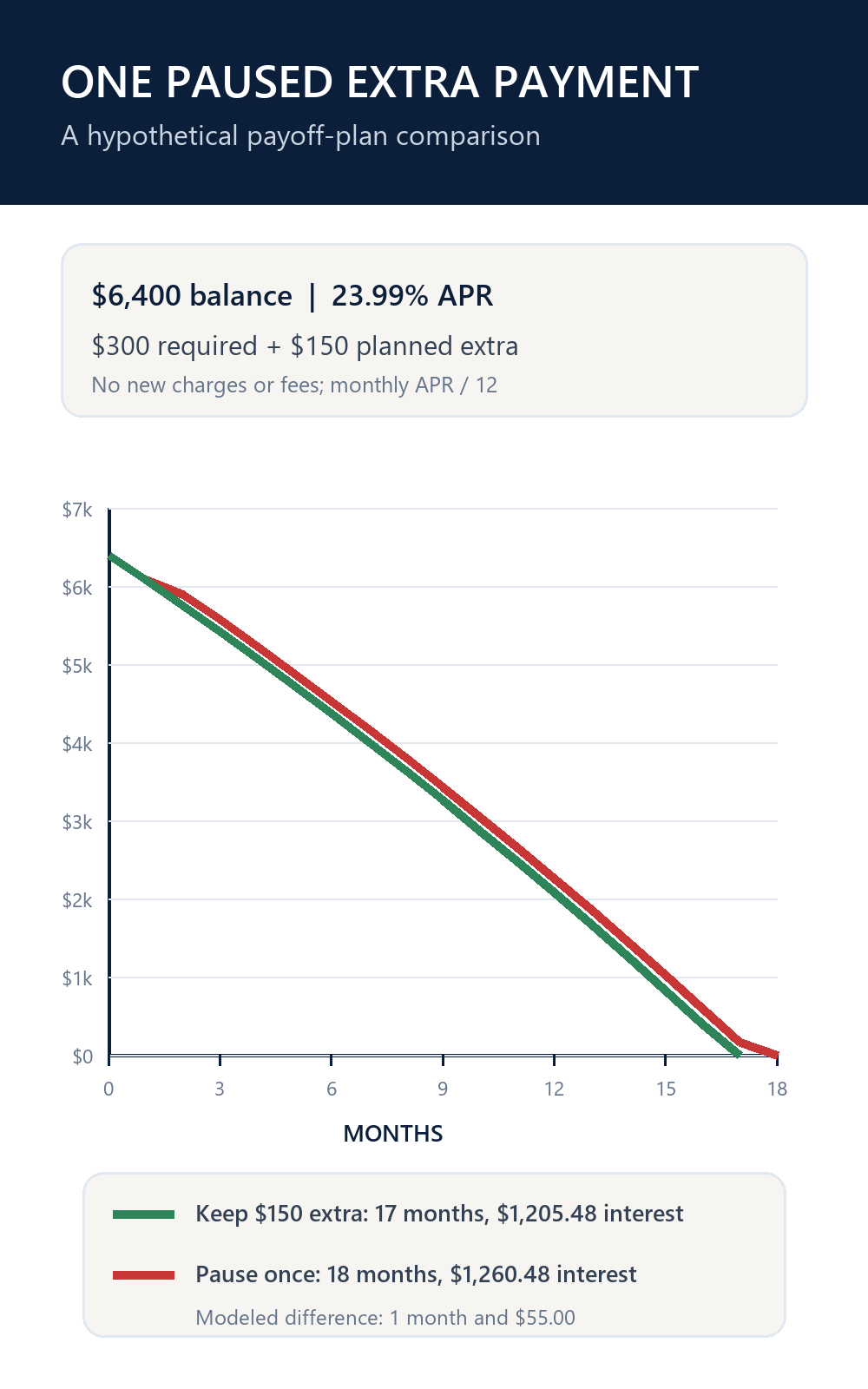
Hypothetical projection: $6,400 at 23.99% APR, $300 required monthly payment, and $150 planned extra. Only the optional extra is paused once.
This is a planning illustration, not a prediction of how a bank investigation will turn out. It excludes new purchases, late charges, overdraft or NSF fees, penalty APR, daily-interest methods, and posting differences. The lesson is narrower: protecting essential cash by pausing one optional extra payment can change the model, but it does not destroy the payoff plan.
Rebuild the payoff plan from settled numbers
Once the bank and creditor finish correcting the records, write down the final state:
- the settled bank-account withdrawal total;
- the creditor's final applied-payment total;
- any reversed credit;
- any refunded or retained fees;
- the next minimum amount and due date; and
- whether automatic payment remains active.
Then update the debt balance and monthly extra-payment amount in Debt Freedom Planner. You can compare the original path with a temporary lower-extra scenario without pretending a pending credit is permanent. The planner does not file an EFT dispute or replace your bank's records; it helps you see how verified balances and payment choices affect the payoff timeline.
The bottom line
Treat a duplicate automatic debt payment as a reconciliation problem with two records. Verify what settled, preserve proof, report the alleged error promptly to the bank, coordinate with the creditor, protect essential cash, and confirm the next required payment. Update the payoff plan only when the transaction and debt balance are final.
This article provides general educational information, not individualized financial, legal, tax, credit-repair, or bankruptcy advice. Account agreements, payment rails, state law, and transaction facts can change the result. Contact the financial institution, creditor, or a qualified professional about your specific situation.
0 comments
Ask a question, add context, or share what worked for your household.
Create a free account or sign in to comment, reply, and vote on blog posts.