

Does a Credit Card Charge-Off Mean You No Longer Owe the Debt?
A credit-card charge-off does not erase the balance. Verify who owns it, confirm the itemized amount, and get written terms before you pay.
A credit-card charge-off does not mean the debt disappeared. It means the issuer moved a seriously delinquent account out of its ordinary receivables and recorded it as a loss. You may still owe the balance, the creditor may keep collecting or transfer the account, and the late-payment history can remain on your credit reports. Your next job is to identify who owns the debt now, verify the amount, and get any repayment or settlement terms in writing before sending money.

A charge-off is an accounting and collection-status change. The account file—and potentially the obligation—still exists.
What a credit-card charge-off actually means
When a card issuer believes a delinquent account is unlikely to be collected through normal billing, it may classify the balance as a charge-off. The Federal Trade Commission explains that this often follows several missed minimum payments. That is an accounting decision by the creditor. It is not the same as a written settlement, bankruptcy discharge, court ruling, or formal cancellation of the balance.
The most useful distinction is simple:
| Term | What it changes | What it does not prove |
|---|---|---|
| Charge-off | How the creditor accounts for and handles a delinquent balance | That you no longer owe it |
| Collection transfer or sale | Who may contact you and receive payment | That the amount claimed is automatically correct |
| Settlement | The amount the creditor or collector agrees to accept under written terms | That the credit history disappears |
| Bankruptcy discharge | Whether a court order removes personal liability for covered debts | That every kind of debt is covered |
That is why “charged off” should trigger a verification process, not a victory lap and not a panic payment.
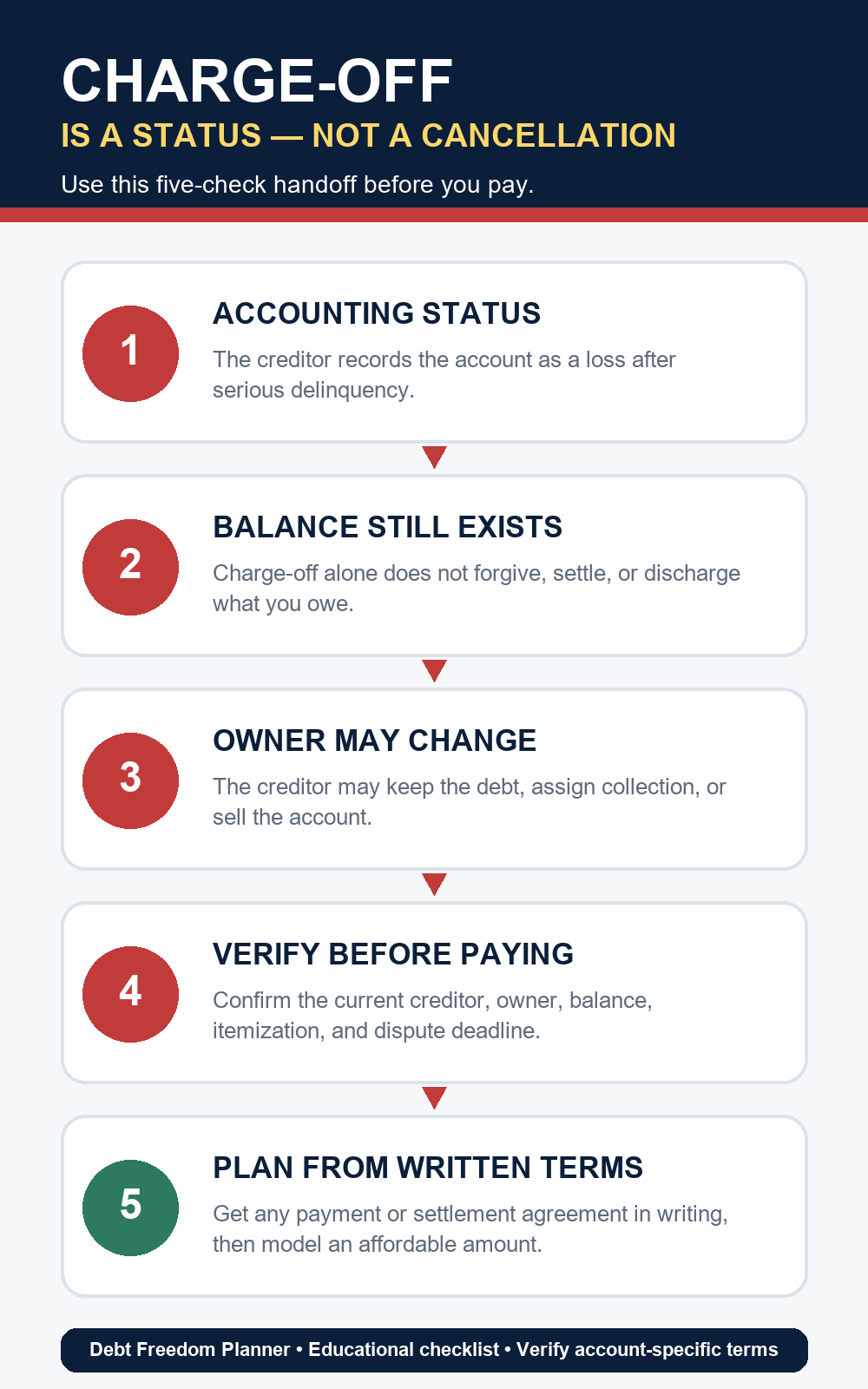
The safe sequence is status, balance, owner, verification, then a written plan.
Do you still have to pay after a charge-off?
Usually, yes: charge-off by itself does not cancel the obligation. The FTC states that even after a creditor charges off a credit-card debt as a loss, the consumer still owes it, and the creditor may sell it to a debt collector. The original creditor may also keep the account or use a collector without selling it.
There are important exceptions and defenses that depend on facts and law. The debt might not be yours. The amount might be wrong. A settlement may already have resolved it. A bankruptcy discharge may cover it. A lawsuit deadline may have expired under applicable state law. Those questions require documents and, when legal rights are at stake, qualified legal advice. “Charged off” alone answers none of them.
Do not assume that silence means forgiveness. A charged-off card may stop producing the same monthly statements you remember. The Consumer Financial Protection Bureau notes that an issuer may not have to send ordinary periodic statements for a charged-off account. Use the latest written account or validation information to establish the current balance and payment destination.
What can change after the account is charged off?
The company contacting you may change
The issuer can keep the debt, place it with a collection agency, or sell it to a debt buyer. A new company name is not automatically a scam—but it is not proof that the demand is valid, either.
If a debt collector contacts you, look for the validation information. The CFPB says the notice generally identifies the collector, current creditor, account number, itemized amount, current amount, dispute instructions, and the end of the 30-day dispute period. If the debt or amount seems wrong, act within the stated deadline. A timely written dispute generally requires the collector to pause collection of the disputed amount until it adequately responds.
The balance and payment channel may change
Do not keep sending money to an old portal just because it once worked. Confirm:
- the legal name and mailing address of the current creditor or collector;
- whether the original creditor still owns the account;
- the account identifier used in the notice;
- the itemized current balance, including interest, fees, payments, and credits;
- whether interest or fees are still being added under the contract and applicable law; and
- exactly how a payment will be credited.
Never give bank credentials or a full Social Security number to an inbound caller you have not independently verified. Use contact information from an authenticated account portal, a written validation notice, or a regulator-verified company listing.
Credit-report damage does not vanish when you pay
Payment can resolve the balance under the agreement you make, but it does not rewrite accurate history. The CFPB says most negative account-payment information can generally remain on a credit report for seven years. Accurate negative information cannot simply be removed because someone charges a “credit repair” fee. Errors, duplicates, wrong balances, or information that is not yours can be disputed.
This also means you should separate two goals:
- Resolve a verified debt on affordable terms.
- Check that each credit report describes the account accurately.
One action does not automatically complete the other.
A worked example: turning a verified balance into a plan
Suppose a household confirms that a collector owns a charged-off card balance of $6,400. The written validation and proposed plan show 0% ongoing interest and no added fees. Those are hypothetical assumptions, not typical promises and not facts you should apply to your own account without checking.
The household compares two fixed monthly amounts in Debt Freedom Planner:
| Hypothetical plan | Monthly amount | Modeled payoff time | Modeled finish | Modeled interest |
|---|---|---|---|---|
| Base plan | $200 | 32 months | April 2029 | $0.00 |
| Faster plan | $300 | 22 months | June 2028 | $0.00 |
Under those assumptions, the additional $100 per month shortens the modeled timeline by 10 months. It does not create a legal settlement, verify ownership, stop a lawsuit, or guarantee how the account will be reported. It answers a narrower planning question: once the balance and terms are verified, what monthly amount fits the household’s target date?
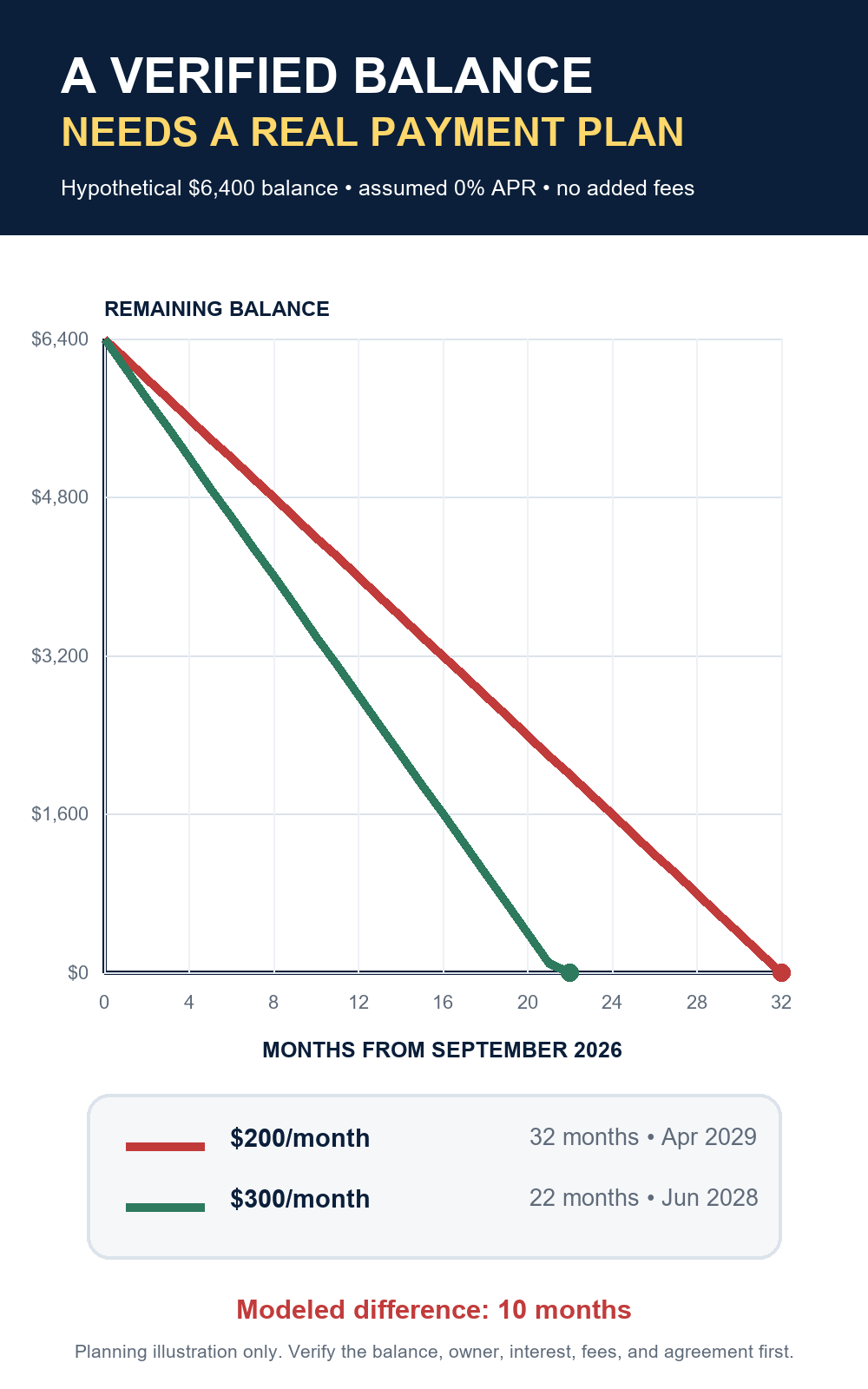
Hypothetical Debt Freedom Planner model: $6,400 starting in September 2026, 0% APR, no added fees, and no missed payments. Actual charged-off accounts can have different balances, interest, fees, settlement terms, and legal deadlines.
Should you pay in full, use a payment plan, or settle?
There is no universal best answer. Start with what the verified documents and your cash flow support.
Paying in full
Full payment may be simplest when you can afford it without missing housing, utilities, insurance, food, taxes, or other priority obligations. Ask for a written payoff amount and instructions before sending funds. Keep the confirmation and proof of payment.
A monthly repayment plan
A payment plan may preserve emergency cash and make the obligation manageable. The risk is agreeing to more than the household can sustain. A broken agreement can create new collection problems, so compare the required payment against realistic take-home income and essential expenses.
A settlement for less than the claimed balance
A collector may—or may not—accept less than the full balance. The CFPB recommends confirming the debt, calculating a realistic proposal, and getting the collector’s promises in writing before paying. The document should explain the total accepted amount, deadlines, installment terms, what happens after completion, and whether the remaining balance will be treated as satisfied or forgiven.
A settlement can also create tax questions when part of a debt is canceled. That is a separate issue from charge-off and may warrant tax advice. Do not treat a phone promise or a portal discount as a complete agreement.
A six-step checklist before sending money
- Confirm the account is yours. Match the original issuer and enough account detail to recognize it without exposing sensitive information.
- Identify the current owner. Ask whether the collector owns the debt or is collecting for someone else.
- Review the itemization. Reconcile the balance, interest, fees, payments, and credits with your records.
- Protect dispute and legal deadlines. Do not make a rushed payment when the amount, identity, age, lawsuit status, or limitation period is uncertain.
- Get the complete deal in writing. Confirm the amount, schedule, payment method, and what completion will accomplish.
- Model the payment only after verification. Use a number your household can repeat without falling behind on higher-priority bills.
If the card has not yet been charged off and you are struggling to make the minimum, act sooner. The CFPB’s current guidance says to contact the card company immediately, explain why you cannot pay, state what you can afford, and say when normal payments might resume. A hardship option before charge-off may be better than waiting for collections.
Put the verified numbers into Debt Freedom Planner
Once you know the current balance, confirmed interest rate, required payment, and payment destination, start a Debt Freedom Planner roadmap. Enter the charged-off account as one debt alongside your other verified balances, then compare a base payment with an affordable extra amount. The planner can show a payoff date, month-by-month schedule, total modeled interest, and how rolling a freed payment into the next debt changes the timeline.
The calculator is a planning tool, not a substitute for a validation notice, settlement letter, court response, credit-report dispute, lawyer, credit counselor, or tax professional. Keep the legal and documentary questions separate from the arithmetic.
Bottom line
A credit-card charge-off means the creditor changed how it accounts for a seriously delinquent balance. It does not, by itself, mean you are free of the debt. Verify who owns it, confirm the itemized amount, protect any dispute or court deadlines, get repayment or settlement promises in writing, and only then build the payment into your broader debt plan.
This article provides general educational information, not individualized financial, legal, tax, bankruptcy, or credit-repair advice. Laws, contracts, reporting, interest, fees, and limitation periods vary. Consult an appropriate qualified professional about your specific situation.
0 comments
Ask a question, add context, or share what worked for your household.
Create a free account or sign in to comment, reply, and vote on blog posts.