

Got IRS Notice CP523? Act Before Your Installment Agreement Ends
CP523 means the IRS says your installment agreement defaulted. Check the deadline, call immediately, and ask about cure, reinstatement, revision, or appeal.
The short answer: IRS Notice CP523 means the agency says your installment agreement has defaulted and it intends to terminate the plan. Do not ignore it or wait for another letter. Read the reason and termination date, check your payment and filing records, and contact the IRS immediately at the number printed on the notice. Depending on the facts, you may be able to cure the default, reinstate or revise the plan, or appeal the proposed termination.

A CP523 response starts with the notice date, your recent payment records, and a prompt call to the IRS—not a guess about what happened.
What CP523 actually means
The IRS CP523 notice page says CP523, CP523 (SP), and CP623 tell a taxpayer that an installment agreement has defaulted. The notice warns that the IRS intends to terminate the agreement and can begin collection action, including a federal tax lien or a levy on wages or bank accounts, if the problem is not resolved.
That does not mean a levy happened the moment the envelope arrived. It does mean the protected status of an active payment plan is at risk. The notice should identify the reason for default, the affected balance, and the date by which you need to act.
The IRS says to contact it as soon as possible and no later than 30 days from the notice date. Treat the date on your own notice as controlling. Mailing delays, weekends, and time spent searching for records do not create a safe reason to postpone the call.
Five steps to take before the deadline
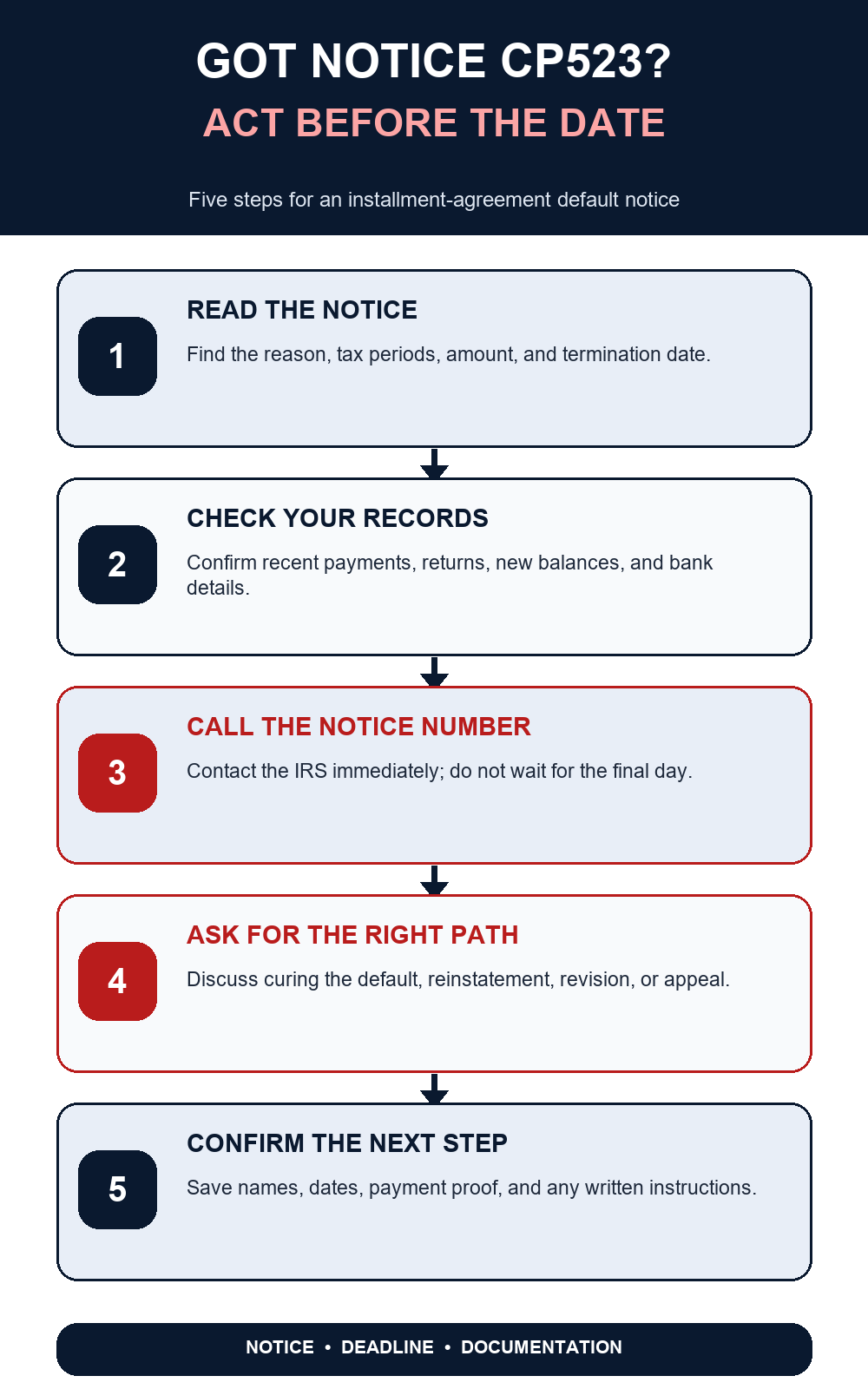
Read the notice, verify the account facts, call promptly, ask for the correct resolution path, and preserve proof of every next step.
1. Read the reason, amount, and dates
Confirm that the notice is addressed to you and note the tax periods, total balance, proposed termination date, and stated reason. Do not assume the problem is simply one missed payment. A plan can also be jeopardized when a required return is not filed, a new tax balance is not paid, direct-debit information changes, or the agreement's other terms are not met.
2. Check what actually happened
Gather your installment-agreement acceptance letter, recent IRS account transcript or Online Account information, bank statements, payment confirmations, filed-return records, and any earlier correspondence. If a debit failed, record the date and bank response. If you paid, check whether the payment posted to the correct tax period.
Do not send account numbers, Social Security numbers, or tax documents through ordinary email. Use the contact and submission instructions the IRS gives you.
3. Call the number printed on the notice
The CP523 page directs taxpayers to the number at the top of the notice. Be ready to explain what happened and what you can do now. If you already made the missing payment or corrected the stated problem, the IRS still says to call so the account reflects that action and the agreement can be reinstated when appropriate.
Write down the date, the representative's name or identification number, and the instructions you receive. Ask what must be paid or filed, the exact deadline, whether a fee applies, and how you will know the agreement is active again.
4. Ask which path fits the facts
There are several possible paths, and they are not interchangeable:
| Path | When it may fit | What to confirm |
|---|---|---|
| Cure the default | You can correct the stated problem before termination | Amount, filing, or documentation required and the deadline |
| Reinstate the plan | The agreement lapsed but the IRS will restore it | New payment terms, due date, direct-debit details, and fee |
| Revise the plan | The old monthly amount or date no longer works | Affordable payment, required financial statement, and fee |
| Appeal | You disagree with the proposed termination or cannot resolve it | Which appeal process applies and the exact request deadline |
The IRS payment-plan page says an individual may be able to use Online Account to change a monthly amount or due date, update direct-debit information, or reinstate after default. It also warns that reinstatement may carry a fee. If online changes are unavailable or the notice is urgent, follow the letter and contact the IRS right away.
5. Confirm the resolution and protect the next payment
Ask whether you will receive written confirmation and when the next payment is due. Then verify that any promised payment posts to the intended period and that a scheduled debit uses the correct bank account. Keep making required payments unless the IRS specifically tells you otherwise.
Also fix the reason the plan failed. A one-time catch-up payment will not prevent another default if the due date still conflicts with your income, the bank account is closed, or a new estimated-tax obligation remains unfunded.
What happens while termination or an appeal is pending?
The current IRS payment-plan guidance says the agency generally will not take enforced collection action while a plan is being considered or is in effect, for 30 days after a request is rejected or an agreement is terminated, or while an appeal of a rejection or termination is being evaluated. Exceptions can apply, so this is not a reason to wait.
IRS Publication 1660 explains that the Collection Appeals Program, or CAP, is available for a proposed or completed installment-agreement termination. It says to call the number on the notice and request an appeal if the matter cannot be resolved. A written request may be required when a Revenue Officer sent the notice, and the publication describes Form 9423 as the preferred form in that situation.
Publication 1660 also distinguishes CAP from Collection Due Process. CAP can cover installment-agreement termination and may produce a quicker decision, but its decision generally cannot be taken to court. Do not assume that a form or deadline from a different kind of IRS notice applies to CP523. Follow your notice and current IRS instructions, and consider a qualified tax professional or Low Income Taxpayer Clinic when rights, deadlines, or significant collection risk are involved.
Worked example: why a payment pause can cost more
Suppose a household has a hypothetical $9,600 planning balance, uses a 7.00% annual rate in Debt Freedom Planner, and budgets $320 per month. This is not an IRS account calculation; it is a simple payoff illustration.
With uninterrupted $320 payments, the app's monthly model reaches payoff in 34 months and calculates $983.77 in interest. If no payment is made for two months, the same monthly-rate assumption raises the planning balance to $9,712.33. Resuming the same $320 payment then takes 34 payment months, or 36 calendar months from the original start, and produces $1,120.66 in modeled interest from the original starting point.
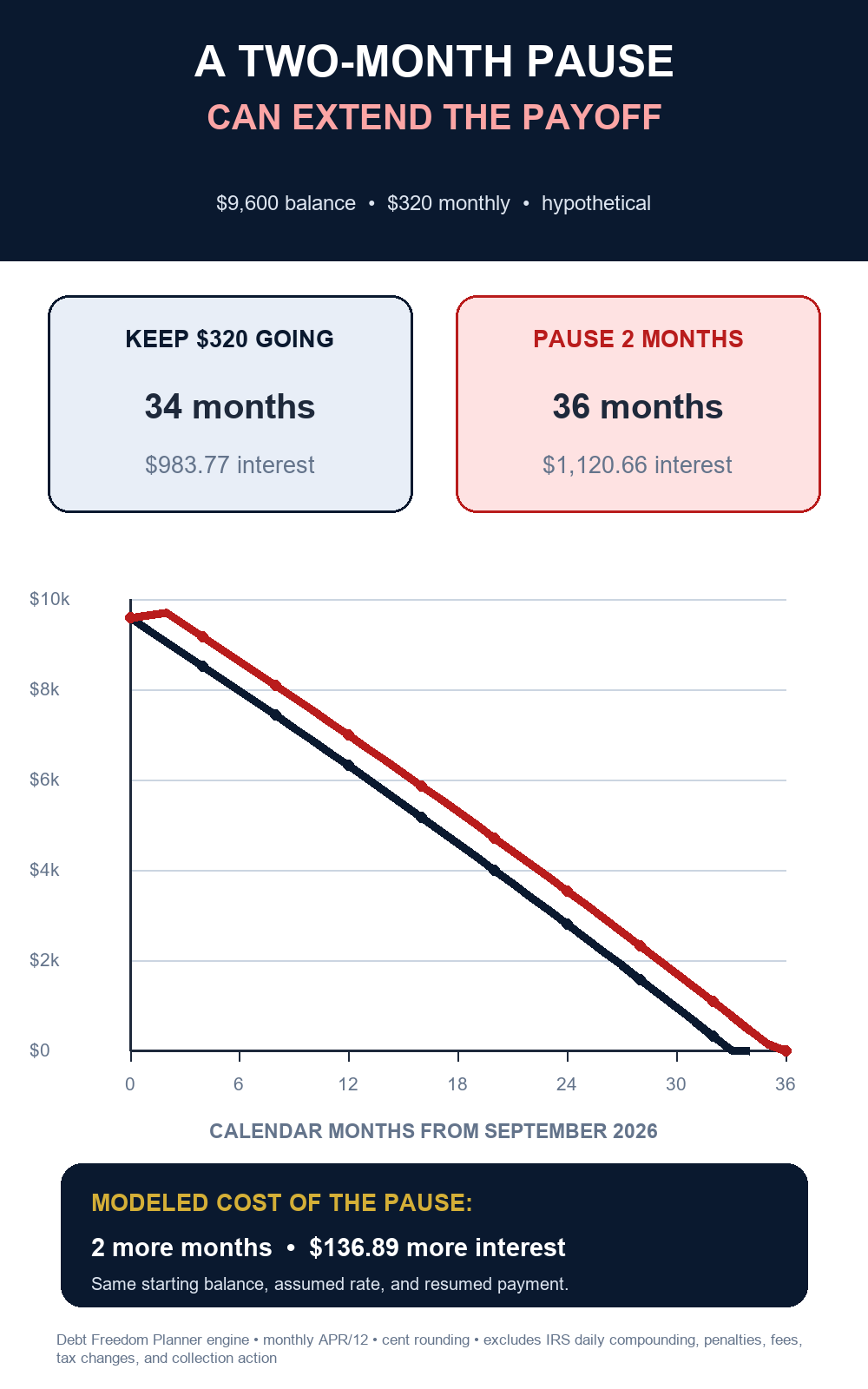
Hypothetical Debt Freedom Planner result: a two-month pause adds two calendar months and $136.89 of modeled interest under the assumptions shown.
| Hypothetical path | Calendar time | Modeled interest | Difference |
|---|---|---|---|
| Keep paying $320 | 34 months | $983.77 | Baseline |
| Pause two months, then pay $320 | 36 months | $1,120.66 | 2 months and $136.89 more |
The model uses APR divided by 12 and rounds to cents. Actual federal tax interest compounds daily, rates can change quarterly, and applicable penalties can continue until the balance is paid. The example excludes failure-to-pay penalties, reinstatement or revision fees, payment timing, new tax liabilities, refunds, and collection action. IRS Publication 594 explains the broader federal collection process and makes clear that applicable interest and penalties continue while tax remains unpaid.
The point is not that sending $320 automatically fixes CP523. It may not. The point is that delay can make the payoff problem larger while the legal and administrative problem remains unresolved. Contact the IRS first, learn the required cure or appeal path, and then rebuild a monthly plan around the confirmed terms.
How to revise your household payoff plan after the call
Once you know the IRS requirements, separate the immediate cure from the longer payoff schedule.
- Record the confirmed tax balance, required catch-up amount, monthly payment, due date, and any fee.
- Protect essentials and required minimum payments before promising an amount the household cannot sustain.
- Update the tax balance and payment in your payoff roadmap.
- Compare the revised tax plan with other debts using the same monthly cash-flow limit.
- Keep a small buffer so one irregular expense does not trigger another missed debit.
- Recheck the IRS account after every important payment or plan change.
Debt Freedom Planner can model a balance, APR assumption, minimum payment, and extra-payment scenario. It cannot access an IRS account, determine tax liability, stop a levy, file an appeal, transmit a payment, or tell you which tax resolution the IRS will approve.
Start a Debt Freedom Planner roadmap after you have the confirmed account terms and want to see how the revised monthly payment fits beside credit cards, loans, and other balances. Use the planner to make the cash-flow tradeoff visible; use the IRS and, when appropriate, a qualified tax professional for the actual agreement and appeal.
Bottom line
CP523 is a deadline notice, not routine mail. Read it, verify the account records, and call the IRS immediately. Ask exactly what will cure, reinstate, revise, or appeal the agreement; document the answer; and confirm the next payment. Then update your household payoff plan so the new terms are realistic enough to keep.
This article provides general educational information, not individualized financial, legal, tax, accounting, or collection advice. IRS rules, fees, rates, and procedures can change. Follow the dates and instructions on your notice and verify current requirements directly with the IRS or a qualified professional before acting.
0 comments
Ask a question, add context, or share what worked for your household.
Create a free account or sign in to comment, reply, and vote on blog posts.