

If Your Car Is Repossessed and Sold, Do You Still Owe a Deficiency Balance?
A repossession may leave a deficiency balance. Verify the payoff, costs, sale credit, and account terms before building a realistic payoff plan.
Yes. A repossession usually does not erase an auto loan. After the lender sells the vehicle, you may still owe a deficiency balance: the unpaid loan amount plus allowed repossession and sale costs, minus the money credited from the sale and any other required credits. If the sale produces more than the amount owed and permitted costs, you may instead be entitled to a surplus. The exact calculation and your rights depend on your contract and state law, so verify the post-sale statement before treating the number as final.

A repossession changes the asset, but it may leave a debt behind. Start by verifying the sale and every line in the balance calculation.
The short version: do not assume the sale paid everything
The basic planning equation is:
Verified loan payoff + allowed costs − sale proceeds − other credits = possible deficiency balance
That is a starting framework, not a substitute for your actual post-sale accounting. The Consumer Financial Protection Bureau explains that a borrower may still owe the difference between the amount left on the loan, plus repossession fees, and the vehicle's sale price. It also says that if the sale brings in more than the amount owed after fees, the borrower is entitled to the surplus.
The Federal Trade Commission's repossession guide makes another important point: voluntarily returning the vehicle may reduce some repossession costs, but it does not automatically eliminate the remaining loan balance or the credit consequences.
The CFPB's Repossession in Auto Finance report also emphasizes the practical harm: a household can lose transportation and still face an outstanding balance, repossession-related fees, and credit damage.
Before you put a deficiency into any payoff plan, collect the documents that show how it was produced.
What to request after the car is sold
Ask the lender or servicer for a written post-sale explanation. The names and timing of documents differ by state and contract, but your file should let you answer these questions:
- What was the loan payoff amount on the relevant date? This may differ from the principal balance on an older statement because of accrued interest, late charges, or credits.
- When and how was the vehicle sold? Save the sale date, whether it was public or private, and any notice you received.
- What were the gross and net sale proceeds? “Net” may reflect certain sale expenses, so do not subtract the same fee twice.
- Which repossession, towing, storage, repair, preparation, auction, or legal costs were added? Ask for an itemized list rather than accepting one unexplained total.
- Were refunds or credits applied? Depending on the facts, this might include an insurance payment, a GAP-related payment, or refunds for canceled add-on products. Do not assume a credit applies; verify it.
- Is the result a deficiency or a surplus? Check the arithmetic yourself.
- Who owns or services the remaining account now? A lender may retain it or place or sell it for collection.
The CFPB says lenders must sell a repossessed vehicle in a commercially reasonable manner, and state law can create additional notice, reinstatement, redemption, sale, or deficiency protections. A low sale price alone does not settle the legal question, but it is a reason to preserve market-value evidence and get qualified local help if something looks wrong.
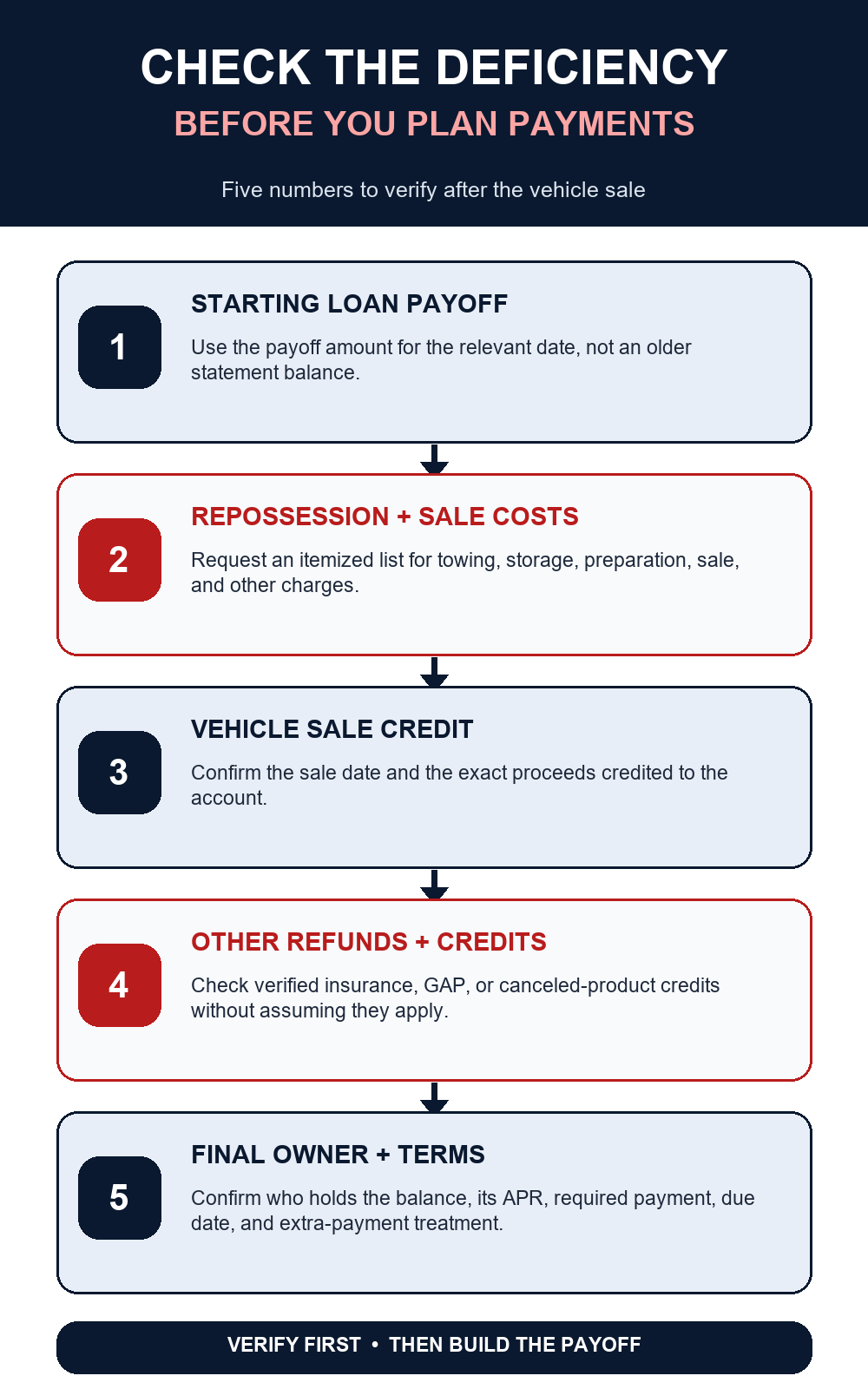
Verify the starting payoff, costs, sale credit, other credits, and final owner before scheduling payments.
A worked deficiency example
Suppose a lender's post-sale documents show these hypothetical numbers:
| Item | Hypothetical amount |
|---|---|
| Loan payoff immediately before sale | $18,500 |
| Repossession, storage, and sale costs | +$1,200 |
| Vehicle sale proceeds credited | −$13,000 |
| Possible starting deficiency | $6,700 |
The $6,700 is not simply “what was left on the old loan.” It is a new planning balance assembled from the payoff, costs, and credits. If the fee list is wrong, a required credit is missing, or the sale did not follow applicable rules, the amount could change. That is why verification comes before acceleration.
For payoff modeling only, assume the verified $6,700 balance carries an 11.50% APR, the required monthly payment is $180, and there are no new fees or missed payments. Using Debt Freedom Planner's monthly APR/12 engine:
| Hypothetical path | Monthly payment | Modeled payoff time | Modeled interest |
|---|---|---|---|
| Pay the verified $180 amount | $180 | 47 months | $1,626.02 |
| Add $120 each month | $300 | 26 months | $875.47 |
| Modeled difference | +$120 | 21 months sooner | $750.55 less |
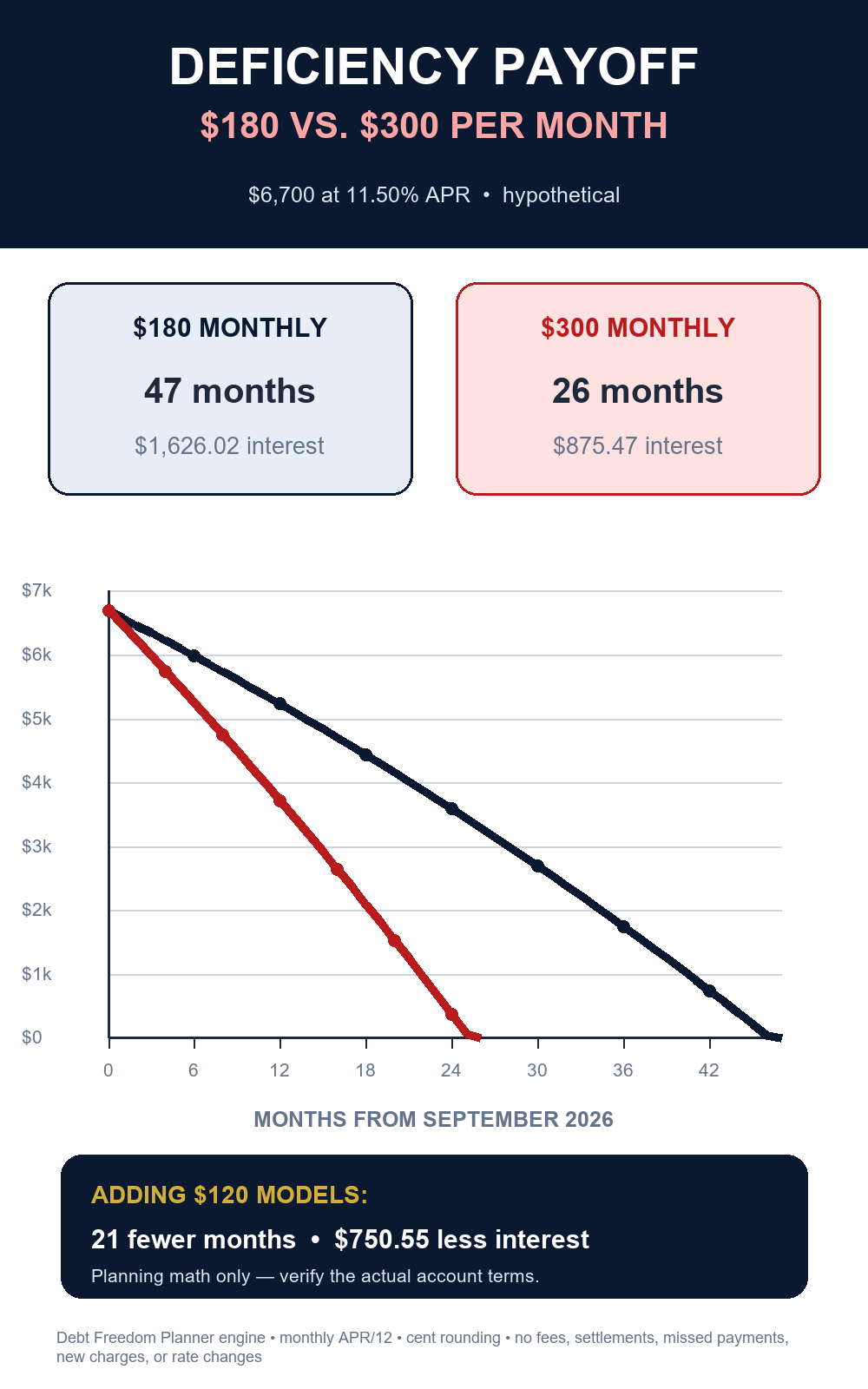
Hypothetical Debt Freedom Planner model: $6,700 at 11.50% APR, comparing $180 and $300 monthly payments. It excludes fees, settlements, missed payments, new charges, rate changes, and legal disputes.
This graph is a planning illustration, not a prediction of a lender's terms. Your post-sale agreement or collection account may use daily interest, a different rate, changing fees, or a negotiated arrangement. Enter the terms you actually verified.
What if the deficiency calculation looks wrong?
Do not ignore it, and do not rush into a payment promise you cannot support. Keep the discussion factual and in writing when possible.
- Compare the payoff date and balance with your last statements.
- Recalculate every fee and credit once, watching for duplicated costs.
- Keep copies of sale notices, auction information, photographs, valuation records, insurance or GAP correspondence, add-on cancellation requests, and personal-property records.
- Ask the lender or servicer to explain any line you cannot reproduce.
- Check your state attorney general or consumer protection office for state-specific repossession rules.
- Consider local legal-aid or consumer-law help if you believe the repossession, notice, sale, personal-property handling, or deficiency claim violated the law.
The CFPB's auto-payment guidance recommends contacting the lender or servicer promptly when payments are becoming difficult and getting any modified agreement in writing. If the account is already with a debt collector, you may also have federal debt-collection rights that are separate from the original auto-loan rules.
If the amount is verified, build a payment you can maintain
A fast payoff is useful only if it does not cause another missed essential bill. Start with the amount required by the verified agreement. Then test an extra payment that fits after housing, food, utilities, insurance, transportation, and a small cash buffer.
For the hypothetical example, the move from $180 to $300 saves meaningful time and modeled interest. But a household with unstable income might choose a smaller recurring amount and use occasional extra payments when cash is genuinely available. The goal is a plan you can repeat, not one aggressive month followed by a default.
Also ask how extra money will be applied. You want to know whether it reduces principal immediately, pays future installments ahead, or first covers interest, fees, or collection costs. Save payment confirmations and compare the next statement with your expectation.
How Debt Freedom Planner can help after verification
Once you know the balance, APR, required payment, and current account owner, you can try Debt Freedom Planner to model the remaining debt alongside your other balances. Enter the deficiency as its own debt, use only verified terms, and compare the regular payment with a realistic extra amount.
The planner can show a projected payoff date, total modeled interest, month-by-month schedule, and how an extra payment changes the path. It does not determine whether the deficiency is legally valid, negotiate with a lender, or replace the post-sale accounting. It helps after those questions are settled enough to create a responsible household plan.
Final checklist
Before paying or planning around a repossession deficiency, confirm:
- the loan payoff date and amount;
- the vehicle's sale date and proceeds;
- each repossession and sale cost;
- every refund, insurance payment, or other credit;
- whether the sale and notices raise a state-law question;
- the current owner or collector of the balance;
- the APR, required payment, due date, and extra-payment treatment; and
- that your proposed monthly amount leaves essential bills protected.
Repossession is disruptive, but the remaining number becomes more manageable when it is documented, challenged when necessary, and converted into a payment path built from real terms.
This article provides general educational information, not individualized financial, legal, tax, credit-repair, or bankruptcy advice. Repossession and deficiency rules vary by state and contract. Consider qualified local legal help for advice about your rights or a disputed balance.
0 comments
Ask a question, add context, or share what worked for your household.
Create a free account or sign in to comment, reply, and vote on blog posts.