

What If an Automatic Debt Payment Changes Amount? Check the 10-Day Notice and Your Authorized Range
A changing automatic debt payment may require 10-day written notice. Compare the authorization, any range, and the actual debit before replanning.
If a recurring debt payment pulled from your bank account will change from the amount you previously authorized or from the last transfer, federal Regulation E generally requires written notice of the new amount and transfer date at least 10 days before the scheduled debit. There is an important exception: your authorization may let you choose notices only when a debit falls outside a specified range or differs by more than an agreed amount. Check the actual authorization and every notice before deciding that a changed debit was wrong.

A changing automatic debit deserves a document check before it becomes a cash-flow surprise.
The short answer: compare three things
When an automatic debt payment changes, put these side by side:
- The written authorization — Did you approve one fixed amount, the statement balance, the minimum due, a range, or another formula?
- The advance notice — Does a statement, letter, or electronic notice show the amount and scheduled date at least 10 days before the transfer?
- The actual debit — Did the company take the amount on the date described, and did it stay within any range you selected?
The current Regulation E rule on preauthorized transfers says that when a preauthorized electronic fund transfer from a consumer's account will vary from the previous transfer or the preauthorized amount, the payee or financial institution must send written notice of the amount and date at least 10 days before the scheduled transfer.
The same rule permits a range arrangement. The company or institution must inform you of the right to notice of all varying transfers, but it may offer the option to receive notice only when a transfer falls outside a specified range or differs from the most recent transfer by more than an agreed amount. The official interpretation says an offered range should be one a consumer could reasonably anticipate.
This article focuses on a company pulling a recurring payment from a consumer bank account. That is different from recurring bill-pay instructions you give your bank or credit union to send money to a company. The Consumer Financial Protection Bureau's automatic-payment guide explains that distinction and recommends keeping the authorization terms and monitoring the account.
A payment can vary without being unauthorized
Many debt payments are not fixed. A credit-card autopay might be set to the minimum due, the statement balance, or another selected amount. A loan payment might change after a modification, rate adjustment, escrow review, fee, or other account event. The fact that this month's debit differs from last month's debit does not, by itself, prove an error.
Start with the words you approved. Look for terms such as:
- fixed dollar amount;
- minimum payment due;
- statement balance;
- total amount due;
- specified range;
- difference threshold; or
- a formula tied to the account balance or billing statement.
Then search your statement inbox, email, postal mail, account messages, and payment portal for the notice. Save a copy showing when it was delivered. A statement can contain meaningful notice even when the subject line does not say “automatic payment change.”
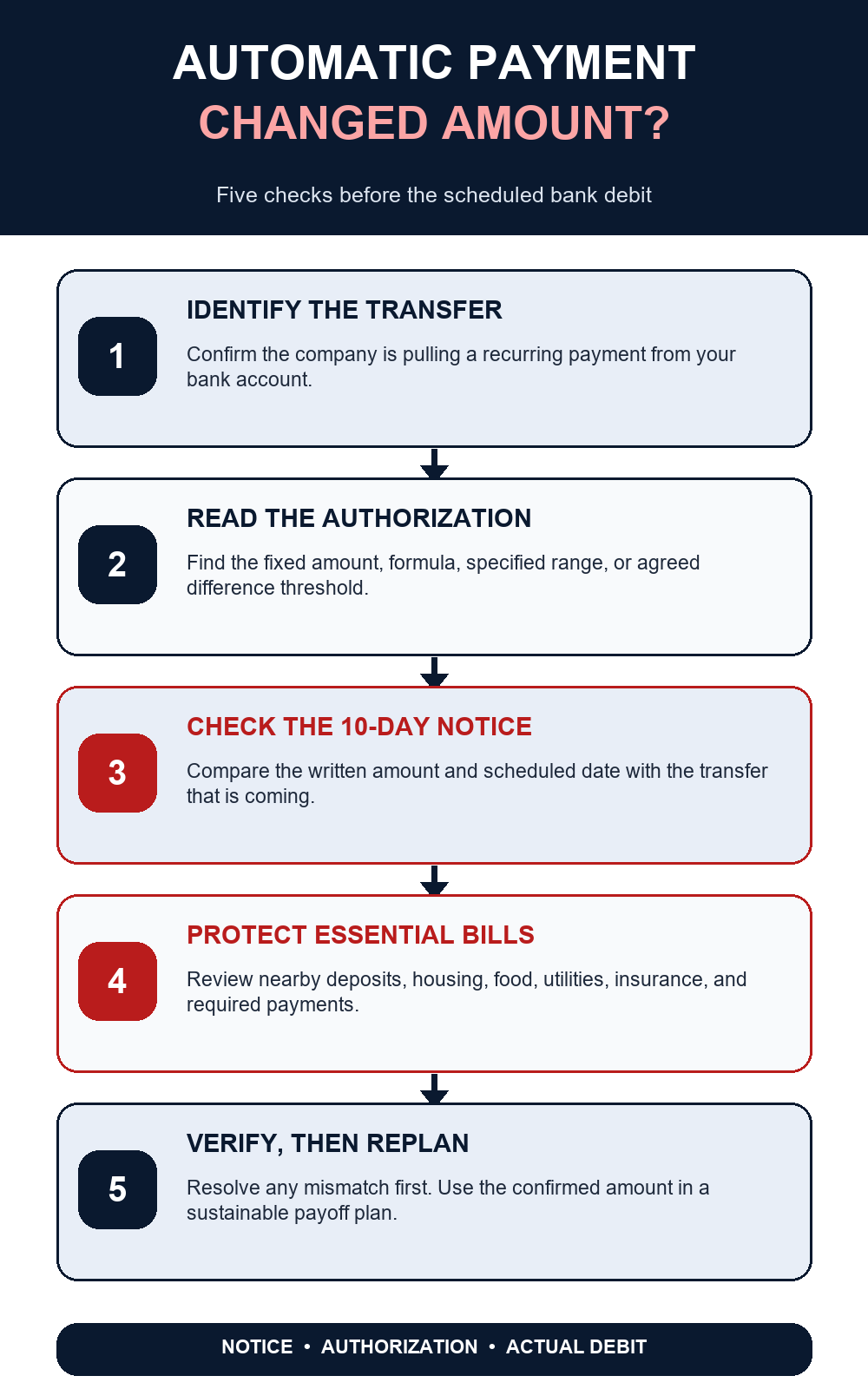
Identify the transfer, compare the notice with the authorization, protect essential bills, and update the payoff plan only after the amount is verified.
A worked cash-flow example
Suppose a household has $520 available after its paycheck and already scheduled essentials. It expects a $225 automatic credit-card payment, followed by a $240 utility payment.
| Hypothetical cash-flow step | Expected $225 debit | Changed $315 debit |
|---|---|---|
| Available before debt debit | $520 | $520 |
| Automatic debt payment | −$225 | −$315 |
| Buffer after debt payment | $295 | $205 |
| Utility payment still coming | −$240 | −$240 |
| Remaining after both | $55 | −$35 |
The $90 difference may help the debt fall faster, but it also turns a $55 cushion into a $35 shortfall. That does not predict an overdraft or fee; deposits, posting order, overdraft settings, and bank policies vary. It shows why advance notice matters. The household needs time to verify the debit, protect essential payments, move funds if appropriate, or ask about another payment method.
What the higher amount could do to the payoff
After the amount is verified and the next essentials are protected, recalculate the debt plan. A higher recurring payment can be useful when it is intentional and sustainable.
For a transparent hypothetical, assume one $7,500 credit-card balance at 23.99% APR, no new charges or fees, and monthly interest modeled as APR divided by 12 with cent rounding. Debt Freedom Planner's payoff engine produces:
| Hypothetical path | Monthly payment | Modeled payoff time | Modeled interest |
|---|---|---|---|
| Keep the expected payment | $225 | 56 months | $4,978.92 |
| Deliberately keep the higher payment | $315 | 33 months | $2,784.84 |
| Modeled difference | +$90 | 23 months sooner | $2,194.08 less |
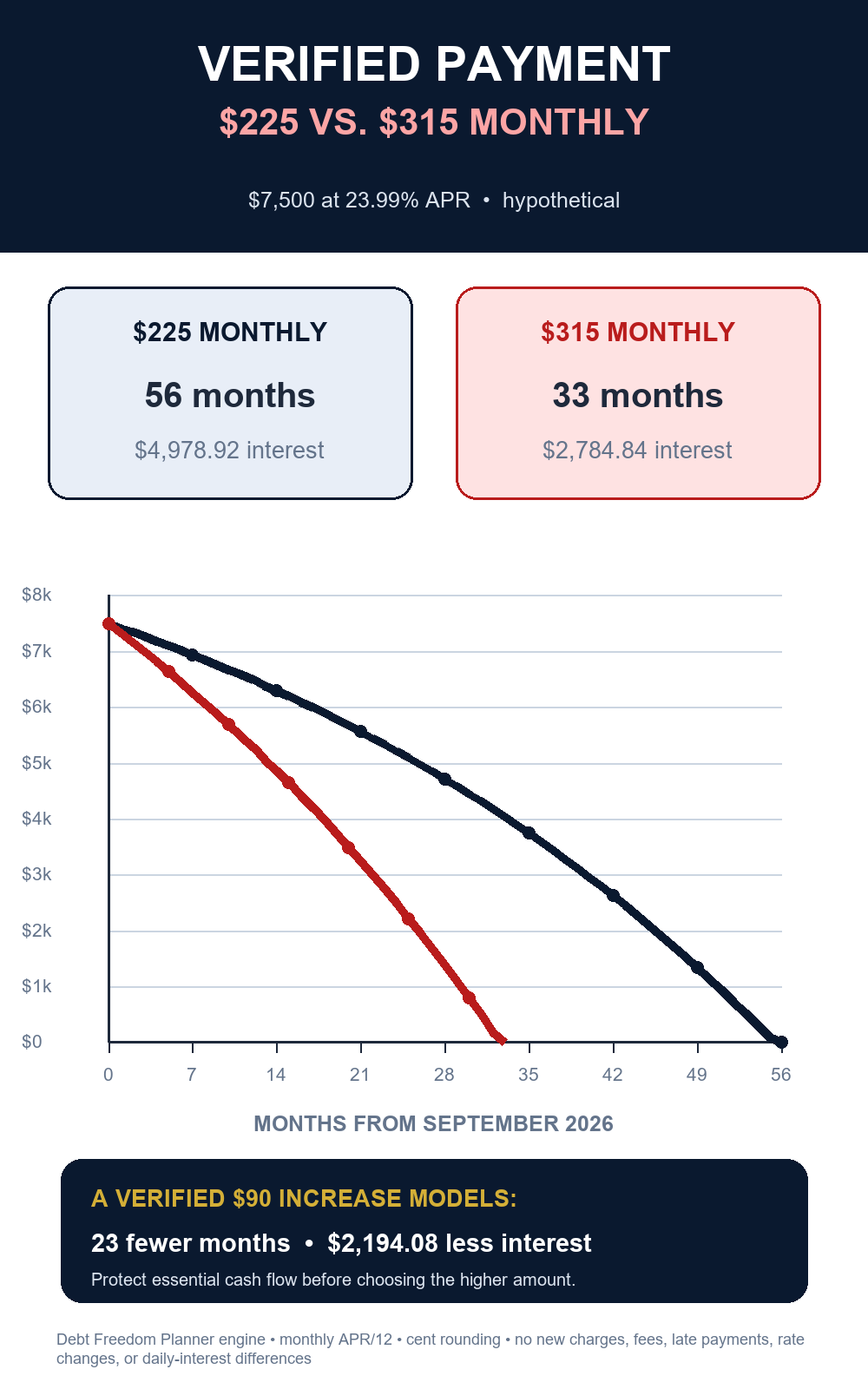
Hypothetical Debt Freedom Planner model: $7,500 at 23.99% APR, comparing $225 and $315 monthly payments. It excludes new charges, fees, late payments, rate changes, and daily-interest differences.
This graph is planning math, not a reason to accept an unexplained debit. The $315 path looks better for payoff time and modeled interest, but only if the account terms are correct and the household can repeat the payment without missing rent, food, utilities, insurance, transportation, or another required debt payment.
What to do before the scheduled debit
If you notice the change before money moves, work in this order:
- Capture the details. Save the authorization, notice, statement, scheduled date, amount, and any confirmation number.
- Ask the company to explain the calculation. A changed minimum, statement balance, interest charge, fee, or modified agreement should be traceable to the account record.
- Compare the notice timing. Count from delivery of the written notice to the scheduled transfer date; do not rely only on when you happened to open it.
- Check the selected range or threshold. If you chose limited notices, decide whether this debit crossed that boundary.
- Protect essential cash flow. Review other payments and deposits that may post near the same date.
- Request a correction or different payment method when needed. Get any replacement arrangement in writing and confirm how the debt payment will still be made on time.
Do not assume that stopping the bank debit cancels the debt or the underlying payment obligation. The CFPB's guide to stopping automatic payments explains that revoking an automatic debit and stopping a payment are separate from canceling a contract or repaying a loan. If you change the payment method, make sure the required debt payment is still handled.
What if the unexpected amount already posted?
Contact both the company and your bank or credit union promptly. Describe the specific transfer, date, amount, and why you believe it did not match the authorization or notice. Ask the company for the authorization and calculation, and ask the financial institution which error-resolution process applies.
The Regulation E error-resolution rule includes an incorrect electronic fund transfer within its definition of an error. For the rule's standard error process, a consumer's notice generally must reach the financial institution no later than 60 days after it sends the periodic statement first showing the alleged error. The rule contains investigation, provisional-credit, and timing details that depend on the facts, so report the issue quickly rather than treating 60 days as a reason to wait.
Keep a simple record:
- who you contacted and when;
- the amount and scheduled date;
- the authorization language;
- the notice or missing-notice issue;
- the account statement showing the debit;
- case or confirmation numbers; and
- any promised correction, refund, or replacement payment plan.
If the company says the debit was correct, ask it to point to the exact authorization term and notice. If the account is with a debt collector, disputed debt, bankruptcy matter, or court order, get qualified help for the specific legal issue rather than relying on a general checklist.
Update the payoff plan only after the payment is understood
Once you verify the balance, APR, required amount, and recurring-payment terms, you can try Debt Freedom Planner to compare the old amount with a sustainable new one. The planner can show a projected payoff date, modeled interest, payoff order, and month-by-month schedule using the numbers you enter.
Use the verified required payment as the safety floor. Treat additional money as a payoff choice, not as cash that is available before housing, food, utilities, insurance, transportation, and other required payments are covered. If income changes, test a smaller recurring extra and use occasional one-time payments when the cash is genuinely available.
Debt Freedom Planner does not decide whether a debit was authorized, resolve an electronic-transfer dispute, or contact a creditor or bank. It helps turn verified account terms into a repeatable payoff roadmap.
Final checklist
Before you accept, challenge, or plan around a changed automatic debt payment, confirm:
- whether the company pulled the payment from your bank account;
- the exact amount or formula in your authorization;
- whether you selected notice for every variation or only outside a range;
- the amount and date in the advance notice;
- whether the actual debit matched both documents;
- which essential payments share the same cash window;
- how the debt must be paid if the automatic debit changes or stops; and
- whether the new recurring amount is sustainable in your payoff plan.
A varying debit is manageable when it is visible, documented, and fitted into the rest of the household's obligations. The practical sequence is simple: verify the authorization, verify the notice, protect the account, then recalculate the debt plan.
This article provides general educational information, not individualized financial, legal, tax, credit-repair, or bankruptcy advice. Regulation E coverage and remedies depend on the transfer and account facts. Contact your bank, creditor, a qualified consumer-law professional, or an appropriate regulator for help with a specific dispute.
0 comments
Ask a question, add context, or share what worked for your household.
Create a free account or sign in to comment, reply, and vote on blog posts.