

If You Pay Extra on Federal Student Loans, Which Loan Gets the Money?
Extra federal student loan payments may target a higher-rate loan and advance your due date. Verify allocation, paid-ahead status, and the posted principal change.
The short answer: after your required federal student loan payment is satisfied, an extra amount will generally go to accrued interest first and then principal. If you have multiple loans, the servicer's default allocation often sends the overpayment toward the highest-rate loan, but you should verify that rule and submit payment directions if you want a specific loan targeted. A large payment may also advance your due date, creating a "paid ahead" status. That does not necessarily mean the extra money missed principal; allocation and the next bill due are two separate questions.

A clear extra-payment plan starts with each loan's balance, rate, accrued interest, and your servicer's current allocation settings.
First, separate application, allocation, and paid-ahead status
These terms sound interchangeable, but they answer different questions:
| Term | What it answers | What to check |
|---|---|---|
| Payment application | Within one loan, what gets paid first? | Accrued interest, then principal; fees may apply in some situations |
| Payment allocation | If you have several loans, which loan receives each part of the payment? | The servicer's default rule and any special directions you submitted |
| Paid-ahead status | Did the payment satisfy some or all of a future bill? | Your next due date, amount due, and whether automatic payments continue |
Federal Student Aid says that paying more than the minimum can reduce total interest and recommends asking the servicer whether the additional amount can be allocated to higher-interest loans first. The Consumer Financial Protection Bureau's payment-application guide likewise explains the usual order of fees, interest, and principal and warns borrowers to understand paid-ahead treatment.
The practical lesson is simple: do not judge an extra payment only by the next statement's amount due. Confirm both where the dollars went and what happened to the due date.
Which federal loan usually gets the extra money?
There is no safe universal answer without checking your servicer and account. Current federal-servicer guidance shows a common pattern, but the details matter.
For example, Aidvantage's current payment guidance says that after the total amount due is satisfied, an overpayment is generally allocated to the loan with the highest interest rate. Its tie-breakers may favor unsubsidized loans and then prorate among otherwise similar loans. MOHELA's payment-allocation page also describes highest-rate-first treatment for overpayments unless the borrower gives payment directions.
That makes highest-rate targeting a reasonable default to verify, not a promise to assume. Your account could include different loan groups, delinquent amounts, outstanding interest, consolidation-loan portions, or saved payment instructions. Before sending a large extra amount, sign in and read the servicer's current rules for your loans.
A five-check routine before paying extra
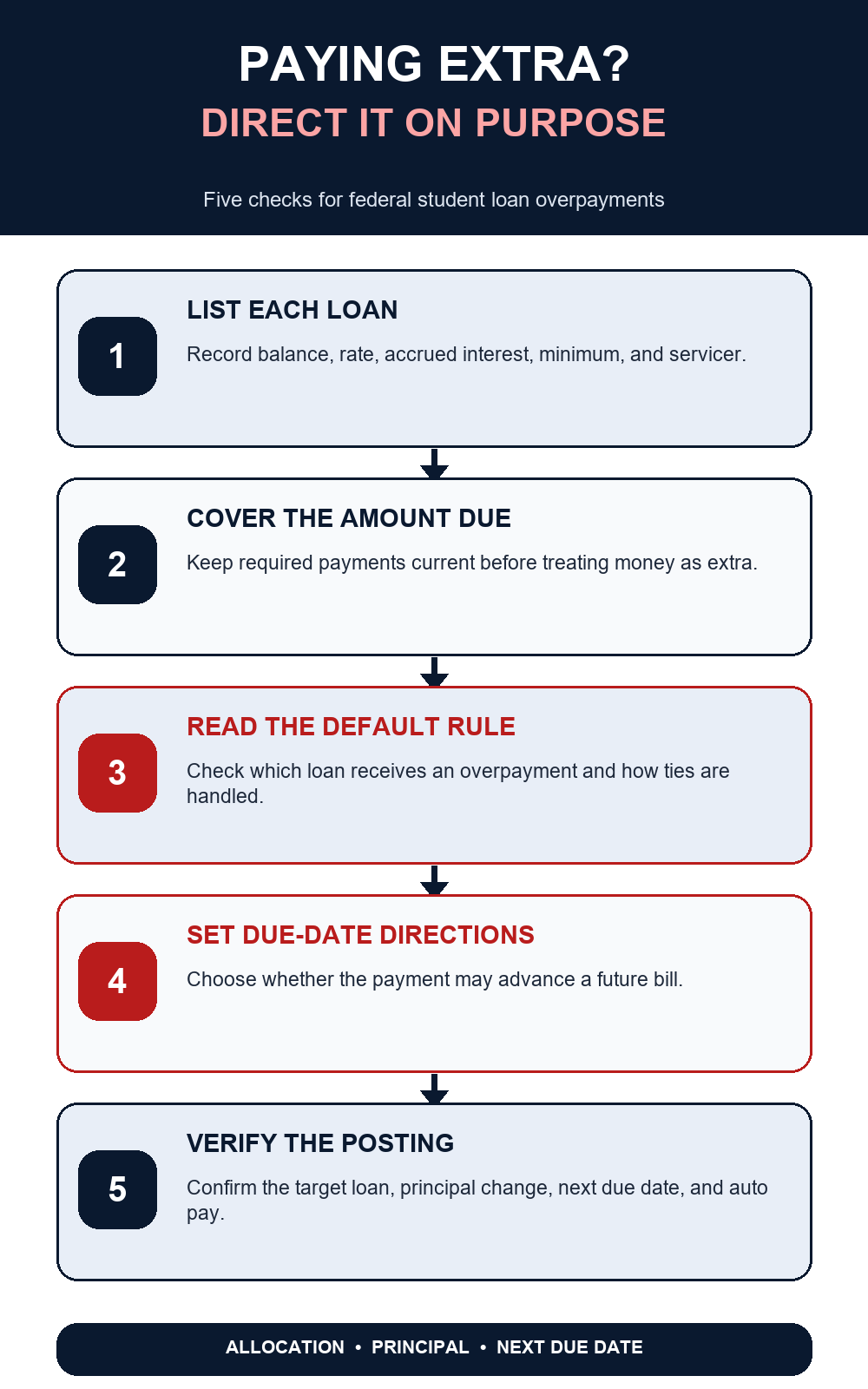
Check the loan list, required payment, default allocation, due-date setting, and posted transaction before treating an extra payment as complete.
1. List every loan separately
Do not work only from the combined account balance. Your StudentAid.gov dashboard can show each loan's principal, accrued interest, interest rate, repayment plan, and servicer. Copy those details into one place.
2. Protect the required payment
An extra-payment strategy comes after the required amount is covered. If an account is past due, the servicer may apply money to delinquent amounts before following normal overpayment directions. Keep the account current unless your servicer has confirmed another arrangement.
3. Read the default allocation rule
Find the servicer's page for "payment allocation," "special payment instructions," or "overpayment allocation." Record how it handles the highest rate, equal rates, subsidized versus unsubsidized loans, and consolidation-loan groups.
4. Choose whether to advance the due date
Some servicers let you request that an overpayment not advance the due date, or not advance it by more than one month. If you want to keep paying every month, confirm the setting instead of assuming a future $0 amount due will preserve your plan automatically.
5. Verify the posted transaction
After the payment settles, save the confirmation and compare the before-and-after principal and accrued interest for the targeted loan. Also check the next due date and automatic-payment schedule. If the posting does not match your directions, contact the servicer promptly and keep written records.
What paid ahead really means
Paid ahead generally means your payment satisfied at least part of a future scheduled bill. Your next statement may show a reduced amount due or $0 due. That can provide breathing room, but interest may still accrue on an outstanding principal balance.
Current servicer explanations add an important nuance to older shorthand about paid-ahead status. Edfinancial explains that being paid ahead affects what is required on the next bill, while the payment itself is still applied to outstanding interest and then principal. In other words, a future $0 bill does not by itself prove that the extra amount failed to reduce principal.
The risk is behavioral: if you stop paying because the statement says nothing is due, the balance has more time to accrue interest. Federal Student Aid recommends continuing monthly payments even when a prior payment satisfied future installments if faster payoff is the goal.
Worked example: directing $150 to the higher-rate loan
Suppose a borrower has these two hypothetical federal-loan balances and can pay $150 beyond the combined $270 minimums each month:
| Hypothetical loan | Starting balance | APR | Minimum | Extra-payment priority |
|---|---|---|---|---|
| Loan A | $16,000 | 8.08% | $180 | Higher-rate-first target |
| Loan B | $7,500 | 5.50% | $90 | Lower-balance-first alternative |
Debt Freedom Planner modeled the same $420 total monthly budget two ways. Sending the extra money to Loan A first produced a 76-month payoff with $5,132.63 in modeled interest. Sending it to lower-balance Loan B first produced an 81-month payoff with $6,214.61 in modeled interest.
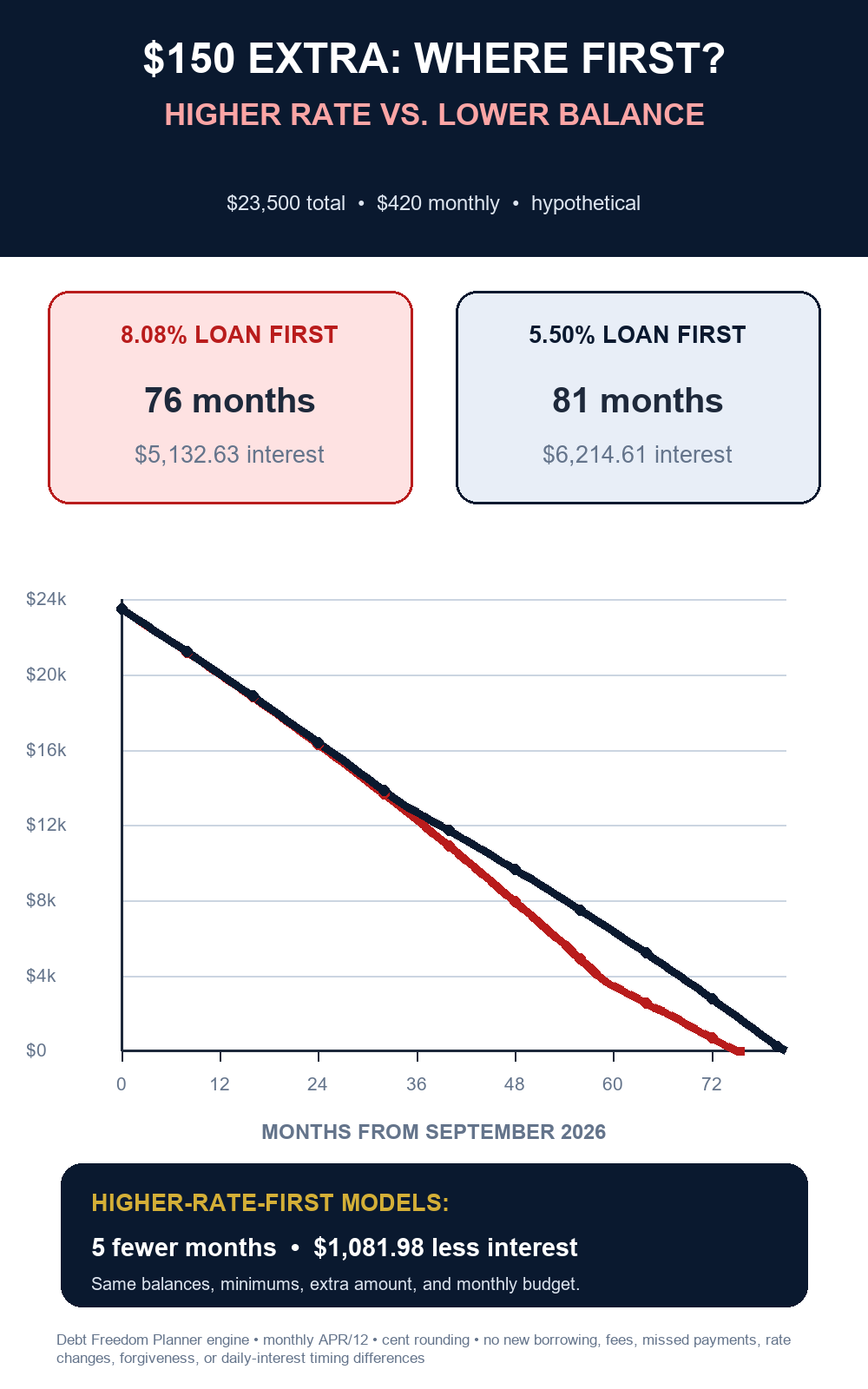
Hypothetical Debt Freedom Planner result: higher-rate-first finishes five months sooner and models $1,081.98 less interest under the assumptions shown.
| Direction for the $150 extra | Modeled payoff time | Modeled interest | Difference |
|---|---|---|---|
| Loan A at 8.08% first | 76 months | $5,132.63 | Baseline |
| Loan B at 5.50% first | 81 months | $6,214.61 | 5 months and $1,081.98 more |
This is a planning illustration, not a quote from a servicer. The model uses monthly APR divided by 12, cent rounding, stable rates, no fees, no missed payments, and no new borrowing. Actual Direct Loans accrue interest daily, as Federal Student Aid explains, so real postings will differ with payment dates, daily balances, loan status, and servicer rules.
When highest-rate-first may not be your first move
Paying the highest-rate loan first often minimizes modeled interest, but faster payoff is not the only federal-loan objective.
- If you are pursuing Public Service Loan Forgiveness or another discharge path, extra payments may reduce money expected to remain for forgiveness without making you eligible sooner. Verify the current program rules before accelerating.
- If you are on an income-driven plan, paid-ahead limits and annual recertification can affect how future bills are treated.
- If your required payment strains essential expenses, stabilizing the monthly obligation may matter more than adding an extra payment.
- If one loan has a special benefit, subsidy, or dispute, confirm how an extra payment interacts with it before directing money there.
- If your emergency cushion is empty, a large one-time payment can leave you borrowing again when an unavoidable expense arrives.
MOHELA's current guidance specifically cautions that paying extra does not make a borrower eligible for PSLF sooner. Treat that as a signal to check your own program, servicer, and account before choosing a payoff-only strategy.
How to use Debt Freedom Planner without pretending it is your servicer
Debt Freedom Planner can compare balances, APRs, minimum payments, and payoff order so you can see the effect of targeting one loan before another. It does not pull your federal account, transmit payment instructions, calculate forgiveness eligibility, or replace the servicer's official balance.
To model your own options:
- Copy each loan's current balance, APR, and minimum payment from official account records.
- Build one scenario with the highest-rate loan first.
- Build a second scenario with your preferred custom order.
- Compare payoff months and modeled interest using the same total monthly budget.
- If you decide to pay extra, submit the instruction through your servicer and verify the posting afterward.
Start a Debt Freedom Planner roadmap when you want a calm side-by-side view of those payoff scenarios. Use the model to make the tradeoff visible; use your servicer for the actual payment and account rules.
Bottom line
An extra federal student loan payment generally reduces accrued interest and then principal, but the loan that receives the overpayment depends on the servicer's default allocation and your directions. Paid-ahead status usually changes what the next bill requires; it is not a complete description of where the money went. Verify the target loan, principal change, due date, and automatic-payment behavior every time you make a meaningful extra payment.
This article provides general educational information, not individualized financial, legal, tax, credit, student-aid, or forgiveness advice. Federal programs and servicer procedures can change. Confirm current requirements with StudentAid.gov and your loan servicer before acting.
0 comments
Ask a question, add context, or share what worked for your household.
Create a free account or sign in to comment, reply, and vote on blog posts.