

If a Debt Collector Holds More Than One Debt, Where Does Your Payment Go?
Direct one payment across multiple collection accounts clearly: exclude disputed debts, name each allocation, compare payoff costs, and verify posting.
If one debt collector is collecting more than one debt from you, a single payment does not have to become a guessing game. Under the federal debt-collection rule, the collector must not apply that payment to a debt you dispute and, when you give applicable directions, must apply it according to those directions. The practical move is to identify each account, state the exact dollar allocation before you pay, and keep proof that the collector received both the payment and your instructions.
That rule does not decide which debt is smartest to target. You still need to confirm the debts, review any repayment or settlement terms, protect essential household bills, and compare the cost of directing extra money to one account versus another.

A clear allocation starts with separating the accounts. The folders and paperwork shown here are illustrative and contain no real account information.
The short answer: give the collector clear directions
Regulation F, section 1006.30(c) addresses a consumer making one payment to a debt collector with respect to multiple debts owed to that collector. It says the collector:
- must not apply the payment to a debt the consumer disputes; and
- if applicable, must apply the payment according to the consumer's directions.
For example, if the collector holds Account A and Account B and you send $400, you could direct $300 to Account A and $100 to Account B. Use the collector's account identifiers rather than relying only on the original creditor's name, because two accounts can have similar labels.
The regulation does not say in this paragraph that your allocation direction must be written. Written directions are still the safer record. A portal message, letter, or other method the collector accepts can show what you instructed and when. If you give directions by phone, follow up in writing and save the confirmation.
First confirm that each debt and balance is yours
Payment allocation comes after verification, not before it. The CFPB recommends confirming that you owe the debt, calculating a realistic payment plan, and getting any repayment or settlement agreement in writing before paying. Its settlement guidance also specifically notes that a consumer with more than one debt at a collector can direct a payment to a particular debt.
Before sending money, make a small account table for yourself:
| What to record | Account A | Account B |
|---|---|---|
| Collector's account identifier | Last four digits only | Last four digits only |
| Current creditor | Name shown on notice | Name shown on notice |
| Original creditor | If different | If different |
| Itemized current balance | Principal, interest, fees, credits | Principal, interest, fees, credits |
| Dispute status | Confirmed or disputed | Confirmed or disputed |
| Proposed payment | Exact dollar amount | Exact dollar amount |
Do not put full account numbers, Social Security numbers, or bank credentials into a general budgeting note. Keep only what you need to identify the debt safely.
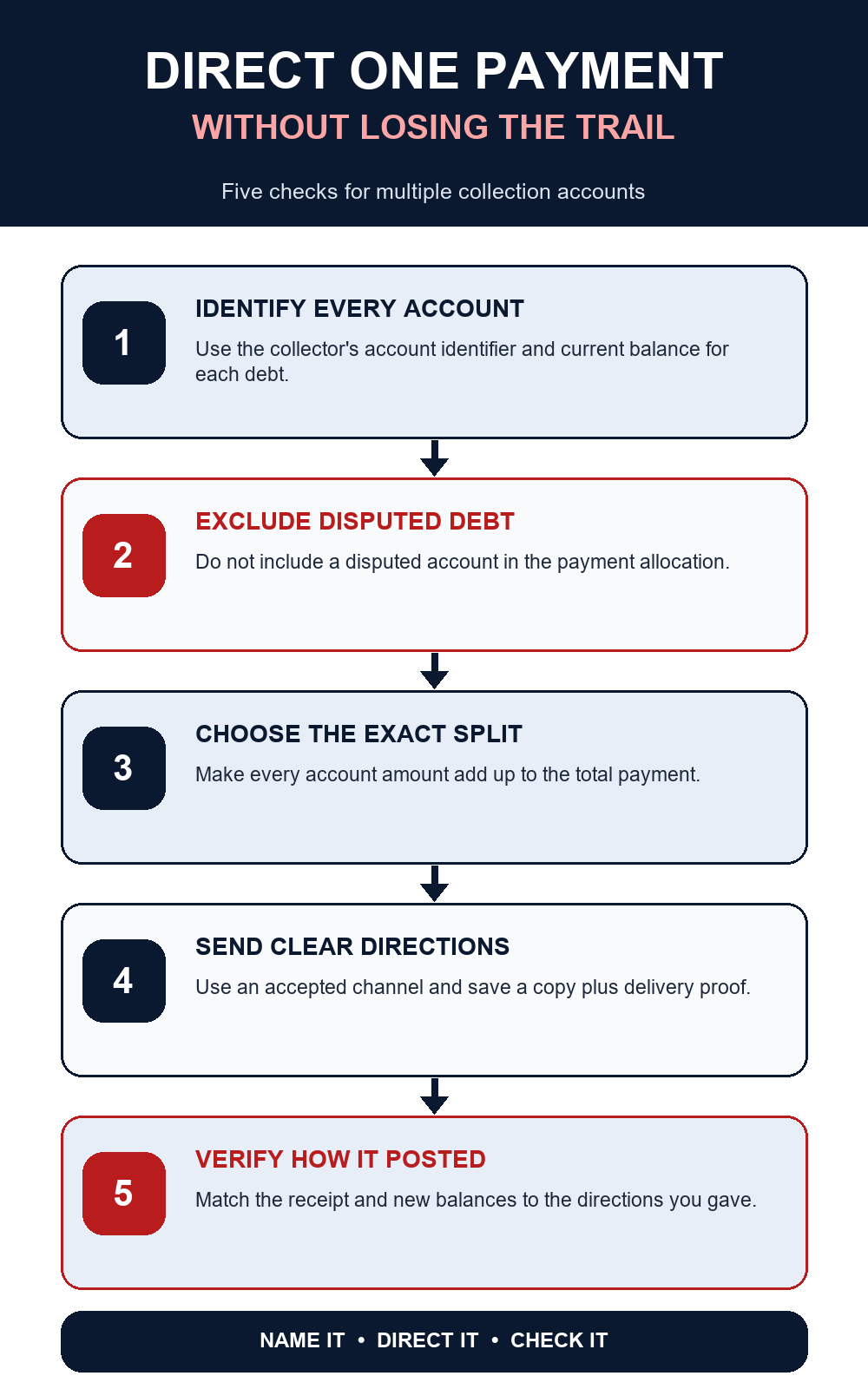
Use the account identifiers on the collector's notices, exclude any disputed debt, send an exact allocation, and verify the posted result.
If one debt is disputed, separate it from the payment plan
The multiple-debt rule says the collector must not apply your single payment to a debt you dispute. A separate rule, Regulation F section 1006.38, provides additional protections for a written dispute submitted within the validation period. In that situation, the collector generally must cease collection of the debt or disputed portion until it sends verification or a copy of a judgment, subject to the rule's details.
That does not mean every disagreement automatically erases a debt. It means you should keep the dispute distinct from any account you have confirmed and chosen to pay. Identify the disputed account clearly in your allocation message and do not describe a payment on another account as payment toward “all accounts.”
If you are still within the validation period, use the response methods listed on the validation notice. The CFPB's current rule recognizes timely written disputes sent by mail, through an electronic channel the collector accepts, or through other listed written methods. Save the notice, your dispute, delivery proof, and the response.
Worked example: the direction can change payoff cost
Consider a hypothetical household with two confirmed collection accounts held by the same collector:
| Hypothetical account | Starting balance | APR used in model | Monthly base amount |
|---|---|---|---|
| Higher-APR collection | $3,600 | 18.00% | $100 |
| Zero-interest collection | $2,400 | 0.00% | $100 |
The household can pay $400 per month: $100 toward each account plus $200 directed to one target. There are no new charges, fees, settlements, missed payments, or rate changes in the model. Debt Freedom Planner applies monthly interest as balance × APR ÷ 12 and rounds to cents.
Two directions produce different projections:
| Direction for the extra $200 | Modeled payoff time | Modeled total interest |
|---|---|---|
| Higher-APR account first | 17 months | $399.20 |
| Zero-interest account first | 20 months | $728.07 |
Directing the extra money to the higher-APR account finishes three months sooner and reduces modeled interest by $328.87. Both paths pay the same $6,000 starting principal. The difference comes from how long the 18% balance remains outstanding.
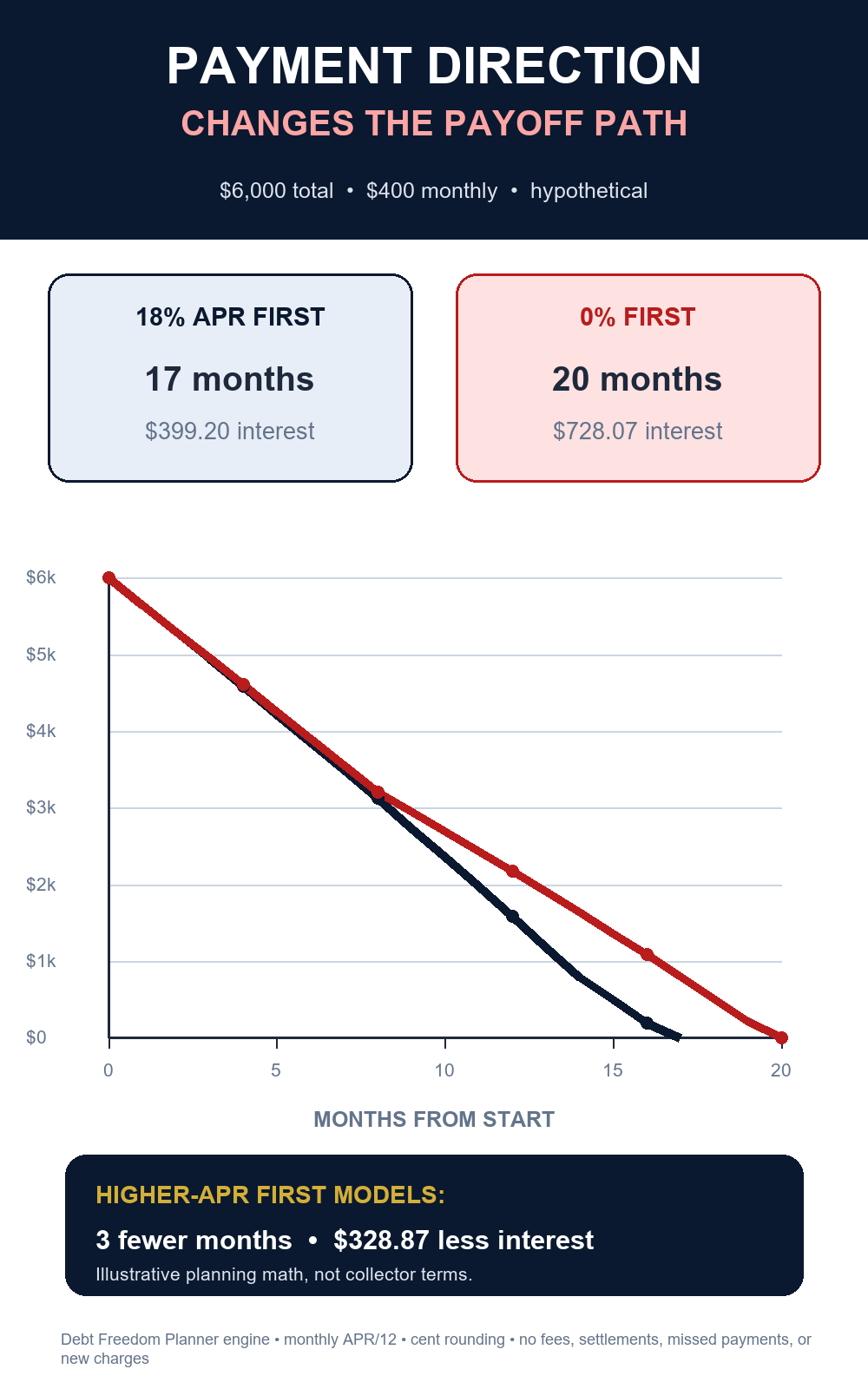
Hypothetical Debt Freedom Planner projection: $6,000 across two confirmed accounts, a $400 monthly budget, monthly APR/12 interest, and no fees, settlements, or new charges. Actual collector terms can differ.
This is planning math, not a prediction of what a collector will accept. A settlement could change the balance, a collector may require a different payment schedule, interest may be governed by the agreement and applicable law, and real posting dates can affect daily interest. Get the repayment terms in writing before treating any projection as your operating plan.
A simple payment-direction message
Use the collector's accepted communication channel and replace the placeholders with the identifiers on your notices. A concise message could say:
For my September 2026 payment of $400, apply $300 to account ending 1234 and $100 to account ending 5678. Do not apply any portion of this payment to any other account. Please confirm the allocation after the payment posts.
If an account is disputed, name it separately:
Account ending 9012 is disputed. Do not apply any portion of this payment to that account. This payment is only for the confirmed accounts and allocations listed above.
Do not use sample wording as a substitute for reading your notice or getting legal help when the amount, ownership, age, lawsuit status, or settlement terms are contested. State law may provide additional rights, and special rules can apply in litigation or bankruptcy.
Check these five things before pressing Pay
- The payee is legitimate. Match the collector's name, payment address, website, and phone number to the validation notice. Avoid paying from an advertisement or an unexpected link.
- The account identifiers are exact. Use the collector's identifier for each debt and show only the minimum digits needed in ordinary correspondence.
- The amounts add up. Your account allocations should equal the payment total. In the example, $300 plus $100 equals the $400 payment.
- The agreement is documented. The CFPB advises getting a repayment or settlement plan and the collector's promises in writing before paying.
- The payment will not destabilize the household. Keep room for housing, food, utilities, transportation, insurance, and a reasonable cushion for surprises.
After the payment posts, compare the collector's receipt or portal balance with your directions. If it was applied differently, contact the collector promptly, attach the written direction, and ask for a correction. Keep the before-and-after balance records together.
Model the direction before you commit
Debt Freedom Planner can help you compare the math without connecting a bank account. Create an account, enter each confirmed debt separately, add the balance, APR, and planned payment, then compare avalanche, snowball, or a custom order. The planner shows a projected debt-free date, modeled interest, and a month-by-month schedule so you can see how a different target changes the path.
Start a Debt Freedom Planner roadmap and use a custom order when you want the model to follow the exact account direction you are considering. The planner does not send payments, negotiate with collectors, validate debts, or decide your legal rights. It helps organize confirmed inputs and compare payoff scenarios.
Bottom line
When one debt collector holds multiple debts, label every account and direct every dollar. Do not let a payment drift onto a disputed debt, and do not assume the collector will choose the order that best reduces your interest. Confirm the debts, document the allocation, verify how the payment posted, and recalculate your plan when balances or terms change.
Debt Freedom Planner provides educational payoff projections, not individualized financial, legal, tax, credit-repair, or bankruptcy advice. Confirm account details and collector terms, review applicable federal and state law, and consult a qualified professional when your situation requires it.
0 comments
Ask a question, add context, or share what worked for your household.
Create a free account or sign in to comment, reply, and vote on blog posts.