

If You Settle a Debt for Less, Will You Get Form 1099-C?
A settlement can trigger Form 1099-C, but the form is not the whole tax answer. Check the canceled amount, exclusions, and written terms before paying.
The short answer: you may receive Form 1099-C after settling a debt for less than the amount owed, especially when an applicable financial institution cancels $600 or more. But the form is not the whole tax answer. Canceled debt is generally taxable unless an exception or exclusion applies, and you may still have a reporting obligation even if no form arrives. Before accepting a settlement, get the terms in writing, identify how much will be canceled, and plan for a tax review as well as the settlement payment.

A settlement decision has two separate questions: what resolves the debt, and how the canceled amount may affect your tax return.
Will every debt settlement produce Form 1099-C?
No. The IRS Form 1099-C page says an applicable financial entity files the form when it cancels $600 or more of a debt and an identifiable event has occurred. Applicable entities include many banks, credit unions, federal agencies, and organizations whose significant trade or business is lending money.
That $600 threshold is a filing rule for the creditor. It is not a rule saying the first $599 of canceled debt is tax-free. IRS Publication 4681 says that, in general, debt forgiven or discharged for less than the full amount owed is canceled debt and is included in income unless an exception or exclusion applies.
The reverse is also important: not receiving a form does not automatically make canceled debt nontaxable. Publication 4681 expressly warns that canceled debt may still need to be reported even when no Form 1099-C arrives.
What should you look for on Form 1099-C?
The form reports an identifiable cancellation event to the IRS. The most important starting points are:
| Form item | What it helps you check |
|---|---|
| Creditor and account information | Whether the form relates to the debt you settled |
| Box 1 | The reported date of the identifiable event |
| Box 2 | The amount of debt the creditor reports as canceled |
| Box 3 | Interest included in box 2, if any |
| Box 6 | The reason code for filing the form |
Do not assume box 2 must equal the simple difference between the last statement balance and your settlement payment. Publication 4681 explains that box 2 can include principal and may include interest, fees, or penalties. Compare the form with the written agreement, the final account statement, and proof of payment.
The IRS canceled-debt topic says to contact the creditor if the form contains incorrect information. It also notes that if the creditor continues trying to collect after issuing the form, the debt may not actually have been canceled. Verify the account status rather than treating the form alone as a paid-in-full letter.
Five checks before you accept a settlement
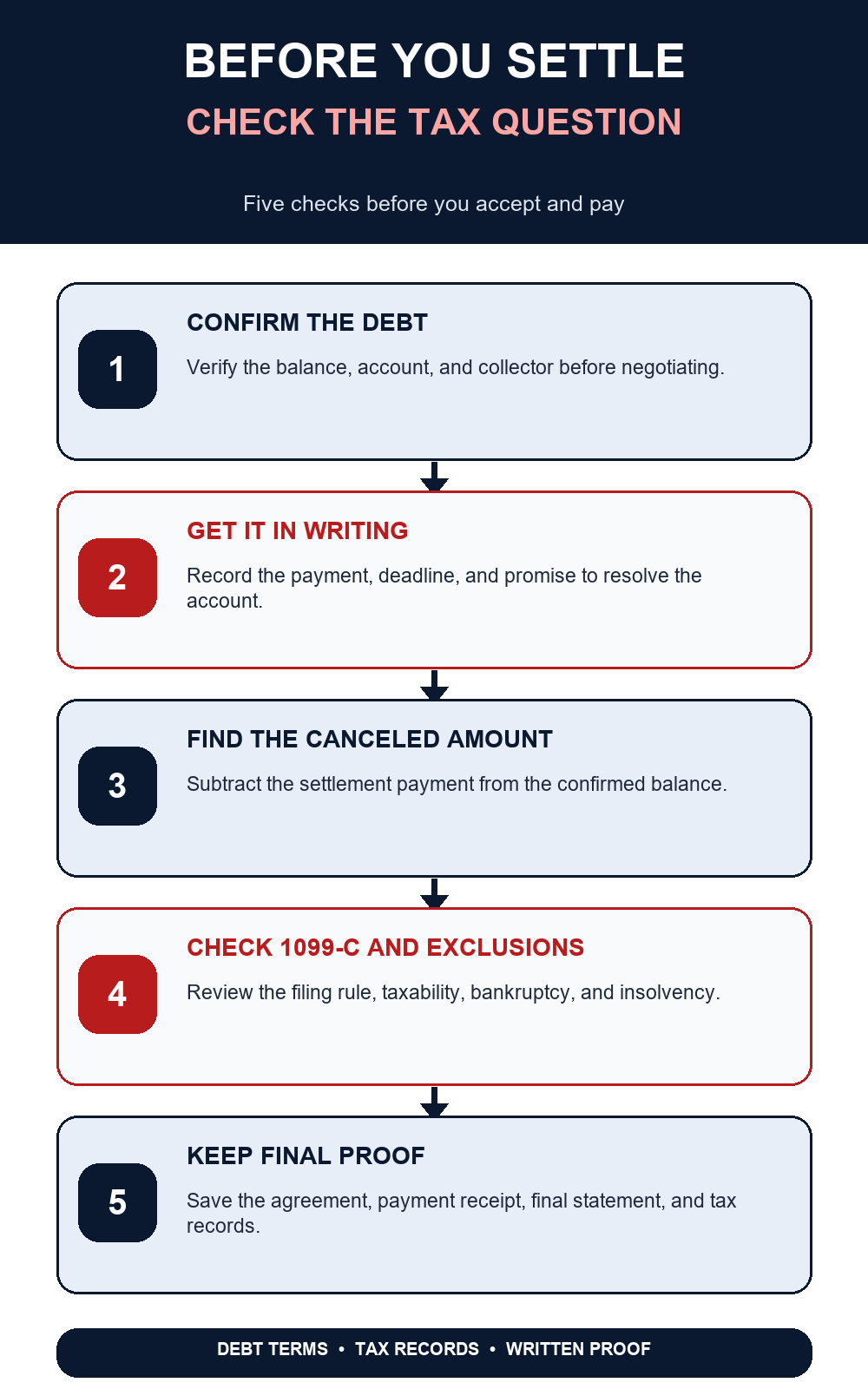
Confirm the debt, document the exact promise, identify the canceled amount, prepare the tax records, and keep final proof.
1. Confirm the debt and the collector
Make sure the balance belongs to you, the collector has authority to collect it, and the amount is supported by account records. If the debt is unfamiliar or disputed, use the validation and dispute process before negotiating payment.
2. Get the complete settlement promise in writing
The Consumer Financial Protection Bureau’s settlement guidance recommends getting the repayment or settlement plan and the collector’s promises in writing before paying. The agreement should identify the account, amount and due date, whether one payment or installments are required, and what happens to the remaining balance after you complete the plan.
Ask for plain language stating whether the payment satisfies the entire account and whether collection efforts will end. Do not rely only on a phone promise or a payment portal showing a discounted button.
3. Calculate the amount that may be canceled
Start with the confirmed balance covered by the agreement and subtract the amount you are required to pay. Then ask the creditor how it expects to report the cancellation, including whether interest or fees are included.
This estimate is a planning input, not a substitute for the form or a tax return calculation. The cancellation date, type of debt, ownership of any collateral, and identity of the creditor can all matter.
4. Check exceptions and exclusions before guessing at tax
Canceled debt is not always taxable. The IRS lists exceptions and exclusions that can apply in specific circumstances, including certain bankruptcy discharges and cancellation to the extent a taxpayer was insolvent immediately before the cancellation.
Insolvency has a specific federal tax meaning: immediately before cancellation, total liabilities exceed the fair market value of total assets. It is not the same as being short on cash that month. Retirement accounts and other assets that creditors might not ordinarily reach can still count in the IRS calculation.
The exclusion is also limited to the amount of insolvency. If $5,000 is canceled but liabilities exceed assets by only $3,500, the insolvency exclusion may cover up to $3,500 rather than automatically covering all $5,000. Other rules and exclusions may change the result.
5. Preserve the records for the tax year
Keep the signed agreement, payment confirmation, final statement, collector correspondence, and any Form 1099-C together. Record the date the debt was actually canceled. If you claim an exclusion, preserve the documents supporting the calculation made immediately before that date.
The IRS Form 982 page explains that Form 982 is used in certain circumstances to determine discharged debt excluded from gross income. Publication 4681 also explains that exclusions can require reductions to tax attributes. That is one reason to get qualified tax help when a large balance, insolvency, bankruptcy, secured property, or a disputed form is involved.
Worked example: a $3,000 settlement on an $8,000 balance
Suppose a household confirms an $8,000 unsecured collection balance and receives a written offer accepting $3,000 to settle the entire account. The simple canceled amount is $5,000.
For a cautious household cash-flow illustration, assume all $5,000 is potentially taxable and use a hypothetical 22% federal marginal rate only to create a reserve target:
- Settlement payment: $3,000
- Canceled amount used as the tax-planning input: $5,000
- Illustrative reserve: $5,000 × 22% = $1,100
- Immediate settlement-plus-reserve target: $4,100
The $1,100 is not a predicted tax bill. Actual federal tax can be higher, lower, or zero depending on the taxpayer’s income, deductions, credits, exceptions, exclusions, filing status, and other facts. State tax treatment can also differ.
If the household was insolvent by $3,500 immediately before cancellation and qualified to exclude that amount, only $1,500 of the example’s canceled debt would remain potentially taxable before considering any other rule. Applying the same rough 22% illustration to $1,500 produces $330, not $1,100. A taxpayer using the insolvency exclusion generally documents it and attaches Form 982; this article cannot determine eligibility.
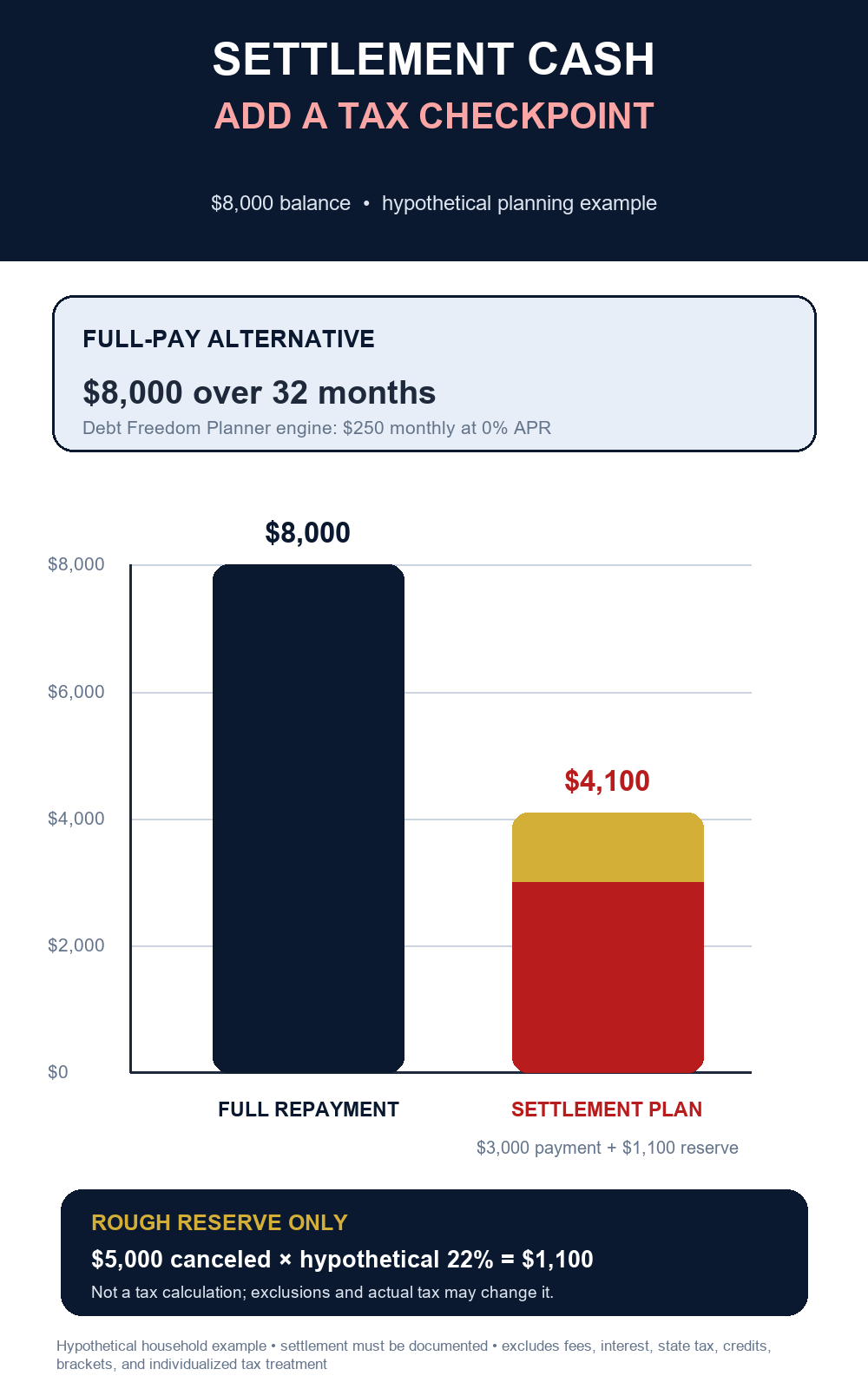
Hypothetical example: a $3,000 settlement plus a $1,100 planning reserve totals $4,100. The reserve is not a tax calculation or guarantee.
For comparison, Debt Freedom Planner’s engine models the same $8,000 as a 0% balance with $250 monthly payments. It takes 32 months and $8,000 total to repay. The 0% assumption deliberately removes interest so the example does not invent collection charges. If the written account terms allow interest or fees, use the confirmed balance and rate instead.
| Hypothetical path | Cash timing | Modeled or planned amount | Important limit |
|---|---|---|---|
| Repay the full balance | $250 monthly for 32 months | $8,000 total | App-engine result at 0% APR; no fees or new charges |
| Accept the settlement | $3,000 by the agreement deadline | $3,000 payment | Only if the written agreement resolves the full account |
| Add a rough tax reserve | Saved separately | $1,100 | Assumes all $5,000 is taxable at a hypothetical 22% rate |
| Settlement plus reserve | Up front or before filing | $4,100 | Planning target, not a guaranteed final cost |
The settlement path uses less cash in this illustration, but it also requires $3,000 quickly and creates tax, documentation, credit-reporting, and legal questions the payoff engine cannot decide. A full-payment plan spreads cash over time but may remain subject to collection terms, interest, or litigation risk. Compare only offers and payment plans you have verified in writing.
How to use Debt Freedom Planner after the terms are confirmed
Debt Freedom Planner can help with the household cash-flow side of the decision. Enter the confirmed balance, APR, minimum payment, and any extra amount available. Compare how a full-payment path fits beside credit cards, auto loans, medical bills, and other debts. If a settlement will be paid in installments, model the promised remaining balance and required payment—not the original balance as though it still exists after a completed settlement.
Start a Debt Freedom Planner roadmap when you have the written terms and want to compare the monthly payoff path with your other debts.
The planner does not negotiate a settlement, validate a collector, determine whether canceled debt is taxable, calculate an insolvency exclusion, prepare Form 982, predict a credit-score change, or file a tax return. Keep the settlement decision and the tax decision connected, but use the right source for each one.
Bottom line
A debt settlement can lead to Form 1099-C when an applicable entity cancels $600 or more, but the form threshold does not decide whether the canceled amount is taxable. Before paying, confirm the debt, get the entire settlement promise in writing, estimate the canceled amount, preserve every record, and review the IRS exceptions and exclusions. Then plan for both the settlement cash and a careful tax review instead of letting the next filing season become a surprise.
This article provides general educational information, not individualized financial, legal, tax, accounting, credit-reporting, or debt-collection advice. Tax and collection rules depend on specific facts and can change. Verify current requirements with the IRS, the written settlement documents, and a qualified professional before acting.
0 comments
Ask a question, add context, or share what worked for your household.
Create a free account or sign in to comment, reply, and vote on blog posts.