

Debt Collector Has a Postdated Check? Know the Warning Rule Before Deposit
A covered debt collector may need to warn you in writing before depositing a postdated check—and it cannot deposit early. Here is how to protect your cash flow.
If a covered debt collector accepts a check or other payment instrument dated more than five days in the future, federal Regulation F says the collector must give you written notice of its intent to deposit it no more than 10 and no less than three business days before the deposit. A debt collector also may not deposit—or threaten to deposit—a postdated payment before the date written on it. That protection matters, but it does not guarantee your bank will reject an early-presented check, and it does not erase a valid debt.
The safest response is practical: verify the collector and debt, get every payment term in writing, confirm the planned deposit date, ask what notice will be sent, and monitor the bank account. If the timing no longer works, contact both the collector and your bank promptly instead of assuming the date on the check controls every part of the payment system.

A date on a payment instrument is only one control point; confirm the collector's notice and your bank's process too.
The postdated-check rule in plain English
The current text of Regulation F, section 1006.22(c) separates three protections:
| Situation | Federal rule for a covered debt collector |
|---|---|
| The collector accepts a payment instrument postdated by more than five days | It must send written notice of its intent to deposit the instrument between 10 and three business days before deposit. Saturdays, Sundays, and federal legal public holidays are excluded when counting that window. |
| The collector asks for a postdated instrument to threaten or start criminal prosecution | That solicitation is prohibited. |
| The collector deposits or threatens to deposit the instrument before its date | That is prohibited, regardless of the special written-notice window above. |
The timing distinction is easy to miss. The three-to-10-business-day written notice requirement is tied to an instrument postdated by more than five days. The separate ban on depositing before the written date is broader.
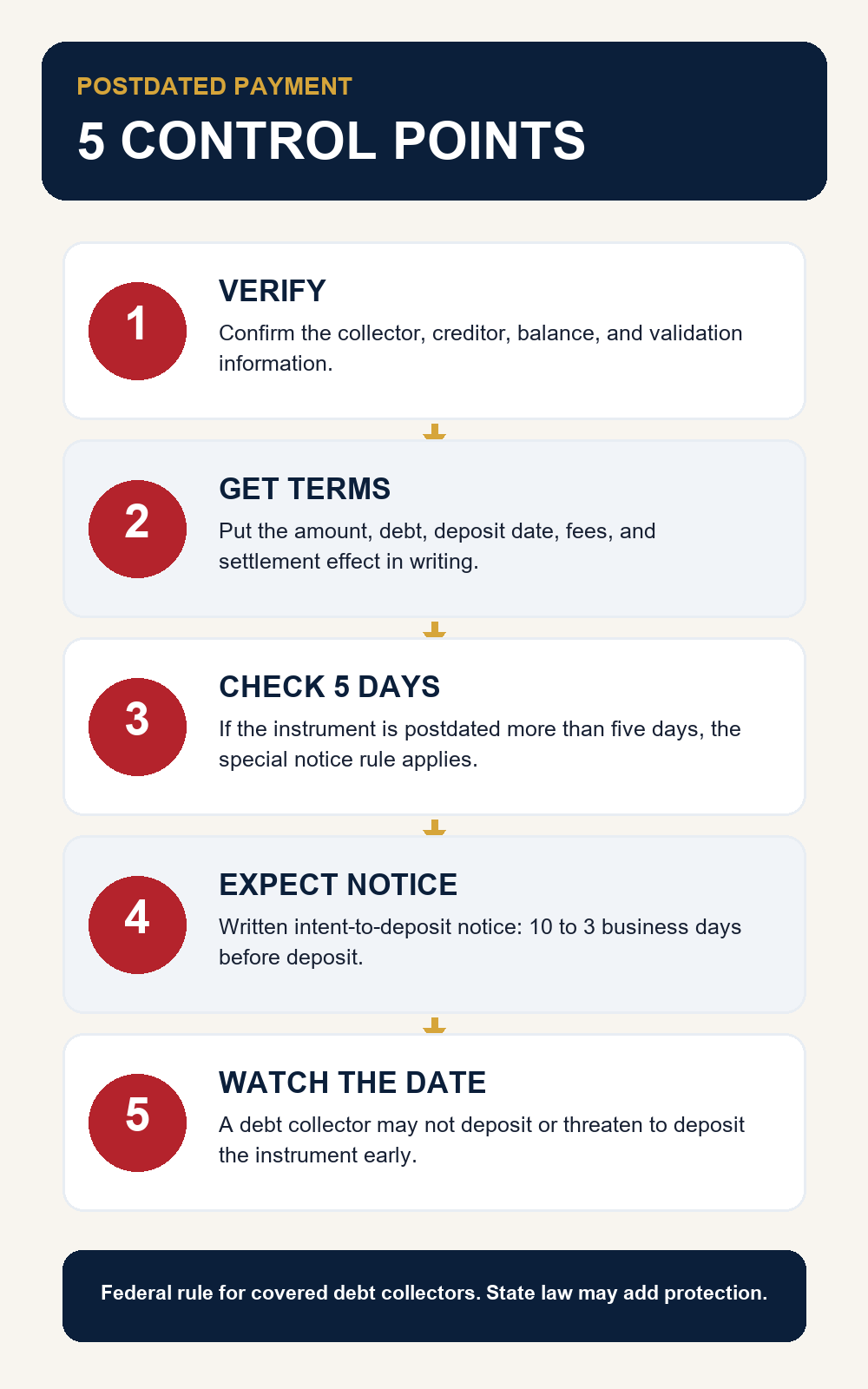
The rule creates a notice window, but your safest process starts before you hand over a payment instrument.
First confirm that the rule fits the collector
Regulation F implements the federal Fair Debt Collection Practices Act. Its debt-collector rules generally cover people or companies whose principal purpose is collecting debts or who regularly collect debts owed to someone else. The CFPB explains that collection agencies, collection lawyers, and many debt buyers can fit that description.
An original creditor collecting its own account may not fit the federal definition in the same way, although state law can provide additional or broader protection. Do not assume the label on a letter settles the question. Record the company name, mailing address, phone number, original creditor, current creditor, account reference, and the amount it claims you owe.
Before giving payment information, use a known official number or website to verify the company. The CFPB recommends using the collector's validation information to determine whether the debt is legitimate and yours. It also warns against giving sensitive financial information until you have confirmed the collector is legitimate.
Get the payment agreement and deposit date in writing
A postdated check should not stand in for a complete payment agreement. Ask for a written document that states:
- the debt and account the payment will be applied to;
- the exact amount of the payment;
- the date the collector intends to deposit or process it;
- whether this is one payment or part of a series;
- whether interest or fees continue to accrue;
- what the payment changes—if anything—about collection activity; and
- whether the arrangement settles the account, satisfies one installment, or merely reduces the balance.
If the collector is handling multiple debts, identify the specific debt to which the payment applies. Keep the agreement, validation notice, check image, envelope, emails, and notes from each call. The CFPB advises keeping copies of letters and other collector communications.
Do not write a full bank account number into your notes or payoff planner. Debt Freedom Planner is designed for balances, APRs, minimum payments, and payoff scenarios—not bank credentials or account numbers.
A worked example: a check dated 20 days ahead
Suppose a household has verified a $4,800 collection balance. For planning only, assume the agreement allows 8.00% APR, no new fees, and a $250 monthly payment. The collector asks on September 7 for a payment instrument dated September 27—20 days later.
Because the instrument is dated more than five days ahead, a covered debt collector that accepts it must give written notice of its intent to deposit within the federal three-to-10-business-day window. The household should not count weekends or federal legal public holidays when checking that window. The collector still may not deposit it before September 27.
Now add the banking reality: the CFPB says banks and credit unions generally do not have to wait for the date written on a postdated check. State law may require the institution to wait if you notify it properly, and the CFPB says a written notice may remain valid longer than an oral notice. Contact your bank or credit union directly for its policy and any state-law process. Ask about deadlines, fees, and whether a stop-payment request is appropriate; do not assume it is free or that it changes the underlying debt.
That apparent conflict is exactly why the date alone is not a cash-flow plan. The collector has obligations, while the bank may process an item presented through its own system. You need to manage both sides.
Model the payment before authorizing it
Using Debt Freedom Planner's payoff engine, the hypothetical $4,800 balance at 8.00% APR produces these planning estimates:
| Monthly payment | Modeled payoff time | Modeled interest | Modeled total paid |
|---|---|---|---|
| $250 | 21 months | $353.53 | $5,153.53 |
| $325 | 16 months | $270.14 | $5,070.14 |
The extra $75 shortens the model by five months and reduces modeled interest by $83.39. But that faster amount is useful only if the household can keep enough money in the bank on the actual processing date. An aggressive promise that triggers an overdraft, returned-payment fee, or missed essential bill is not a stronger plan.
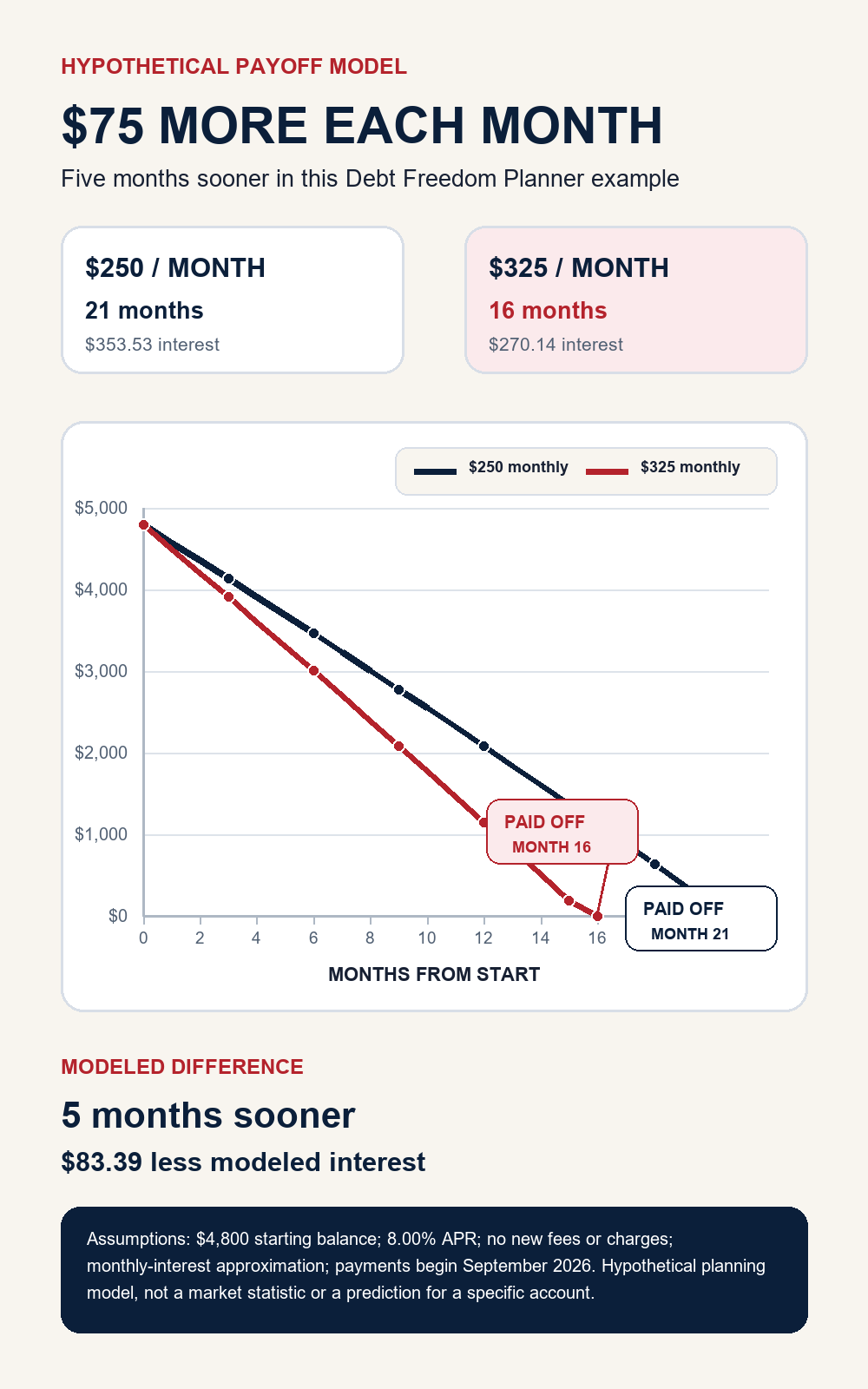
Hypothetical Debt Freedom Planner model: $4,800 starting balance, assumed 8.00% APR, no new fees or charges, monthly interest approximation, and payments of $250 or $325.
Real collection accounts may calculate interest differently, stop interest under an agreement, add only contract- or law-authorized charges, or use settlement terms that do not match a standard amortization model. Confirm the actual written terms and replace the assumptions whenever your documents provide better numbers.
What to do if the collector deposits early
If an item appears before its written date, move quickly and document facts rather than arguing from memory:
- Save a screenshot or statement showing the processing date and amount.
- Save the front and back image of the item if your bank provides it.
- Contact the bank or credit union and ask how it handled your postdated-check notice, if you gave one.
- Contact the collector in writing and identify the instrument, written date, and actual processing date.
- Preserve the collector's deposit notice—or note that you did not receive one.
- Ask about reversing any bank or collector fee caused by the early processing.
- If the issue is not corrected, consider a complaint to the CFPB, FTC, or your state attorney general.
The FTC's current debt-collection guidance plainly lists depositing a postdated check early as an unfair practice. State rules may add remedies or cover more types of collectors, so a local consumer-law attorney or legal-aid organization can help with an individual dispute.
An early deposit does not automatically prove the debt itself is invalid. Keep the payment-processing dispute separate from questions about the amount owed, ownership of the account, settlement terms, and credit reporting.
A safer payment checklist
Before sending any postdated instrument, pause and confirm:
- Identity: You independently verified the collector and the debt.
- Coverage: You understand whether the company is a debt collector under federal law and whether state law adds protection.
- Terms: The amount, deposit date, debt application, fees, interest, and settlement effect are written down.
- Notice: If the instrument is dated more than five days ahead, you know when the written intent-to-deposit notice should arrive.
- Cash flow: The account can cover the payment even if another bill posts first.
- Bank process: You asked the bank how it handles postdated checks and advance notices.
- Records: You saved the check image, agreement, notices, and communication log.
- Backup: You know whom to contact if the payment is processed on the wrong date.
If a collector refuses to provide basic terms in writing, pressures you to pay immediately, or asks for unusual payment methods, slow down. Verify before sending money or account information.
Turn the agreement into a payoff roadmap
Once the balance, interest rate, and monthly amount are verified, try those numbers in Debt Freedom Planner. You can compare snowball, avalanche, or a custom order; see the projected payoff date and interest; and review a month-by-month schedule without connecting a bank account.
Use the planner as a cash-flow and payoff model, not as proof of a collector's legal rights or your bank's processing rules. Put the real deposit date on your household calendar, keep the required money available, and update the plan if the written agreement changes.
Educational information only: This article provides general educational information, not individualized financial, legal, tax, credit-repair, or bankruptcy advice. Debt-collection coverage, check law, fees, and remedies can vary by collector, agreement, bank policy, and state. Review your documents and consult a qualified professional about your specific situation.
0 comments
Ask a question, add context, or share what worked for your household.
Create a free account or sign in to comment, reply, and vote on blog posts.