

Before You Sign an Auto Loan, Check These Dealer Fees and Add-Ons
Get the written out-the-door price, identify every optional add-on, and see how $3,000 financed at 8.5% can become $3,825.85 of repayment.
Before you sign an auto loan, get the written out-the-door price, identify every fee and optional add-on, and make sure the final amount financed matches what you agreed to buy. A small product or fee can become a much larger cost when it is rolled into a long loan and earns interest for years.
That check matters now. On August 19, 2026, the Federal Trade Commission and Connecticut announced a $4 million settlement resolving allegations that one dealership double-charged some buyers for certified vehicles and inserted other charges without informed consent. The case does not mean every dealer fee is improper. It is a useful reminder to compare the advertisement, written price, add-on choices, and financing contract line by line.

Original editorial artwork created for Debt Freedom Planner. The paperwork is intentionally blank and does not depict a real account or dealer.
Start with the out-the-door price, not the monthly payment
The monthly payment can hide two different decisions: what the vehicle and extras cost and what borrowing that amount will cost.
The FTC recommends getting an out-the-door price in writing before visiting the lot and before discussing dealer financing. That total lets you compare offers using the same basic number and makes surprise charges easier to spot. Ask the dealer to show:
- the vehicle selling price;
- taxes, title, registration, and other required government charges;
- each dealer fee and what it covers;
- every optional product or service;
- the trade-in credit and any old-loan balance being rolled forward; and
- the final amount you would finance after any down payment.
Do not negotiate only around “What payment can you afford?” A longer term can reduce the payment while increasing the time you remain in debt and the interest you pay. The FTC’s dealer-ad guidance recommends confirming the written total price so you can compare offers and spot unwanted add-ons before signing.
Which fees and add-ons deserve a closer look?
Some charges are required by government, while others are dealer charges or optional products. Names and rules vary, so ask for a plain-language explanation instead of assuming a label tells the whole story.
The CFPB says the dealership’s finance and insurance department commonly handles financing and sells products such as extended warranties. Its F&I guidance notes that optional add-ons increase the amount borrowed and that buyers can compare dealer financing with direct offers from banks or credit unions.
Common items to review include:
- document, preparation, delivery, reconditioning, certification, or market-adjustment fees;
- extended warranties or service contracts;
- GAP products;
- credit insurance or debt-cancellation products;
- tire, wheel, paint, fabric, theft, or maintenance packages; and
- accessories or protection products installed by the dealer.
The CFPB’s auto-loan negotiation guide says many add-ons are optional and negotiable, while taxes, title, and registration charges set by government generally are not. If a product is presented as required for financing, ask where the contract says that and verify the requirement with the lender. CFPB guidance says GAP, extended warranties, and credit insurance are generally optional.
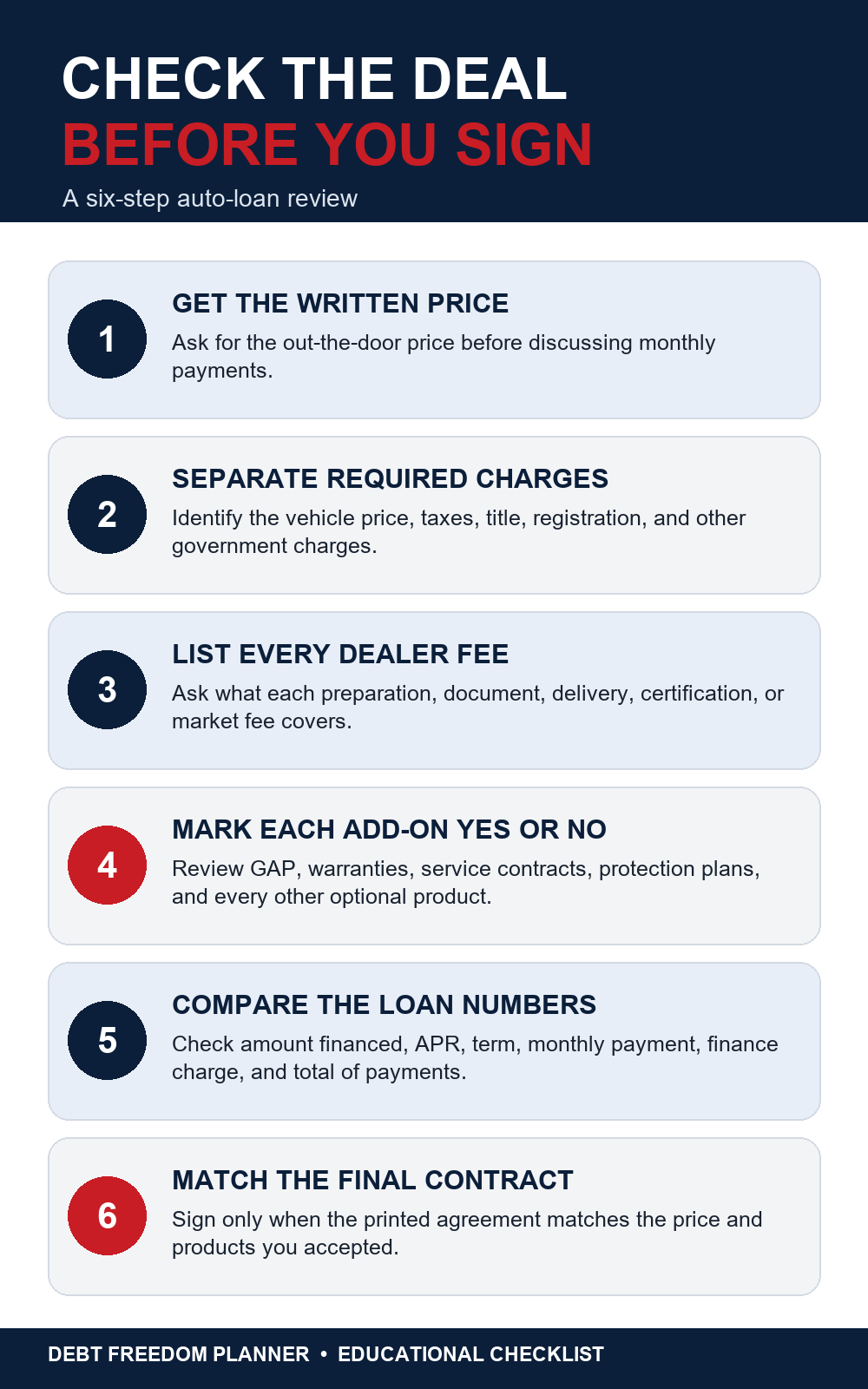
Use this checklist before signing. It separates the purchase price from the financing terms so an acceptable payment does not hide an unwanted product or charge.
Read the final financing agreement as a second price tag
Once the purchase total is clear, compare the loan itself. Look for these figures in the final documents:
| Loan figure | What to verify |
|---|---|
| Amount financed | Does it equal the agreed price after down payment and trade-in math? |
| APR | Does it match the financing offer you accepted? |
| Term | How many monthly payments will you make? |
| Monthly payment | Does it match the contract—not just a spoken estimate? |
| Finance charge | How much does the credit cost over the scheduled term? |
| Total of payments | What will all scheduled payments add up to? |
| Optional products | Are only the products you knowingly accepted included? |
The CFPB explains that an auto-loan payment includes principal, interest, and agreed optional add-ons. If the payment or products do not match the agreement, stop and ask for a corrected printed contract before signing. Keep the advertisement, written out-the-door quote, buyer’s order, financing agreement, and product contracts.
Worked example: what a $3,000 add-on package can cost
Suppose a household is considering a vehicle with $28,000 financed after required charges. A proposed package adds $3,000 of optional products, raising the amount financed to $31,000. Both scenarios use an 8.50% APR.
To create comparable 72-month planning schedules in Debt Freedom Planner, the example uses a $500 monthly payment without the add-ons and $554 with them.
| Hypothetical result | Without add-ons | With $3,000 financed add-ons | Difference |
|---|---|---|---|
| Starting balance | $28,000.00 | $31,000.00 | $3,000.00 |
| Modeled monthly payment | $500.00 | $554.00 | $54.00 |
| Payoff time | 72 months | 72 months | — |
| Modeled interest | $7,793.82 | $8,619.67 | $825.85 |
| Modeled total paid | $35,793.82 | $39,619.67 | $3,825.85 |
The optional products add $3,000 to principal, but the modeled total repayment rises by $3,825.85 because that extra principal also accrues $825.85 of interest. The graph shows the two remaining-balance paths.
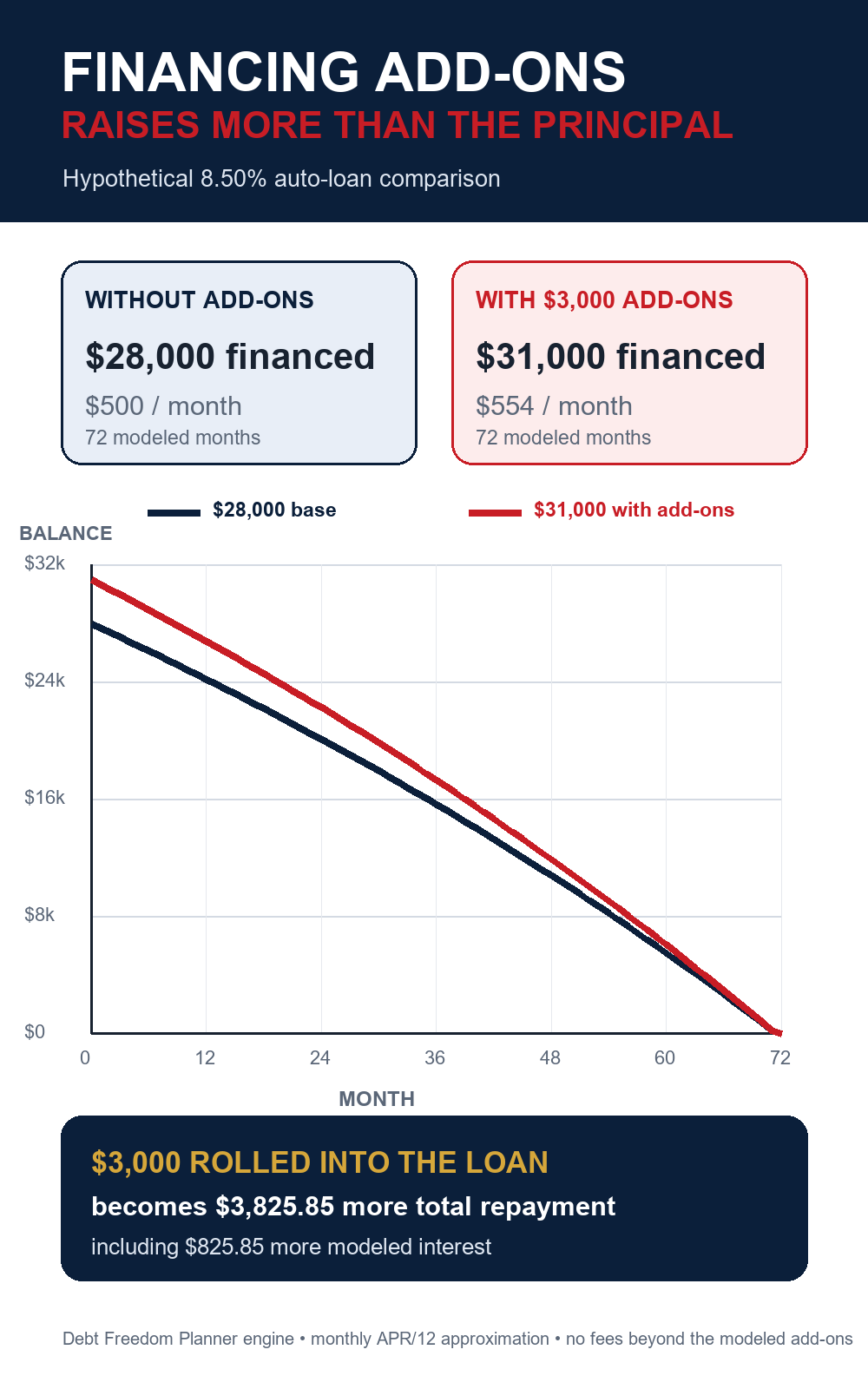
Hypothetical Debt Freedom Planner engine output: 8.50% APR, monthly interest approximated as balance × APR ÷ 12, and no fees beyond the $3,000 modeled add-ons. Actual auto loans may use daily simple interest, different payment timing, or other contract terms.
What if you already signed and find an add-on you did not expect?
Start with the paperwork. Compare the buyer’s order, retail installment contract, product agreement, and lender statement. Write down the charge, why you believe it was not authorized, and the resolution you want.
Then:
- Contact the dealer and lender using the information on your documents.
- Ask whether the product can be canceled and how any refund would be calculated and applied.
- Request the answer and any revised balance in writing.
- Keep making required payments unless the lender gives different written instructions; a dispute does not automatically pause the loan.
- If the issue is not resolved, consider the complaint options identified by the CFPB and FTC, as well as your state attorney general or consumer-protection office.
Cancellation and refund rights can depend on the product, contract, state law, and timing. Debt Freedom Planner cannot determine whether a charge was authorized or calculate a legal refund.
Put the verified loan—not the sales pitch—into your payoff plan
After the final contract is correct, enter the amount financed, APR, and scheduled monthly payment into Debt Freedom Planner. Then compare the plan with a realistic extra payment and see how the modeled payoff date and interest change.
Try Debt Freedom Planner with your verified loan numbers. The planner is useful for modeling the debt you actually accepted; it is not a substitute for reading the sales and financing contracts first.
Bottom line
The safest sequence is simple: get the written out-the-door price, say yes or no to every add-on, confirm the amount financed, and then review APR, term, finance charge, and total payments. A few minutes spent matching those numbers can prevent years of paying interest on something you never meant to buy.
Debt Freedom Planner provides educational payoff projections, not individualized financial, legal, tax, credit, or consumer-protection advice. Contract rights and dealer rules vary by product and state; consult the appropriate professional or agency for guidance about your situation.
0 comments
Ask a question, add context, or share what worked for your household.
Create a free account or sign in to comment, reply, and vote on blog posts.