

How Does an Auto Loan Payment Extension Change Your Payoff Date and Total Interest?
A payment extension can ease short-term cash flow while interest keeps growing and the payoff date moves. See the written terms to request and a worked $18,000 example.
An auto-loan payment extension can create short-term breathing room, but it usually does not erase the skipped payment. Interest may keep accruing, the deferred amount may move to the end of the loan, and your payoff date can move farther out. Before accepting an extension, get the exact terms in writing and ask what you must pay during the pause, how interest is handled, whether there is a fee, and what the new final-payment date will be.

A payment extension is a trade: temporary cash-flow relief now in exchange for a changed loan schedule that may cost more later.
The quick answer: expect the date and cost to change
For many simple-interest auto loans, a one- or two-month extension works roughly like this:
- one or more scheduled payments are postponed;
- interest continues to build on the unpaid balance;
- the regular payment resumes after the extension; and
- extra payment time, a larger final payment, or both may be needed.
That is a general pattern, not a promise about your contract. The Consumer Financial Protection Bureau says payment-extension plans vary by lender. Some lenders may defer an entire payment, while others may still require interest during the extension. Eligibility, fees, credit reporting, and the treatment of add-on products can also differ.
If you know a payment will be difficult, contact the lender or servicer before the due date. The CFPB recommends asking about available options as soon as possible and getting the agreement in writing.
An extension, a due-date change, and a payment plan are different
The words are sometimes used loosely, so ask the representative to describe the actual transaction.
| Option | What it may do | Question to ask |
|---|---|---|
| Due-date change | Moves the monthly due date to better match cash flow | How many extra days of interest will accrue? |
| Catch-up payment plan | Spreads past-due amounts across future payments | Will the normal payment increase, and for how long? |
| Payment extension or deferral | Pushes one or more payments to a later time | What is postponed: principal, interest, fees, or the full payment? |
| Refinance | Replaces the loan with a new loan and term | What are the new APR, fees, payment, and total cost? |
A due-date change may solve a paycheck-timing problem without creating a full two-month pause. A payment plan may be more relevant after a missed payment. An extension is usually aimed at a temporary hardship, while refinancing creates a new credit agreement. Do not assume that one label guarantees one set of terms.
Seven questions to ask before saying yes
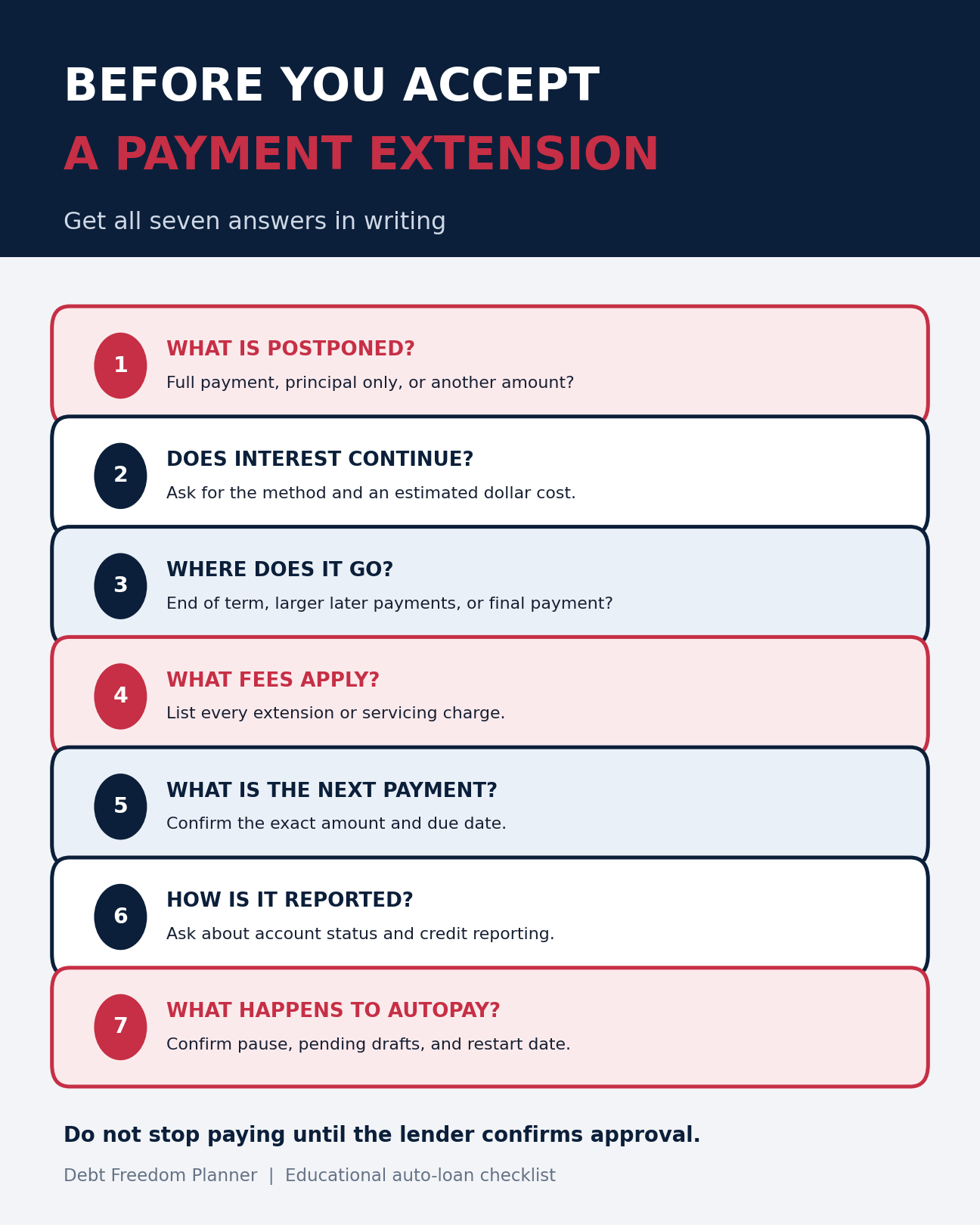
Use the written answers—not the word “extension”—to understand how the offer changes your loan.
1. What exactly is being postponed?
Ask whether the lender is deferring the full payment, only principal, or a specific dollar amount. A regular auto-loan payment can include principal, interest, and optional add-ons under the purchase contract, according to the CFPB's breakdown of monthly auto-loan payments.
2. Does interest continue to accrue?
Ask for the accrual method and an estimated dollar amount. Many auto loans use simple interest calculated daily on the outstanding balance, so a longer gap between payments can increase the interest due. Your contract controls.
3. Where do the postponed amounts go?
They may be added to the end of the schedule, spread across later payments, or handled through a larger final payment. Ask for the revised maturity date and an updated payment schedule.
4. Is there an extension fee or other charge?
Request every fee in writing. A small fee may not look important beside the monthly payment, but it still belongs in the total-cost comparison.
5. Will the regular payment change afterward?
Some arrangements keep the same monthly payment and add time. Others change later payments or create a final balloon-like amount. Ask for the exact next payment amount and date.
6. How will the account be reported?
Ask how the approved extension will be reported to consumer reporting companies and what happens if the request is still pending when the current payment comes due. Do not treat a phone request as approval.
7. What happens to automatic payments?
Confirm whether autopay will pause automatically, whether you must cancel a scheduled draft, and when it will restart. Avoid creating an overdraft by guessing.
Worked example: a two-month extension on an $18,000 balance
Assume a hypothetical borrower has:
- an $18,000 remaining auto-loan balance;
- an 8.50% APR;
- a fixed $400 monthly payment;
- no extension fee, late fee, new charge, or add-on change; and
- a two-month full-payment extension beginning in September 2026.
For transparency, this illustration uses the Debt Freedom Planner engine's monthly approximation: APR divided by 12, applied to the starting balance and rounded to cents. That is useful for comparing scenarios, but it is not a lender payoff quote. A real simple-interest auto loan may accrue interest daily, so exact results depend on payment dates, day count, contract terms, and rounding.
Without an extension, the app engine projects:
- 55 months to payoff;
- a payoff month of March 2031; and
- $3,751.89 in modeled interest.
During the hypothetical pause, the model adds $127.50 of interest in month one and $128.40 in month two. The balance before regular payments resume becomes $18,255.90.
If the borrower then resumes the same $400 payment, the model projects 56 more payment months and a payoff in June 2031. Counting the two paused months, the total timeline becomes 58 calendar months, or three months later than the no-extension scenario. Total modeled interest becomes $4,130.05—an increase of $378.16.
| Hypothetical path | Calendar months from start | Modeled payoff month | Modeled interest |
|---|---|---|---|
| No extension; pay $400 | 55 | March 2031 | $3,751.89 |
| Pause 2 months; resume $400 | 58 | June 2031 | $4,130.05 |
| Difference | 3 later | 3 months later | $378.16 more |
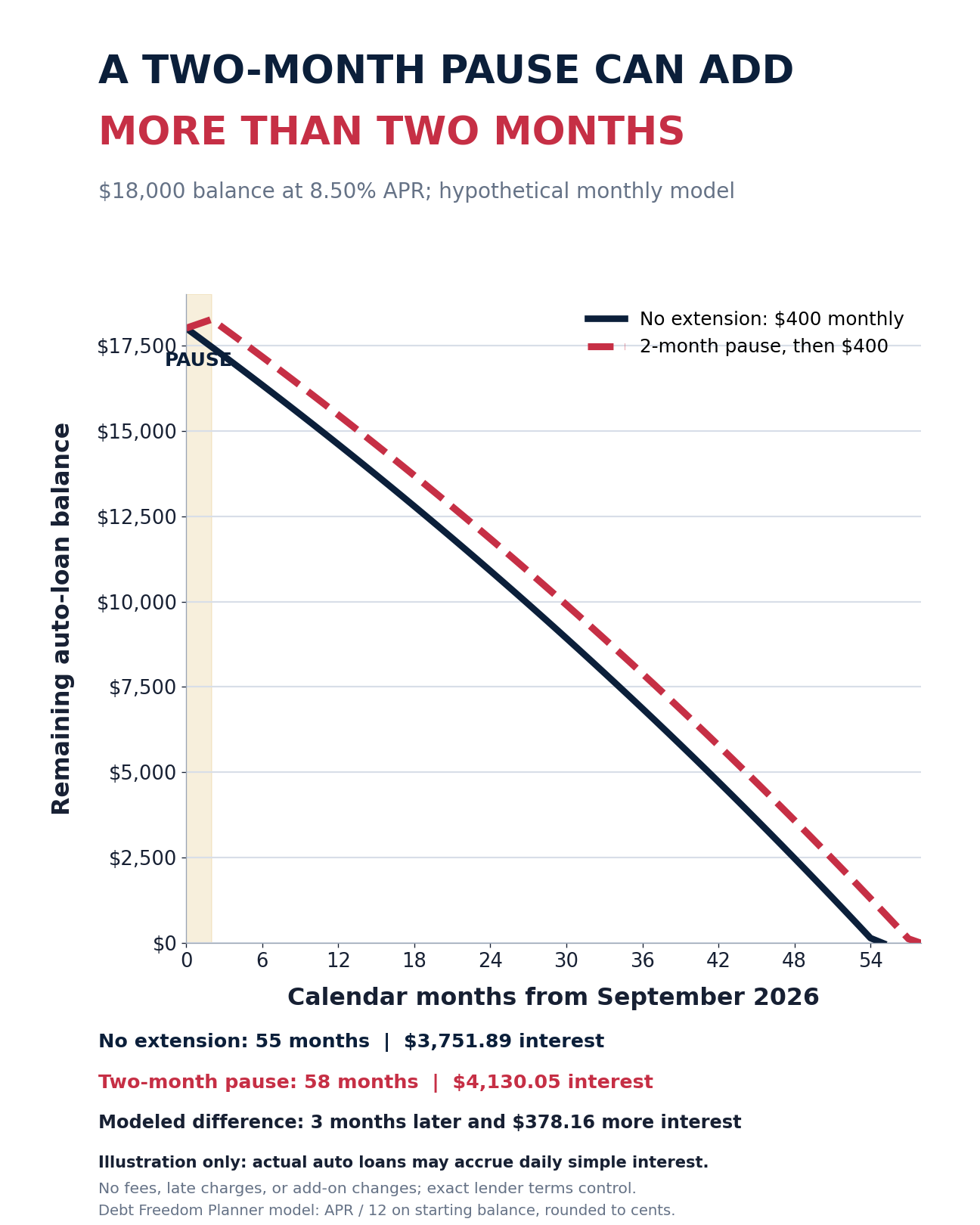
Hypothetical monthly model: $18,000 at 8.50% APR. The two-month pause assumes no payment and continuing interest, then the same $400 payment resumes. Actual lender calculations may use daily simple interest and different extension terms.
Why two skipped payments can add three months
The extension moves two payment opportunities out of the schedule. It also leaves the balance higher when repayment resumes because interest built during the pause. With the same $400 payment, that larger balance can require an additional payment month beyond the two deferred months.
The exact result could be smaller or larger. An extension later in the loan may add less interest because the balance is lower. A higher APR, higher balance, longer extension, fee, or principal-only deferral can change the result. Some contracts may produce a larger final payment rather than the neat month count shown here.
Should you take the extension?
An extension can be reasonable when it prevents an unaffordable immediate payment during a truly temporary hardship and the written terms are clearer and safer than falling behind without an agreement. It is not free money, and it does not fix a monthly payment that is permanently unaffordable.
Before deciding, compare:
- the cash you need for housing, food, utilities, insurance, medicine, and transportation;
- the extension's fees and added interest;
- the risk and cost of missing a payment without an agreement;
- a due-date change or short catch-up plan;
- whether the vehicle remains affordable after the temporary hardship; and
- whether another debt payment can be reduced safely without missing a required minimum.
If the lender denies the request or the terms are unclear, keep records of calls and messages. Do not stop paying merely because an application is under review. If you cannot resolve a servicing problem, the CFPB page above explains how to submit a complaint.
Rebuild your payoff plan after the lender confirms the terms
Once you have the written agreement, update the numbers—not just the label. Record the new balance, APR, required payment, next due date, any fee, and the revised maturity date. Then compare the old path with the new one.
You can start a Debt Freedom Planner roadmap using the confirmed balance, APR, required monthly payment, and any sustainable extra amount. The planner can estimate a new payoff date and interest total using its monthly model, and it can compare snowball, avalanche, and custom-order scenarios across the rest of your debts.
Debt Freedom Planner does not approve extensions, read your contract, predict credit reporting, or replace the lender's payoff statement. Use it to understand the household tradeoff after the lender gives you the real terms.
Bottom line
An auto-loan payment extension may protect short-term cash flow, but the postponed payment usually has to be dealt with later. Interest can keep growing, the balance can be higher when payments resume, and the final payoff date can move by more than the number of skipped payments. Get the offer in writing, verify exactly what is deferred, and compare the revised schedule before you agree.
This article is for educational information only and is not individualized financial, legal, credit, or tax advice. Auto-loan contracts, lender programs, state laws, credit reporting, fees, and hardship circumstances vary. Review the written agreement and contact the lender or a qualified professional for account-specific guidance.
0 comments
Ask a question, add context, or share what worked for your household.
Create a free account or sign in to comment, reply, and vote on blog posts.