

Should You Change Bill Due Dates to Match Your Paychecks Before Starting a Debt Payoff Plan?
Changing due dates can smooth paycheck timing, but it does not lower your balance or APR. Use this five-step test before moving a bill.
Yes—changing some bill due dates to fall shortly after your paychecks can make a debt payoff plan easier to execute when the problem is timing rather than a true monthly shortfall. It can create more breathing room between deposits, reduce the chance that an automatic payment hits an underfunded account, and make your extra debt payment easier to protect. But a new due date does not reduce your balance, APR, minimum payment, or total monthly bills. Map the month first, ask each biller what the transition will do to the next statement, and keep paying the date currently shown until the change is confirmed.

A household calendar can reveal a timing problem that a monthly total hides. The dates and balances in this article are hypothetical.
The short answer: move the dates only if cash arrives at the wrong time
The Consumer Financial Protection Bureau's research on paying bills says aligning bill due dates with income flow may help some consumers manage cash flow. Its due-date-change worksheet starts with the sensible sequence: organize every bill, map income and outflows, then decide whether a request would help.
A due-date change is a good candidate when all three statements are true:
- Your reliable monthly income is enough to cover your normal expenses, minimum debt payments, and planned extra payment.
- Several large bills are clustered before the paycheck intended to cover them.
- The biller confirms a new date, the effective month, the next amount due, and any transition cost.
It is not a complete solution when the monthly math is negative. If your reliable take-home pay is less than essential spending plus required payments, moving dates only relocates the shortage. Contact the creditor or servicer before missing a payment and ask about available hardship or payment options.
What changing a due date can—and cannot—do
| A due-date change may help you… | It does not automatically… |
|---|---|
| Put a payment after the paycheck meant to fund it | Lower the balance or interest rate |
| Separate several large withdrawals | Reduce the required minimum payment |
| Make the checking-account cushion easier to see | Erase an existing late payment or fee |
| Protect a planned extra debt payment from timing surprises | Guarantee that the biller will approve your request |
| Simplify reminders and automatic-payment monitoring | Make an unaffordable monthly plan affordable |
For credit cards, the current Regulation Z interpretation for periodic statements allows a creditor to adjust a due date, including honoring a consumer request, as long as the new due date remains the same numerical date each month on an ongoing basis. That is not a promise that every issuer or every type of bill must offer your preferred date.
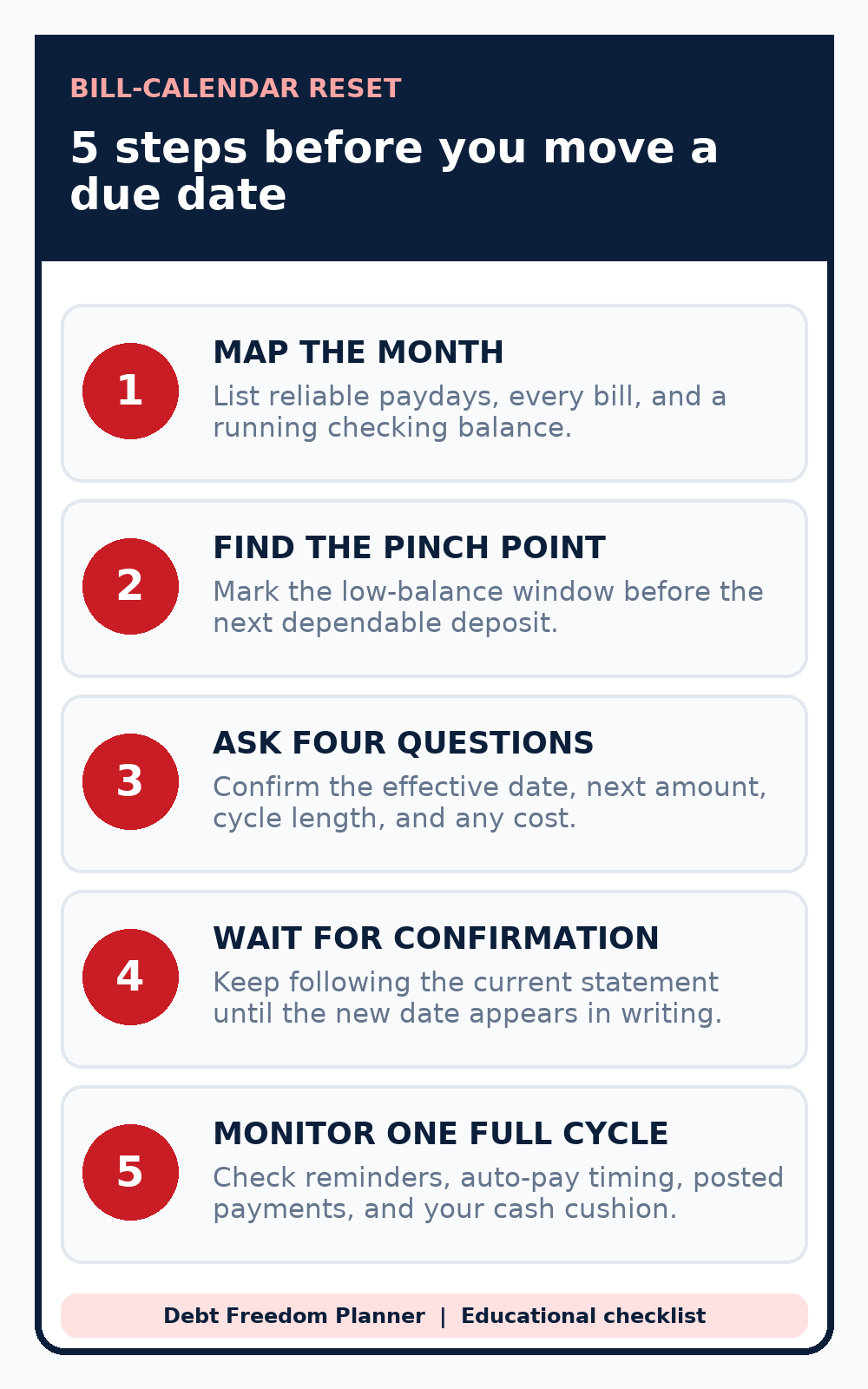
Use this sequence before changing anything: map the month, identify the pinch point, ask precise transition questions, confirm the first new bill, and monitor the first cycle.
A worked example: same bills, safer spacing
Consider a hypothetical household that starts the month with $450 in checking and receives $1,750 on the 1st and 15th. The first half of its original schedule looks like this:
| Day | Cash flow | Running balance after the event |
|---|---|---|
| 1 | Paycheck +$1,750 | $2,200 |
| 3 | Rent -$1,350 | $850 |
| 5 | Utilities -$280 | $570 |
| 7 | Credit-card minimum -$160 | $410 |
| 9 | Personal-loan minimum -$130 | $280 |
| 11 | Insurance -$220 | $60 |
| 15 | Paycheck +$1,750 | $1,810 |
Nothing is late in the example, but the $60 floor leaves little room for a grocery, fuel, or utility surprise. Suppose the card issuer, personal-loan company, and insurer each agree to move those three dates to the 17th, 19th, and 21st. Before the second paycheck, the lowest balance is then $570 rather than $60. The same bills are still paid during the month, so the ending balance is unchanged; only the timing changed.
That distinction matters. The goal is not to manufacture extra money on paper. It is to make the existing plan easier to carry out without accidentally spending money that must cover a withdrawal three days later.
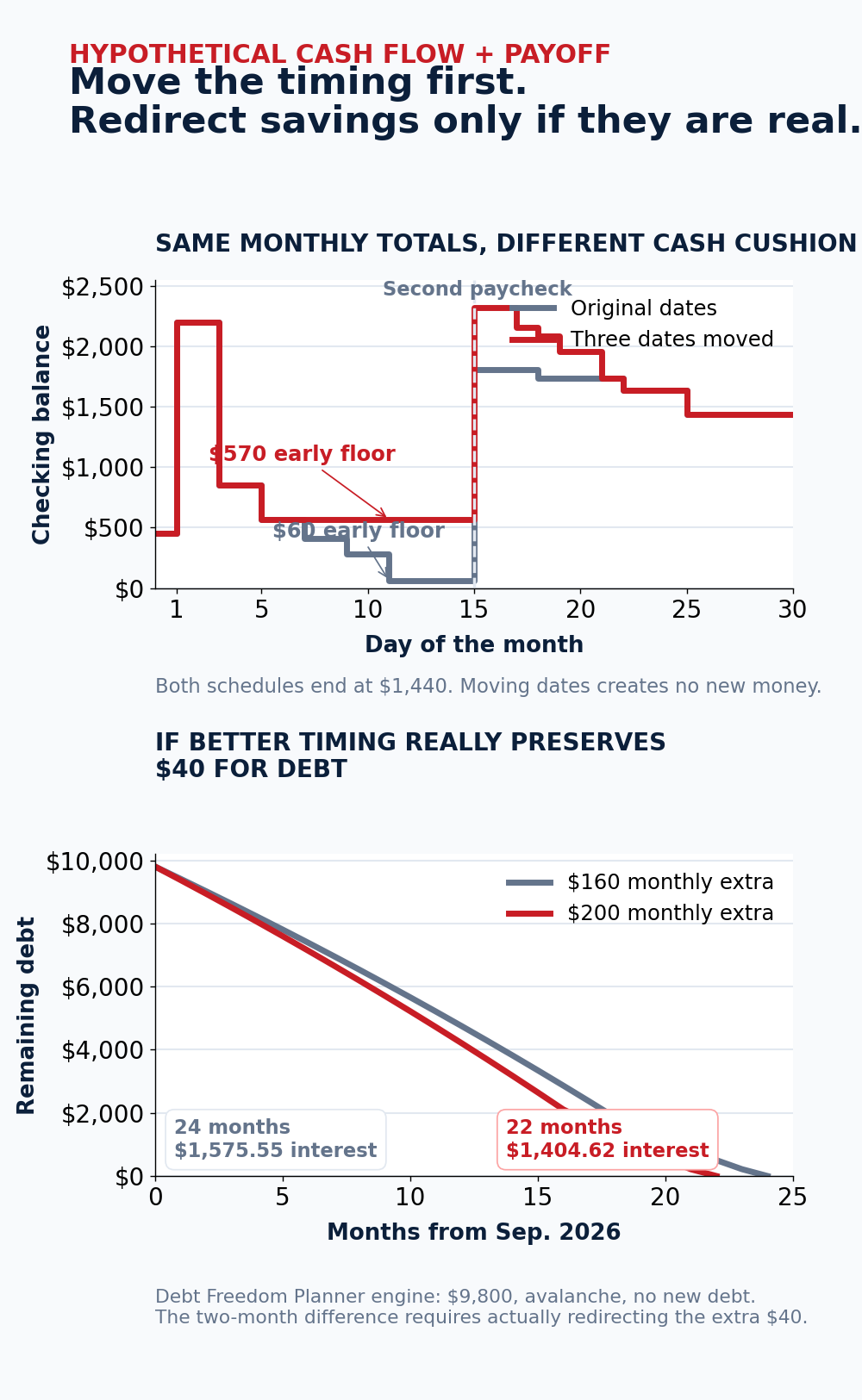
Hypothetical only. The upper panel uses the same $3,700 of paychecks and the same bills in both schedules; only three dates move. The lower panel uses the Debt Freedom Planner payoff engine and assumes that better timing actually preserves and redirects $40 per month instead of losing it elsewhere.
How a better calendar can affect a payoff plan
Moving due dates by itself does not shorten a payoff schedule. In the app's monthly model, the result changes only if the new routine helps you make the promised payment consistently or lets you redirect money that would otherwise leak away.
For a reproducible hypothetical, use these three debts and an avalanche strategy:
| Debt | Starting balance | APR | Minimum |
|---|---|---|---|
| Credit card | $4,800 | 25.99% | $160 |
| Personal loan | $3,500 | 11.50% | $130 |
| Medical payment plan | $1,500 | 0% | $75 |
| Total | $9,800 | — | $365 |
Starting in September 2026, the Debt Freedom Planner engine produces these results:
| Monthly plan | Total monthly debt payment | Payoff time | Modeled interest |
|---|---|---|---|
| $160 extra | $525 | 24 months | $1,575.55 |
| $200 extra | $565 | 22 months | $1,404.62 |
The second plan is two months faster and models $170.93 less interest. That is not a guaranteed savings from changing due dates. It is the modeled result only if the household really preserves another $40 every month and sends it to debt. If payment amounts stay identical, the app's monthly payoff result stays identical too.
A five-step way to choose better dates
1. Build one complete bill calendar
List each paycheck, benefit deposit, fixed bill, variable bill, debt minimum, subscription, savings transfer, and planned extra payment. Use the dependable amount for variable income—not the best month. The CFPB worksheet specifically recommends mapping the week when each bill and income item occurs.
2. Find the low-balance window
Use a running balance, not just monthly totals. Mark where the account gets uncomfortably close to zero before the next deposit. That is the timing problem you are trying to solve.
3. Choose candidates, not every bill
Start with one or two flexible bills that create the largest pinch point. Rent, mortgage, taxes, court obligations, or certain loans may be fixed or may have consequences you should not disturb casually. A credit-card date change can also affect the statement cycle, so ask the issuer how the first statement will work.
4. Ask four transition questions
Before accepting a new date, ask:
- When does the change take effect?
- What exact date and amount will be due next?
- Will the first cycle be longer, shorter, or higher?
- Is there any charge, interest effect, or eligibility requirement?
The CFPB worksheet warns that the first bill after moving to a later date may be higher. Keep the confirmation number, email, or screenshot, and continue following the current statement until the new date appears in writing.
5. Monitor the first full cycle
Confirm that reminders and automatic payments moved with the bill. The CFPB's automatic-payment guidance notes that automatic debits can help with on-time payment, but an underfunded account can still lead to overdraft or nonsufficient-funds fees. It also distinguishes a company pulling an automatic debit from your bank sending a recurring bill payment. Know which arrangement you have and when the creditor will actually receive the money.
Where to place the extra debt payment
Once required bills are safely spaced, schedule the extra debt payment soon after the paycheck that funds it—while leaving a realistic checking cushion. An extra payment should not crowd out food, housing, utilities, insurance, or the next round of minimums.
You can try the same debts in Debt Freedom Planner and compare $160 versus $200 of monthly extra payment. The tool can model snowball, avalanche, and custom order, show the projected payoff date and interest, and build a month-by-month schedule. It does not connect to your bank or move due dates for you, so use your statements and biller confirmations as the source of truth.
Checklist before you call a biller
- [ ] I know my reliable pay dates and conservative take-home amounts.
- [ ] I listed every regular bill and current due date.
- [ ] I calculated the running balance between deposits.
- [ ] I identified the specific bill causing the pinch point.
- [ ] I chose a preferred date after the paycheck meant to cover it.
- [ ] I will ask about the effective date, first amount, cycle length, and any cost.
- [ ] I will keep paying the date on the current statement until the change is confirmed.
- [ ] I will review automatic payments and monitor the first new cycle.
- [ ] I will update my payoff plan only if the amount I can reliably send to debt actually changes.
The best calendar is not the one with the prettiest spacing. It is the one that keeps every required payment on time, protects a modest cash buffer, and makes your promised extra debt payment repeatable.
This article provides general educational information and hypothetical projections. It is not individualized financial, legal, tax, credit-repair, or bankruptcy advice. Account terms, payment-crediting rules, fees, and due-date options vary; confirm them directly with each creditor, servicer, biller, and financial institution.
0 comments
Ask a question, add context, or share what worked for your household.
Create a free account or sign in to comment, reply, and vote on blog posts.