
What Happens When You Lose Your Credit Card Grace Period?
New purchases can start accruing interest from their transaction dates. See how to stop the balance from moving and rebuild a payoff plan.
If you lose your credit card's purchase grace period, new purchases can start accruing interest from each purchase date instead of remaining interest-free until the next due date. Keep the required payment current, stop adding charges if you can, check your statement and card agreement, and work toward the full-balance condition your issuer requires before assuming the grace period is back.
Once a balance carries past the due date, using the same card for everyday spending can make the payoff target move.
The quick answer: carrying a balance can make new purchases cost interest immediately
A purchase grace period is the time between the end of a billing cycle and the payment due date. When a card offers one and you meet its terms, paying the full statement balance by the due date can prevent interest on purchases.
The Consumer Financial Protection Bureau's grace-period guidance explains the other side: if you do not pay the balance in full by the due date and lose the grace period, you can owe interest on the unpaid balance and on purchases in the new billing cycle beginning on each purchase date.
That does not mean every card uses identical wording or timing. Credit cards are not required to offer a grace period, and cash advances generally do not receive the same treatment as purchases. Your periodic statement and cardholder agreement control the details for your account.
What changes after the grace period is lost
The due date still matters, and the minimum payment still matters. Losing a grace period is not permission to skip the bill. The practical change is that paying only the minimum no longer protects new purchases from purchase interest.
Many issuers calculate interest daily using an average daily balance. The CFPB says that when there is no grace period, paying sooner can reduce interest because interest is accruing daily.
Three balances can now interact:
- the amount carried from the prior cycle;
- new purchases added after the cycle closed; and
- interest that accrues while both remain unpaid.
This is why a household can send the same $250 payment every month and still feel as though the balance barely moves. The payment is covering interest and principal while new charges keep rebuilding the amount owed.
A five-step reset for the card and the payoff plan
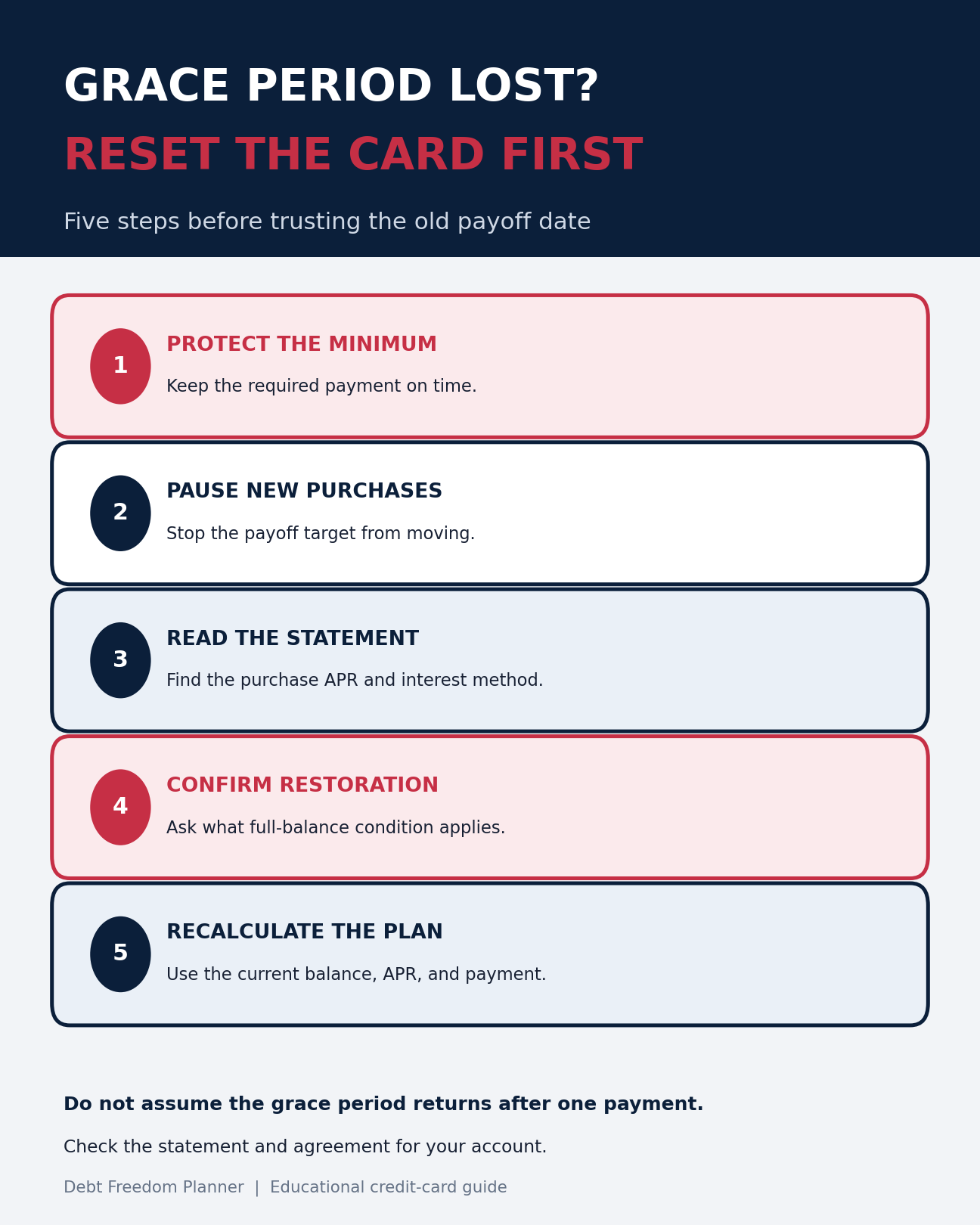
The safest reset separates payment safety, new-spending control, issuer-specific rules, and payoff planning.
1. Protect the required payment first
Pay at least the required minimum by the due date. A faster-payoff strategy comes after payment safety. If cash is tight, do not redirect money needed for housing, food, utilities, insurance, or another required debt payment just to chase a projected payoff date.
2. Pause new purchases if practical
Moving recurring charges and everyday spending to money already available can stop the card balance from growing. Do not move spending to another high-cost debt merely to make this card look better. The goal is to stop borrowing for new purchases, not hide it on a different account.
If the card is your only safe way to handle an emergency, protect the emergency need. Then record the new charge and update the plan instead of pretending the earlier payoff date still applies.
3. Read the statement's interest-charge section
Look for the purchase APR, balance subject to interest, daily periodic rate, interest-charge calculation, and any separate categories such as cash advances or balance transfers. The statement may also say how to avoid interest on purchases.
If you need the underlying terms, use the issuer's current agreement or search the CFPB's credit-card agreement database. Match the issuer and product carefully; a general online agreement may not replace the specific notices sent for your account.
4. Confirm how the grace period can return
Do not assume one large payment restores the grace period immediately. The CFPB notes that paying in full in some months but not others may cause a consumer to lose the grace period for the unpaid month and the following month. Ask the issuer what balance must be paid, by what date, and whether more than one full-pay cycle is required under your agreement.
Also ask for a current payoff amount if you are trying to take the account to zero. Interest may continue between the statement closing date and the date a payment posts, creating residual interest. That is a related issue, but it is not the same as new purchases accruing interest while a grace period is unavailable.
5. Recalculate with the balance you actually owe
Once new charges stop, enter the current balance, purchase APR, required minimum, and a sustainable extra amount into your payoff plan. Recalculate whenever the balance, rate, minimum, or planned extra payment materially changes.
Worked example: a $600 purchase after the grace period is gone
Assume a hypothetical card has:
| Input | Hypothetical amount |
|---|---|
| Carried balance | $4,000 |
| Purchase APR | 27.99% |
| Monthly payment | $250 |
| New purchases in the illustration | $600 |
| New fees or later purchases | None |
First isolate the possible short-term interest on the new purchases. If the $600 is outstanding for 30 days and a simplified daily-rate estimate applies:
$600 × (27.99% ÷ 365) × 30 = $13.80
That $13.80 is an illustration, not a statement prediction. Actual interest depends on transaction dates, posting dates, the issuer's average-daily-balance method, payment allocation, and the agreement.
Next, use Debt Freedom Planner's monthly payoff engine to show why updating the starting balance matters. The first path begins at $4,000. The second treats the $600 purchase block as added starting principal, for $4,600 total. Both use 27.99% APR, a $250 monthly payment, a September 2026 start, and no later purchases or fees.
| Hypothetical payoff path | Months to payoff | Modeled payoff month | Modeled interest |
|---|---|---|---|
| Stop new purchases at $4,000 | 21 | May 2028 | $1,065.43 |
| Add $600, then stop at $4,600 | 25 | September 2028 | $1,479.94 |
| Modeled difference | 4 months later | 4 months later | $414.51 more |
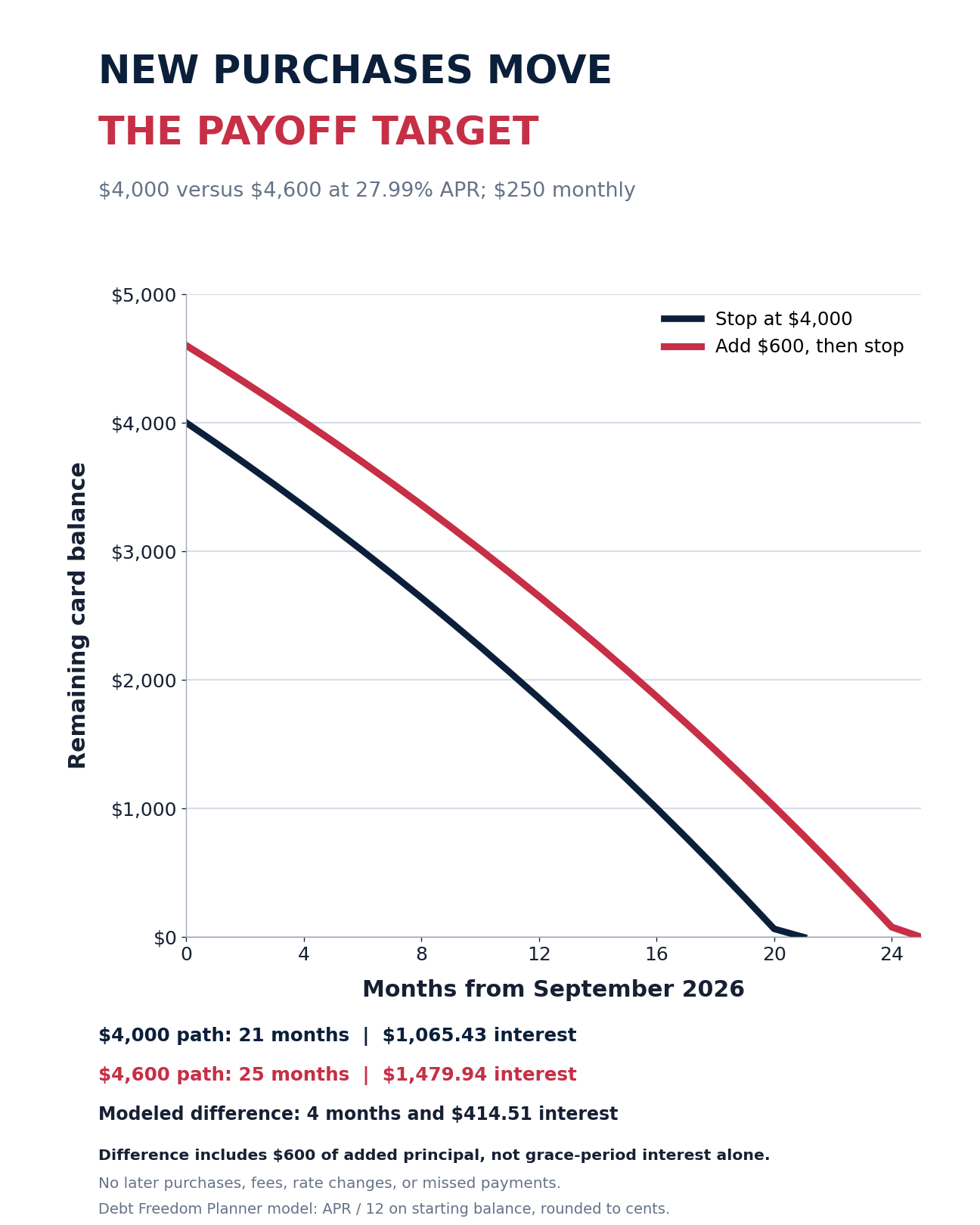
Hypothetical monthly model: $4,000 versus $4,600 at 27.99% APR with $250 monthly. The difference includes the extra $600 of borrowed principal and the interest generated by the larger balance; it is not a measure of grace-period interest alone.
The graph makes one narrow point: after a new charge changes the balance, the old payoff date is stale. It does not predict the exact interest on each purchase or when an issuer will restore a grace period.
A balance transfer can create the same surprise
A 0% balance transfer does not necessarily make new purchases interest-free. The CFPB warns that for most cards, purchases can accrue interest when a balance is carried month to month, even when the transferred balance itself has a promotional rate.
Before using a balance-transfer card for groceries, fuel, or subscriptions, check whether the purchase grace period remains available and what full-balance condition applies. Keeping the transfer card separate from new spending can make the promotion easier to track.
Where Debt Freedom Planner fits
Debt Freedom Planner models balances, APRs, required payments, payoff order, and extra monthly payments. It can compare snowball, avalanche, and custom strategies and show how a changed starting balance moves the projected payoff date and interest.
You can start a Debt Freedom Planner roadmap after updating the card to the balance and APR shown on your latest statement. If the card still receives new transactions, revisit the plan after they post; the planner does not automatically know about purchases, fees, or issuer-specific daily interest.
The planner does not interpret your card agreement, determine whether an interest charge is legally correct, restore a grace period, or replace the issuer's payoff quote. It is a planning tool for the numbers you enter.
Bottom line
Losing a purchase grace period can turn new card spending into interest-bearing debt from the transaction date. Keep the minimum current, pause new charges when practical, read the interest section of the statement, confirm the restoration rule with the issuer, and recalculate using the balance that actually exists. The key is not merely making a payment; it is stopping the payoff target from moving while you work back toward full-balance status.
This article is for educational information only and is not individualized financial, legal, tax, credit-repair, or bankruptcy advice. Card terms, interest methods, and grace-period restoration rules vary. Review your statement and agreement and contact the issuer about your specific account.
0 comments
Ask a question, add context, or share what worked for your household.
Create a free account or sign in to comment, reply, and vote on blog posts.