

What Should You Do If a Credit Card Issuer Cuts Your Limit While You Still Owe a Balance?
Keep the payment current, stop new charges, read the issuer notice, and recalculate only the payoff inputs that actually changed.
If your credit card issuer cuts your limit while you still owe a balance, keep the required payment on time, stop adding charges, and read the notice before changing your payoff strategy. The lower limit does not erase the balance or automatically change your APR, minimum payment, or payoff date. It can, however, remove available credit and make the same balance use a much larger share of the new limit.

A credit-limit reduction calls for a calm account review: protect the due date, verify the new terms, and work from the numbers actually shown on the notice and statement.
The quick answer: protect the payment first
Do these three things before anything else:
- Pay at least the required minimum by the due date. A limit reduction is not permission to skip a payment.
- Pause new purchases and recurring charges on that card. If the new limit leaves little room, an automatic subscription or pending transaction could create another problem.
- Save and read the issuer's notice. Confirm the new limit, the effective date, the stated reason or instructions for requesting the reason, and whether any other account term changed.
The Consumer Financial Protection Bureau says card issuers generally can reduce a credit limit, even when the new limit leaves no available credit. In most instances, the issuer also must provide an adverse-action notice that gives specific reasons or tells you how to request them.
What actually changes when the limit drops?
A credit limit is the most the issuer currently allows you to borrow on the account. Your balance is what you already owe. Changing the first number does not directly change the second.
Here is a hypothetical account immediately before and after a limit reduction:
| Account number | Before notice | After notice |
|---|---|---|
| Balance | $7,500 | $7,500 |
| Credit limit | $12,000 | $8,000 |
| Available credit | $4,500 | $500 |
| Balance ÷ limit | 62.50% | 93.75% |
| APR | 24.99% | 24.99% assumed unchanged |
| Planned monthly payment | $300 | $300 assumed unchanged |
The account did not gain $4,000 of debt. Its available credit fell by $4,000, and the same balance now occupies more of the line. That distinction matters because the CFPB's credit-line-decrease research found that these actions can remove much of a card's available credit and sharply raise utilization on the affected card.
Utilization is not the whole credit-scoring formula, and no one can responsibly promise a certain point change from this example. Treat the percentage as an account-management signal, not a score forecast.
Does the issuer have to give you 45 days?
There is an important nuance. A card issuer generally does not have to wait 45 days before lowering the limit itself. But under Regulation Z's credit-limit-reduction rules, advance notice is required before an over-the-limit fee or penalty rate can be imposed solely because your balance exceeds the newly reduced limit. The notice must be provided at least 45 days before that fee or penalty rate is imposed.
That protection is not a reason to ignore the notice. Read it for:
- the new limit and when it applies;
- any date tied to a possible fee or penalty APR;
- whether the existing APR, minimum payment, annual fee, or due date also changed;
- the issuer's stated reason or how to request it; and
- contact information for questions or an appeal.
If the notice and your online account disagree, capture the current account details and contact the issuer using a trusted number from the back of the card, a statement, or the issuer's official site. Do not call a number from an unexpected text message.
A five-step response that keeps the payoff plan intact
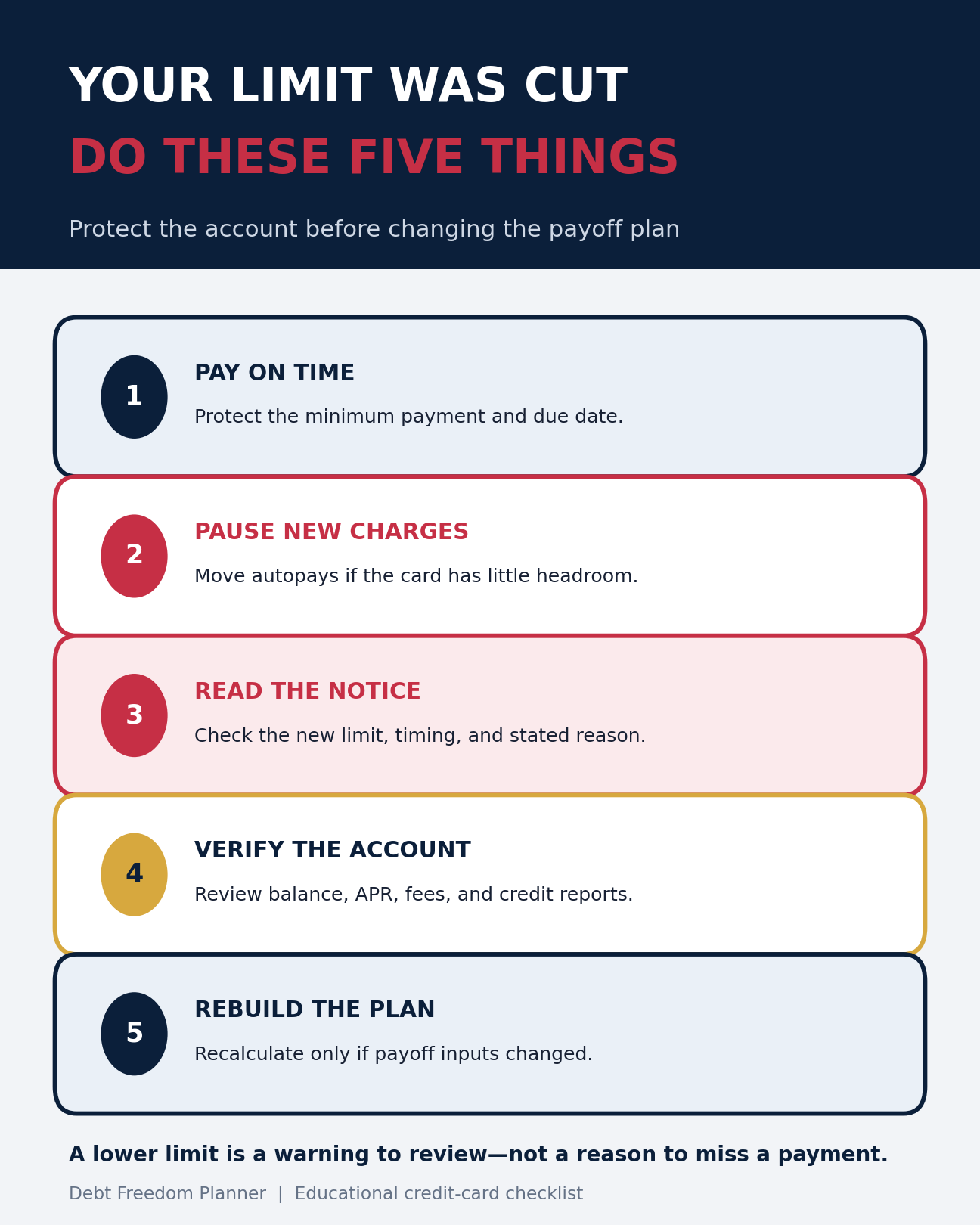
The order matters: protect the payment and prevent new charges before you troubleshoot the notice or redesign the payoff plan.
1. Keep the minimum payment safe
Confirm the due date, minimum due, and automatic-payment status. If your bank balance is tight, protecting an on-time minimum comes before sending an aggressive extra payment that could cause an overdraft or leave essentials uncovered.
2. Stop the balance from growing
Move subscriptions and household autopays if the account has little remaining room. Allow for pending transactions, tips, and delayed merchant postings. A payment may restore available credit only after it posts; do not assume a scheduled payment creates immediate room.
3. Understand the issuer's reason
Read the adverse-action notice and ask for the specific reason if the notice explains how. You can ask the issuer to reconsider, especially if the decision appears to rely on outdated or incorrect information, but do not build your household plan around the limit being restored.
4. Verify the account and your credit reports
Check the statement balance, current balance, APRs, minimum payment, due date, fees, and new limit. If the notice points to credit-report information, review the report for accuracy. The CFPB recommends reviewing credit reports and disputing errors; accurate negative information is different from an error and should not be disputed merely because it is unwelcome.
5. Recalculate only when payoff inputs change
Your payoff projection uses balances, APRs, minimum payments, extra payments, and payoff order. The credit limit itself is not part of the interest calculation. Recalculate if the notice or statement also changes an APR or minimum payment, if you choose a different sustainable monthly amount, or if new charges post. Otherwise, keep the existing schedule and update the account note.
Worked example: the limit cut is a warning, not the math
Assume the same hypothetical $7,500 balance carries a 24.99% APR. There are no new charges, fees, or missed payments. Interest is modeled monthly as APR divided by 12 on the starting balance and rounded to cents.
With a fixed $300 monthly payment, the Debt Freedom Planner engine projects:
- 36 months to payoff;
- $3,202.80 in modeled interest; and
- $10,702.80 total paid.
Suppose the household reviews its cash flow after the notice and finds a genuinely sustainable $100 monthly extra payment, bringing the total to $400. The model then projects:
- 25 months to payoff;
- $2,107.80 in modeled interest; and
- $9,607.80 total paid.
That is 11 months sooner and $1,095.00 less modeled interest. The savings come from the higher payment, not from the issuer lowering the credit limit.
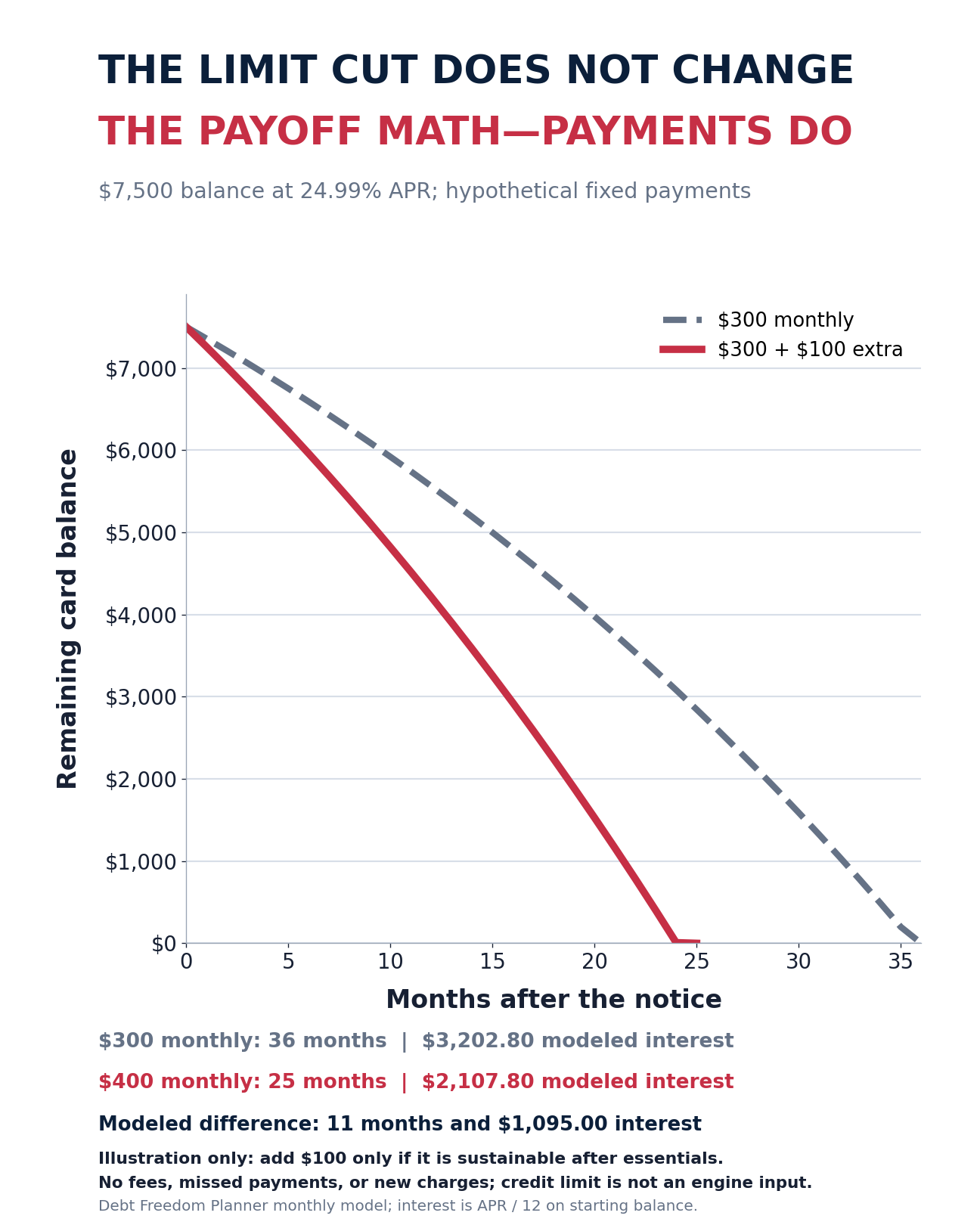
Hypothetical Debt Freedom Planner model: $7,500 at 24.99% APR, $300 monthly versus $300 plus $100 extra, with no fees, missed payments, or new charges. The credit limit is not an engine input.
Do not force the extra $100 if it would cause missed essentials, overdrafts, or new borrowing elsewhere. A smaller amount you can repeat is more useful than one large payment you must reverse with another charge.
Should you move this card to the front of your payoff order?
Not automatically. A lower limit can make the account feel urgent, but payoff order should still consider APR, minimum-payment safety, balances, and household cash flow.
- Under the avalanche method, this card moves first only if its APR is the highest among your debts.
- Under the snowball method, it moves first only if its balance is the smallest.
- Under a custom order, you may prioritize it for a documented household reason, but compare the interest cost before changing course.
Do not divert money from another required minimum just to get this card below the new limit faster. First keep every debt current. Then direct the available extra payment according to the strategy you can follow.
Use Debt Freedom Planner to test the response
You can start a Debt Freedom Planner roadmap with the current balance, APR, required minimum, and the extra amount you can repeat each month. Compare snowball, avalanche, and custom order using the same debts, then test the payment you were already making against a modest extra-payment scenario.
Record the new credit limit in your own account notes if helpful, but remember that the planner's payoff result changes only when a payoff input changes. Recheck the plan after a rate change, minimum-payment change, new purchase, returned payment, or updated balance.
Bottom line
A credit-limit cut can shrink your safety margin and make the same balance look much closer to maxed out, but it does not rewrite the debt. Keep the payment on time, stop adding charges, understand the notice, verify the account, and then decide whether your actual payoff inputs need to change. Let the numbers—not the surprise—drive the next move.
This article is for educational information only and is not individualized financial, legal, credit-repair, or tax advice. Credit-card agreements, issuer practices, state laws, and personal circumstances vary. Review your notice and agreement, contact the issuer for account-specific information, and consider a qualified professional when needed.
0 comments
Ask a question, add context, or share what worked for your household.
Create a free account or sign in to comment, reply, and vote on blog posts.