

Why Did My Credit Card Minimum Payment Change? How to Keep Your Payoff Plan on Track
Credit card minimums move with balances, interest, fees, and account terms. Use a two-number system to protect due dates without letting a shrinking minimum stretch your payoff.
Short answer: Your credit-card minimum payment can change every month because the issuer recalculates it from the new statement balance and the formula in your card agreement. Interest, fees, past-due amounts, new purchases, a promotional rate ending, or a lower balance can all move the number. To keep a payoff plan from drifting, track two amounts: the current statement minimum you must pay by the due date and a fixed monthly payoff target you keep paying when the minimum falls.

A changing required payment does not have to create a changing payoff commitment. Use each new statement to verify the safety floor, then keep the larger plan steady when your budget allows.
Why your minimum payment changed
A credit-card minimum is not usually a fixed installment like a car-loan payment. It is recalculated after the billing cycle closes. Capital One's January 2026 explanation says minimums are generally based on the monthly statement balance and may use a percentage of the balance plus interest and late fees, a flat percentage, or past-due amounts.
The exact calculation is account-specific. Common moving parts include:
- Statement balance: New purchases, balance transfers, cash advances, payments, credits, and refunds can change the balance used in the formula.
- Interest: A carried balance can generate a different interest charge each cycle because the balance, APR, and number or timing of days differ.
- Fees and past-due amounts: A late fee, annual fee, returned-payment fee, or unpaid amount from a prior statement may be added to the required payment under the agreement.
- APR changes: A variable APR can move with its index, and an introductory APR can expire. If interest is part of the formula, the minimum can move too.
- A fixed floor: Many formulas use the greater of a dollar floor or a percentage-based calculation. Near the end, the final required payment may simply be the remaining balance.
Citi describes two common methods: a flat percentage or fixed amount, and a percentage plus billed interest and fees or a fixed amount. As one real-world example—not a rule for every card—Chase says that in most cases its minimum is the greater of $40 or 1% of the statement balance plus interest and late fees. Your own statement and agreement control.
| What changed on the statement? | Likely effect on the minimum | What to check |
|---|---|---|
| Balance fell after a payment | Often falls | Did the issuer's percentage formula produce a smaller amount? |
| New purchase or balance transfer posted | May rise | Compare the new statement balance and transaction list |
| Interest or a fee increased | May rise | Review the interest-charge and fee sections |
| Payment was late or short | May rise sharply | Look for a past-due amount, fee, or penalty APR notice |
| Promotional APR ended | May rise | Check the APR table and promotion end date |
The minimum is a safety floor, not a payoff schedule
Paying at least the current minimum by the due date helps keep the account from becoming late. It does not promise a fast or inexpensive payoff. Federal Regulation Z requires a minimum-payment warning and an estimate of how long minimum-only repayment may take, based on the current balance, no new charges, and only minimum payments.
That warning matters because a percentage-based minimum may shrink as the balance shrinks. If you lower your payment every time the issuer lowers the requirement, less principal may come off the balance than it would under a steady payment.
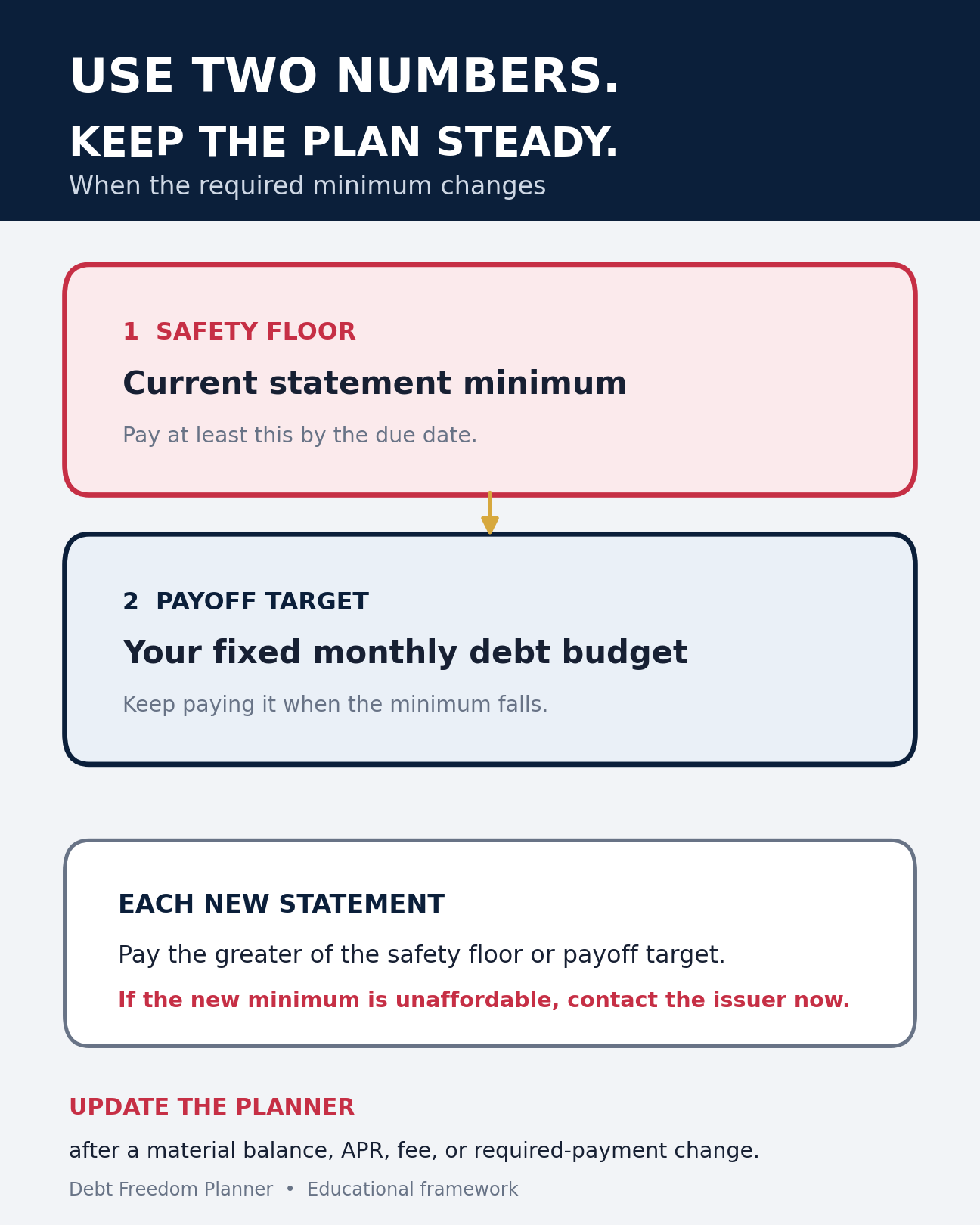
The two-number system separates late-payment safety from payoff speed. Pay at least the statement minimum; when affordable, keep a fixed payoff target above it.
Use a two-number system each month
1. Record the safety floor
This is the minimum due on the latest statement, along with its due date. Do not rely on last month's number. Autopay for the statement minimum can be a useful backstop if the checking balance can safely support it, but confirm how your issuer handles returned payments and newly posted statements.
2. Set a fixed payoff target
Choose a total monthly debt amount your budget can support after housing, food, utilities, transportation, insurance, and a reasonable cash buffer. If the minimum falls from $267 to $264, keep paying $267 rather than automatically spending the $3 difference. If the minimum rises above your target, the new minimum becomes the safety floor and the plan needs an update.
The practical rule is:
Payment for this card = the greater of the current statement minimum or your planned target, limited by what you actually owe.
For several debts, apply the same idea at the household level: add the current minimums, protect that total first, then direct the rest of your fixed debt budget according to your snowball, avalanche, or custom order.
Worked example: why a falling minimum can slow the payoff
Consider a hypothetical card with:
- Starting balance: $8,000
- Fixed APR for the model: 27.99%
- No new charges, fees, or missed payments
- Modeled minimum: the greater of $40 or 1% of the starting monthly balance plus that month's interest
- Monthly interest approximation: APR divided by 12, rounded to cents
This resembles a common formula, but it is not a quote from any particular account. Actual issuers may use daily balances, different floors, different percentages, and account-specific rounding.
| Month | Starting balance | Modeled interest | Recalculated minimum | Ending balance |
|---|---|---|---|---|
| 1 | $8,000.00 | $186.60 | $266.60 | $7,920.00 |
| 2 | $7,920.00 | $184.73 | $263.93 | $7,840.80 |
| 3 | $7,840.80 | $182.89 | $261.30 | $7,762.39 |
| 4 | $7,762.39 | $181.06 | $258.68 | $7,684.77 |
The required payment falls by $7.92 in four statements even though the APR is unchanged. Paying each recalculated minimum in this simplified model takes 241 months and produces $16,748.14 of modeled interest.
Now keep the monthly payment at $267. Debt Freedom Planner's payoff engine, using the same balance and APR with monthly interest, pays the card off in 53 months with $5,898.82 of modeled interest. That is not a promise about a real card; it shows why the payment path matters as much as the first statement's minimum.
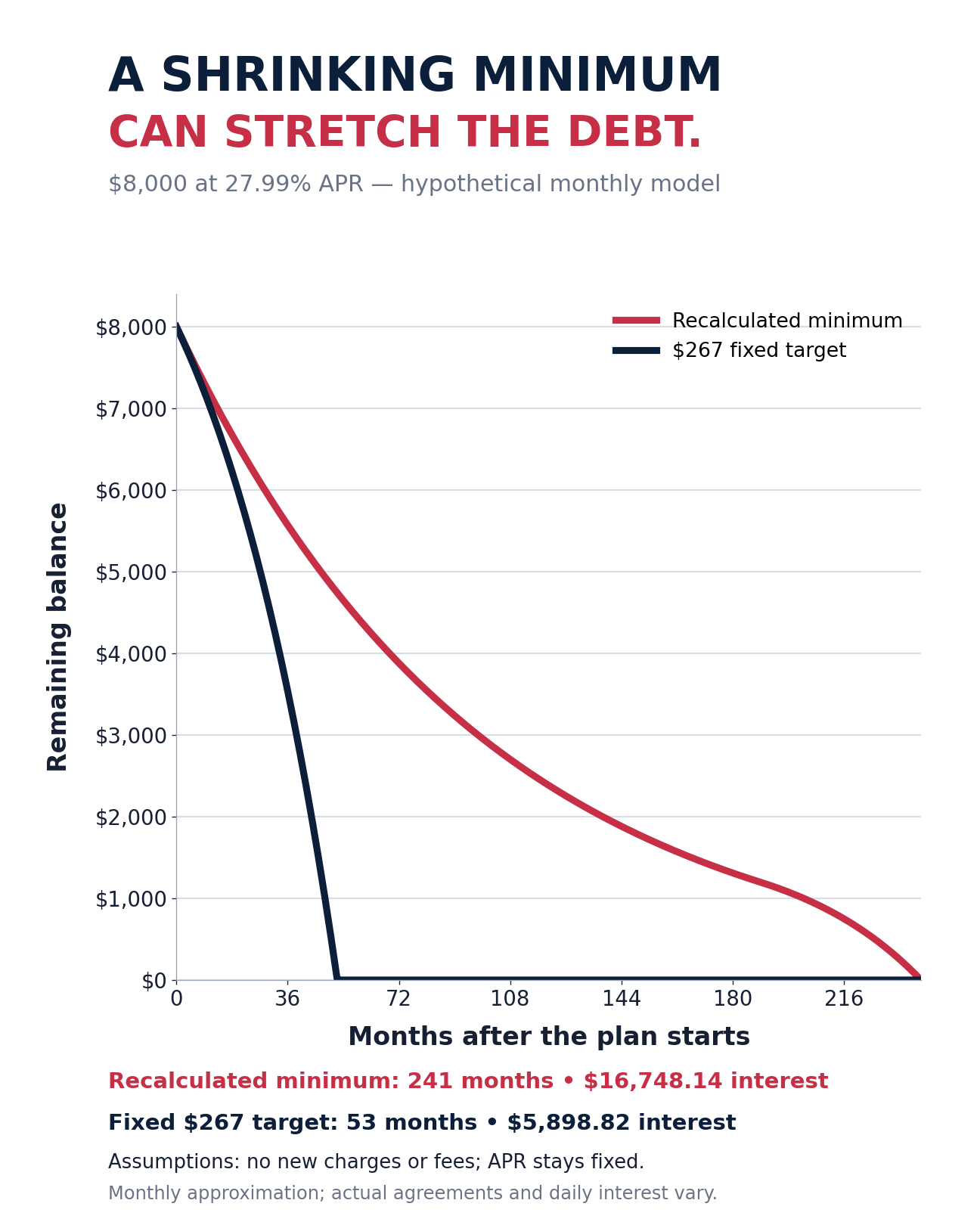
Hypothetical comparison: $8,000 at 27.99% APR, no new charges or fees. The red line recalculates the minimum each month; the navy line keeps a $267 target. The fixed scenario uses the Debt Freedom Planner payoff engine. Actual daily interest and agreement terms will differ.
How to build this in Debt Freedom Planner
For a one-card plan, enter the current balance, APR, and latest minimum. Then set the extra amount so the total payment reaches your fixed target. In the example, a $266.60 minimum plus $0.40 extra creates a $267 target.
For multiple debts:
- Enter each current balance, APR, and latest required minimum.
- Choose snowball, avalanche, or a custom payoff order.
- Set a fixed household debt budget.
- Subtract the current total minimums from that budget; the remainder is the extra amount available to the target debt.
- Update the plan after a material balance, APR, fee, or required-payment change.
You can try Debt Freedom Planner to compare the payoff order and see how a steady extra amount changes the projected payoff date and interest. The planner uses the numbers you enter; it does not connect to your bank or automatically read a new statement, so keep the inputs current.
What to do when the minimum jumps
Do not assume the issuer made a mistake, but do not ignore a surprise either.
- Compare the last two statements line by line: balance, APR, interest, fees, past-due amount, and new transactions.
- Check the minimum-payment formula in your agreement. The CFPB credit-card agreement database can help locate many issuer agreements, but your account copy is best.
- Confirm that your last payment posted and was credited correctly.
- Look for an introductory-rate expiration or a variable-rate change.
- If the new minimum is more than you can afford, act before the due date. The CFPB recommends contacting the card company immediately, explaining why you cannot pay the minimum, what you can afford, when normal payments could resume, and what temporary amount you are requesting.
Avoid covering an unaffordable minimum with a cash advance or another high-cost debt without understanding the new fees and interest. A smaller payment negotiated with the issuer may affect the account and credit, but silent nonpayment can create additional costs and fewer options.
Bottom line
A changing minimum usually reflects a changing balance or a formula that includes interest, fees, past-due amounts, or a fixed floor. Treat the current statement minimum as the amount that protects on-time status—not as your long-term payoff strategy. When your budget allows, keep a fixed payment target, verify every new statement, and recalculate the plan when the minimum rises or the account terms materially change.
This article is for educational information only and is not individualized financial, legal, tax, credit-repair, or bankruptcy advice. Your card agreement and statement govern your required payment. Contact the issuer or an appropriate qualified professional about your situation.
0 comments
Ask a question, add context, or share what worked for your household.
Create a free account or sign in to comment, reply, and vote on blog posts.