

How Are Credit Card Payments Applied When One Card Has Multiple APRs?
The amount above your minimum generally goes to the highest APR first, while the minimum portion may follow your issuer agreement. Here is the rule, exception, and payoff math.
If one credit card has purchases, a balance transfer, and a cash advance at different APRs, your payment is not spread evenly. The amount above your required minimum payment generally must go first to the balance with the highest APR, then to lower-rate balances in descending order. The minimum-payment portion is different: federal payment-allocation rules generally leave that part to the issuer, so your card agreement and statement matter.

One card can hold several APR buckets. The statement—not the card's total balance alone—shows what you are actually paying down.
The rule in plain English
Suppose your statement shows three balances:
| Balance category | Balance | APR |
|---|---|---|
| Cash advance | $1,500 | 29.99% |
| Purchases | $4,500 | 19.99% |
| Promotional transfer | $2,000 | 0% until a stated date |
If the required minimum is $200 and you send $400, think of the payment as two parts:
- The first $200 is the minimum. The issuer generally decides how to allocate it under the card agreement and applicable law.
- The other $200 is the excess. Under Regulation Z section 1026.53, the issuer generally must apply it first to the highest-APR balance, then work downward by APR.
That means the extra $200 would normally attack the 29.99% cash-advance bucket before the 19.99% purchase bucket or the 0% balance. The CFPB's consumer explanation states the same distinction: the issuer generally controls the minimum portion, while the amount paid over the minimum goes to the highest rate first.
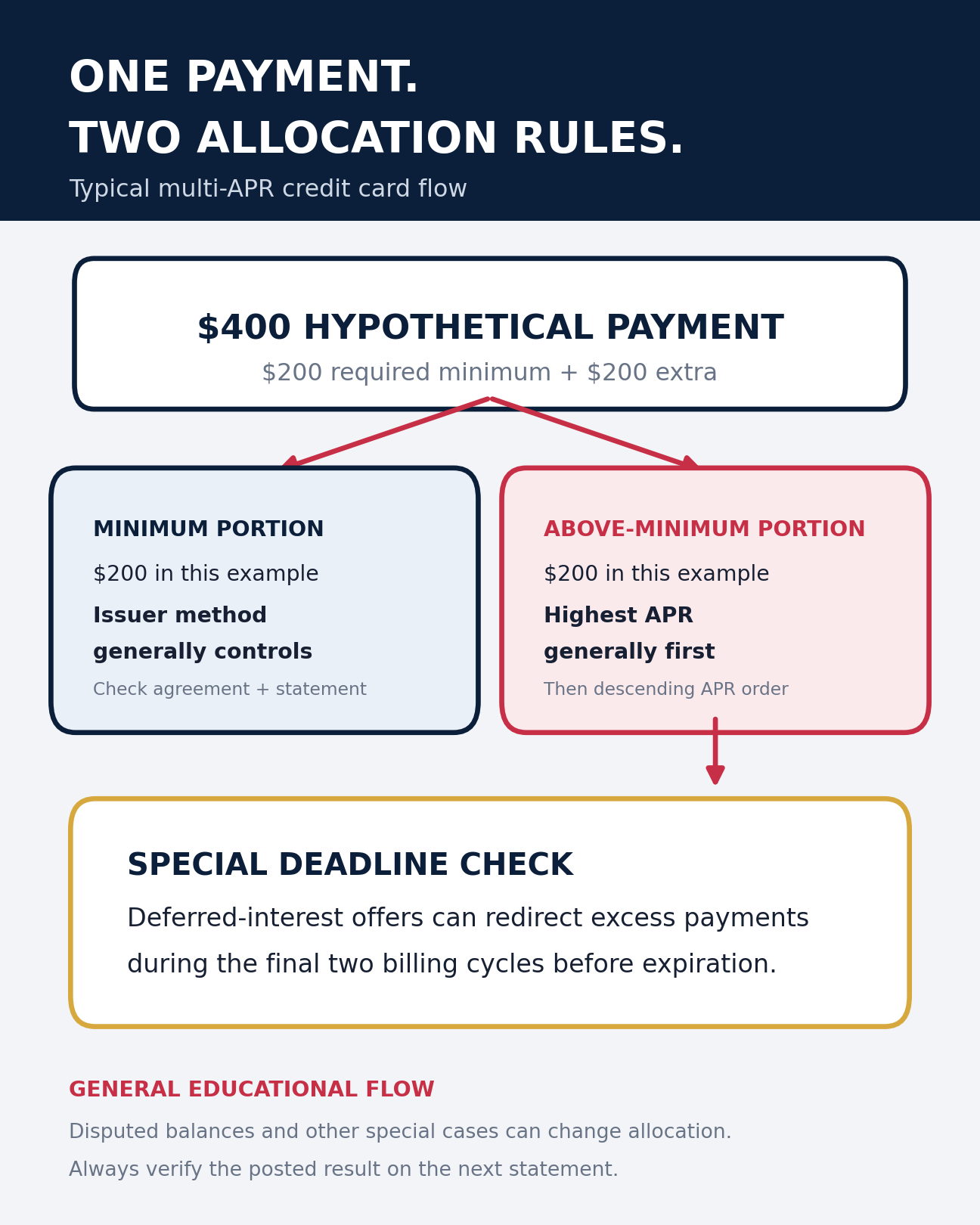
Payment flow for a typical multi-APR card. “Generally” matters because deferred-interest promotions, disputed balances, and some secured balances have special rules.
Why the minimum-payment detail matters
Many people see “highest APR first” and assume every dollar follows that rule. It does not necessarily work that way.
The federal rule is aimed at the amount above the required minimum. Your issuer can use the agreement's method for the minimum portion. As one current real-world example—not a rule for every card—the Capital One customer agreement says it generally applies payments up to the minimum to the lowest APR first, then applies the amount above the minimum to the highest APR first.
That is why paying only the minimum can leave an expensive cash-advance balance shrinking slowly even when the account is technically current. Sending more than the minimum gives the high-rate-first rule something to work with.
A worked example with one $6,000 card balance
Consider a hypothetical card with two active APR buckets:
- $1,500 cash advance at 29.99% APR
- $4,500 purchases at 19.99% APR
- $200 modeled combined minimum
- $200 extra each month
- $400 total monthly payment, with cleared minimums rolled forward
For a transparent planning comparison, we entered the two APR buckets as separate debts in the Debt Freedom Planner payoff engine. We assigned $75 of the modeled minimum to the cash-advance bucket and $125 to purchases. That split is an assumption for the illustration; it is not a prediction of how a particular issuer will calculate or allocate its minimum.
In the higher-APR-first model, the $200 extra targets the 29.99% bucket. In the comparison, the same $200 targets the 19.99% bucket first. Both keep the total payment at $400 until the final month.
| Planning model | First target | Payoff time | Total modeled interest |
|---|---|---|---|
| Higher APR first | 29.99% cash advance | 18 months | $1,019.04 |
| Lower APR first | 19.99% purchases | 18 months | $1,158.60 |
The higher-APR-first model saves $139.56 in this example. The payoff month is the same because the monthly payment is held constant, but less of that payment is consumed by interest.
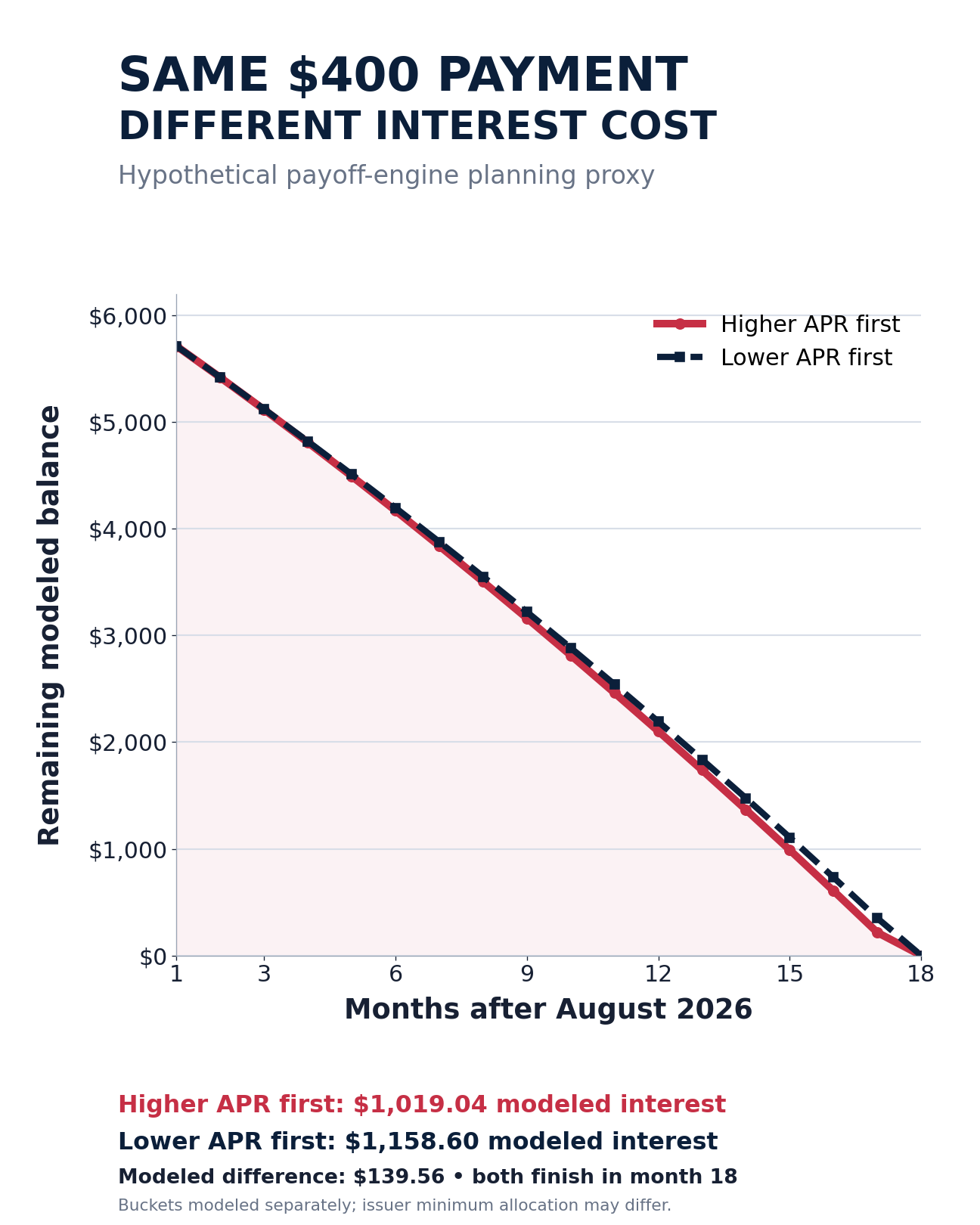
Hypothetical planning comparison generated with the app payoff engine. It treats APR buckets as separate debts and is not an issuer statement calculator.
Your statement is the source of truth
Before changing your payment, open the most recent statement and look for a table that separates balances by APR. The CFPB says statements must show each category with a different APR and the balance in that category.
Check for:
- purchase APR and purchase balance;
- balance-transfer APR and the promotion end date;
- cash-advance APR and balance;
- penalty APR, if one applies;
- required minimum payment;
- interest charged for each category; and
- language explaining how payments are applied.
Do not rely only on the large “total balance” number at the top. Two households can owe the same total but face very different interest costs because their balances sit in different APR categories.
The deferred-interest exception can reverse the normal order
A true 0% introductory APR and a deferred-interest offer are not the same thing. With deferred interest, interest can accrue in the background and may become due if the promotional balance is not paid in full by the deadline.
Regulation Z has a special allocation rule for the last two billing cycles before a deferred-interest period expires: the amount above the minimum generally must be directed first to the deferred-interest balance. The CFPB's deferred-interest guidance also suggests asking the issuer whether it will honor an earlier allocation request; it may, but it is not always required to do so.
This is a deadline problem, not just an APR-ranking problem. Confirm the exact offer language and payoff deadline directly with the issuer.
A practical monthly checklist
1. Protect the minimum first
Pay at least the required minimum by the due date. The allocation rule does not protect you from a late fee, a missed-payment mark, or other consequences of paying late.
2. Stop adding to the expensive bucket
Avoid new cash advances while paying down an existing cash-advance balance. New activity can change the bucket balances and the interest calculation.
3. Send a deliberate amount above the minimum
The larger the excess payment, the more principal can reach the highest-rate bucket under the general rule. Even a consistent $50 or $100 above the minimum can be more useful than an irregular payment you cannot sustain.
4. Confirm the next statement
Compare the prior and current balances by APR. If the result does not match your understanding, contact the issuer and ask how the minimum and excess portions were allocated.
5. Recheck every promotional deadline
Put the end date on your calendar. A payment plan that works at 0% may need to change before the promotion ends or before deferred interest can be assessed.
How Debt Freedom Planner fits—and where it stops
Debt Freedom Planner is designed to compare payoff strategies across debts. It does not replace your issuer's statement system or determine how one card company allocates its minimum payment.
For a useful planning proxy, you can enter each APR bucket as a separate debt, label it clearly—such as “Card A cash advance” and “Card A purchases”—and use the same statement balances and APRs. Then compare avalanche, snowball, or a custom order while keeping the total monthly amount realistic.
Start a Debt Freedom Planner roadmap to see how the payoff date and modeled interest change when you direct more money toward the expensive bucket. Afterward, reconcile the plan with the next card statement. The planner gives you a roadmap; the issuer's posted allocation remains the account record.
Bottom line
On a credit card with multiple APRs, the amount over the minimum generally goes to the highest APR first. The minimum portion may follow the issuer's own method, which is why a minimum-only strategy can move the expensive balance more slowly than expected. Read the APR breakdown, pay on time, add a sustainable amount above the minimum, and verify the result on the next statement.
Sources
- CFPB Regulation Z section 1026.53: Allocation of payments
- CFPB: How does my credit card company calculate the amount of interest I owe?
- 15 U.S.C. 1666c: Prompt and fair crediting of payments
- Capital One customer agreement: How we apply your payments
- CFPB: How deferred-interest promotions work
This article provides educational information and hypothetical payoff projections. It is not individualized financial, legal, tax, credit-repair, or bankruptcy advice. Your card agreement and issuer statements control your account.
0 comments
Ask a question, add context, or share what worked for your household.
Create a free account or sign in to comment, reply, and vote on blog posts.