

Credit Card Payment Cutoff Times: Does Paying on the Due Date Count?
Paying on the due date can count - but receipt time, payment channel, time zone, and the issuer's cutoff determine whether it is on time.
Yes—paying a credit card on the due date can count as on time, but only if the issuer receives a qualifying payment by the cutoff that applies to your payment method and time zone. A payment you merely send on the due date may arrive too late. The safest practical rule is to use a payment channel your issuer identifies, schedule it at least one business day early when possible, and keep the confirmation until the statement shows the payment correctly.

A due date is only part of the deadline. The payment channel, receipt time, and issuer instructions determine whether a same-day payment is credited on time.
What time does a credit card payment have to be made?
The Consumer Financial Protection Bureau says card companies generally cannot treat a payment as late if they receive it by 5 p.m. on the due date, using the time zone stated on the billing statement. There are important details:
- An issuer may set a reasonable cutoff for online, phone, mail, or other payments. For most of those channels, the cutoff generally cannot be earlier than 5 p.m. at the place the issuer says payments must be received.
- An in-person payment may have an earlier cutoff if the branch closes before 5 p.m.
- A payment sent through your bank's bill-pay service is generally received when the card issuer gets the transfer—not when you click “send.”
- A mailed payment is received when it reaches the issuer, not when it is postmarked.
- A payment through the issuer's own website is generally received on the date you authorize it, as long as you act by the issuer's cutoff and follow its requirements.
These rules come from the current Regulation Z payment-crediting requirements. Your statement and card agreement still matter because they identify the address, time zone, accepted channels, and any later cutoff the issuer offers.
Same due date, different result: compare the payment methods
| Payment method | When it generally counts as received | Main timing risk |
|---|---|---|
| Issuer website or app | The date you authorize the issuer to make the payment, if submitted by the stated cutoff | Choosing a future date, missing the cutoff, or failing to complete confirmation |
| Bank or credit-union bill pay | When the issuer receives the bank's check or electronic transfer | The bank's “send date” may not be the issuer's receipt date |
| When the payment reaches the specified payment address | A due-date postmark does not prove timely receipt | |
| Phone payment | By the cutoff and instructions the issuer provides | Calling after the cutoff or not finishing authorization |
| In person | When accepted before that branch or office closes | The location may close before 5 p.m. or may not accept card payments |
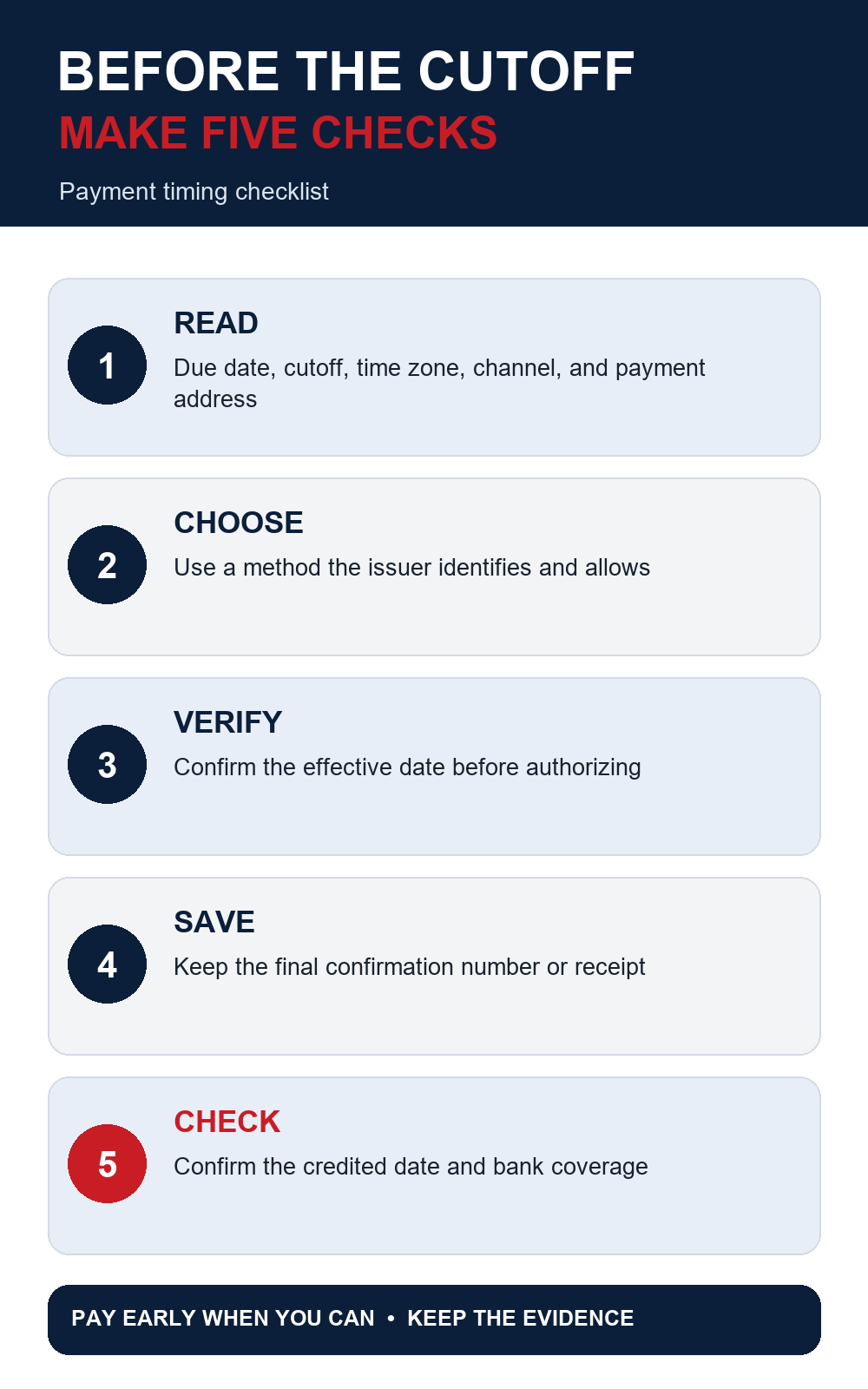
Five checks turn “I paid today” into evidence that the issuer received a conforming payment on time.
A worked due-date example
Suppose a statement says the minimum payment is due Tuesday, September 15, and lists a 5 p.m. Central Time cutoff.
| Action | Likely timing result | Why |
|---|---|---|
| Authorize a payment on the issuer's website at 4:42 p.m. Central and save the confirmation | Generally on time | It was authorized through the issuer's channel before the stated cutoff |
| Authorize the same payment at 5:08 p.m. Central | May count on the next business day | It missed the stated cutoff |
| Tell your bank's bill-pay service to send the payment Tuesday morning | Not automatically on time | The issuer may receive the transfer after Tuesday |
| Put a check in the mail Tuesday | Not on time merely because it was mailed that day | Receipt, not the postmark, generally controls |
The practical answer is not “all online payments are instant.” It is “follow the issuer's instructions and verify the receipt date.” A confirmation page that shows the amount, account, authorization date, and effective date is stronger evidence than a screen that only says “submitted.”
What if the due date falls on a Sunday or holiday?
The weekend-and-holiday rule is narrower than many people assume. The CFPB explains that if the issuer does not accept mailed payments on the due date, a mailed payment received by 5 p.m. on the next business day must be treated as on time. However, if the issuer accepts electronic or phone payments on the due date, those payments generally still must be made on the stated due date.
That means you should not automatically move every Sunday due date to Monday. Check the payment channel and instructions. When possible, schedule the payment for the preceding business day and remove the ambiguity.
Five checks before you press submit
- Read the payment instructions on the current statement. Confirm the due date, time zone, cutoff, accepted channel, and mailing address.
- Distinguish “send” from “receive.” A bank bill-pay delivery estimate is more useful than its send date. Mail needs transit time.
- Review the effective date before authorizing. The screen may default to tomorrow or the next business day even though you are submitting today.
- Complete every confirmation step. Do not close the page at “review payment.” Save the final confirmation number or receipt.
- Check the account afterward. Confirm that the payment appears with the expected credited date and that the available bank balance can cover it.
Minimum-payment safety comes first. If cash is tight, protect the required minimum by the cutoff before directing extra money to another debt. A faster payoff strategy helps only after each account stays current.
How one missed cycle can change a payoff projection
Missing a cutoff does not create the same cost in every account. Fees depend on the agreement and applicable law, interest depends on the balance and APR, and some issuers may waive a first mistake. The example below is a transparent stress test—not a prediction of what one late payment will cost you.
Assume a $5,000 credit card at 24.99% APR with a fixed $200 monthly payment. The on-time plan starts in September 2026. The comparison assumes a cutoff problem leads to one full skipped payment cycle, a hypothetical $30 fee, and one month of interest before $200 payments resume in October.
| Hypothetical path | Modeled payoff time | Modeled interest | Modeled total repaid |
|---|---|---|---|
| Payment stays on schedule | 36 months | $2,135.18 | $7,135.18 |
| One-cycle disruption plus assumed $30 fee | 39 months | $2,391.84 | $7,421.84 |
| Difference | 3 months | $256.66 | $286.66 |
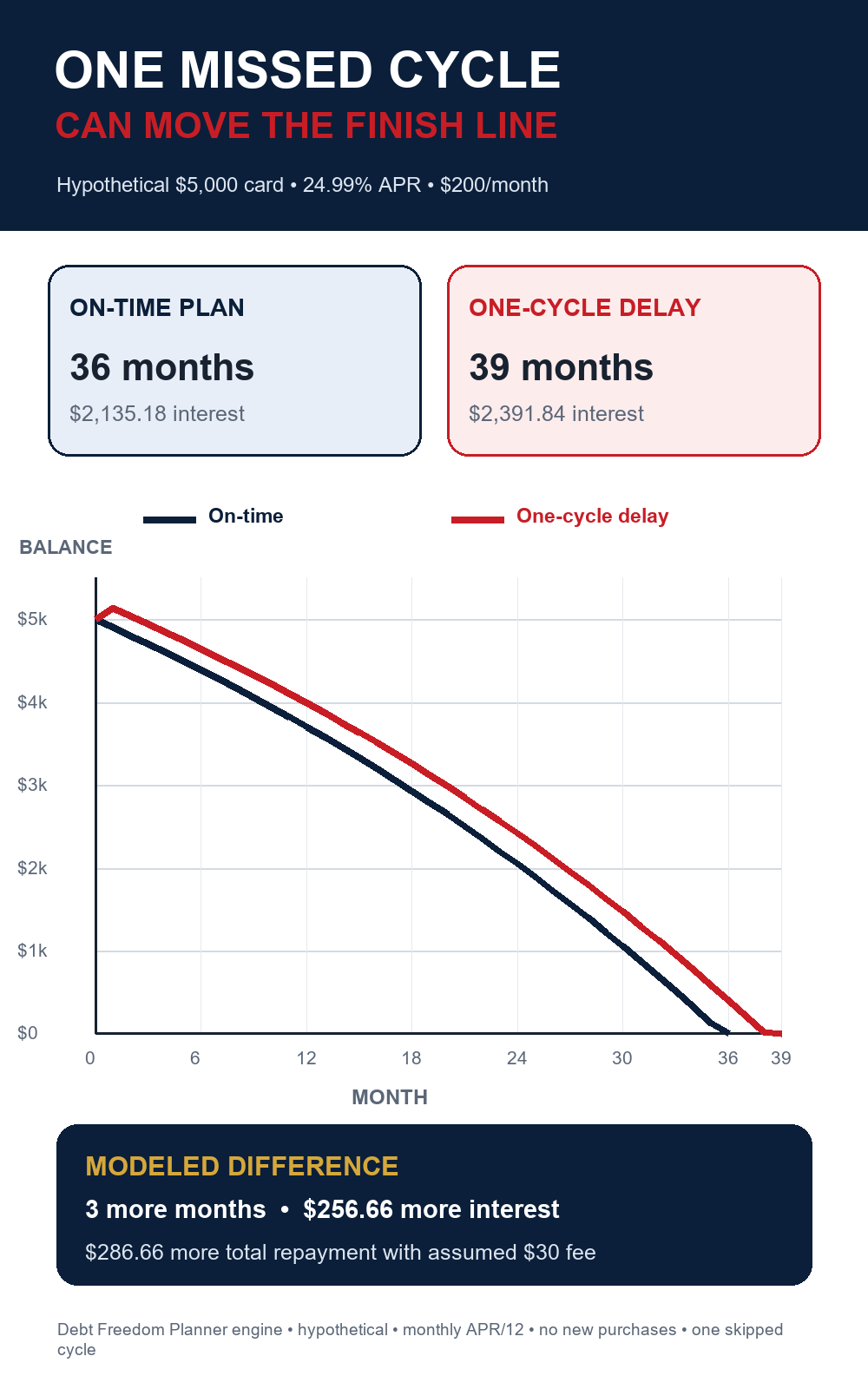
Debt Freedom Planner payoff-engine comparison using monthly APR/12 interest, cent rounding, no new purchases, a fixed $200 payment, one fully skipped cycle, and one hypothetical $30 fee. Actual card calculations and fees can differ.
The point is not that a few minutes after a cutoff always causes $286.66 of damage. The graph shows how a payment disruption can push a high-APR balance off its planned path when the missed amount is not caught quickly.
What should you do if a payment looks late?
First, do not immediately send a duplicate payment without checking whether the original is pending. A second debit could strain your checking account.
Then:
- Save the confirmation, bank record, statement instructions, and a screenshot of the credited date.
- Contact the issuer using the number on the back of the card or on the statement.
- Ask whether the payment was received, whether it met the stated method requirements, and which date was credited.
- If the issuer received a conforming payment on time but credited it late, point to the confirmation and ask for any resulting charge to be corrected. Regulation Z requires an account adjustment when improper payment crediting causes finance or other charges.
- If you truly missed the deadline, ask whether the issuer will waive the fee, then bring the account current as quickly as your situation allows.
- Check the next statement for the credited payment, fee reversal, interest, minimum due, and any change to the account's grace-period status.
Build cutoff protection into your debt payoff plan
A payoff plan is easier to follow when payment timing is part of the setup instead of a last-minute decision each month.
- Put every due date, time zone, and issuer cutoff in one calendar.
- Schedule at least the minimum early enough to survive a processing problem.
- If you use autopay, confirm the amount and bank balance before the draft date.
- Keep a small checking cushion so a payment is less likely to be returned.
- Direct extra money only after the required payments are protected.
- Recalculate after a fee, returned payment, APR change, or missed cycle changes the real balance.
You can use Debt Freedom Planner to enter the current balances, APRs, and minimum payments, compare payoff orders, and test what happens when your monthly amount changes. It does not move money or connect to your bank; use the issuer's own payment instructions for the actual transaction.
Bottom line
Paying on the due date can count, but “I clicked submit today” is not enough by itself. Use the issuer's stated channel, act before the applicable cutoff in the stated time zone, verify the effective date, and save the confirmation. When you can, pay one business day early so the debt payoff plan does not depend on a same-day timing rule.
This article is for educational information only and is not individualized financial, legal, credit-repair, or tax advice. Card agreements, state law, payment systems, and account facts vary; confirm your issuer's current instructions and seek qualified help for your situation.
0 comments
Ask a question, add context, or share what worked for your household.
Create a free account or sign in to comment, reply, and vote on blog posts.