
What Should You Do If a Credit Card Payment Is Returned After It Looked Successful?
Verify both accounts before retrying, protect the due date, document fees, and rebuild the payoff plan from the balance that is actually owed.
A credit-card payment that first appears successful can still be returned if the funding bank does not honor it. Treat the balance as unpaid until the issuer confirms a valid payment has posted: check both accounts, learn whether the same debit will be re-submitted, protect the due date with a replacement only after ruling out a duplicate, save the evidence, and recalculate your payoff plan from the verified balance.
A confirmation screen is useful evidence, but it is not the same as final settlement. Verify the card account and the funding bank before retrying a payment.
Why can a credit-card payment look successful and then be returned?
A payment can move through several statuses before it is final. An issuer may show a scheduled, pending, or provisionally posted credit while the debit is still being presented to your bank. If the bank does not honor it—because of insufficient available funds, a closed or restricted account, incorrect account details, or another processing problem—the issuer can reverse the credit and mark the payment returned.
The CFPB's credit-card contract definitions define a returned payment as a payment that is not honored by the consumer's financial institution. The same definitions warn that the card agreement may authorize a returned-payment fee and that the funding bank may impose its own fee.
This is different from a payment that the issuer never received or credited correctly. If a payment should appear on the statement but does not, CFPB guidance says to contact the card company and, to protect billing-error rights, send a written notice to the billing-dispute address within 60 days after receiving the statement that should have reflected it.
What should you do first?
Start by comparing the same transaction on both sides:
| Check | What to capture |
|---|---|
| Credit-card account | Status, reversal date, amount now due, due date, fees, and whether the issuer plans to re-submit the debit |
| Funding bank or credit union | Available balance on the debit date, pending holds, returned-item code or reason, and any bank fee |
| Your records | Confirmation number, screenshot or receipt, date and time submitted, payment channel, and account used |
Call the number on the back of the card or on a statement you independently retrieved. Ask, “Has this payment been returned, or is it still pending? Will you re-submit the same debit? What valid amount must arrive, and by what date?” Then ask the funding institution why it did not honor the debit.
Do not assume a green check mark, confirmation email, or temporarily lower balance means the payment is final. Also do not immediately press “pay” again. If the issuer is already re-submitting the debit—or if another payment is pending—an unplanned duplicate could strain the checking account and trigger a different cash-flow problem.
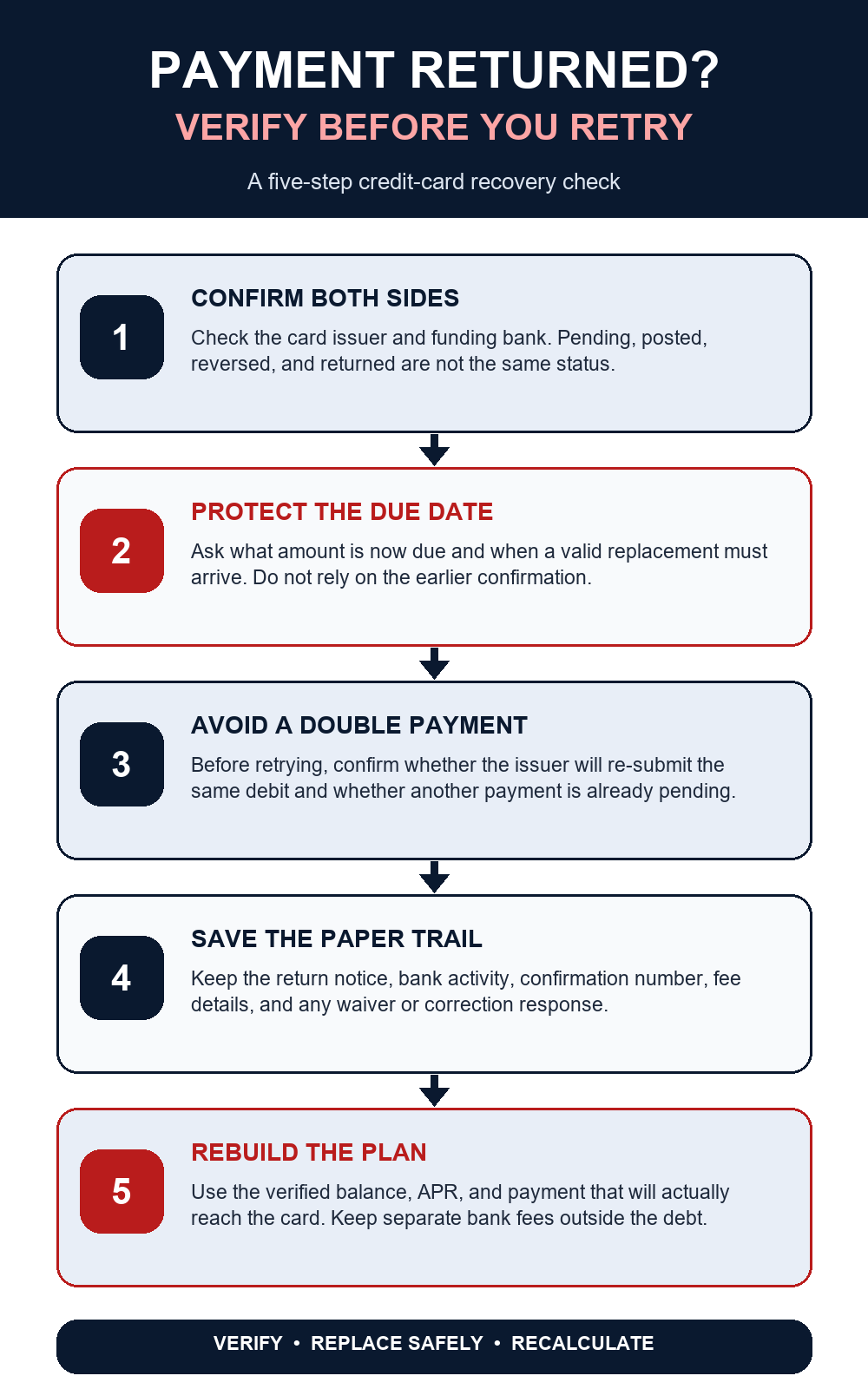
Confirm both accounts, protect the due date, rule out a duplicate debit, preserve the records, and rebuild the payoff projection from verified numbers.
Should you send a replacement payment right away?
Protecting the due date matters, but the safe sequence is verification first, replacement second. Once the issuer confirms the original debit will not settle—or tells you exactly how a re-submission will work—choose a valid payment source and follow the issuer's instructions for the amount and deadline.
CFPB due-date guidance explains that a payment generally must be received by the due date, not merely sent that day, and that even online bill-pay services can take time. If the original payment was returned after the due date, ask whether a replacement can still prevent or reverse a late fee, how it will be credited, and whether any grace-period treatment changed. A waiver is possible at an issuer's discretion, but do not plan as though it is guaranteed.
Use cleared money for the replacement. If the returned payment exposed a timing gap between payday and the card due date, move the future payment date earlier only if the funding balance will truly be available. Autopay reduces manual work; it does not guarantee the bank will honor the debit.
Can the issuer charge a returned-payment fee and a late fee?
The answer depends on the card agreement, the event, and applicable law. Review the fee table and the transaction history instead of assuming every charge is valid—or invalid.
Current Regulation Z fee limitations address penalty fees on consumer credit-card accounts. Among other limits, a returned-payment fee cannot exceed the required minimum periodic payment associated with that event. The rule's official examples also say an issuer cannot impose another returned-payment fee when it re-submits the same payment and that same payment is returned again. A genuinely new payment that is later returned is a separate event.
A returned payment and a late payment are not automatically identical. But if the reversal leaves the required minimum unpaid after the due date, the account history can also show a missed or late minimum under the agreement. Ask the issuer to identify each fee, the event and date behind it, and the agreement term relied on. Compare that explanation with the statement and your bank record.
If the fee or payment credit looks wrong, use the issuer's billing-error process. The CFPB's five-step billing-error guide recommends reviewing the statement, contacting the issuer, following up in writing, paying undisputed amounts on time, and keeping copies.
Worked example: what can one returned payment change?
Assume a household has a hypothetical $4,800 credit-card balance at 26.99% APR and intends to pay $225 every month. There are no new purchases. The Debt Freedom Planner engine models interest monthly as APR divided by 12 with cent rounding.
For the returned-payment path, assume the first $225 payment is not honored, no replacement reaches the issuer during that modeled cycle, $107.96 of interest accrues, and a hypothetical $30 returned-payment fee is added. The next cycle therefore begins at $4,937.96, and honored $225 payments resume.
| Hypothetical path | Payoff time | Modeled interest | Assumed fee | Total paid |
|---|---|---|---|---|
| Every $225 payment honored | 30 months | $1,812.15 | $0 | $6,612.15 |
| First payment returned; resume next cycle | 32 months | $2,053.93 | $30 | $6,883.93 |
| Difference | 2 months | $241.78 | $30 | $271.78 |
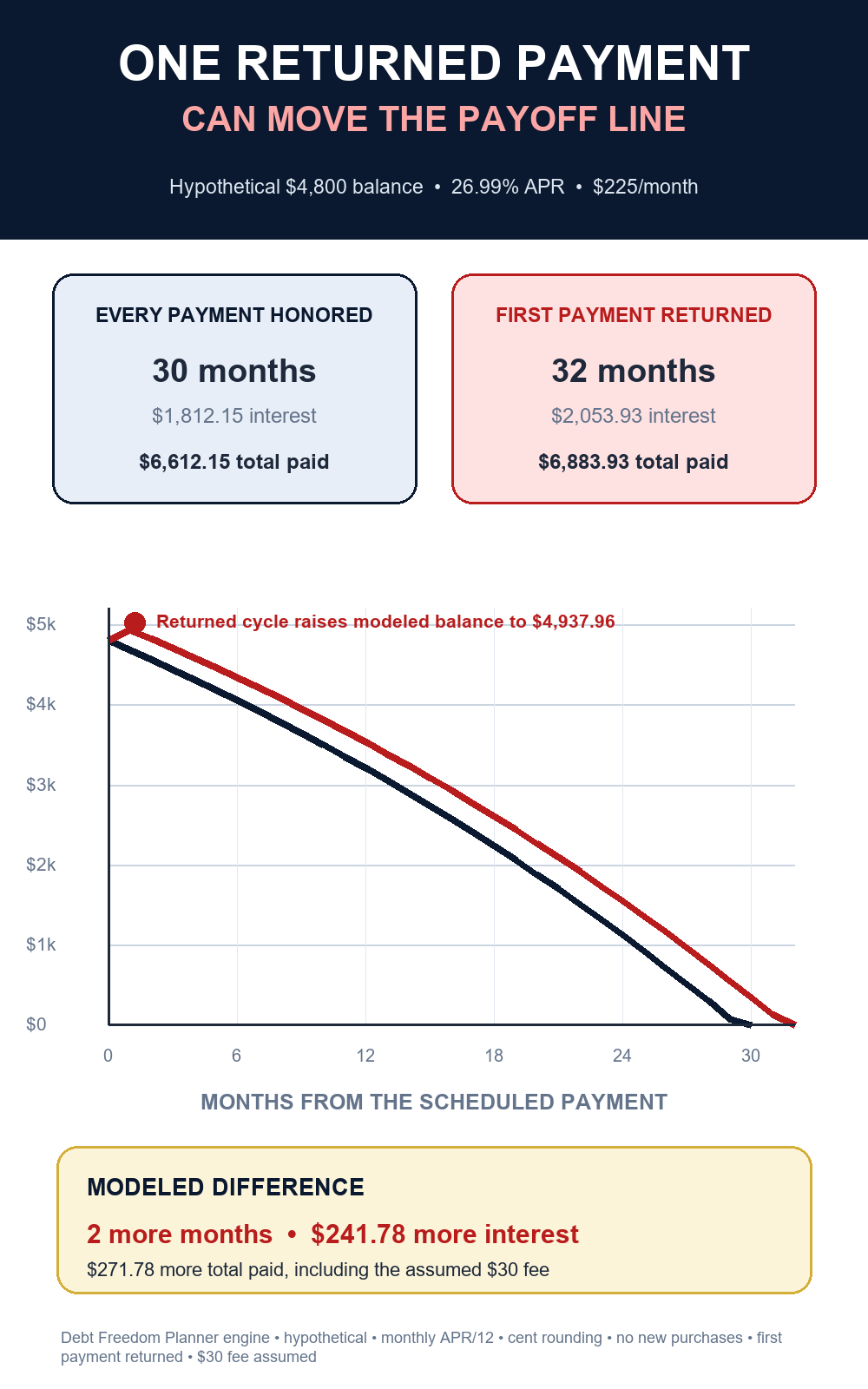
Debt Freedom Planner engine example: $4,800 at 26.99% APR with $225 monthly. The returned path assumes one cycle without a valid payment and a $30 fee before payments resume. Actual card interest and fee timing can differ.
The example does not predict what your issuer will charge and does not assume the fee is lawful. Real cards commonly use daily balance methods, so the exact return date, replacement date, fee posting date, and purchases can change the result. The lesson is narrower: a temporarily credited payment should not remain in a payoff model after the credit is reversed.
How should you update your payoff plan?
After the issuer and bank agree on the transaction status, update three inputs:
- Verified current balance. Include interest or fees only when the card account actually shows them. Keep a separate bank returned-item fee outside the card balance unless it was charged to the card.
- APR now in effect. Use the purchase APR that applies to the modeled balance. Do not assume a penalty APR started; verify the statement and notices.
- Payment that will actually reach the card. A confirmation for a debit that was later returned is not a completed payoff payment.
Then enter those numbers in Debt Freedom Planner. You can compare snowball and avalanche order, test a different monthly payment, and review the modeled payoff date, total interest, and month-by-month schedule. If the replacement payment reduces what you can send to another debt this month, model the amount you can actually sustain rather than the amount you originally intended.
The planner does not connect to banks, move money, verify whether a debit settled, waive fees, interpret account contracts, or submit billing disputes. It projects a schedule from the balances, APRs, minimums, and extra payment you enter.
How can you reduce the chance of another return?
Use a short pre-payment check:
- Confirm the funding account and routing details.
- Check available funds, not only the ledger balance; pending transactions and holds can matter.
- Leave a practical cushion for payments that have not cleared.
- Avoid scheduling multiple card and household debits against the same dollars.
- Review both the bank and card accounts until the debit clears and the payment remains posted.
- Keep the issuer's confirmation and the bank transaction record together.
- If the due date repeatedly falls before income arrives, ask whether the issuer offers a due-date change and understand when that change takes effect.
Do not solve a repeated return by cycling the same payment through an unfunded account. Pause, confirm the true cash available, make at least the required payment through a valid method when possible, and revise the extra-payment goal to something sustainable.
Bottom line
When a credit-card payment is returned after it looked successful, verify the issuer and bank records before sending another payment. Confirm whether the same debit will be re-submitted, protect the due date with a valid replacement, challenge any incorrect credit or fee through the proper process, and replace the reversed payment in your payoff model with the verified balance. The faster you turn a provisional confirmation into a documented final status, the less likely one failed debit is to disrupt the rest of your plan.
This article provides educational information, not individualized financial, legal, tax, credit-repair, or banking advice. Account agreements, processing timelines, fee rules, state law, and individual facts vary. Confirm current instructions with your card issuer and financial institution, and consult a qualified professional when needed.
0 comments
Ask a question, add context, or share what worked for your household.
Create a free account or sign in to comment, reply, and vote on blog posts.