

What Happens If a Credit Card Penalty APR Starts After You Are 60 Days Late?
Track the first six required payments after a delinquency-based penalty APR, understand the separate six-month review, and model the payoff impact.
If a credit-card issuer raises your APR because it did not receive a required minimum payment within 60 days after the due date, the first goal is to stop the delinquency from getting worse and make the next six required minimum payments on time. Under federal Regulation Z, six consecutive qualifying payments can require the issuer to restore the pre-increase rate on the eligible balance. Keep the rate notice and every payment confirmation, because this six-payment rule is separate from the issuer's broader six-month rate-review duty.

A penalty APR can make a payoff plan more expensive, but the next due date matters more than panic. Track the exact payment sequence and verify the rate change on the statement.
What happens when a credit-card payment is more than 60 days late?
Credit-card issuers generally cannot raise the rate on an existing balance whenever they choose. One important exception applies when the issuer has not received a required minimum periodic payment within 60 days after its due date. The CFPB's current consumer guidance explains that this can allow a rate increase on an existing balance.
That does not mean every account changes on the sixtieth day or that every issuer uses the same penalty APR. Read the notice and card agreement. Confirm:
- the missed payment and due date that triggered the increase;
- the penalty APR and its effective date;
- which existing balances and new transactions it covers;
- the next required minimum amount and due date;
- what the notice says about six consecutive on-time payments; and
- whether late fees or other account restrictions also apply.
Regulation Z section 1026.55 requires specific notice and rate-treatment protections when an issuer uses the delinquency exception. A notice is evidence you can use to build the recovery calendar; it is not just fine print to discard.
The six-payment restoration rule is precise
For a rate increase caused by this 60-day delinquency exception, the issuer must disclose that the increased rate, fee, or charge will stop applying if it receives six consecutive required minimum payments on or before their due dates. The sequence begins with the first payment due after the increase takes effect.
Every word matters:
| Rule element | Practical meaning |
|---|---|
| Six consecutive payments | A broken sequence can prevent the special automatic restoration rule from applying |
| Required minimum | A smaller partial payment may not count, even if money reaches the account |
| Received by the issuer | Scheduling a payment is not the same as the issuer receiving it |
| On or before the due date | Build in processing time instead of aiming for the last minute |
| First payment after the effective date | Do not start counting from the warning letter, the original missed payment, or a later convenient month |
The regulation's official interpretation also says this special rule does not apply when the first six-payment sequence fails, even if six on-time payments happen later. That is why a written calendar is more useful than a vague promise to “do better.” If the account is already in this window, ask the issuer which payment it considers number one.
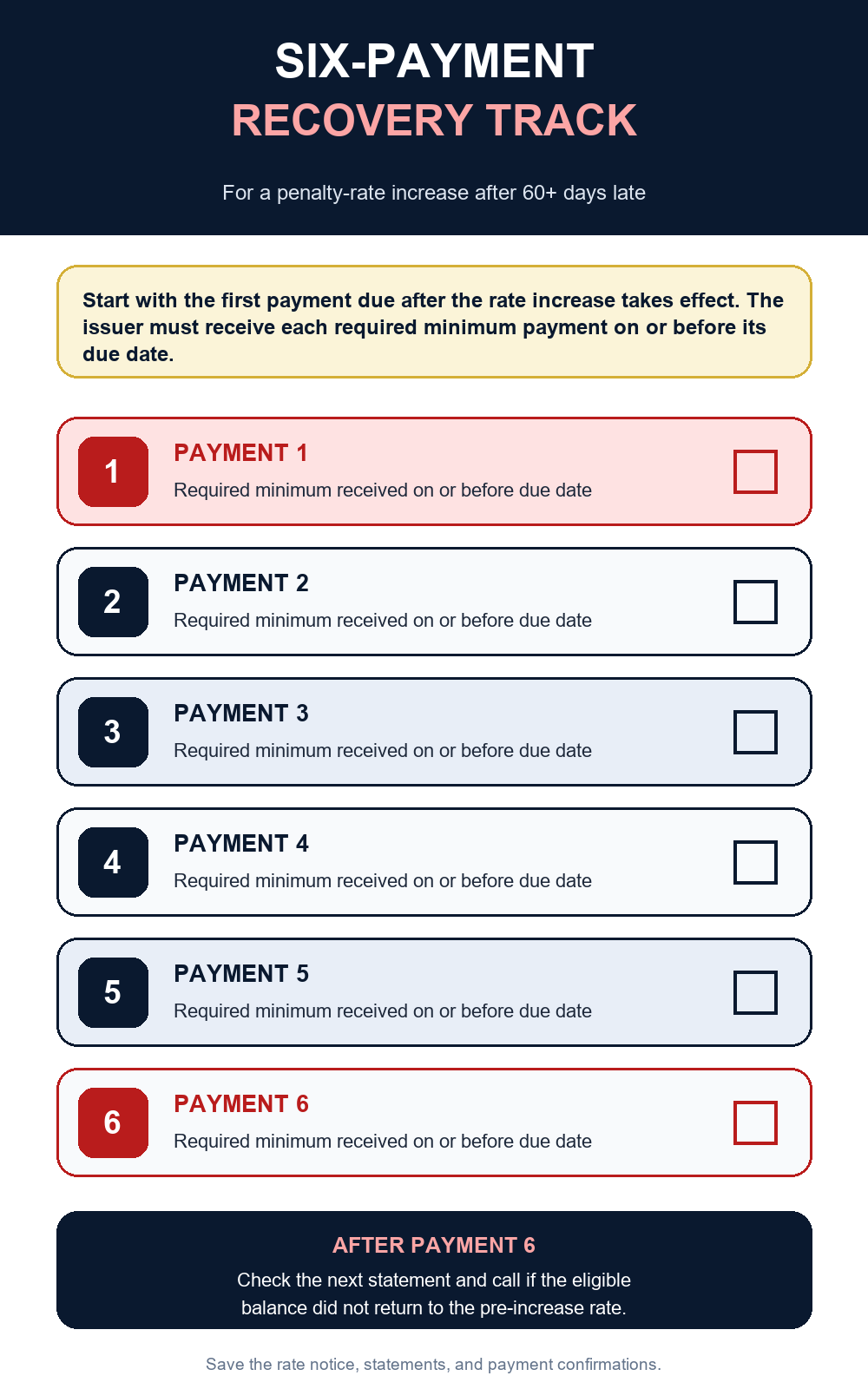
Start with the first payment due after the increase takes effect. Save the rate notice, each statement, and proof that all six required minimums were received by their due dates.
Which rate and balance must be restored?
The special restoration rule applies to the APR, fee, or charge increased under the 60-day delinquency exception. For transactions that occurred before, or within 14 days after, the required notice, section 1026.55 generally requires the issuer to reduce the increased rate to the rate that applied before the penalty increase when the six-payment conditions are met.
That does not promise that every future purchase will receive the old rate forever. A temporary promotional rate may expire, a variable rate can move with its index, and new transactions can be governed by the notice and account terms. After payment six, compare the next statement with the notice. Look separately at:
- the APR on the protected existing balance;
- the APR assigned to newer purchases or cash advances;
- any variable-rate index change; and
- fees or charges that were part of the delinquency increase.
If the eligible balance did not return to the required rate, contact the issuer promptly and provide the six payment dates and confirmation numbers. Keep notes of the call and any written response.
Six on-time payments and a six-month review are different protections
It is easy to blend two “six” rules together, but they do different jobs.
The six-payment rule is tied to an increase caused by a payment that became more than 60 days delinquent. When its exact conditions are met, it requires the relevant reduction described above.
The broader rule in Regulation Z section 1026.59 requires an issuer to review covered rate increases at least once every six months. The issuer evaluates the factors that led to the increase or the factors it currently uses for similar new accounts. If the review shows that a reduction is required, the issuer must reduce the rate within the regulation's timing rules.
A six-month review does not automatically guarantee the original APR. The result can depend on the reason for the increase and the issuer's current pricing factors. Likewise, the fact that an issuer performs periodic reviews does not make it safe to miss one of the first six due dates after a delinquency-based increase.
What should you do before the next due date?
1. Protect the required minimum first
Paying the required minimum by the due date is the safety floor. An extra principal payment does not help if the required payment posts late or is applied in a way that leaves the minimum unpaid. Verify the amount and allow time for processing.
If the required minimum is not affordable, contact the issuer before the due date and ask about a hardship arrangement. Get the terms in writing. A hardship plan can change the rate, payment, account access, or payoff schedule, so do not assume it preserves the same six-payment path.
2. Remove avoidable timing risk
Consider scheduling earlier than the due date and setting a separate reminder to confirm that the payment posted. Automatic payment can reduce timing risk only if the funding account will have enough money. Keep a small checking-account buffer when possible, and do not treat a “scheduled” screen as final proof.
3. Stop adding expensive new balances
New purchases can complicate rate treatment and lengthen the recovery. If essentials must go on the card, record them honestly in the payoff plan. Otherwise, avoiding new charges makes the balance easier to model and reduces the chance that a high new-transaction rate stays in the account after the protected balance changes.
4. Separate recovery from acceleration
For the first six due dates, minimum-payment safety comes before aggressive payoff tactics. Once the required payment is protected, an extra monthly amount can reduce interest and shorten the schedule. Do not drain rent, food, medicine, transportation, insurance, or a basic cash cushion merely to make the graph look faster.
Worked example: an $8,000 balance at 29.99%
Assume a hypothetical card has an $8,000 balance on the date a penalty APR takes effect. The prior APR was 19.99%, the penalty APR is 29.99%, and the household pays $300 every month. There are no new purchases, fees, or missed payments in the model.
Path A models six payments at 29.99%, leaving $7,360.81, and then applies 19.99% to that remaining balance. Path B keeps 29.99% for the full illustration.
| Hypothetical path | Rate assumption | Payoff time | Modeled interest | Modeled total paid |
|---|---|---|---|---|
| Six qualifying payments, then prior APR | 29.99% for 6 months, then 19.99% | 38 months | $3,342.35 | $11,342.35 |
| Penalty APR continues for illustration | 29.99% until payoff | 45 months | $5,344.65 | $13,344.65 |
| Modeled difference | — | 7 months | $2,002.30 | $2,002.30 |
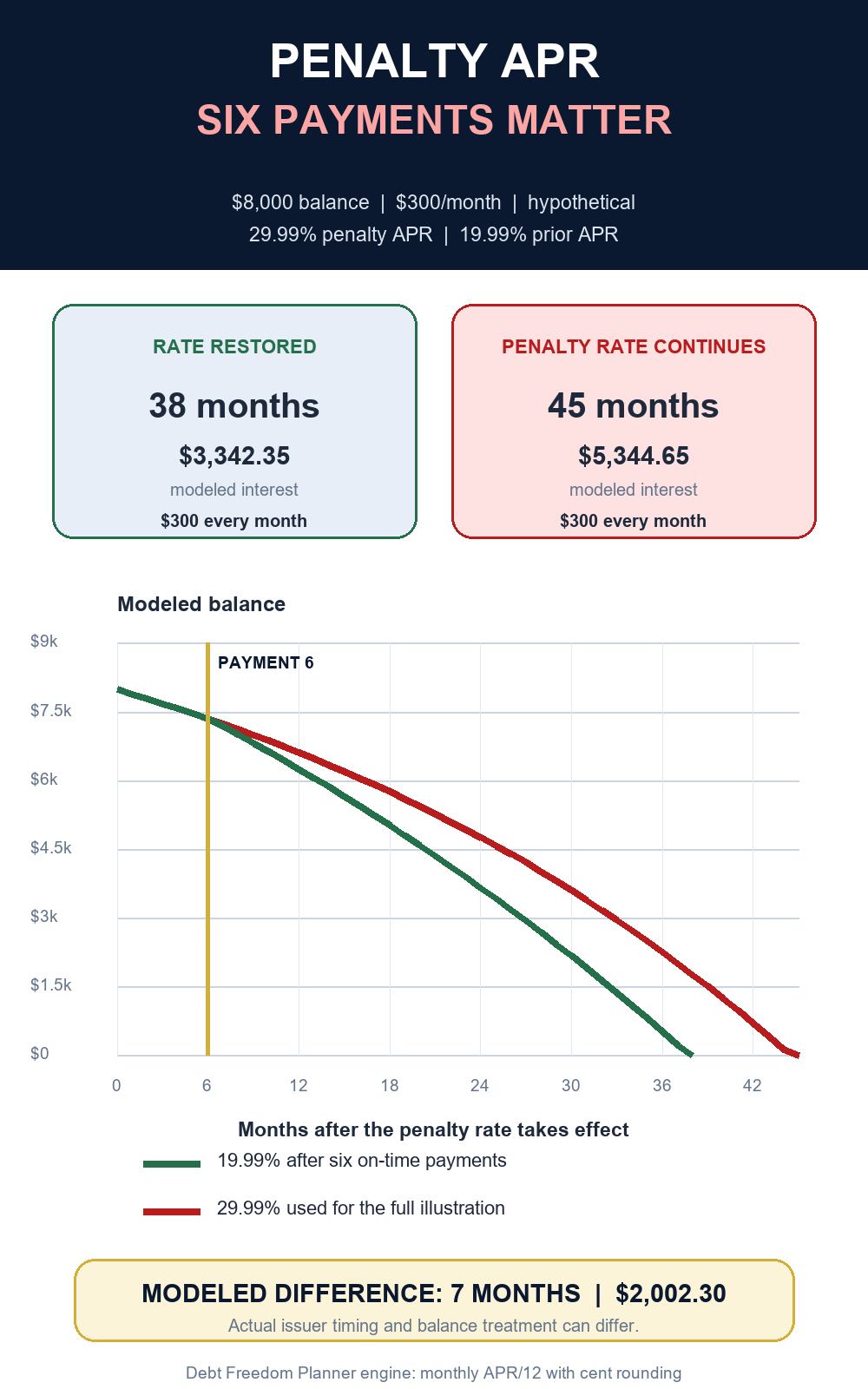
Debt Freedom Planner engine example: $8,000, $300 monthly, 29.99% for the first six modeled months, then either 19.99% or 29.99%. The engine uses monthly APR divided by 12 with cent rounding.
The continued-penalty path is a comparison, not a prediction of what an issuer must or will do. The separate rate-review rule, the notice, variable-rate changes, the account agreement, and the transactions covered can all change the real result. The model also begins on the penalty-rate effective date, so it excludes prior missed payments, late fees, and credit-report consequences.
Still, the example shows why confirming the restored rate matters. With the same $300 payment, a ten-percentage-point difference in APR creates a large gap when the balance remains for several years.
How to model the new APR in Debt Freedom Planner
Use the issuer's actual statement figures—not the hypothetical numbers above—to test the payoff effect in Debt Freedom Planner:
- Enter the current balance, current penalty APR, required minimum, and any extra monthly amount you can reliably sustain.
- Save that as the penalty-rate scenario.
- Create a second scenario using the rate the notice says should apply after the qualifying sequence.
- Compare payoff months, total modeled interest, and the monthly schedule.
- When the issuer actually changes the rate, update the plan with the posted balance and APR rather than relying on the forecast.
Debt Freedom Planner does not connect to your card, decide whether a payment counted, read an issuer agreement, restore an APR, or predict credit-score effects. It models the balances, APRs, minimums, and extra payments you enter so you can see how a verified rate change affects the payoff path.
Bottom line
After a penalty APR starts because a required minimum payment was not received within 60 days after its due date, focus on the next six required minimums. Track the first due date after the increase takes effect, pay each required amount early enough to be received on time, keep proof, and inspect the statement after payment six. Then distinguish the special six-payment restoration rule from the issuer's separate six-month reevaluation duty.
This article provides educational information, not individualized financial, legal, credit-repair, debt-relief, or bankruptcy advice. Card agreements, notices, variable rates, hardship arrangements, payment posting, state law, and account facts differ. Confirm your terms with the issuer and consult a qualified professional when appropriate.
0 comments
Ask a question, add context, or share what worked for your household.
Create a free account or sign in to comment, reply, and vote on blog posts.