

What Happens to a Credit Card Refund After You Already Paid the Balance?
A merchant refund usually returns to the card you used. Learn how a credit balance works, when to request the money back, and how to update another payoff plan without double-counting it.
If a merchant refunds a purchase after you already paid the credit card balance, the refund normally posts back to that card account. If you owe nothing, it can create a credit balance—often displayed as a negative balance—which means the card issuer owes you money. You can usually leave the credit for future charges or ask the issuer to return it. Do not subtract a promised refund from another debt plan until the credit has actually posted and you know when the cash will be available.

A merchant refund usually travels back to the card used for the purchase. Paying the statement first does not redirect the refund to your checking account.
Where does the refund go after the card is paid off?
The refund generally returns to the same credit card account. What happens next depends on the account balance when the credit posts:
| Account before the refund | $350 refund posts | Result after posting |
|---|---|---|
| You still owe $900 | -$350 | You now owe $550 |
| You owe exactly $350 | -$350 | Balance becomes $0 |
| You owe $0 | -$350 | $350 credit balance |
| You owe $100 | -$350 | $250 credit balance |
The Consumer Financial Protection Bureau explains that a credit balance is money the card company owes you. A return, an overpayment, a reward, or a corrected billing mistake can create one when total credits exceed what you owe.
A negative sign can be confusing because card sites do not all display credits the same way. One issuer may show -$350, another may show $350 CR, and another may place the amount in a “credit balance” field. Check the transaction description and balance label instead of assuming every minus sign means new debt.
Does a refund count as a credit card payment?
A refund reduces the account balance, but it is not a safe substitute for a required payment unless your issuer's statement and account status clearly show that no payment is due. A merchant credit can post later than expected, be issued for a different amount, or arrive after the payment deadline.
Protect minimum-payment safety first:
- Pay at least the required minimum by the due date unless the issuer confirms otherwise.
- Do not rely on a merchant's “refund submitted” message as proof that the card account received the credit.
- Confirm the posted—not pending—transaction and the new statement balance.
- If a statement still shows a minimum due, follow the issuer's current instructions.
This distinction matters during payoff. A refund changes one card's balance when it posts. It does not automatically make a payment on a different card, move cash to your bank, or update a plan you saved earlier.
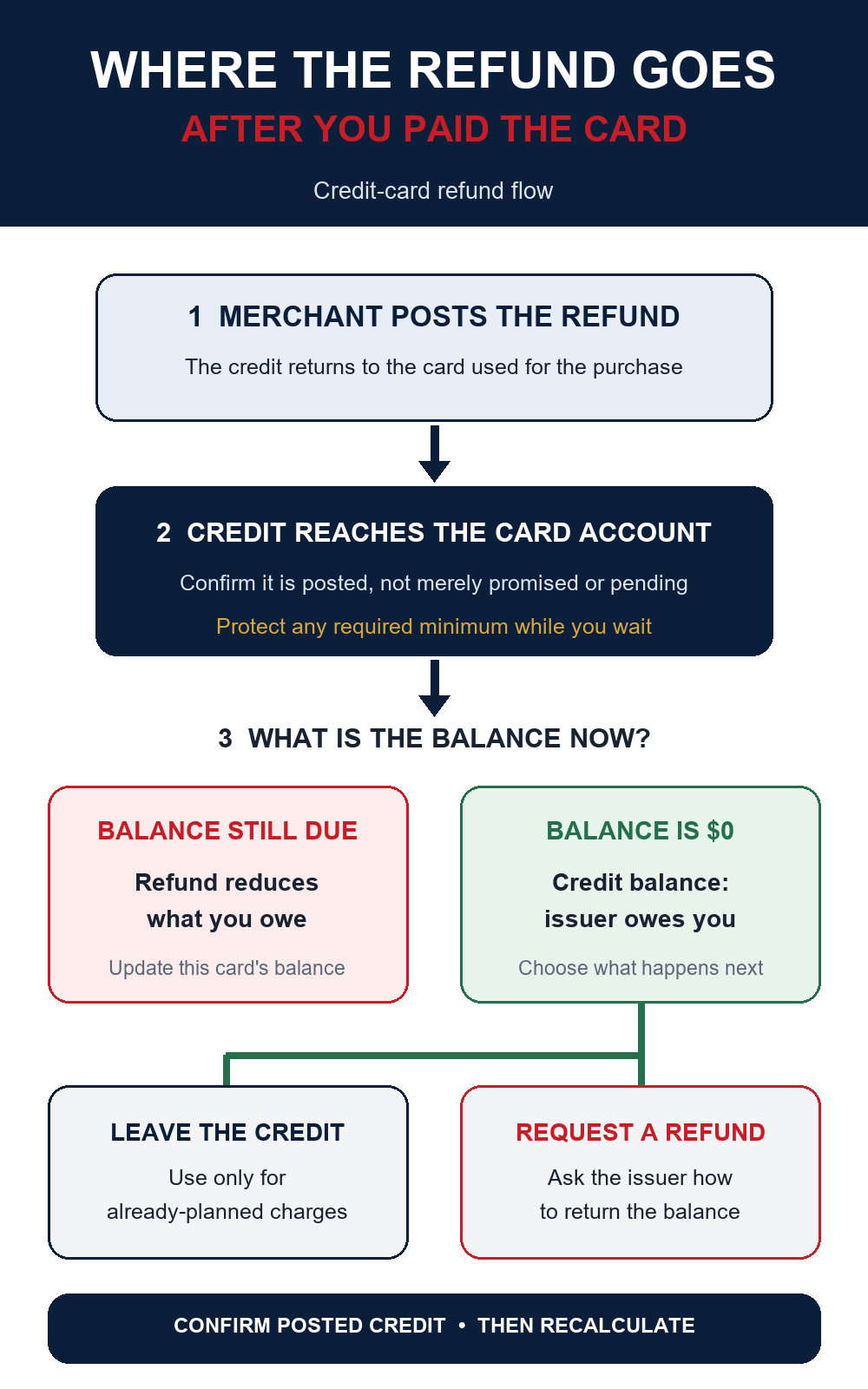
Follow the credit from the merchant to the card account first. Decide what to do with a true credit balance only after the transaction posts.
A worked refund example
Suppose you bought a $350 appliance on a credit card. You paid the $1,200 statement balance in full before returning the appliance. The merchant later posts a $350 refund.
- The card balance was $0 immediately before the refund.
- The $350 credit posts to the card account.
- The account now has a $350 credit balance.
- If you then make $200 of planned purchases, the credit can absorb those charges and leave a $150 credit balance.
- If you make no new purchases, you can ask the issuer to return the available credit instead.
The refund does not normally increase your checking balance the moment the merchant approves it. It must reach the card account, and a separate issuer refund may be needed before you have cash to send elsewhere.
Can you ask the card company to send the credit balance back?
Yes. The current Regulation Z credit-balance rule applies when a credit balance greater than $1 is created. The issuer must credit the amount to the account. If you send a written request, the issuer must refund any remaining credit balance within seven business days after receiving that request.
The rule also requires a good-faith effort to refund a credit balance that remains for more than six months. The amount returned can reflect purchases or other debits that reduced the credit before the refund became due. The CFPB's consumer guidance says an issuer may accept a phone request but might ask for the request in writing.
Before requesting a check or deposit, ask:
- Is the merchant credit fully posted rather than pending?
- What is the current credit balance after newer purchases or fees?
- Does the issuer require a written request, and where should it be sent?
- Will the refund arrive by check or deposit?
- What tracking or confirmation will the issuer provide?
Keep the merchant confirmation, the statement showing the credit, your refund request, and the issuer's response until the money arrives.
What if the merchant has not issued the refund?
Start with the seller. The CFPB recommends asking the company that sold the product or service to fix the problem or reverse the charge. A merchant refund, a chargeback, and a billing-error claim are related but not identical processes.
If the seller does not resolve the issue, contact the card issuer and ask what dispute rights and deadlines apply. The CFPB notes that a written billing-error notice generally must reach the issuer within 60 days after the charge appears on the statement when the facts qualify. Do not describe a valid purchase return as fraud, and do not assume that paying the card erased every dispute right. Save the order, return tracking, seller messages, and statements so you can explain what happened accurately.
Could the refund help you pay another card faster?
Potentially—but only through a deliberate cash-flow step. A $600 credit on Card A does not automatically reduce Card B. You could request the $600 back and use it after it arrives. Or, if you already planned $600 of ordinary purchases, you could let Card A's credit cover those purchases and direct the $600 of cash you no longer need for them to Card B. Avoid creating new spending just to “use up” a credit.
Here is a transparent hypothetical using the Debt Freedom Planner payoff engine:
- Card A has a posted $600 credit balance.
- Card B has a $4,000 balance at 27.99% APR.
- Card B receives $200 every month.
- The comparison path adds one extra $600 payment to Card B in month one.
- There are no new purchases or fees, and interest is modeled monthly as APR divided by 12 with cent rounding.
| Hypothetical Card B path | Payoff time | Modeled interest | Modeled total paid |
|---|---|---|---|
| Keep paying $200/month | 28 months | $1,450.35 | $5,450.35 |
| Add $600 in month one, then $200/month | 23 months | $1,003.84 | $5,003.84 |
| Modeled difference | 5 months sooner | $446.51 less | $446.51 less |
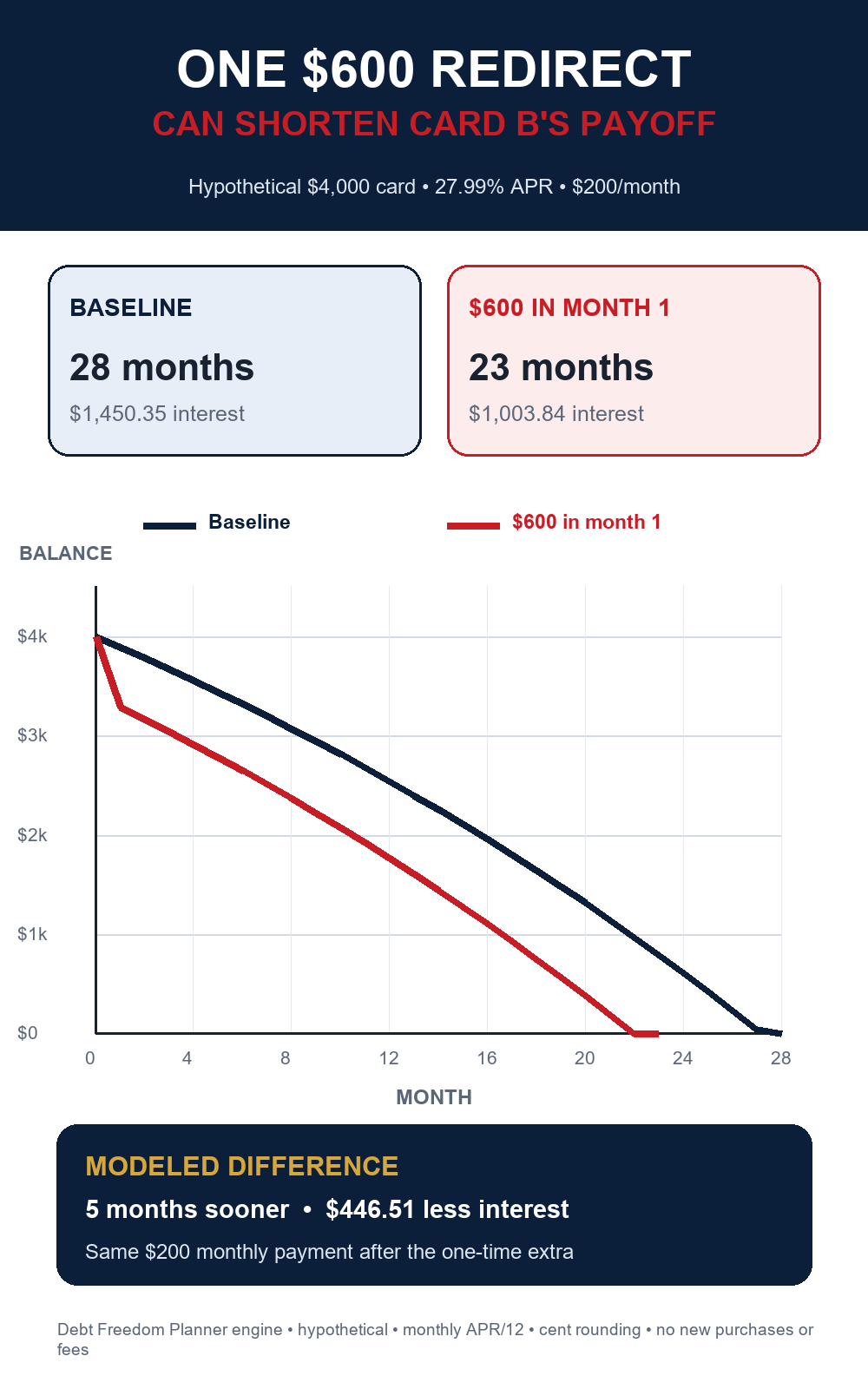
Debt Freedom Planner engine example: $4,000 at 27.99% APR, $200 monthly, no new charges or fees, and one hypothetical $600 extra payment in month one. The refund sits on a different card; the graph assumes the household separately redirects equivalent available cash.
This example does not promise that every $600 refund saves $446.51. Actual issuer calculations, payment timing, minimums, and spending differ. It shows why the plan should be recalculated only after you know which balance changed and what cash is truly available.
How to update your debt payoff plan without double-counting the refund
Use this sequence:
- Wait for the merchant credit to post. Keep the old balance in your plan while the refund is only promised or pending.
- Identify the actual destination. Confirm whether it reduced an owed balance or created a credit balance.
- Protect every required minimum. A pending refund should not make another payment late.
- Choose the credit-balance path. Leave it for already-planned purchases or request it back; do not invent purchases to consume it.
- Move only available cash. Redirect money to another debt only after it is received or genuinely freed in the household budget.
- Recalculate from current numbers. Update balances, APRs, and minimums so the payoff date reflects the account today.
You can use Debt Freedom Planner to enter the current balances, compare snowball and avalanche order, test a one-time change through a revised scenario, and see a month-by-month projection. The planner does not connect to your bank, issue refunds, or move money. Use the merchant and card issuer for the actual transaction.
Bottom line
When a refund arrives after you paid the card, it usually returns to that card account. It reduces any new amount owed first; if credits exceed the balance, the issuer owes you the difference as a credit balance. Confirm that the credit posted, keep required payments safe, then decide whether to leave it for planned charges or request the money back. Update the rest of your payoff plan only when the refund is real and available—not when it is merely expected.
This article is for educational information only and is not individualized financial, legal, tax, credit-repair, or dispute advice. Merchant policies, card agreements, state law, transaction timing, and account facts vary; confirm current instructions with the seller and card issuer and seek qualified help for your situation.
0 comments
Ask a question, add context, or share what worked for your household.
Create a free account or sign in to comment, reply, and vote on blog posts.