

Why Did I Get Charged Credit Card Interest After Paying the Balance? Residual Interest Explained
Paid the statement but got another interest charge? See how residual interest builds, estimate it, and close the card balance cleanly.
You can receive another interest charge after paying the balance shown on your credit-card statement because interest may keep accruing between the statement closing date and the day your payment posts. That final amount is commonly called residual interest or trailing interest. It is most likely when you were already carrying a balance and no longer had a grace period. Paying the valid final charge and confirming a zero balance closes the loop; if the amount looks wrong, check the dates and your cardholder agreement before disputing it.

A paid statement is not always the same as a same-day payoff amount when interest is accruing daily.
Why interest can appear after a payoff payment
A credit-card statement is a snapshot. It shows activity through one closing date, but the payment due date usually comes later. If your account is accruing interest during that gap, the number on the statement may not include all interest that builds before the issuer receives and credits your payment.
The Consumer Financial Protection Bureau explains that, when you carry a balance, many card companies charge interest from the billing date until they receive the payment. The exact rule depends on the cardholder agreement.
This is different from a late fee. You can make the statement payment on time and still see residual interest if the account was already accruing interest. It is also different from deferred interest on a promotional purchase, which can reach back to the original purchase date if its terms are not met.
A worked residual-interest example
Suppose a cardholder has these hypothetical numbers:
| Input | Hypothetical amount |
|---|---|
| Balance when the statement closes | $3,200.00 |
| Purchase APR | 29.99% |
| Time until the payment posts | 18 days |
| New purchases, fees, or credits | None |
For a simplified estimate, divide the APR by 365 to get a daily periodic rate:
29.99% ÷ 365 = about 0.08216% per day
Then estimate the interest that accrues while the $3,200 remains unpaid:
$3,200 × (0.2999 ÷ 365) × 18 = $47.3267
Rounded to the nearest cent, that is $47.33. The cardholder sends $3,200, sees that payment post, and reasonably expects the next balance to be zero. Instead, the next statement may show roughly $47.33 because that interest was generated after the prior statement closed.
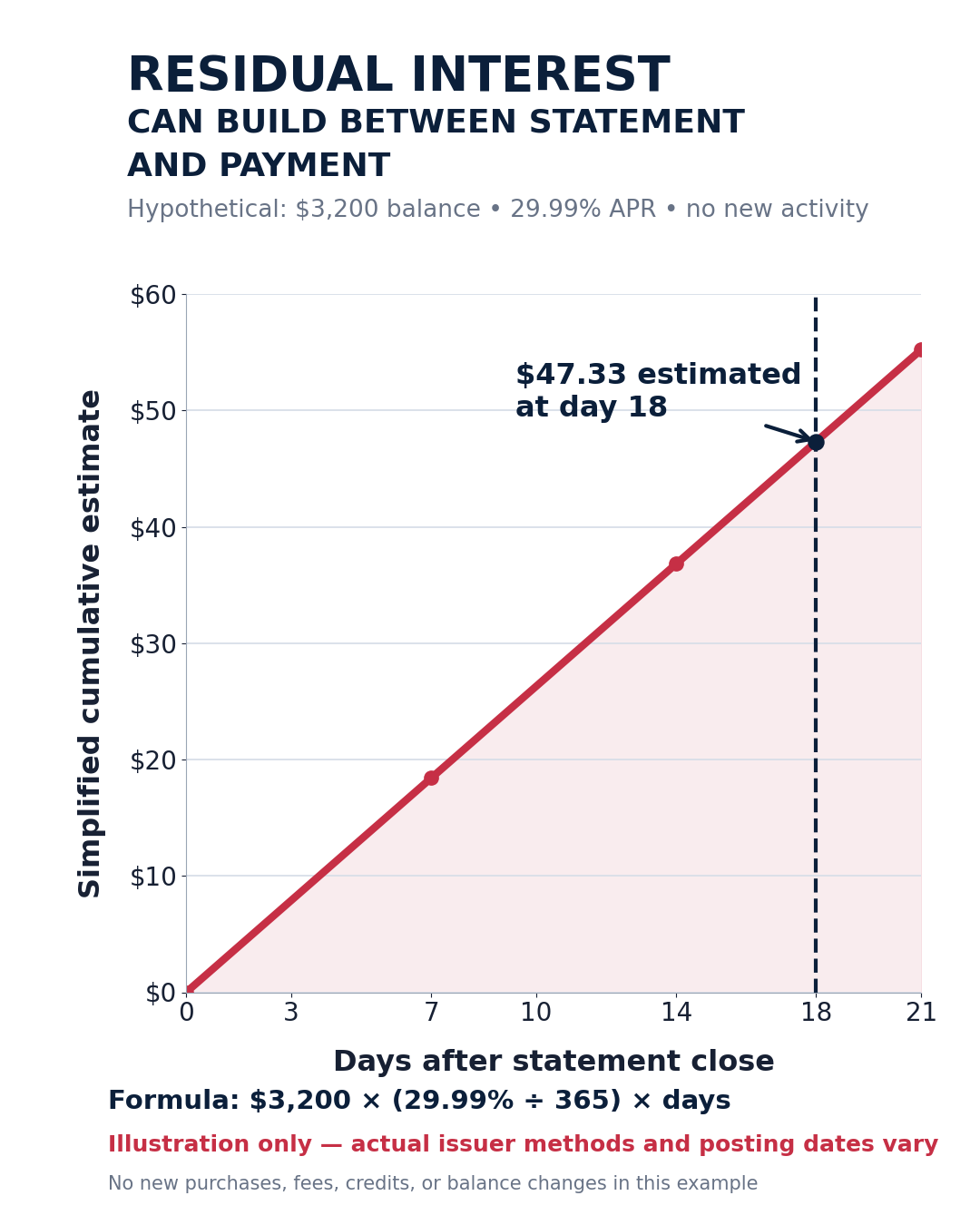
Hypothetical graph: a constant $3,200 balance at 29.99% APR, no new activity, and a simplified daily-interest estimate. Actual issuer calculations and posting dates can differ.
This calculation is an illustration, not a payoff quote. An issuer may use an average daily balance, compound amounts differently, separate purchases from cash advances or balance transfers, and apply its own posting rules. The CFPB's interest-calculation guide says many card companies calculate interest daily based on the average daily account balance.
Does a grace period prevent residual interest?
Often, but only when its conditions are met.
A grace period is the time between the end of a billing cycle and the payment due date. The CFPB's credit-card definitions say you may avoid purchase interest during that period if you pay the balance in full by the due date. Credit-card companies are not required to provide a grace period, though most cards provide one for purchases.
If you routinely pay the full statement balance and have an active purchase grace period, you generally should not see purchase interest. Residual interest becomes more likely when:
- you carried part of a balance from an earlier cycle;
- you recently paid off a revolving balance after interest had begun accruing;
- the account includes a cash advance or another balance category without the same grace period;
- the payment posted later than expected; or
- the agreement requires more than one full-pay cycle to restore a grace period.
Do not assume every balance category follows the same rule. A statement can show different APRs for purchases, cash advances, balance transfers, and promotional balances.
How to finish paying the card without another surprise
Use a short closeout process instead of treating the last statement balance as automatically final.
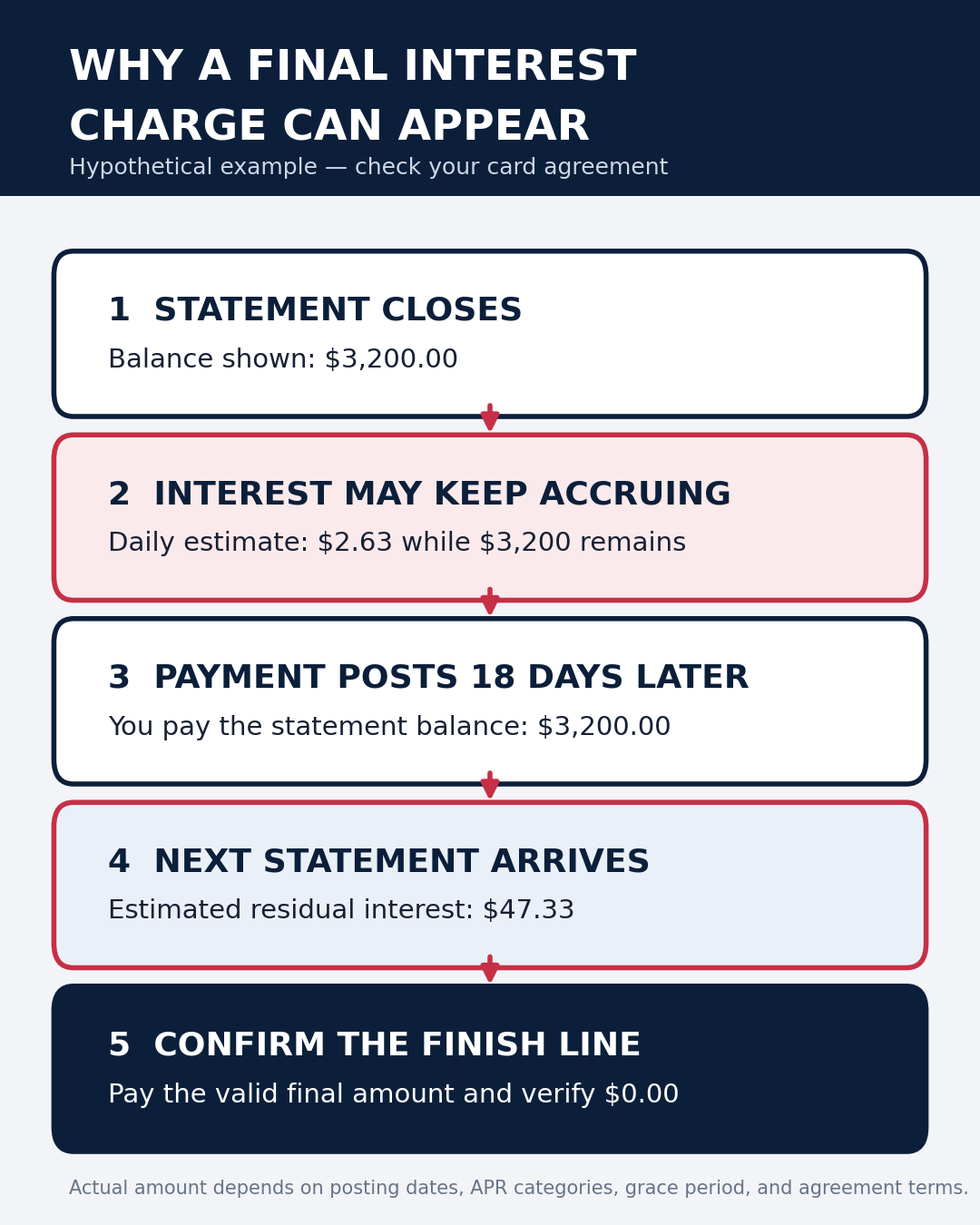
Closeout sequence: identify the statement snapshot, account for the posting gap, pay the valid final amount, and confirm the account reaches $0.00.
1. Stop adding new charges temporarily
Move recurring subscriptions and everyday purchases off the card while you are trying to bring it to zero. New activity can make it hard to tell whether the next amount is residual interest or a new purchase.
2. Read the interest-charge section
Check the statement for each balance category, its APR, the balance subject to interest, and the issuer's explanation of the calculation method. Review the cardholder agreement for grace-period conditions. The agreement, not a generic formula, controls your account.
3. Ask the issuer for the amount needed on your payment date
Call the number on the card and ask what amount would bring the account to zero on the date you plan to pay. Also ask whether more interest could post on the next statement and whether your purchase grace period is currently active. Write down the date, the representative's answer, and any confirmation number.
4. Pay early enough for the payment to post
Submitting a payment and having it credited are not always the same moment. Follow the issuer's payment instructions and cutoff time. Keep the confirmation until the account is settled.
5. Check the next statement and the online balance
Do not stop monitoring the card as soon as the large payment clears. Look again after the next statement closes. If a valid small residual amount appears, pay it promptly and confirm the balance becomes $0.00.
6. Keep minimum-payment protection until zero is confirmed
If you use autopay as a safety net, do not disable it prematurely. Review its rules so you do not accidentally make an unwanted duplicate payment, but keep a reliable reminder or minimum-payment safeguard until the issuer shows the account is fully settled.
What if the interest charge looks wrong?
First compare four details: the prior statement's closing date, the date the issuer credited your payment, the APR and balance category used, and the grace-period language in your agreement. Ask the issuer to show how it calculated the charge. A correctly calculated residual-interest charge is not a billing error merely because it appeared after your large payment.
If the issuer used the wrong balance, APR, or payment date, act quickly. The CFPB's credit-card billing-error guide recommends contacting the company and sending a written notice to protect your rights; it says the notice should be sent no later than 60 days after the company sent the statement where the error first appeared. Follow the billing-error address and instructions on your own statement, and continue paying undisputed amounts on time.
Put the final card payment into a complete payoff plan
Residual interest is usually a closeout detail, not a reason to abandon the payoff plan. Keep making at least every required minimum while you verify the final amount. Then redirect the money that had been going to this card toward the next target instead of letting it disappear into routine spending.
Debt Freedom Planner can help you enter your debts, compare snowball and avalanche ordering, add a monthly extra payment, and see an estimated payoff date, total interest, and month-by-month schedule. It does not replace an issuer's same-day payoff information, but it can help you keep the larger household plan intact while you close out one balance.
Bottom line
If you carried a credit-card balance, paying the amount on the last statement may leave a small interest charge for the days between statement close and payment posting. Treat the statement balance as a snapshot, ask how your issuer handles a final payoff, stop new activity, pay the valid remaining amount, and verify a true zero on the next statement.
Sources
- Consumer Financial Protection Bureau: interest after paying a balance
- Consumer Financial Protection Bureau: how credit-card interest is calculated
- Consumer Financial Protection Bureau: credit-card key terms
- Consumer Financial Protection Bureau: how to fix credit-card billing mistakes
- Chase: understanding residual interest
This article is for general educational information. It is not individualized financial, legal, tax, credit-repair, or bankruptcy advice. Card terms and applicable law vary; review your agreement and contact the issuer for account-specific information.
0 comments
Ask a question, add context, or share what worked for your household.
Create a free account or sign in to comment, reply, and vote on blog posts.