

Should You Pay a Credit Repair Company? 7 Red Flags Before You Spend
Before paying for credit repair, check seven warning signs and compare what recurring fees could cost your debt payoff plan.
Paying a credit-repair company is not the first step to fixing a credit report. Start by checking your reports yourself, disputing only information that is inaccurate or incomplete, and comparing any proposed fee with what that money could do in your debt payoff plan. A demand for upfront payment, a guaranteed score increase, or instructions to dispute accurate debts are serious warning signs.
In August 2026, the Federal Trade Commission announced that a federal court had temporarily halted a network of credit-repair businesses. The FTC alleges the operation used false promises, impersonated creditors and debt collectors, filed false identity-theft reports in some cases, and collected unlawful upfront and recurring charges. Those are allegations in an active case, not a final court finding. But the situation is a useful reminder: a polished ad or confident phone call does not prove that a credit-repair offer is legitimate.

A careful pause before paying can protect both your credit-report rights and the money available for your debts. Original image created for Debt Freedom Planner.
What can a credit-repair company actually do?
A legitimate service may help investigate possible mistakes and organize disputes. It cannot legally erase accurate, current negative information simply because that information is painful or lowers a score. The FTC says you can do anything a credit-repair company can legally do for yourself at little or no cost.
That distinction matters:
- An error is disputable. Examples include an account that is not yours, a payment incorrectly marked late, or the same debt listed twice.
- An accurate negative item is different. A company cannot make a valid late payment or legitimate collection disappear merely by sending repeated disputes.
- Paying debt does not guarantee a particular score change. Credit scoring depends on multiple factors and models. A payoff plan can reduce balances and help you build a consistent payment record, but it does not promise a score result.
Before hiring anyone, get your reports through AnnualCreditReport.com, the federally authorized source for free reports. Read each report carefully. The three nationwide bureaus may not contain identical information, so check all of them.
Seven credit-repair red flags to check before paying
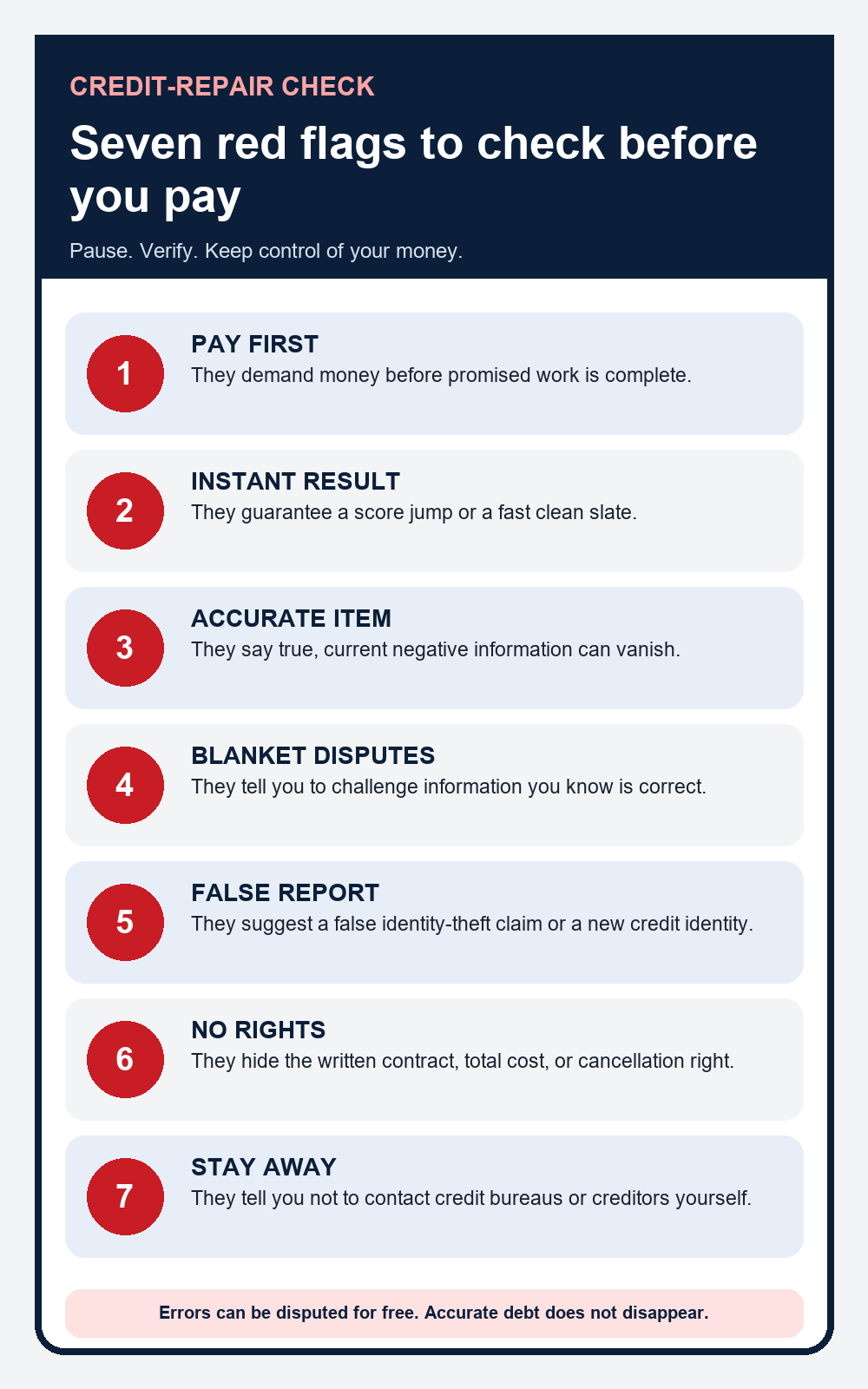
Use these seven checks before sharing payment information or signing a credit-repair contract. The list is based on FTC and CFPB consumer guidance.
1. The company wants money before completing promised work
The Consumer Financial Protection Bureau gives a simple warning: “don’t pay upfront.” Its credit-repair scam guidance explains that federal law restricts when credit-repair organizations can request or receive payment. Calling the charge an enrollment, audit, software, or subscription fee does not automatically make the arrangement safe.
Ask for the exact service, completion date, total price, and payment trigger in writing. Do not let a salesperson rush you into giving a bank-account or card number while you are still trying to understand the offer.
2. It guarantees a fast score increase
No company controls the credit bureaus or scoring models. A promise to add a precise number of points, remove every negative item, or create a clean report in a few weeks should make you stop. Even a valid correction may affect different scoring models differently.
3. It promises to remove information that is accurate and current
Errors can be corrected. Accurate and timely negative information generally cannot be removed just because a company sends a dispute. The FTC explains that most negative information stays on a report for a defined period and that legitimate improvement usually takes time.
4. It tells you to dispute everything
A dispute is a legal tool for information that is wrong, incomplete, or unverifiable—not a strategy for denying debts you know are yours. Repeated form-letter disputes can also be treated as frivolous. The CFPB explains how credit repair differs from credit counseling, debt settlement, and debt consolidation, including why accurate items may reappear after verification.
5. It suggests a false identity-theft report or a “new credit identity”
Never file an identity-theft report for a debt that is actually yours. Never use an identification number that is not legally yours to apply for credit. The FTC warns that these tactics can expose a consumer to serious legal consequences while leaving the underlying debt unresolved.
6. It hides your contract rights or total cost
Credit-repair companies must give required information in a written contract, including the services, time to perform, total cost, and a three-business-day cancellation right. If the paperwork is missing, vague, or different from the sales pitch, do not proceed until you understand the discrepancy.
7. It tells you not to contact bureaus or creditors yourself
You have the right to contact a credit bureau and the business that furnished the information. A company that tries to isolate you from those sources may be protecting its sales process rather than protecting you.
Credit repair is not the same as nonprofit credit counseling
The terms sound similar, but the services are different. Credit repair usually focuses on credit-report items. Credit counseling usually looks at the household’s broader financial situation and may help build a budget or debt management plan.
According to the CFPB, credit counseling organizations are usually nonprofits that provide education and may arrange a plan through which payments go to creditors. That does not mean every nonprofit is automatically trustworthy or that a debt management plan fits every household. Ask about fees, creditor participation, payment handling, cancellation terms, and what happens if you miss a payment.
Use this comparison before agreeing to anything:
| Question | Credit-repair offer | Reputable credit counseling conversation |
|---|---|---|
| Main focus | Credit-report disputes | Overall debts, cash flow, and repayment options |
| Can it erase accurate debt? | No | No |
| Should it promise a score jump? | No | No |
| Should you pay before promised repair work? | Major red flag | Counseling fee rules and services differ; get full terms |
| Should it tell you to stop contacting bureaus? | No | No |
| Best first step | Check reports and identify real errors | Review the full household situation and written plan |
Worked example: what could a $99 monthly fee cost your payoff plan?
Suppose a household has one credit card with an $8,500 balance, a 24.99% APR, and a $250 minimum payment. The household can devote $449 per month to the decision.
This example compares two hypothetical paths:
- Pay $350 per month to the card and spend $99 per month on a hypothetical credit-repair subscription.
- Pay the full $449 per month to the card instead.
Using the Debt Freedom Planner payoff engine’s monthly APR approximation, no new purchases or fees, and an August 2026 start, the model produces:
| Hypothetical path | Monthly card payment | Payoff time | Modeled interest |
|---|---|---|---|
| $99 goes to a separate fee | $350 | 35 months | $3,467.37 |
| Full decision budget goes to debt | $449 | 25 months | $2,420.79 |
Redirecting the hypothetical $99 to the card shortens the model by 10 months and reduces modeled interest by $1,046.58.
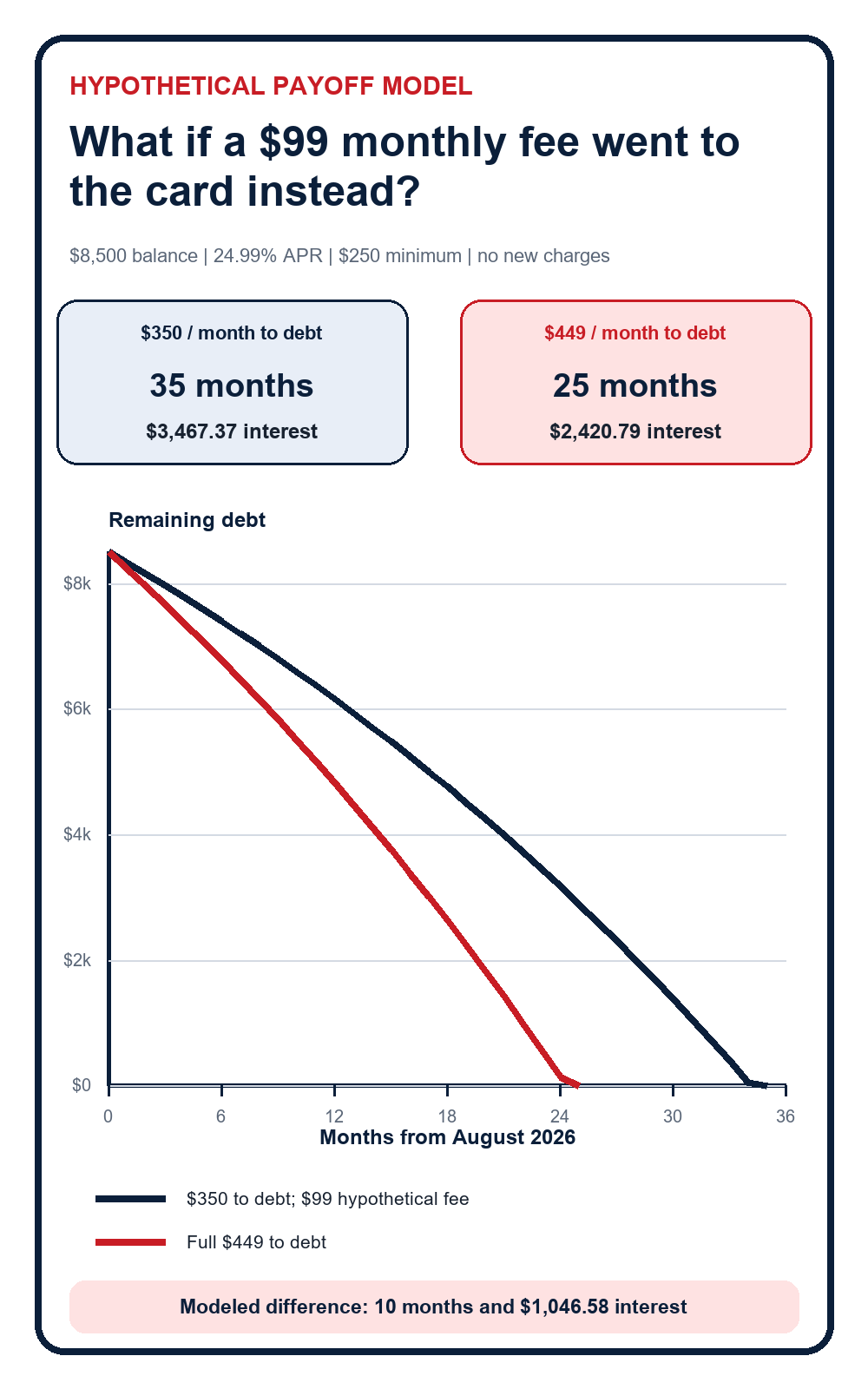
Hypothetical Debt Freedom Planner model: $8,500 at 24.99% APR, $250 minimum, no new charges, and a constant monthly payment. The $99 fee is an illustration, not an industry average or a claim about any company.
This comparison does not prove that every paid service lacks value. It shows the opportunity cost you should calculate. If a service has a legitimate, clearly defined benefit, compare that benefit with the debt payoff impact before you sign. The model also excludes any upfront fee, late charge, APR change, or credit-score effect.
A safer order of operations
Use this sequence before you pay for help:
- Get all three reports. Use the authorized free-report source and save copies.
- Mark only actual errors. Write down what is wrong and collect statements, receipts, letters, or identity-theft records that support the correction.
- Dispute directly for free. Contact both the credit bureau and the business that supplied the information when appropriate.
- Keep minimum payments safe. A credit-report dispute does not pause a legitimate payment obligation. Protect due dates while the issue is reviewed.
- Verify any helper. Check the written contract, total cost, cancellation right, refund terms, state requirements, and complaint history.
- Model the fee. Treat every recurring fee as money that cannot go to debt unless the service produces a real, documented benefit.
- Keep control. Do not give anyone permission to submit information you have not reviewed.
If the report is accurate but the payments are unaffordable, the problem is not a reporting error. Contact the creditor about hardship options or talk with a reputable nonprofit counselor. If collection, identity theft, or possible legal violations are involved, qualified legal help may be appropriate.
If you already paid a suspicious company
Act promptly, but keep a record of every step. Review the contract and cancellation terms. Tell the company in writing that you are canceling if that is your decision. Contact your bank or card issuer about unauthorized or misrepresented charges, and ask how to stop future payments without mischaracterizing legitimate charges.
Save ads, emails, texts, call notes, contracts, reports, and receipts. You can report suspected fraud or deceptive practices to the FTC at ReportFraud.ftc.gov and submit a complaint to the CFPB. Your state attorney general or state consumer-protection office may also have a role.
Put the debt numbers where you can see them
Credit-report accuracy and debt payoff are separate jobs. After you identify and dispute genuine errors, try Debt Freedom Planner to enter your actual balances, APRs, and minimums. You can compare snowball, avalanche, and custom payoff orders and see how redirecting a recurring fee could change the estimated payoff date and interest.
The planner does not repair credit, contact bureaus, negotiate debts, or promise a score increase. It gives you a transparent payoff model so you can make the cost tradeoff with your own numbers.
Debt Freedom Planner provides educational payoff projections, not financial, legal, tax, credit-repair, or bankruptcy advice. Credit-report rights and service rules can depend on the facts and applicable law. Verify information with the relevant bureau, creditor, regulator, or qualified professional before acting.
0 comments
Ask a question, add context, or share what worked for your household.
Create a free account or sign in to comment, reply, and vote on blog posts.