

Can a Debt Collector Add Interest, Fees, or Pay-to-Pay Charges?
A collector cannot simply invent extra charges. Check the itemization, agreement, applicable law, and no-fee payment options before paying.
A debt collector generally cannot add interest, a collection fee, a pay-to-pay charge, or another amount merely because it wants to. Under the federal debt-collection rule, the amount must be expressly authorized by the agreement that created the debt or permitted by applicable law. Before paying an added charge, identify it, compare the collector's itemization with your records, ask what authorizes it, and find out whether a no-fee payment method is available.

Unexpected collection charges deserve a careful review. Verify the collector, the balance, and each added amount before changing your payoff plan.
Can a debt collector add interest or fees?
Sometimes—but not automatically. Current Regulation F says that a debt collector must not collect any amount unless the agreement creating the debt expressly authorizes it or the amount is permitted by law. The rule says “any amount” includes interest, fees, charges, and expenses incidental to the principal obligation.
That creates a two-part authorization test:
- Does the original agreement expressly authorize this specific amount? A vague statement from the collector that the charge is “standard” is not the same as contract language.
- Does applicable law permit it? Federal rules matter, and state law can also allow, limit, or prohibit interest and collection costs.
The CFPB's consumer guidance explains that an interest rate or fee may increase when the original loan or credit agreement permits it and no law prohibits it, or when state law expressly permits the amount. That is why a confident yes-or-no answer without seeing the agreement, the debt type, the state, and the account history can be misleading.
Federal debt-collection protections generally apply to third-party debt collectors collecting consumer debts; different rules may apply to an original creditor, a business debt, a government debt, or a court judgment. State protections may be broader. Treat this article as a review framework, not a conclusion about your account.
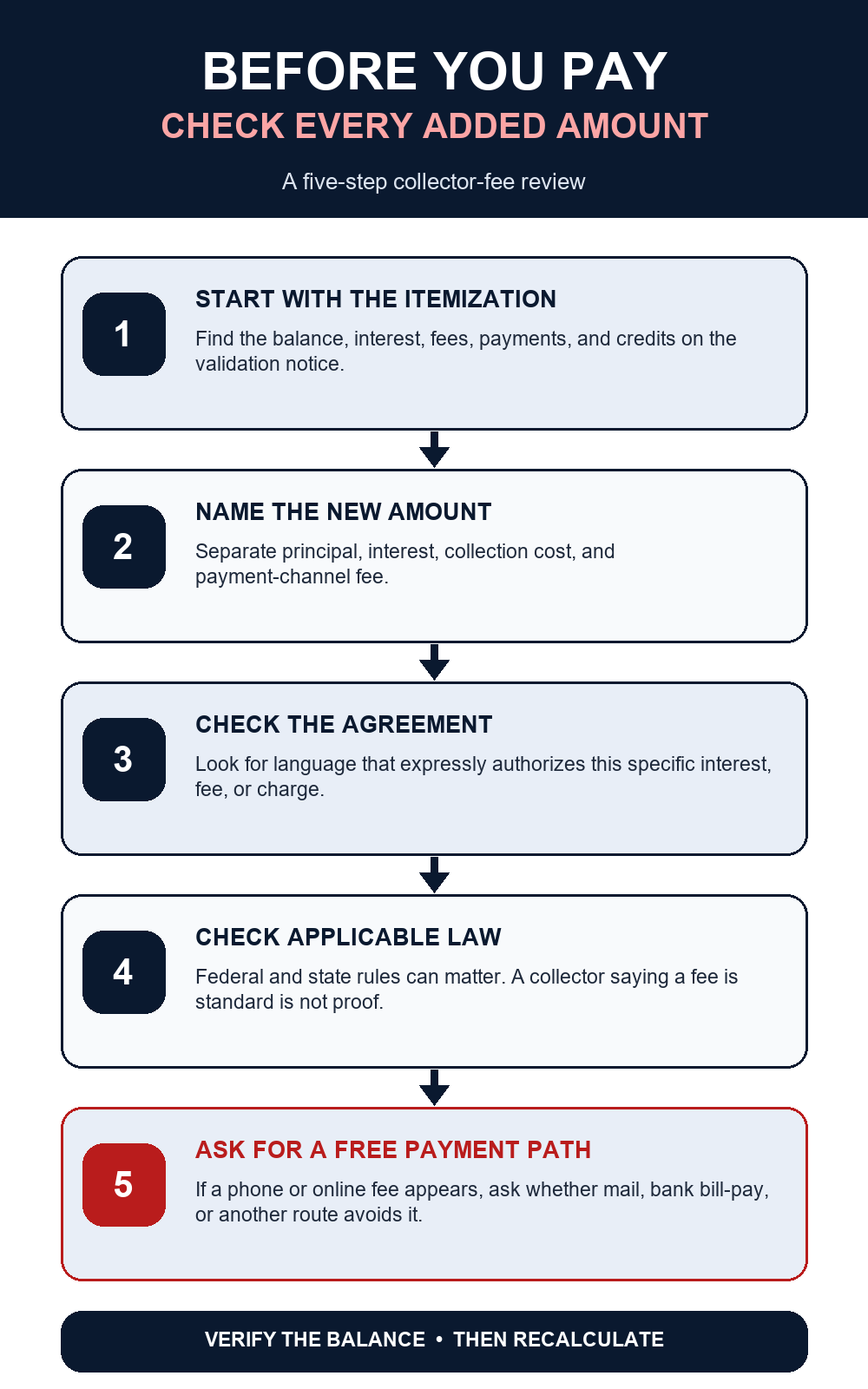
Start with the itemized balance, name the added amount, check the agreement and applicable law, and ask for a free payment path before recalculating.
What should the validation notice show?
A collector's validation information is the best starting point because it should help you connect today's balance to an earlier reference date. Regulation F's validation-notice rule requires an itemization of the current amount reflecting interest, fees, payments, and credits since the itemization date. The notice should also show the amount on that date and the current amount.
Use those fields to build a simple audit:
| Line to verify | What to compare |
|---|---|
| Amount on the itemization date | Last statement, charge-off notice, judgment, or other named reference record |
| Interest added | Rate, date range, balance used, and agreement or law cited |
| Fees added | Exact fee name, date, amount, and claimed authorization |
| Payments and credits | Your receipts, bank confirmations, adjustments, and returned-payment records |
| Current amount | Starting amount + allowed interest + allowed fees - payments - credits |
The CFPB's validation-information guide says the notice generally includes a deadline for a 30-day dispute period. If you dispute the debt or a portion of it in writing within that period, the collector generally must pause collection of the disputed amount until it has adequately responded. Keep the envelope, notice, screenshots, and delivery proof because timing can matter.
Do not confuse “the notice lists a fee” with “the fee is authorized.” Itemization tells you what the collector says changed. The agreement and applicable law determine whether the collector may collect that amount.
Are pay-to-pay or convenience fees allowed?
A pay-to-pay fee is a charge for using a particular payment channel, such as paying by phone or online. According to the CFPB's pay-to-pay fee guidance, a debt collector can charge one only if the agreement that created the debt expressly authorizes the fee or another applicable law specifically permits it.
The CFPB's advisory opinion on debt-collector pay-to-pay fees applies the same rule even when a collector uses a payment processor. A separate processor does not automatically make an otherwise unauthorized collection fee permissible.
Before using a fee-bearing channel, ask:
- What is the exact fee amount, and who receives it?
- What contract provision or law authorizes it?
- Is there a free method by mail, bank bill-pay, ACH, or another channel?
- How long will each method take to credit the account?
- Will the receipt separately show the debt payment and the fee?
Do not give bank credentials or sensitive information until you have verified the collector. The CFPB's collector-legitimacy checklist recommends confirming the company name, street address, phone number, and license information when your state licenses collectors.
Worked example: what can a $10 monthly fee change?
Assume a household is reviewing a legitimate $3,600 collection balance at 18% APR and has $150 per month available. There are no new charges or settlements. The Debt Freedom Planner engine models monthly interest as APR divided by 12 with cent rounding.
The $10 charge below is purely hypothetical. The example does not assume that the fee is authorized or lawful.
| Hypothetical path | Amount reaching debt | Payoff time | Modeled interest | Assumed fees | Total household cash |
|---|---|---|---|---|---|
| No-fee reference | $150/month | 30 months | $896.29 | $0 | $4,496.29 |
| $10 fee paid on top | $150/month | 30 months | $896.29 | $300 | $4,796.29 |
| $150 total budget: $140 debt + $10 fee | $140/month | 33 months | $982.30 | $330 | $4,912.30 |
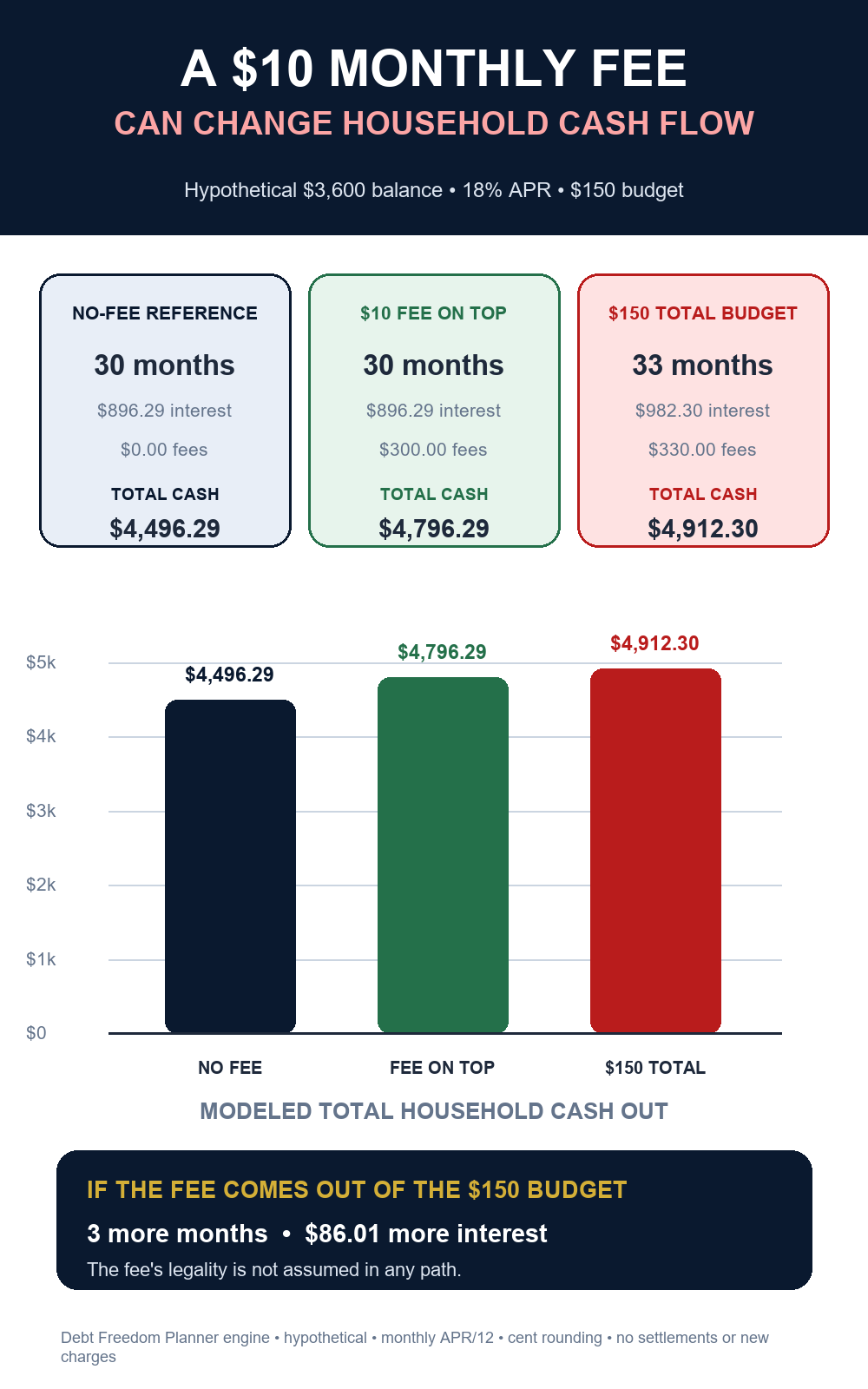
Debt Freedom Planner engine example: $3,600 at 18% APR. If a hypothetical $10 fee comes out of a fixed $150 budget, the modeled debt payment falls to $140, extending payoff by three months and adding $86.01 in interest. Legality is not assumed.
When the fee is paid on top, the debt balance follows the same payoff path because the full $150 still reaches the debt, but household cash out rises by $300. When the household keeps outflow fixed at $150 and only $140 reaches the debt, payoff takes longer and interest increases. Actual collector accrual, fee timing, judgments, settlements, and state rules can produce different results.
The important planning lesson is not “every $10 fee costs exactly this much.” It is that you must know how much reaches the debt before relying on a payoff date.
What should you do if the amount looks wrong?
Move in this order:
- Verify the collector. Use contact information from a trusted record or independently verified source, not only a link or number in an unexpected message.
- Preserve the validation deadline. If you are within the stated period and the amount is wrong, consider a written dispute that identifies the specific portion you contest.
- Request the calculation. Ask for the itemization date, balance, interest rate, date range, fee name, payments, credits, and the agreement or law relied on.
- Compare your documents. Review the original agreement, later amendments, statements, payment receipts, settlement letters, and any judgment.
- Check state-specific rules. A state consumer-protection agency, attorney general, licensed attorney, or qualified legal-aid organization may help with local limits and court deadlines.
- Do not ignore a lawsuit. A dispute letter does not replace answering a court case. Missing a court deadline can have serious consequences.
- Keep payment proof. Save confirmations that show the date, amount applied to the debt, separate fee, and remaining balance.
Avoid promising a payment you cannot sustain just to end a call. Also avoid sending a token payment on an old debt without understanding possible state-law consequences. Time-barred debt rules vary, and a payment or acknowledgment can matter in some places.
How should you update your Debt Freedom Planner plan?
First establish the balance you will actually plan around. Then enter the current balance, APR, and payment amount into Debt Freedom Planner. You can compare snowball and avalanche order, test a different monthly payment, and see the modeled payoff date, interest, and month-by-month schedule.
Keep external payment-channel fees separate from the debt balance unless reliable account records show the fee was added to the balance. If a $150 household outflow includes a separate $10 fee, enter the $140 that actually reaches the debt—not the full $150—as the payment for that scenario. If the fee is paid on top and $150 still reaches the debt, keep the $150 debt payment and track the fee separately in your household cash flow.
The planner does not verify collectors, interpret contracts or state law, dispute debts, negotiate settlements, connect to bank accounts, or move money. It is a projection tool for numbers you have already verified.
Bottom line
A debt collector cannot add interest, fees, or pay-to-pay charges simply by labeling them as due. Ask what expressly authorizes each amount, use the validation notice to reconcile the math, preserve dispute and court deadlines, and choose a no-fee payment method when one is available. Recalculate your payoff plan only after you know the verified balance and the amount that will actually reach it.
This article provides educational information, not individualized financial, legal, tax, credit-repair, or debt-collection advice. Contract terms, debt types, court orders, collector status, and federal and state law vary. Confirm current requirements with qualified counsel or an appropriate consumer-protection agency for your situation.
0 comments
Ask a question, add context, or share what worked for your household.
Create a free account or sign in to comment, reply, and vote on blog posts.