

Deferred Interest vs. 0% APR: What Happens If You Miss the Payoff Deadline?
Deferred interest can add interest back to the purchase date, while a true 0% APR generally starts charging only after the promotion. Use this deadline plan and worked example.
Deferred interest and a true 0% introductory APR are not the same deal. If you miss the payoff deadline on a true 0% APR offer, interest generally starts on the balance still unpaid after the promotion. If you miss a deferred-interest deadline, the issuer can add the interest that accrued from the original purchase date. The safest move is to identify the exact offer language, divide the promotional balance by the months remaining, and aim to finish at least one billing cycle early.

Promotional financing can look calm on the surface. The agreement language and payoff deadline determine what happens underneath.
The one word that changes the deal
Look for the word “if.”
- “0% intro APR for 12 months” generally describes a true promotional APR. Interest is not charged on that promotional balance during the stated period. If a balance remains after the promotion, the regular APR generally begins applying from that point forward.
- “No interest if paid in full in 12 months” generally describes deferred interest. Interest accrues in the background. If the entire promotional purchase is not paid by the deadline—or if another term triggers the offer's loss—that accumulated interest can be added to the account.
The Consumer Financial Protection Bureau's comparison of promotional offers explains this difference directly. The current Regulation Z advertising interpretation also distinguishes deferred-interest offers from 0% APR offers where the consumer cannot be charged interest attributable to the promotional period.
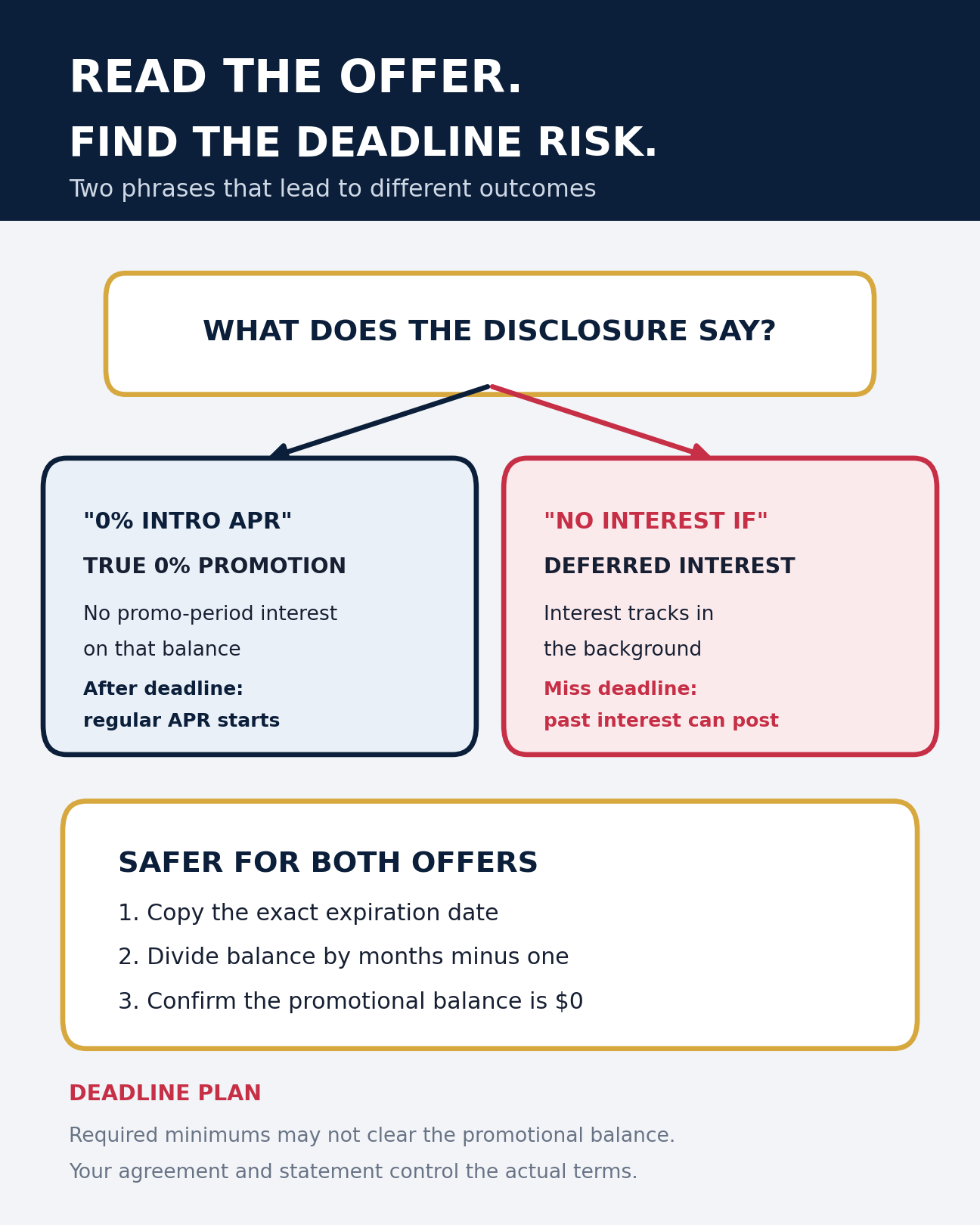
Start with the exact phrase on the offer or statement. “If paid in full” signals a deadline with retroactive-interest risk.
What happens if you miss the deadline?
With a true 0% APR promotion, the missed target is still expensive—but the cost normally begins with the remaining balance. Suppose $120 is left when the promotion expires and the regular APR becomes 29.99%. The card generally begins charging interest on that $120 after the promotional period, subject to the agreement's timing and daily-balance method.
With deferred interest, leaving even a small promotional balance can activate a much larger charge. The CFPB says the issuer can charge interest going back to the original purchase date. A 2024 CFPB report on retail cards gives a stark example: a consumer with only $180 left on a $4,500 promotional purchase could face $1,439.55 in deferred interest at the report's assumed 31.99% APR.
That does not mean every agreement uses the same calculation. Issuers may use daily balances, different cycle lengths, compounding conventions, or offer-specific terms. Your statement and card agreement control the actual amount.
Worked example: a $2,400 purchase with a 12-month offer
Consider this transparent hypothetical:
| Assumption | Amount |
|---|---|
| Promotional purchase | $2,400 |
| Promotional period | 12 months |
| Regular/deferred APR | 29.99% |
| Planned monthly payment | $190 |
| Total paid by month 12 | $2,280 |
| Promotional principal still unpaid | $120 |
At a true 0% APR, the arithmetic during the promotion is simple: $2,400 minus twelve $190 payments leaves $120.
For a deferred-interest planning proxy, we modeled the same $2,400 as if 29.99% APR had been active from day one while the same $190 payment was made monthly. Debt Freedom Planner's payoff engine uses monthly interest—balance × APR ÷ 12—then applies the payment. After month 12, that model leaves $606.39. The difference between $606.39 and the $120 promotional principal is $486.39 of modeled accumulated interest.
This is not a statement prediction. Actual deferred interest is commonly calculated using daily balances, so the issuer's result will differ. The model is useful because it shows the shape of the risk: being only $120 short can expose you to interest tied to a much larger balance history.
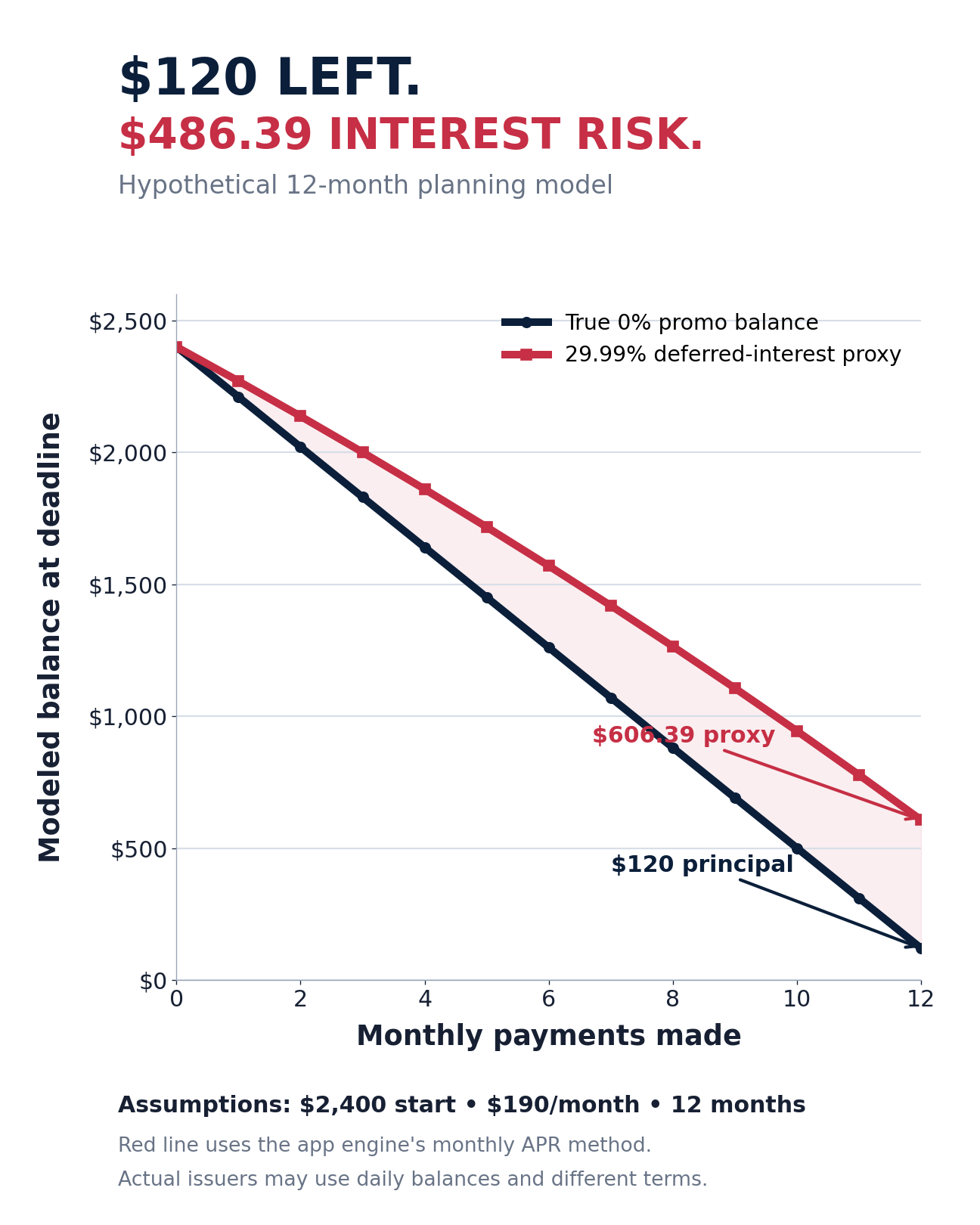
Hypothetical monthly model: $2,400 starting balance, twelve $190 payments, and 29.99% APR. The red line is a planning proxy for accumulated deferred interest, not an issuer quote.
The payment that actually reaches the deadline
Dividing the balance by the number of months gives the minimum planning target, not the card's required minimum payment:
$2,400 ÷ 12 months = $200 per month
Paying $200 monthly would clear the purchase exactly at month 12 if every dollar reached that promotional balance and no fees or new transactions changed the account. That is too close for comfort. A posting delay, a payment allocated elsewhere, or a deadline before the normal due date could spoil the plan.
A one-cycle buffer is stronger:
$2,400 ÷ 11 months = $218.18, so round up to $220
At $220 per month, the modeled purchase is gone during month 11. The extra month is not wasted—it is protection against timing and allocation surprises.
Why paying the minimum can fail
The required minimum is designed to keep the account current, not necessarily to clear a promotional purchase before its expiration. The CFPB's deferred-interest consumer guidance warns that minimum payments probably will not be enough.
Payment allocation adds another complication when the same card has other balances. Under Regulation Z section 1026.53, a deferred-interest balance is generally treated as a 0% balance for payment-allocation purposes during the promotion. Amounts above the minimum may therefore go to a higher-APR balance first. In the final two billing cycles before the deferred-interest period expires, excess payments generally must go first to the deferred-interest balance. An issuer may also choose to honor a consumer's earlier allocation request.
Check the next statement after any special payment. Do not assume a phone request worked just because the payment posted.
A five-step deadline plan
1. Copy the exact expiration date
Use the date printed on the statement, not “about 12 months” from memory. The promotional deadline may not match your ordinary payment due date.
2. Confirm the offer type
Find the phrase “0% APR” or “no interest if paid in full.” If the disclosure is unclear, ask the issuer whether interest from the purchase date will be charged if any promotional balance remains.
3. Calculate a finish-early payment
Divide the current promotional balance by one fewer month than you have left. Round up to a payment you can repeat. If that amount is not affordable, contact the issuer early and compare alternatives before the cliff arrives.
4. Keep making required minimums on time
A payoff target does not replace the statement's minimum due. The CFPB notes that being more than 60 days late can cause a deferred-interest balance to lose the promotion, while even a single late payment can bring other consequences.
5. Verify a zero promotional balance
After the final planned payment, read the next statement or online account detail. Confirm the promotional purchase balance is $0, not merely that the total card balance fell.
Should you use savings to avoid the deferred-interest cliff?
If the deadline is near, compare the known cost of using some cash with the possible retroactive-interest charge. Do not drain money needed for housing, utilities, food, insurance, transportation, or a basic emergency cushion just to make a card balance look cleaner.
Instead, write down three numbers:
- the promotional balance still due;
- the deferred interest shown or estimated by the issuer; and
- the cash you can use without missing essential obligations.
If you cannot safely close the gap, call the issuer before the deadline. Ask for the payoff amount, the exact expiration date, how a payment will be allocated, and whether any available accommodation changes the terms. Get the answer in writing or save the secure-message transcript when possible.
How Debt Freedom Planner can help
Debt Freedom Planner does not read your card agreement, reproduce an issuer's daily-balance calculation, or guarantee how a payment will be allocated. It can help you turn the deadline into a household plan.
Enter the promotional purchase as a separately labeled debt, use its current balance, and set a custom payoff order that reflects the deadline. Then compare what happens when you raise the monthly amount from $190 to $200 or $220 while keeping rent, food, utilities, and other minimum payments protected.
Start a Debt Freedom Planner roadmap to compare payment amounts and see the modeled payoff month. Reconcile the roadmap with your issuer statement every month; the statement remains the account record.
Bottom line
A true 0% APR offer starts charging interest on the remaining balance after the promotion. A deferred-interest offer can reach backward and add interest from the purchase date if the balance is not fully paid by the deadline. Read the exact phrase, aim one billing cycle early, pay required minimums on time, and confirm the promotional balance reaches zero.
Sources
- CFPB: How to understand special promotional financing offers
- CFPB: How deferred-interest plans work
- CFPB: The high cost of retail credit cards
- CFPB Regulation Z section 1026.53: Allocation of payments
- CFPB Regulation Z section 1026.16: Advertising
This article provides educational information and hypothetical payoff projections. It is not individualized financial, legal, tax, credit-repair, or bankruptcy advice. Your card agreement and issuer statements control your account.
0 comments
Ask a question, add context, or share what worked for your household.
Create a free account or sign in to comment, reply, and vote on blog posts.