

Federal Student Loan Auto Pay's 1% Rate Reduction: What Could It Save?
A 24-month payoff-engine example shows what the temporary federal student-loan auto-pay rate reduction could save, plus the dates and cash-flow checks borrowers need.
Answer: If you have an eligible federal Direct Loan, enrolling in auto pay by September 30, 2026 can reduce your interest rate by a total of 1 percentage point through June 30, 2028. On a hypothetical $30,000 loan at 6.5% with a $350 monthly payment, a 5.5% effective rate would reduce interest charged during that 24-month window by about $586.28 and leave the balance the same amount lower. The exact benefit depends on your balance, rate, payment, eligibility, and how long you remain enrolled.

A calm payoff plan starts with the loan details you can verify: balance, rate, payment, due date, and the date a temporary benefit ends.
The U.S. Department of Education announced the temporary auto-pay benefit on June 18, 2026. Federal Student Aid's borrower guidance now tells borrowers to enroll through their loan servicer. This is a real rate reduction, but it is not a reason to ignore cash flow, switch repayment plans blindly, or assume every student loan qualifies.
The dates and eligibility rules to check first
The headline is simple. The fine print matters:
- The enhanced rate reduction began July 1, 2026.
- You must enroll in auto pay by September 30, 2026, unless you were already enrolled.
- The temporary benefit runs through June 30, 2028.
- You must remain enrolled in auto pay to keep receiving the reduction.
- The Education Department says the benefit applies to eligible Federal Direct Loans originated after July 1, 2012, including student and parent borrowers.
- Borrowers already using auto pay do not need to re-enroll. Their servicer should add another 0.75 percentage point to the existing 0.25-point auto-pay reduction, producing a total 1-point reduction.
- A borrower in default must first bring eligible loans back into good standing through the applicable federal process before enrolling.
Check your own servicer account and billing statement instead of relying on a general example. Your displayed rate, loan type, origination date, repayment status, and enrollment date control the answer for your account.
“1%” means one percentage point off the rate
The official announcement calls this a 1% interest rate reduction. For payoff math, treat it as a one-percentage-point reduction in the annual rate, not a 1% discount on the amount of interest.
For example:
- A listed rate of 6.50% becomes 5.50% while the full benefit applies.
- A listed rate of 7.25% becomes 6.25%.
- The benefit does not reduce a 6.50% rate to 6.435%.
That distinction is important because a full percentage point can make a noticeable difference over 24 months, especially on a larger balance.
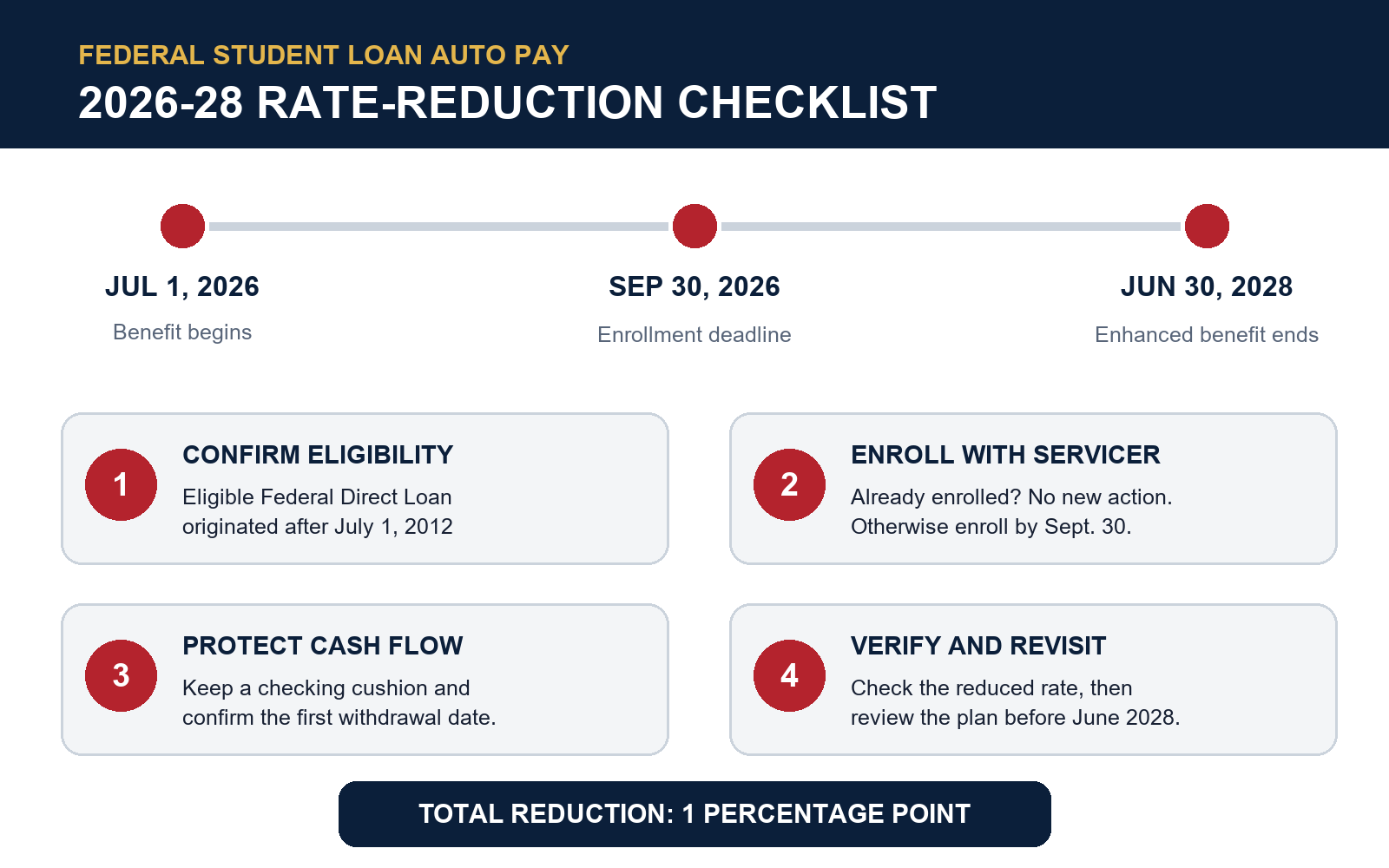
The temporary benefit has four practical gates: confirm loan eligibility, enroll by the deadline, keep enough cash in the payment account, and verify the reduced rate on the servicer's records.
Worked example: a $30,000 federal Direct Loan
Consider a hypothetical borrower with these assumptions:
| Assumption | Amount |
|---|---|
| Starting balance on July 1, 2026 | $30,000.00 |
| Listed APR without auto pay | 6.50% |
| Effective APR with the full reduction | 5.50% |
| Monthly payment | $350.00 |
| Comparison window | July 2026 through June 2028 |
| Number of payments | 24 |
Debt Freedom Planner's payoff engine calculates monthly interest as the starting balance multiplied by APR divided by 12, rounds to cents, applies the payment, and carries the remaining balance into the next month. Running the same loan and payment through the engine at both rates produces this comparison:
| Result after 24 payments | 6.50% without benefit | 5.50% with benefit | Difference |
|---|---|---|---|
| Total payments | $8,400.00 | $8,400.00 | $0.00 |
| Interest charged | $3,608.21 | $3,021.93 | $586.28 less |
| Ending balance | $25,208.21 | $24,621.93 | $586.28 lower |
The result is not a survey, forecast, or promise. It is transparent hypothetical math. It assumes the rate difference applies for all 24 months, the payment arrives every month, no fees or capitalization events occur, no new borrowing is added, and the borrower receives no separate government interest waiver or principal match. It also stops on June 30, 2028 rather than pretending the temporary reduction continues for the life of the loan.
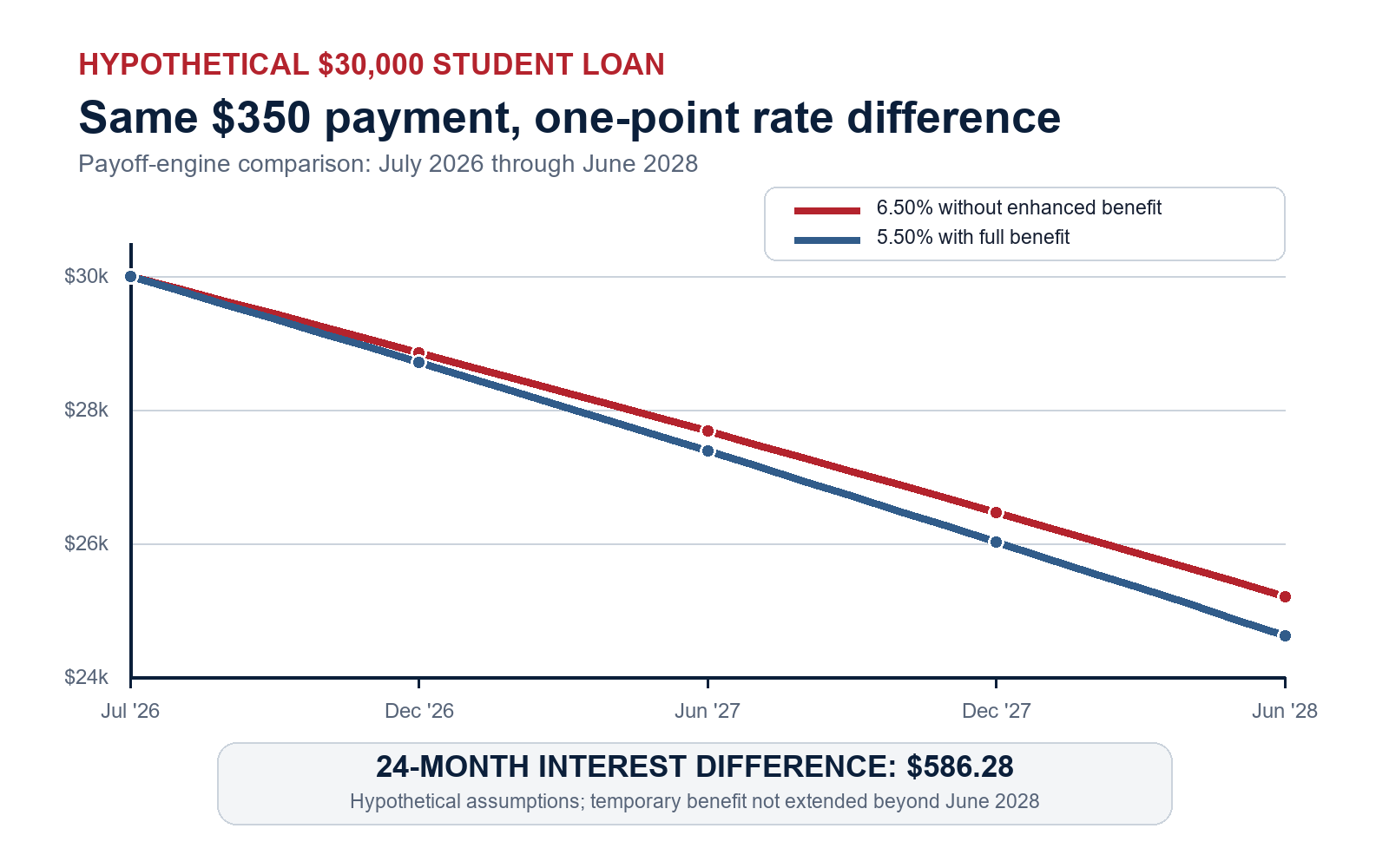
Hypothetical payoff-engine comparison: the same $30,000 starting balance and $350 monthly payment at 6.5% versus 5.5% from July 2026 through June 2028.
Auto pay does not choose the right repayment plan for you
Auto pay controls how a scheduled payment reaches the servicer. It does not by itself decide whether the Tiered Standard plan, Repayment Assistance Plan (RAP), Income-Based Repayment, or another available plan is appropriate.
The Education Department's July 1 fact sheet says RAP and the Tiered Standard plan became available July 1, 2026. RAP has its own rules for income-based payments, unpaid-interest treatment, and a possible principal match. Those features are not included in the simple worked example above.
Before changing plans, use the official Federal Student Aid Repayment Calculator and review the result with your servicer. This is especially important if you are pursuing Public Service Loan Forgiveness, using an income-driven plan, working through default, or depending on a payment amount tied to income. A lower rate is helpful, but losing a more valuable federal benefit would be a bad trade.
Make sure auto pay fits your household cash flow
The rate reduction only helps if the automatic withdrawal does not create a different problem. Before enrolling, check:
- Your pay schedule. Make sure the withdrawal lands after dependable income, not before it.
- Your checking cushion. Leave room for normal bills and a payment that posts earlier than expected around a weekend or holiday.
- The exact debit amount. Confirm whether the servicer will withdraw only the required payment or a higher amount you selected.
- Your first effective date. Do not assume auto pay begins immediately. Keep making required payments until the servicer confirms activation.
- Your monthly statement. Verify the payment posted and the reduced rate appears. Save the confirmation.
- The end date. Put June 30, 2028 on your calendar and review the loan before the temporary enhancement expires.
If your income varies, a manual payment may offer more day-to-day control. You can still compare the potential interest savings with the risk of an overdraft or returned payment. Minimum-payment safety comes first; faster payoff comes after the required payment is protected.
How to model the benefit in Debt Freedom Planner
Debt Freedom Planner does not connect to your bank or federal loan account. You enter the numbers yourself, which makes the assumptions visible and easy to revise.
For a planning snapshot:
- Copy the verified balance, listed APR, minimum payment, and due date from your servicer.
- Create one scenario using the listed rate without the enhanced benefit.
- Create a second scenario using a rate one percentage point lower, but only if your servicer confirms eligibility and enrollment.
- Keep the monthly payment the same so the rate effect is isolated.
- Compare the next 24 months, then plan to update the rate after June 2028.
The planner can show a month-by-month payoff schedule and help you compare snowball, avalanche, or a custom order when student loans sit beside credit cards, car loans, or personal loans. It does not model federal forgiveness rules or determine eligibility, so use StudentAid.gov and your servicer for those decisions.
What to do now
If you may qualify, the practical sequence is straightforward:
- Log in to your federal loan servicer account.
- Confirm the loan type, origination date, current rate, repayment status, and required payment.
- Review the official terms and enroll in auto pay by September 30, 2026 if it fits your cash flow.
- Keep making payments until enrollment is confirmed.
- Verify the lower rate on the next statement.
- Add the temporary rate and June 2028 review date to your payoff plan.
The rate reduction will not erase a balance, but it can redirect hundreds of dollars from interest to principal in a realistic two-year window. The useful move is to verify the benefit, protect the payment account, and then put the lower rate into a plan you can actually follow.
Educational information only: This article provides general educational payoff illustrations, not financial, legal, tax, credit-repair, or student-loan advice. Federal program rules and individual eligibility can change. Confirm current terms with StudentAid.gov and your loan servicer before acting.
0 comments
Ask a question, add context, or share what worked for your household.
Create a free account or sign in to comment, reply, and vote on blog posts.