

Federal Student Loan Collections Are Delayed: Should You Wait to Fix a Default?
AWG and Treasury offset are temporarily delayed, but default remains. Verify notices, compare official options, and model payment timing.
No. The federal government’s temporary delay of involuntary student-loan collections is not the same as getting a loan out of default. The U.S. Department of Education says implementation of Administrative Wage Garnishment (AWG) and the Treasury Offset Program (TOP) is temporarily delayed, but the debt remains, default can still be reported to credit bureaus, and the Department is encouraging borrowers to use the time to explore official resolution options. The practical move is to verify your loan holder, read every notice, compare the official paths out of default, and build a payment plan around the amount you are actually offered—not to assume the pause erased the problem.

A temporary collections delay can create planning time, but it does not change the underlying loan balance or default status by itself.
What the temporary collections delay actually pauses
In a January 16, 2026 announcement that the Department’s page shows as last reviewed on August 27, the U.S. Department of Education said it would delay involuntary collections. The announcement specifically names:
- Administrative Wage Garnishment (AWG): an involuntary process that can direct an employer to withhold part of a borrower’s disposable pay.
- Treasury Offset Program (TOP): an involuntary process that can take certain federal payments, such as a federal tax refund or some federal benefits, and apply them to a defaulted debt.
The announcement calls the delay temporary but does not give borrowers a universal restart date. It also says the Department continues to report student-loan defaults to credit reporting agencies and urges borrowers in default to explore resolution options.
That creates an important distinction:
| Question | Practical answer during the delay |
|---|---|
| Can ED begin a new AWG or TOP action under the announced delay? | Those two involuntary collection programs are temporarily delayed according to ED’s announcement. |
| Is the loan no longer in default? | No. A collection pause does not remove default status. |
| Does the balance disappear? | No. Verify principal, accrued interest, and any fees shown in the official account. |
| Can default still affect credit? | Yes. ED says default reporting continues. |
| Should you ignore a mailed notice? | No. A notice may contain a response or hearing deadline that matters to your account. |
| Can you still resolve the default voluntarily? | Yes. Official options can include a repayment agreement, rehabilitation, consolidation, or payment in full. |
The current Federal Student Aid default FAQ explains the normal consequences and notices connected with default, including AWG and TOP. Read that guidance together with the temporary ED announcement: the broad policy may delay two collection tools, while your dashboard, loan holder, and actual notices tell you what is happening with your specific debt.
Start by confirming who holds the loan
Do not call a number from a search ad or pay a company to “enroll” you in a federal default program. Begin with your StudentAid.gov dashboard.
Check and save:
- Each loan’s current status.
- Principal, accrued interest, and total balance.
- The listed servicer or loan holder.
- Whether the Department’s Default Resolution Group (DRG) or a guaranty agency is handling the default.
- Your address, email, and phone information.
- Every letter’s sent date and stated response deadline.
Federal Student Aid says DRG handles most Department-held defaulted loans. Some commercially held FFEL Program loans are handled by a guaranty agency instead. That difference matters because contacts, paperwork, and available routes can differ. If the dashboard does not match a letter, verify both through an official federal channel before sending money or personal information.
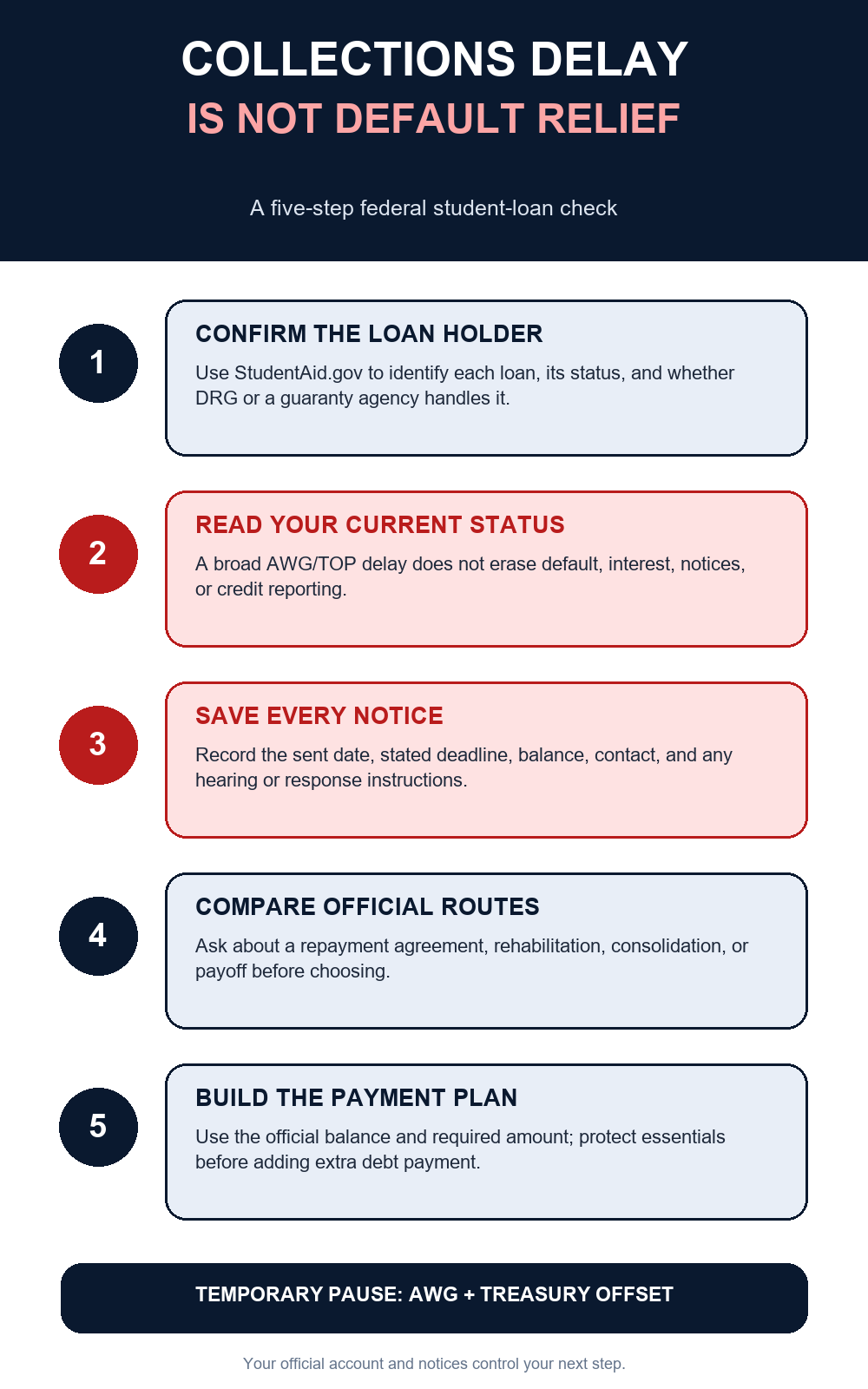
Use the delay to confirm the holder, preserve deadlines, compare official resolution routes, and then build a plan from verified figures.
Compare the official routes before choosing
There is no single best route for every defaulted borrower. Timing, credit-report treatment, accrued interest, collection costs, loan type, and payment affordability all matter.
| Route | What it can do | What to verify before agreeing |
|---|---|---|
| Repayment agreement | Creates a voluntary payment arrangement with the loan holder. Under normal FSA notice guidance, a timely first payment may prevent AWG or TOP from starting. | Required amount, first-payment date, number of payments, fee treatment, and whether the default record remains. |
| Rehabilitation | Uses a signed agreement and a series of qualifying payments to remove the loan from default. | Proposed payment, alternative-payment documentation if it is unaffordable, qualifying-payment count, and when credit reporting changes. |
| Direct Consolidation | Can move eligible defaulted loans into a new Direct Consolidation Loan more quickly than rehabilitation. | Eligibility, new rate and term, capitalization, collection costs, payment-plan eligibility, and treatment of the old default record. |
| Pay in full | Resolves the balance immediately. | Exact payoff quote, expiration date, payment instructions, and written confirmation after posting. |
The Federal Student Aid rehabilitation FAQ says borrowers should sign a rehabilitation agreement and can submit income-and-expense information when the initially proposed payment is unaffordable. It also explains that payments are generally applied to fees first, then interest, then principal. That is one reason a simple payoff calculator cannot quote the result of rehabilitation or a default settlement: you need the loan holder’s actual terms first.
The ED collections-delay announcement also says recent federal changes provide an additional rehabilitation opportunity for some borrowers who previously used rehabilitation. Do not assume you qualify. Ask the official holder to confirm eligibility and provide the agreement in writing.
A hypothetical example: starting now versus waiting six months
The delay may feel like permission to wait, but waiting can still change the math if interest is accruing. Consider this planning illustration:
- Starting balance: $12,000
- APR: 6.50%
- Monthly payment after an official arrangement is in place: $250
- Comparison: begin now versus make no payment for six months and then begin the same $250 payment
- No collection fees, capitalization event, rate change, subsidy, waiver, offset, garnishment, or tax effect
Debt Freedom Planner’s payoff engine uses a monthly APR ÷ 12 planning model. With payments starting immediately, it produces an estimated 56 months, $1,934.91 of interest, and $13,934.91 total paid.
For the wait illustration, six months of modeled accrual increases the planning balance to $12,395.32. Starting the same $250 payment then takes another 58 payment months, or 64 calendar months from today, with $2,473.62 of modeled interest including the waiting period and $14,473.62 total paid.
That is an illustrative difference of eight months and $538.71.
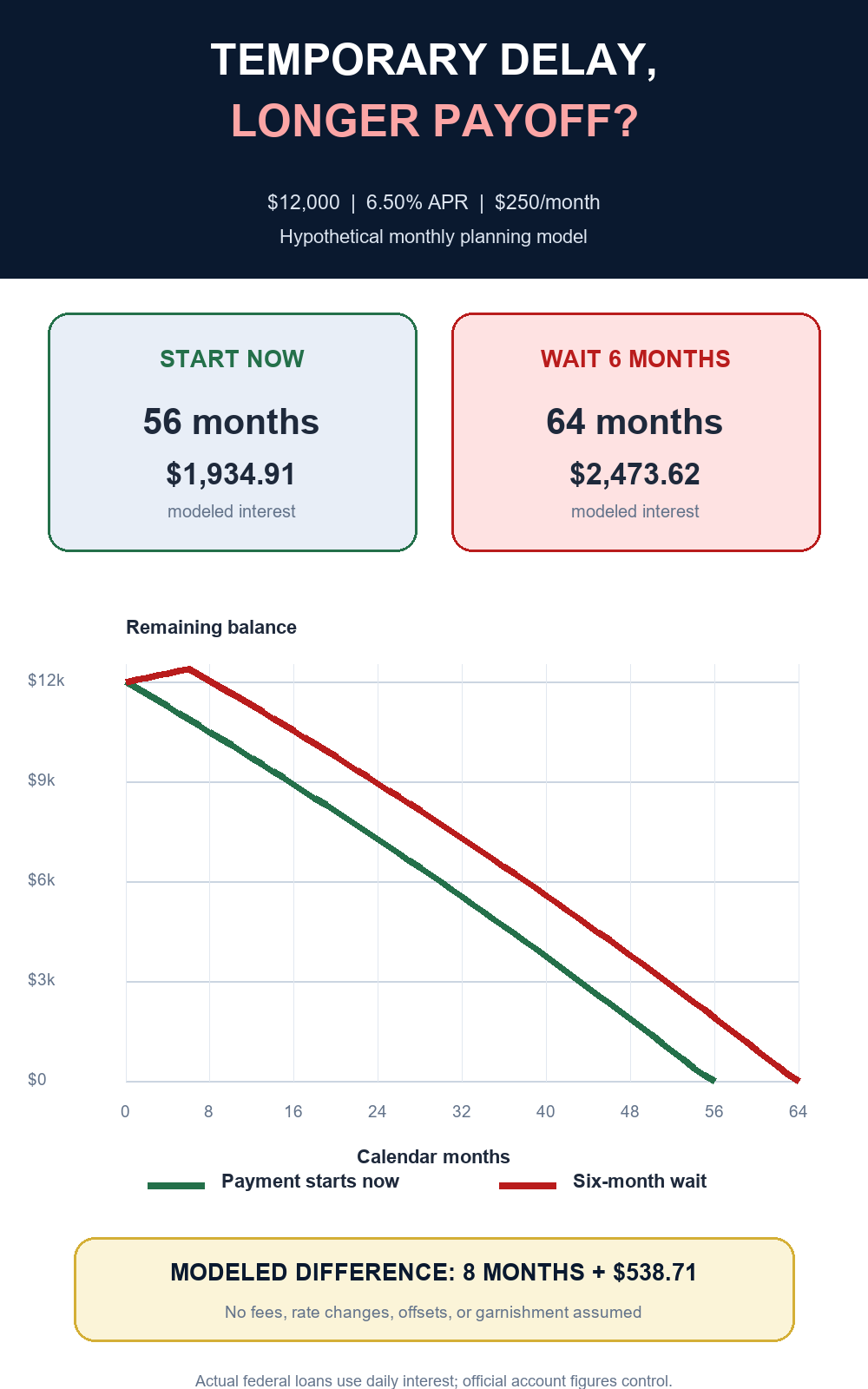
Hypothetical $12,000 balance at 6.50% with $250 monthly. The six-month wait assumes modeled interest accrual and no payments; it excludes fees and every collection action.
This graph is a planning comparison, not an account forecast. Federal Student Aid explains that Direct Loans use daily interest, while the app uses monthly estimates. Defaulted-loan payment application and fees can also differ from this simplified example. Use the balance, interest, fees, payment amount, and dates supplied by the official holder for any real decision.
How to build a payoff plan without missing essential bills
Once the loan holder gives you a written amount and due date, separate required-payment safety from faster-payoff strategy.
First, protect housing, utilities, food, transportation, insurance, medicine, taxes, and other required debt minimums. Then record the verified student-loan balance, APR, and required payment. Only after that should you test an extra-payment amount.
A useful sequence is:
- Enter every active debt, not just the defaulted student loan.
- Use the required payment from the official agreement as the minimum.
- Compare snowball and avalanche order using the same household payment total.
- Test an extra amount that leaves room for irregular expenses.
- Save the projected payoff date and first 12–18 months of payments.
- Recalculate whenever the official balance, payment, rate, or status changes.
Debt Freedom Planner can compare payoff orders, show a projected debt-free date, and lay out a month-by-month roadmap after you enter the verified numbers. It does not determine federal program eligibility, calculate rehabilitation payments, stop collections, or replace StudentAid.gov, DRG, a guaranty agency, an attorney, or a qualified student-loan adviser.
What to do if a notice arrives during the delay
Treat a new notice as actionable even if you have read about the broad collections pause.
- Confirm the sender through StudentAid.gov or the official loan holder.
- Keep the envelope and record the date received.
- Read every deadline, especially any hearing or dispute instructions.
- Compare the debt ID and balance with your official account.
- Ask in writing how the temporary AWG/TOP delay affects this exact notice.
- Do not send a payment based only on a caller’s urgency.
- If you dispute the debt, garnishment, offset, or amount, consider qualified legal help before the deadline.
The key is not panic and not passivity. The temporary delay may give you room to verify the account and choose a route, but only a completed, confirmed resolution changes the default itself.
This article provides general educational information, not individualized financial, legal, tax, credit-repair, or student-aid advice. Federal policy and account status can change. Verify current rules and your loan details with StudentAid.gov and the official loan holder before acting.
0 comments
Ask a question, add context, or share what worked for your household.
Create a free account or sign in to comment, reply, and vote on blog posts.