

Federal Student Loan RAP: How the Interest Waiver and $50 Principal Match Work
RAP can waive qualifying unpaid monthly interest and provide up to $50 in monthly principal assistance. See how the mechanics fit into a complete debt payoff plan.
Answer: The new federal Repayment Assistance Plan (RAP) can keep an on-time borrower’s balance from growing by waiving monthly interest that the required payment does not cover. It can also add a federal principal contribution calculated from the borrower’s required payment, up to $50 per month. That does not make RAP free, erase the debt, or prove that extra student-loan payments should come before every other debt. Use RAP’s official payment estimate for the federal loan, protect every required payment, and compare any extra cash against your other balances before choosing a payoff order.

A useful repayment plan separates three decisions: the required federal payment, the RAP benefits tied to an on-time payment, and where any optional extra money should go.
RAP became available July 1, 2026. The U.S. Department of Education’s July 1 fact sheet says RAP bases payments on income, reduces the payment by $50 for each dependent, can set payments as low as $10, waives qualifying unpaid monthly interest, and provides a matching principal benefit. The Department’s final regulations supply the detailed eligibility, payment, subsidy, and term rules.
RAP’s interest waiver and principal match are two different benefits
The easiest way to understand RAP is to follow one monthly payment in order.
- The loan accrues its monthly interest.
- You make the full required RAP payment on time.
- If that payment does not cover all accrued interest, the remaining monthly interest is waived under RAP’s rules.
- The part of your payment that reaches principal is measured.
- If your payment reduces principal by less than $50, the federal contribution equals the lesser of $50 or the monthly payment, minus the amount of that payment already applied to principal.
The interest waiver prevents qualifying unpaid interest from being added to the balance. The principal match moves the balance down. In other words, the total monthly principal reduction is generally brought to the lesser of $50 or the required monthly payment. They solve related but different problems. The formula appears in the Department of Education’s final RAP regulations.
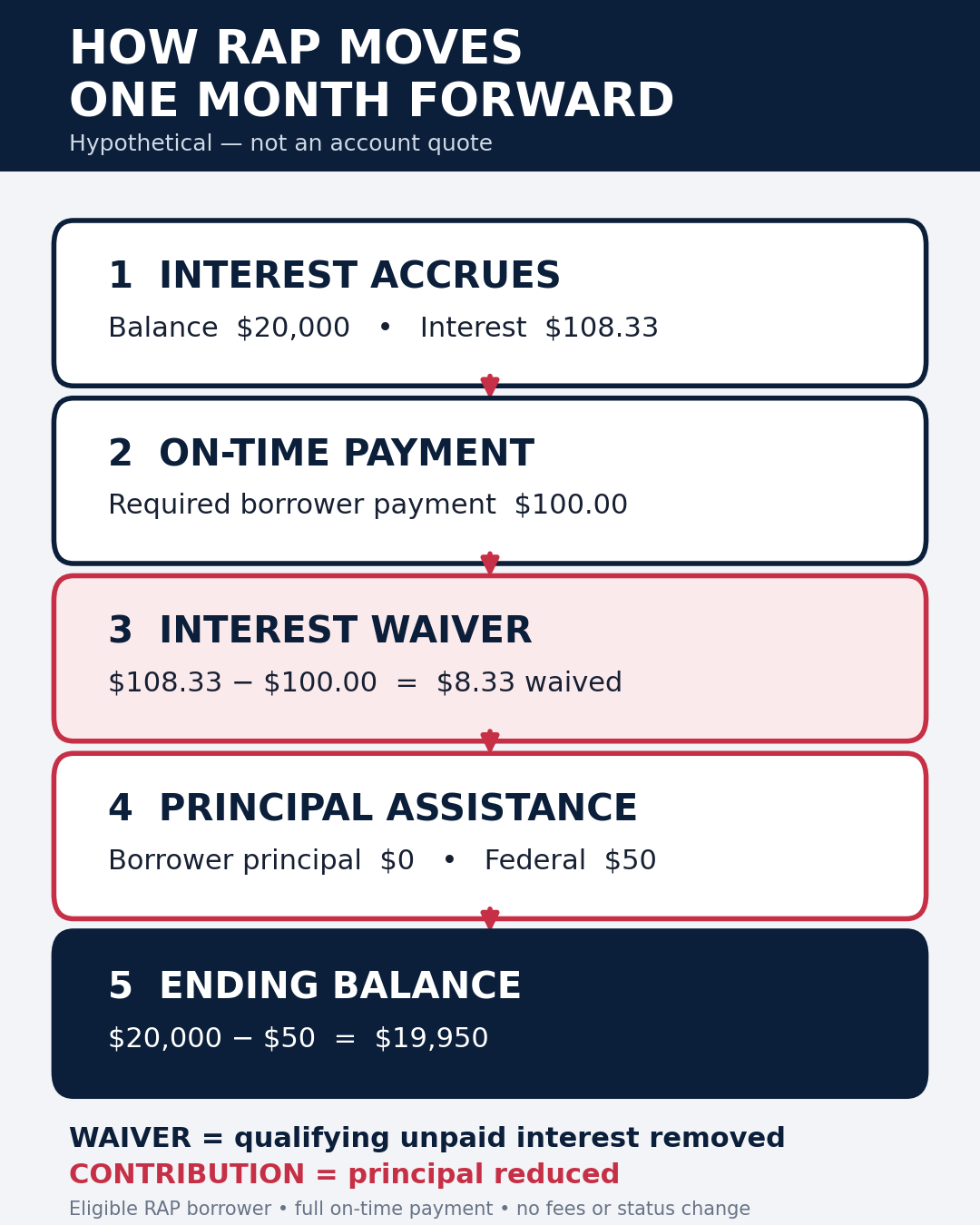
Hypothetical one-month illustration: a $20,000 balance at 6.5% accrues $108.33 of monthly interest. A $100 required payment covers most of the interest, $8.33 is waived, and a $50 federal principal contribution lowers the ending balance to $19,950.
Worked example: one $100 RAP payment
Consider a hypothetical borrower with no fees, capitalization event, missed payment, or new borrowing during the month.
| Item | Hypothetical amount |
|---|---|
| Starting federal loan balance | $20,000.00 |
| Annual interest rate | 6.50% |
| Required RAP payment | $100.00 |
| Monthly interest | $108.33 |
| Interest not covered by the borrower payment | $8.33 |
| Interest waived under the illustration | $8.33 |
| Borrower payment reaching principal | $0.00 |
| Federal principal contribution | $50.00 |
| Ending balance | $19,950.00 |
The arithmetic is transparent: $20,000 × 6.5% ÷ 12 equals $108.33 after rounding to cents. The $100 payment leaves $8.33 of interest uncovered. With that amount waived and $50 applied to principal, the balance falls by $50.
This is an educational illustration, not an account quote. Your servicer determines the payment, tracks whether it arrived on time, applies current program rules, and reports the actual balance. Interest can also behave differently when a loan changes status or a capitalization event applies.
Who can use RAP?
The final regulations and Department guidance divide eligibility by loan history:
- Borrowers whose Direct Loans were all first disbursed before July 1, 2026 may be able to choose RAP among their available options.
- A borrower with at least one Direct Loan first disbursed on or after July 1, 2026 has RAP as the only income-driven repayment option for the borrower’s Direct Loans.
- Parent PLUS Loans, and Direct Consolidation Loans that included Parent PLUS Loans, are not eligible for RAP under the current rules.
- RAP payments are based on adjusted gross income and dependents claimed on federal taxes, with percentages ranging from 1% to 10%.
- The plan can provide discharge after 30 years of qualifying repayment, or sooner through Public Service Loan Forgiveness when all separate PSLF requirements are satisfied.
Eligibility is not the same as suitability. Before changing plans, use the official Federal Student Aid Repayment Calculator and read the result your servicer provides. A lower required payment may improve monthly cash flow, but a longer repayment path can keep the debt in your life longer.
An on-time required payment comes before faster payoff
RAP’s protections depend on making the required payment on time. Faster payoff is a separate decision made only after the required payment and basic household obligations are covered.
Use this order of operations:
- Confirm the required RAP amount and due date with the servicer.
- Keep enough money in the payment account to avoid a missed or returned payment.
- Review whether auto pay is appropriate for your cash flow. Federal Student Aid’s payment-preparation guidance explains how delinquency and default can escalate when payments are missed.
- Maintain the emergency cushion your household needs to avoid putting ordinary surprises back on a credit card.
- Only then compare optional extra money across debts.
If the required RAP payment is $100, sending $200 is not the first question. The first question is whether $100 will arrive safely every month. The next is whether the other $100 prevents more expensive interest somewhere else.
Why your other debts still matter
RAP’s interest treatment can change the effective cost and balance path of a federal loan. A credit card does not receive that federal waiver or principal contribution. That is why you should not rank debts from the printed APR alone without understanding each account’s rules.
Here is a separate hypothetical credit-card example generated with Debt Freedom Planner’s payoff engine:
| Credit-card assumption | Minimum only | Minimum plus $100 extra |
|---|---|---|
| Starting balance | $5,000.00 | $5,000.00 |
| APR | 24.00% | 24.00% |
| Monthly payment | $150.00 | $250.00 |
| Months to payoff | 56 | 26 |
| Total interest | $3,322.17 | $1,449.37 |
| Projected payoff month | March 2031 | September 2028 |
The extra $100 cuts this hypothetical card payoff by 30 months and reduces calculated interest by $1,872.80. That result does not establish a universal priority. It shows why a complete plan should include every balance, rate, minimum, and special program rule before optional money is assigned.
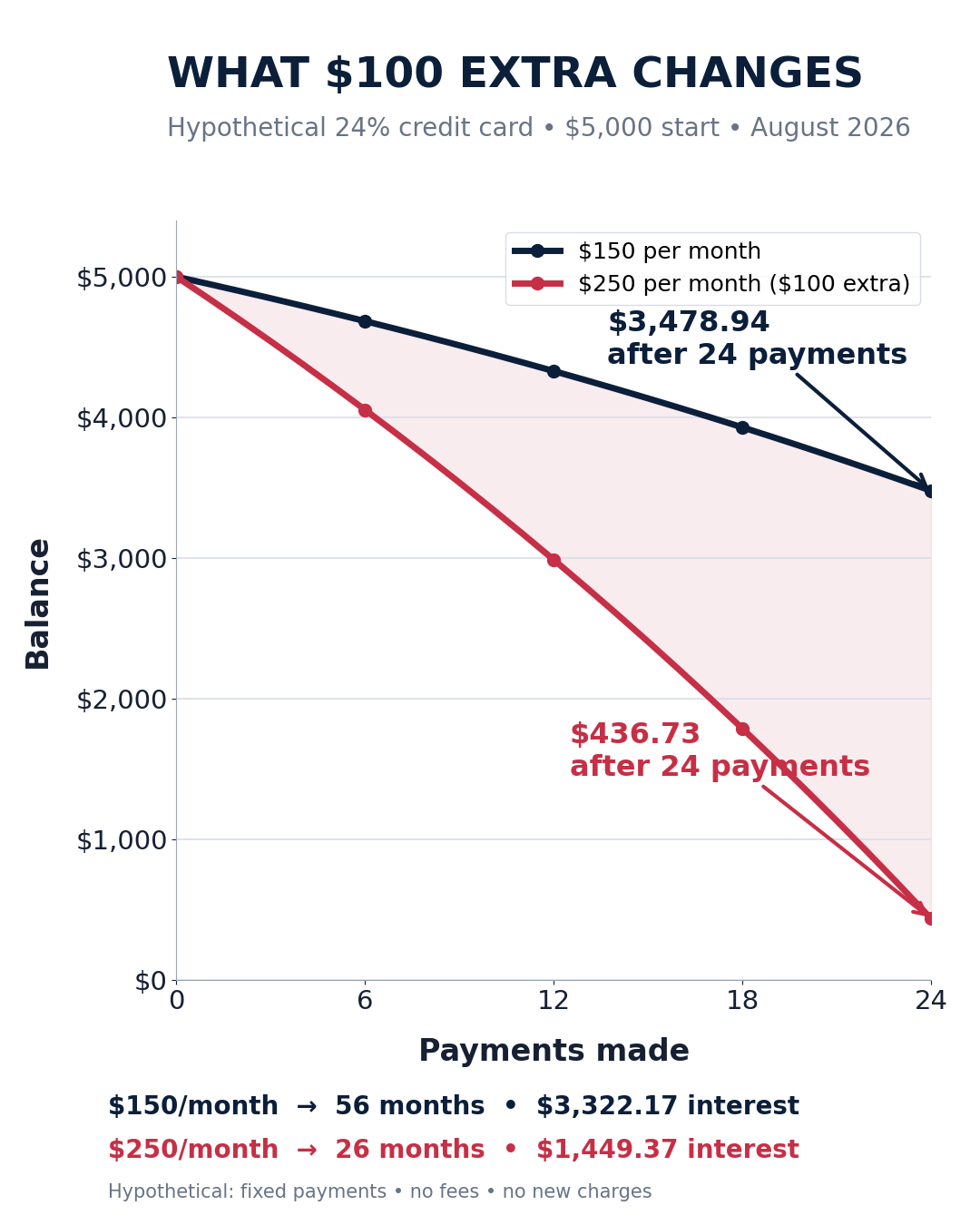
Hypothetical payoff-engine comparison starting August 2026: a $5,000 card at 24% APR with a $150 minimum payment, compared with the same card receiving a $100 monthly extra payment. No fees, new charges, or changing minimums are included.
How to use Debt Freedom Planner without overstating RAP math
Debt Freedom Planner lets you enter balances, APRs, and minimum payments, then compare snowball, avalanche, and custom payoff orders. It can show month-by-month schedules and the effect of extra monthly payments without connecting to a bank account.
The planner’s normal amortization engine does not calculate RAP income-based payments, the federal interest waiver, the principal match, forgiveness, or PSLF eligibility. Keep those boundaries clear.
A practical workflow is:
- Get the official RAP payment from StudentAid.gov or your servicer.
- Enter the federal loan in the planner using the verified balance, stated APR, and official required payment.
- Add credit cards, personal loans, car loans, and other debts using their current statements.
- Treat the planner’s federal-loan schedule as a standard-interest planning baseline, not a prediction of RAP benefits.
- Compare custom scenarios for optional extra cash while keeping the official RAP payment protected.
- Reconcile the planner with the servicer statement each month because the federal waiver and match can make the real student-loan balance differ from a standard amortization schedule.
This approach uses the planner for what it is built to do—organize debts and compare payoff choices—while leaving federal benefit calculations to the federal system that administers them.
RAP checklist before you change your payoff plan
- Verify that your loan type is eligible.
- Check whether any loan was first disbursed on or after July 1, 2026.
- Confirm your adjusted gross income and dependent information used for the payment.
- Read the servicer’s exact required payment and first due date.
- Ask how pending applications, forbearance, delinquency, or consolidation affect your account.
- If pursuing PSLF, confirm that the plan and every payment satisfy current PSLF rules.
- Save the enrollment confirmation and review the first statement.
- Keep required payments safe before directing money toward faster payoff.
- Compare other high-interest debts using current statements, not remembered balances.
- Update your payoff roadmap when the servicer posts the interest waiver or principal contribution.
RAP can solve a real problem: an on-time borrower’s balance should not keep growing merely because the income-based payment does not cover the month’s interest. The principal contribution can also ensure visible progress. The disciplined response is to verify eligibility, protect the required payment, and place every optional dollar only after seeing the whole household debt picture.
Educational information only: This article provides general educational repayment illustrations, not financial, legal, tax, credit-repair, bankruptcy, or student-loan advice. Federal program rules and individual eligibility can change. Confirm current terms with StudentAid.gov and your federal loan servicer before acting.
0 comments
Ask a question, add context, or share what worked for your household.
Create a free account or sign in to comment, reply, and vote on blog posts.