

Federal Student Loan Tiered Standard Plan: Lower Payment, Higher Cost?
The new Tiered Standard plan can lower a federal student-loan payment by extending the term. See the 10-, 15-, 20-, and 25-year tiers and a $30,000 worked example.
Answer: The federal Tiered Standard repayment plan can lower your required monthly payment by stretching a fixed payment across 10, 15, 20, or 25 years, depending on your Direct Loan balance. The tradeoff is important: a longer term usually means more total interest and more years with the debt. In a hypothetical $30,000 example at 6.50%, the Debt Freedom Planner payoff engine calculates about $261.34 per month for 15 years, compared with $340.65 per month for 10 years. The lower payment frees up $79.31 monthly, but it adds 60 payments and $6,161.84 of modeled interest.

A lower required payment can protect monthly cash flow, but the term and total interest still belong in the decision.
The Tiered Standard plan became available July 1, 2026. The U.S. Department of Education's repayment-plan fact sheet describes it as a fixed-payment plan with terms that rise with the amount borrowed. The detailed balance tiers appear in the final federal regulations.
How the Tiered Standard plan works
The plan starts with the total amount of applicable Direct Loans when the borrower enters repayment. That balance sets the maximum fixed term:
| Total Direct Loan balance | Tiered Standard term |
|---|---|
| Less than $25,000 | 10 years |
| $25,000 to less than $50,000 | 15 years |
| $50,000 to less than $100,000 | 20 years |
| $100,000 or more | 25 years |
Payments are fixed rather than based on income. The regulations generally set a $50 monthly floor, except when the remaining amount due is below $50. There is no end-of-term forgiveness built into Tiered Standard: the payment is designed to repay the loan in full over the assigned term.
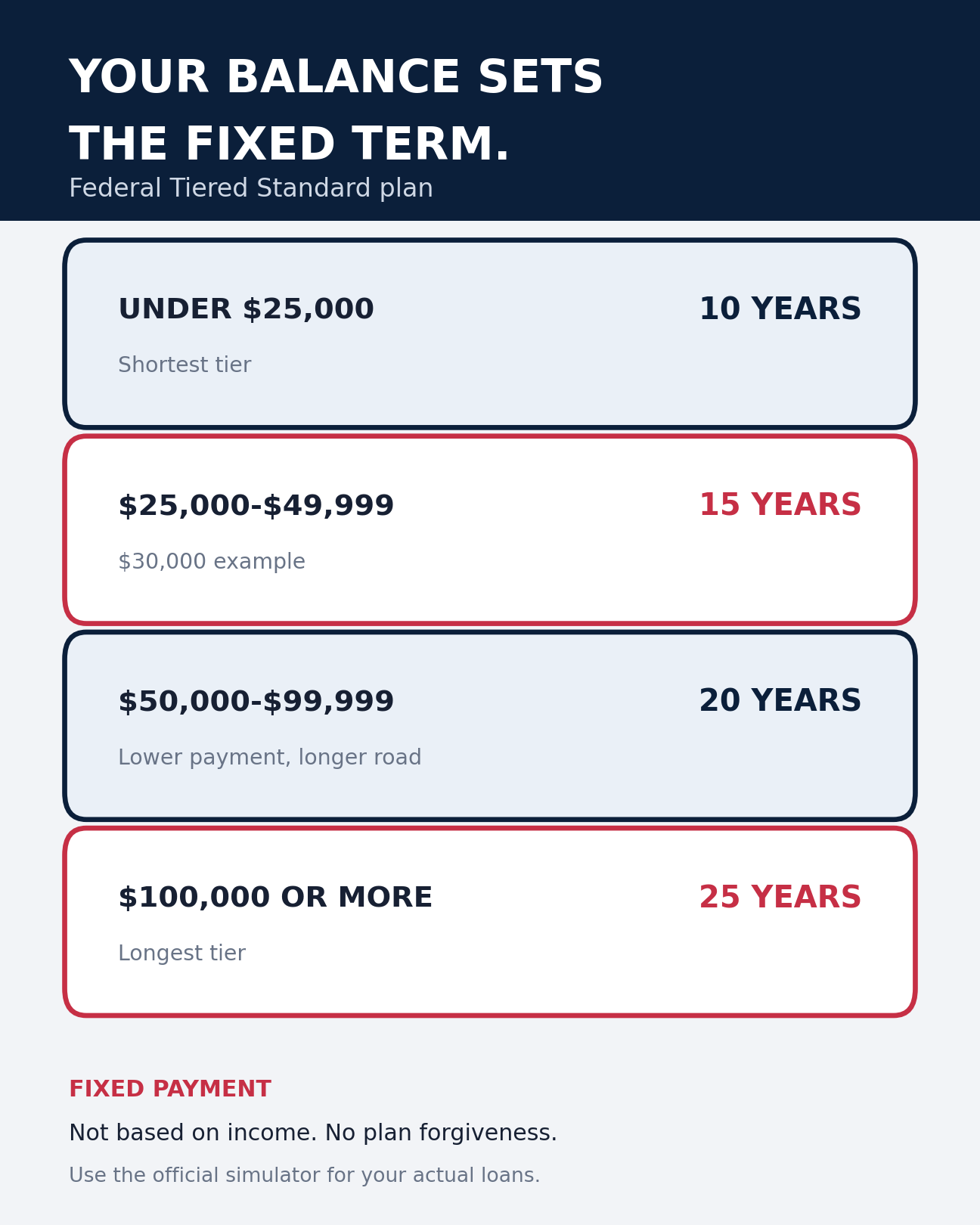
The balance tier sets the fixed repayment term. Verify the loans included in your balance with the official federal tool or your servicer.
Eligibility depends on your loan history. The final federal regulations establish Tiered Standard for Direct Loans made on or after July 1, 2026 and address borrowers who also have earlier Direct Loans. Certain borrowers with only earlier loans may have different choices. Use the official Federal Student Aid Repayment Calculator and your servicer's account-specific result instead of assuming a tier from the headline balance alone.
Worked example: $30,000 at 6.50%
Consider one hypothetical fixed-rate federal loan balance of $30,000 beginning repayment in August 2026. The example assumes no fees, deferment, forbearance, capitalization event, new borrowing, rate change, forgiveness, or missed payment.
A $30,000 balance falls in the 15-year tier. For comparison, the same balance and APR are also modeled with a payment sufficient to finish in 10 years.
| Hypothetical result | 10-year payment | Tiered 15-year payment |
|---|---|---|
| Starting balance | $30,000.00 | $30,000.00 |
| Fixed APR | 6.50% | 6.50% |
| Monthly payment | $340.65 | $261.34 |
| Months to payoff | 120 | 180 |
| Projected final month | July 2036 | July 2041 |
| Total modeled interest | $10,877.01 | $17,038.85 |
| Total modeled payments | $40,877.01 | $47,038.85 |
The 15-year payment is $79.31 lower each month. Over the full model, however, the borrower pays $6,161.84 more interest and stays in repayment five years longer.
Those figures come from the app's payoff engine, which applies monthly interest to the beginning balance, rounds to cents, and then applies the fixed payment. Federal student loans commonly accrue interest daily, and servicers handle rounding and account events under federal rules. Treat this as transparent planning math, not an official quote.
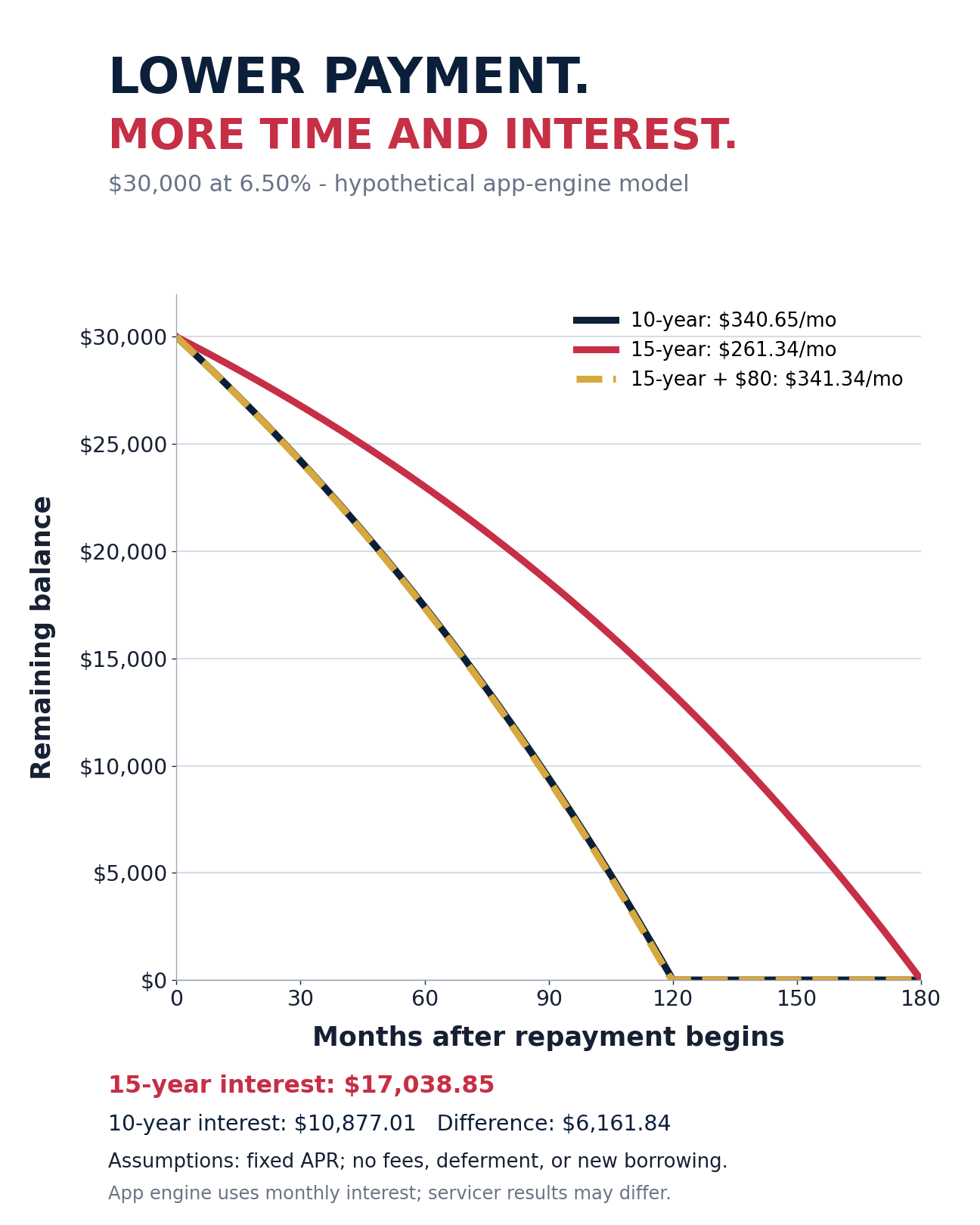
Hypothetical app-engine model: $30,000 at a fixed 6.50% APR starting August 2026. The 15-year payment lowers the monthly requirement, while adding $80 brings the modeled payoff back to 120 months. Actual servicer calculations may differ.
The lower payment is useful when it protects the rest of the household
Paying less each month is not automatically a bad choice. A lower required payment may help you:
- avoid missing rent, utilities, insurance, or other required bills;
- keep a small emergency cushion instead of reaching for a credit card after every surprise;
- remain current during a temporary cash-flow squeeze; or
- direct optional money toward a credit card or loan with a much higher effective cost.
That is the difference between minimum-payment safety and faster-payoff strategy. First, make every required payment safely and on time. Then decide where optional money does the most useful work.
Federal Student Aid's payment-preparation guidance explains that a federal loan becomes delinquent after a missed payment and that borrowers who cannot afford the payment should contact the servicer about available options. Do not create a faster plan that is so tight it makes the required payment fragile.
What happens if you add extra money?
The Tiered Standard term sets the required payment schedule; it does not mean you must wait 15 years to finish a 15-year-tier loan. In the same hypothetical example, adding $80 to the $261.34 payment produces a $341.34 monthly payment.
The app engine then calculates:
| Tiered payment plus $80 | Result |
|---|---|
| Monthly payment | $341.34 |
| Months to payoff | 120 |
| Projected final month | July 2036 |
| Total modeled interest | $10,843.61 |
That result lands one cent below the 10-year comparison's total cost because the accelerated payment is $0.69 higher per month. It shows why keeping the lower required payment can provide flexibility while a separate extra-payment plan controls speed.
Before sending extra money, confirm with your servicer how payments are applied and whether you need special instructions for multiple loans. Also compare the student loan with every other balance. An extra $80 may be more valuable against a 24% credit card than against a 6.50% student loan, but the right order depends on fees, protections, tax treatment, promotional terms, and your need for cash reserves.
Tiered Standard versus RAP is not just fixed versus lower
Tiered Standard and the Repayment Assistance Plan solve different problems.
- Tiered Standard uses a fixed payment and a term based on the loan balance. It is not based on income and does not include plan forgiveness.
- RAP is income-driven. Its payment can change with adjusted gross income and dependents, and current rules include an unpaid-interest waiver and a limited federal principal contribution for qualifying on-time payments.
Do not compare only the first monthly number. Compare payment stability, total expected cost, eligibility, income changes, family size, forgiveness or Public Service Loan Forgiveness goals, and how long you expect to remain in repayment. The official federal simulator is the appropriate place to compare federal-plan estimates.
How Debt Freedom Planner can help without replacing the federal tools
Debt Freedom Planner lets you enter balances, APRs, minimum payments, and optional extra money, then compare snowball, avalanche, and custom payoff orders. It can show a month-by-month schedule and how a higher payment changes the projected payoff date.
The planner does not determine federal plan eligibility, reproduce daily federal interest, calculate RAP benefits, predict forgiveness, or replace your servicer. Use it as a household planning layer:
- Get the official Tiered Standard payment and current balance from StudentAid.gov or your servicer.
- Enter that verified payment, balance, and APR in the planner.
- Add credit cards, auto loans, personal loans, and other debts from current statements.
- Compare a baseline using only required payments with one or more extra-payment scenarios.
- Use a custom order when federal program rules make a simple APR ranking incomplete.
- Reconcile the plan with actual statements because interest timing and account events can move the real balance away from a monthly projection.
Checklist before choosing the longer term
- Confirm which Direct Loans are included in the Tiered Standard balance.
- Verify your assigned term and payment in the official federal result.
- Compare the fixed payment with RAP and every other plan for which you are eligible.
- Check whether you are pursuing PSLF or another discharge program.
- Protect the required payment and basic household bills first.
- Calculate total interest, not just the first monthly payment.
- Decide in advance how much optional extra money you can sustain.
- Confirm how the servicer applies extra payments across multiple loans.
- Recheck the plan after a rate, balance, income, or household change.
The Tiered Standard plan is best understood as a cash-flow trade: it can make the required payment more manageable by buying more time, but that time usually costs interest. Use the official payment, keep the required amount safe, and build a separate extra-payment decision around the whole household debt picture.
Educational information only: This article provides general educational repayment illustrations, not financial, legal, tax, credit-repair, bankruptcy, or student-loan advice. Federal rules and individual eligibility can change. Confirm current terms with StudentAid.gov and your federal loan servicer before acting.
0 comments
Ask a question, add context, or share what worked for your household.
Create a free account or sign in to comment, reply, and vote on blog posts.