

Fixed vs. Variable Credit Card APR: When Should You Recalculate Your Payoff Plan?
Learn when a fixed or variable credit-card APR change should trigger a payoff-plan update, with a statement checklist and a worked $9,000 example.
Short answer: Recalculate your credit-card payoff plan whenever the APR that actually applies to your balance changes—not merely when you hear that market rates moved. For a variable APR, check each new statement because the index portion can move without a traditional rate-change notice. For a fixed APR, update the plan after the issuer gives notice of a permitted change, a promotional period ends, a penalty rate takes effect, or another account term changes the rate you are paying. Use the latest statement APR, keep paying at least the required minimum by the due date, and compare the revised payoff date and total interest before deciding whether to raise your monthly target.

Your payoff projection is only as current as the balance, APR, minimum payment, and monthly target behind it. A statement review is the safest trigger for updating those numbers.
Fixed APR vs. variable APR: the practical difference
The Consumer Financial Protection Bureau's fixed-versus-variable APR guidance makes the distinction simple:
- A fixed APR does not automatically move with an outside index. “Fixed” does not mean the rate can never change; it means index movement alone does not change it.
- A variable APR changes according to an index or formula identified in the card agreement. A common structure is an index plus a fixed margin.
| What to check | Fixed APR | Variable APR |
|---|---|---|
| Moves automatically with an index? | No | Yes, according to the agreement |
| Traditional advance notice for every index move? | Generally relevant when the issuer changes terms | An index-based move may occur under the existing formula |
| Best planning input | APR on the latest statement | APR on the latest statement |
| Recalculation trigger | Verified rate or term change | Any new statement showing a different applicable APR |
Your card may also have different APRs for purchases, balance transfers, and cash advances. The CFPB notes that a statement must show each category with a different APR and the balance in that category. If one card has several rate buckets, a simple monthly payoff model will not perfectly reproduce the issuer's daily interest and payment-allocation process.
When should you recalculate the payoff plan?
Use these triggers instead of guessing:
- The statement shows a different purchase APR. This is the clearest trigger because it is the rate currently being applied to that balance category.
- A change-in-terms notice arrives. The CFPB says issuers generally must give 45 days' advance notice before certain increases that affect new purchases. The current Regulation Z change-in-terms rule contains the detailed notice requirements and exceptions.
- A promotional rate is about to expire. Recalculate before the first statement at the regular rate so you can see whether your current payment still reaches the original target date.
- A variable-rate formula resets. Your agreement may specify the index, margin, and timing. Previewing the possible change is useful, but update the working plan with the rate the statement actually reports.
- A penalty rate or hardship arrangement begins or ends. The live blog's penalty-APR article covers the late-payment path in more detail.
- Your balance or payment target changes materially. A new APR is not the only reason a payoff estimate can drift.
Do not wait for a dramatic jump. Even a few percentage points can change both the final payoff month and the cost of holding the balance.
Worked example: a five-point APR increase
Consider one hypothetical credit-card balance using the same monthly approximation as Debt Freedom Planner:
- Starting balance: $9,000
- Original APR: 19.99%
- New APR: 24.99%
- Original monthly target: $300
- No new charges, fees, missed payments, or later APR changes
| Scenario | Monthly payment | Modeled payoff time | Modeled interest |
|---|---|---|---|
| Original 19.99% APR | $300 | 42 months | $3,577.70 |
| New 24.99% APR | $300 | 48 months | $5,267.29 |
| New 24.99% APR with adjusted target | $325 | 42 months | $4,555.90 |
If the payment stays at $300, the higher APR adds 6 months and $1,689.59 of modeled interest. Raising the monthly target to $325 restores the 42-month timeline in this model, but it does not erase all of the higher interest: the adjusted plan still models $978.20 more interest than the original-rate plan.
That is the real reason to recalculate. The revised projection separates two questions: “Can this payment still fit the household budget?” and “Does it still reach the date I was planning around?”
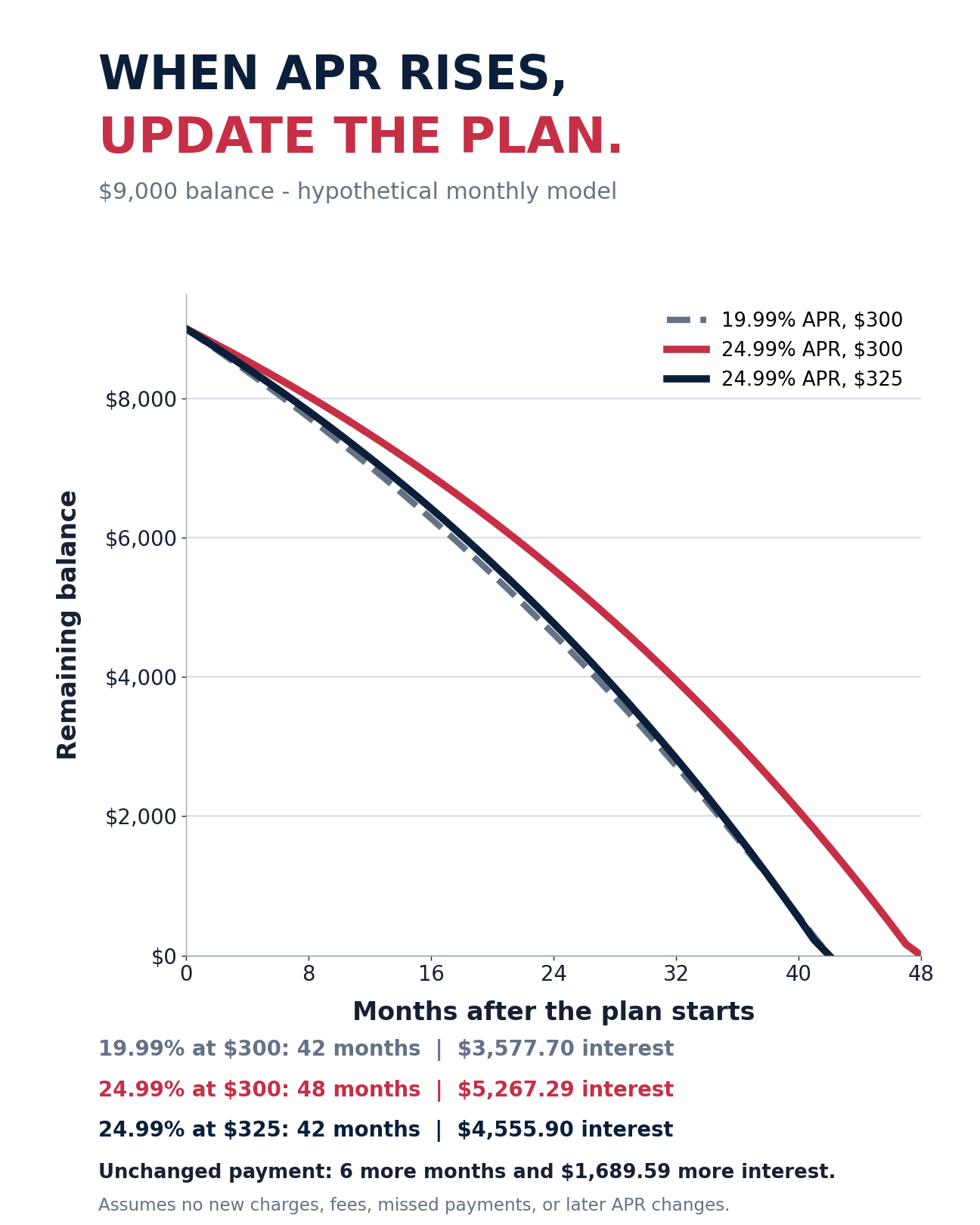
Hypothetical Debt Freedom Planner comparison: $9,000 starting balance, monthly payment model, and no new charges, fees, missed payments, or later rate changes. Actual card interest is often calculated daily from an average daily balance, so issuer results will differ.
A five-step statement check
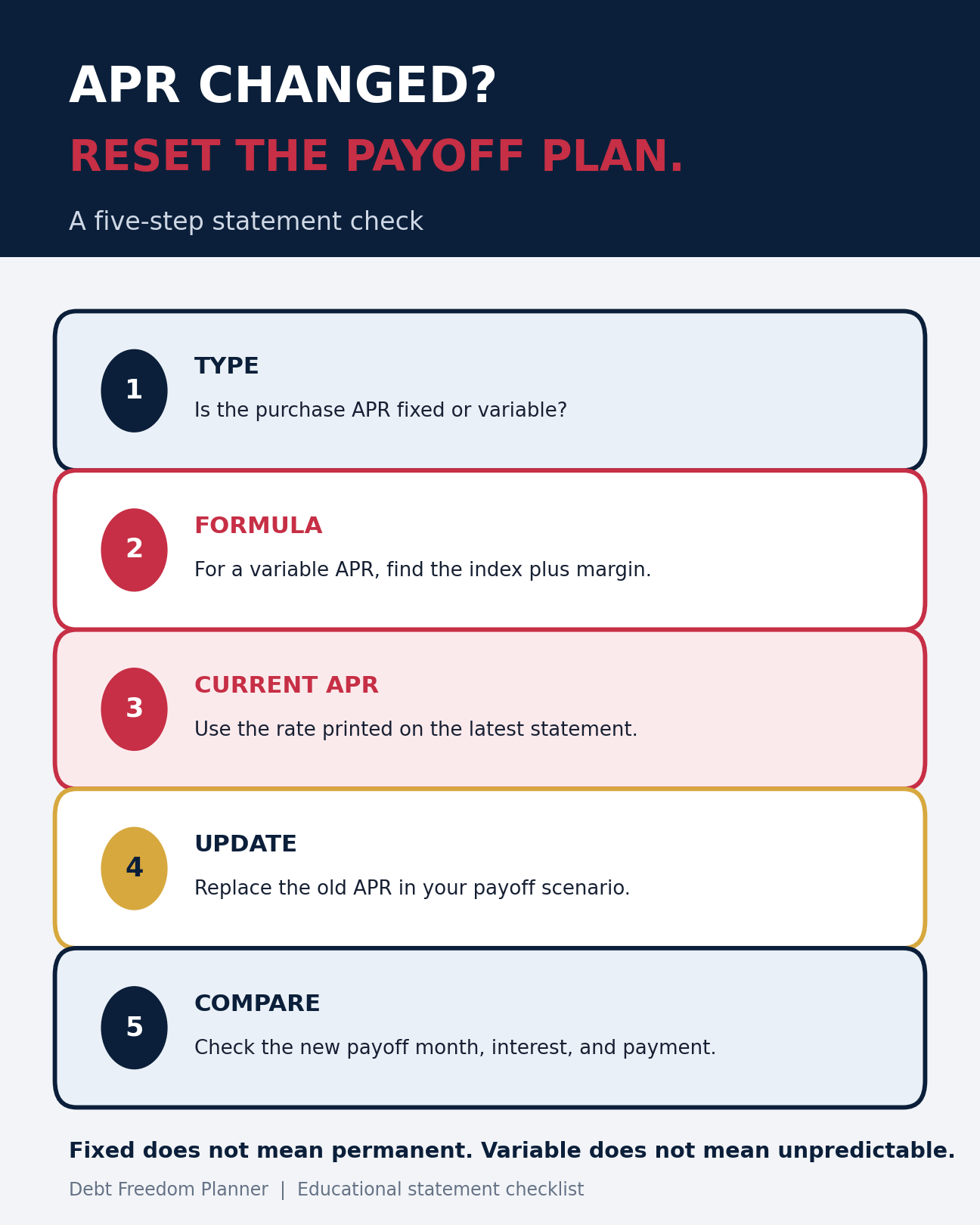
Read the rate type, formula, and current statement APR before replacing the old number in a payoff scenario.
1. Identify the rate type
Look for “fixed,” “non-variable,” or “variable” near the applicable APR. Do not assume the rate type from memory or from a marketing offer.
2. Find the formula
For a variable rate, locate the index and margin in the card agreement. The CFPB maintains a credit-card agreement database, but account-specific terms should come from your issuer or your own agreement.
3. Confirm the current APR
Use the latest statement's APR for the balance category you are modeling. If you do not understand the change, contact the issuer before treating a projection as settled.
4. Replace the old input
Update the balance, APR, minimum payment, and the total amount you realistically plan to send each month. Keep the required minimum separate from your faster-payoff target: the minimum protects payment status; the larger target controls the strategy.
5. Compare the result
Record the new payoff month, total modeled interest, and monthly amount. If the date moved, test one or two affordable payment increases instead of choosing an arbitrary number.
What federal credit-card rules do—and do not—mean for your plan
The CFPB's rate-increase overview explains that issuers are generally restricted from raising the rate on an existing balance, but exceptions include an expired temporary rate, an increase in a variable-rate index, a payment more than 60 days late, and certain arrangement or statutory-protection changes. The current Regulation Z rate-increase rule supplies the legal detail.
Those protections do not freeze your payoff math. If the rate that applies to your balance lawfully changes, the projection changes too. Separately, some issuer-initiated increases must be reevaluated periodically; the current Regulation Z reevaluation rule addresses that process. A future reduction is possible in some circumstances, but it is not a reason to leave today's plan at yesterday's APR.
How Debt Freedom Planner fits
Open Debt Freedom Planner after you verify the statement numbers. Enter the current balance, current APR, required minimum, and the extra amount your household can sustain. Compare scenarios using the same debt and different monthly targets, then save the version you intend to follow.
The planner does not connect to your bank or monitor your APR automatically. That boundary is useful here: you remain responsible for reading the statement, and the tool shows how the numbers you entered affect a monthly payoff projection. Revisit the scenario after every confirmed rate, balance, minimum-payment, or budget change.
Bottom line
Fixed versus variable tells you why a rate may change; the latest statement tells you what rate to plan with now. Recalculate whenever the applicable APR changes, compare the new payoff date and interest, and adjust the monthly target only to a level the household can actually maintain. Continue making at least the statement minimum on time while you evaluate the faster plan.
Debt Freedom Planner provides educational payoff projections, not individualized financial, legal, tax, credit-repair, or bankruptcy advice. Credit-card agreements and issuer calculations vary. Confirm account-specific terms, rates, balances, and required payments with the issuer.
0 comments
Ask a question, add context, or share what worked for your household.
Create a free account or sign in to comment, reply, and vote on blog posts.