

Hospital Financial Assistance vs. a Medical Credit Card: Check This Before Financing a Bill
Apply for hospital financial assistance before financing a medical bill, then compare credit terms using the verified remaining balance.
If a hospital offers a medical credit card, ask about financial assistance before you finance the bill. Assistance or charity care may reduce the amount you owe; a medical credit card usually turns the amount charged into a separate debt with its own interest, fees, payment deadlines, and credit consequences. First verify the bill, request the hospital's written policy, apply if you may qualify, and finance only the confirmed remainder.

The order matters: learn what you actually owe before choosing how to finance it. Original Debt Freedom Planner artwork.
This is not a promise that an application will be approved. Eligibility, covered services, deadlines, and discount amounts vary by hospital and sometimes by state. It is a decision sequence that can keep you from borrowing against a bill that might first be reduced.
The short answer: apply first, finance second
The Centers for Medicare & Medicaid Services says nonprofit hospitals must give financial assistance to eligible patients, and other facilities may offer help too. The IRS explains that a tax-exempt hospital's written financial assistance policy must describe eligibility, how charges are calculated, how to apply, and which providers are covered.
A medical credit card answers a different question: How will I borrow to pay this bill? It does not determine whether the bill is accurate, covered by insurance, eligible for assistance, or negotiable. Once the hospital is paid by a lender, you generally owe the lender under the card agreement.
The practical order is:
- Review the bill and insurance explanation of benefits, if any.
- Ask for the hospital's financial assistance policy, application, and plain-language summary.
- Apply if your income, household size, or financial hardship might qualify.
- Get the decision and a corrected remaining balance in writing.
- Only then compare a provider plan, medical credit card, existing credit, or another payment method.
Why a medical credit card can make the problem harder
The Consumer Financial Protection Bureau's medical-financing guidance warns that medical credit cards and financing plans vary widely. A promotion may use deferred interest, which can add interest from the original purchase date if the balance is not fully paid by the deadline or another term is broken. The product may also involve a credit check, fees, and credit reporting.
The CFPB also says that putting a hospital bill on a regular or medical credit card may make financial assistance harder to obtain, even though a patient can still ask. The safest moment to apply is therefore usually before the hospital balance becomes card debt.
That does not mean every medical card is automatically a bad choice. A clearly documented financing offer may be useful when:
- the bill has been reviewed and is correct;
- the assistance decision is complete;
- you understand whether the promotion is true 0% APR or deferred interest;
- the required payment fits the household budget; and
- you know what happens after a late payment or an unpaid promotional balance.
The mistake is treating quick approval as proof that financing is the cheapest or safest option.
Five questions to ask before financing a hospital bill
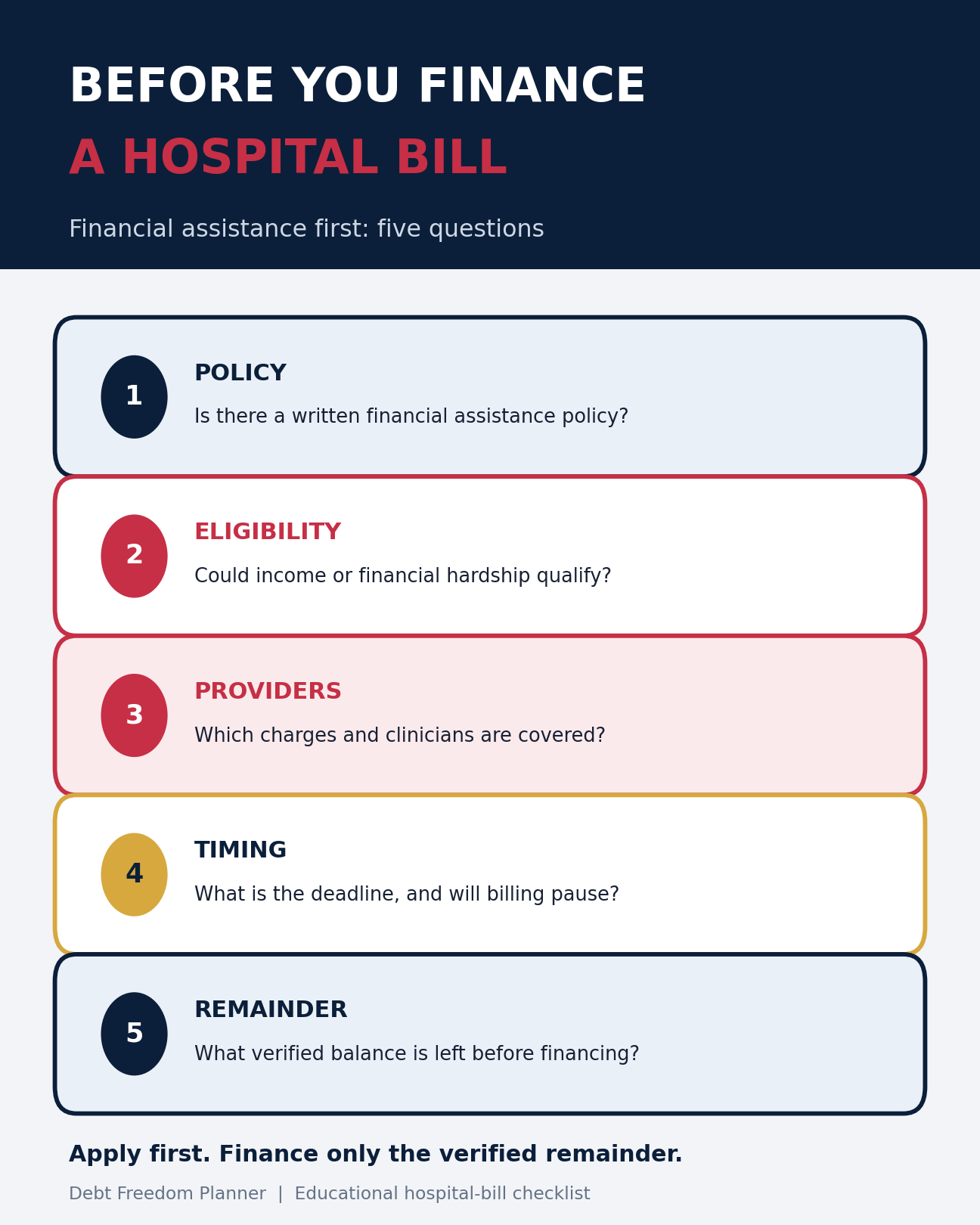
Use this checklist with the billing department. It separates the assistance decision from the financing decision.
1. Is there a written financial assistance policy?
Search the hospital's website for its name plus "financial assistance," or call the billing department. Ask for the policy, application, and plain-language summary. CMS says a hospital can provide the application online or on paper.
2. What are the eligibility rules?
Policies may consider income, household size, insurance status, or hardship. Do not assume that having insurance or some income automatically disqualifies you. Ask what documents are required and whether the hospital can screen you for presumptive eligibility.
3. Which charges and providers are covered?
A hospital's policy may not cover every clinician who treated you. The IRS says a tax-exempt hospital's policy must identify other providers delivering emergency or medically necessary care and state which are covered. Ask specifically about separate bills from physicians, labs, radiology, or ambulance services.
4. What is the deadline, and what happens while the application is pending?
Ask when the application is due, how long review usually takes, whether billing or collections will pause, and whom to contact for status updates. If the bill is already in collections, CMS advises telling the collector that you are applying for help and asking for a pause. Do not assume a pause exists unless it is confirmed.
5. What is the verified balance after every adjustment?
Request an updated statement showing insurance payments, corrections, discounts, and financial assistance. That remainder—not the first number on the first bill—is the amount to use when you compare payoff options.
Worked example: the starting balance changes the payoff
Suppose a household receives a $6,000 hospital bill. To show why the sequence matters, assume the hospital's policy reduces the eligible bill by 50%, leaving $3,000. This is strictly hypothetical: it is not a typical award, an eligibility estimate, or a promise about any hospital.
Next, assume either balance is financed at 29.99% APR with a fixed $250 monthly payment, no fees, no missed payments, and no new charges. Debt Freedom Planner's local monthly payoff engine produces this illustration:
| Hypothetical path | Starting financed balance | Monthly payment | Payoff time | Modeled interest | Modeled total paid |
|---|---|---|---|---|---|
| Finance before assistance | $6,000 | $250 | 38 months | $3,275.31 | $9,275.31 |
| Assume 50% assistance, then finance the remainder | $3,000 | $250 | 15 months | $611.63 | $3,611.63 |
The modeled interest difference is $2,663.68, and the smaller balance is gone 23 months sooner. The total cash difference is larger because the example assumes the original bill was also reduced by $3,000. Change the assistance result, APR, payment, fees, or card terms and the answer changes.
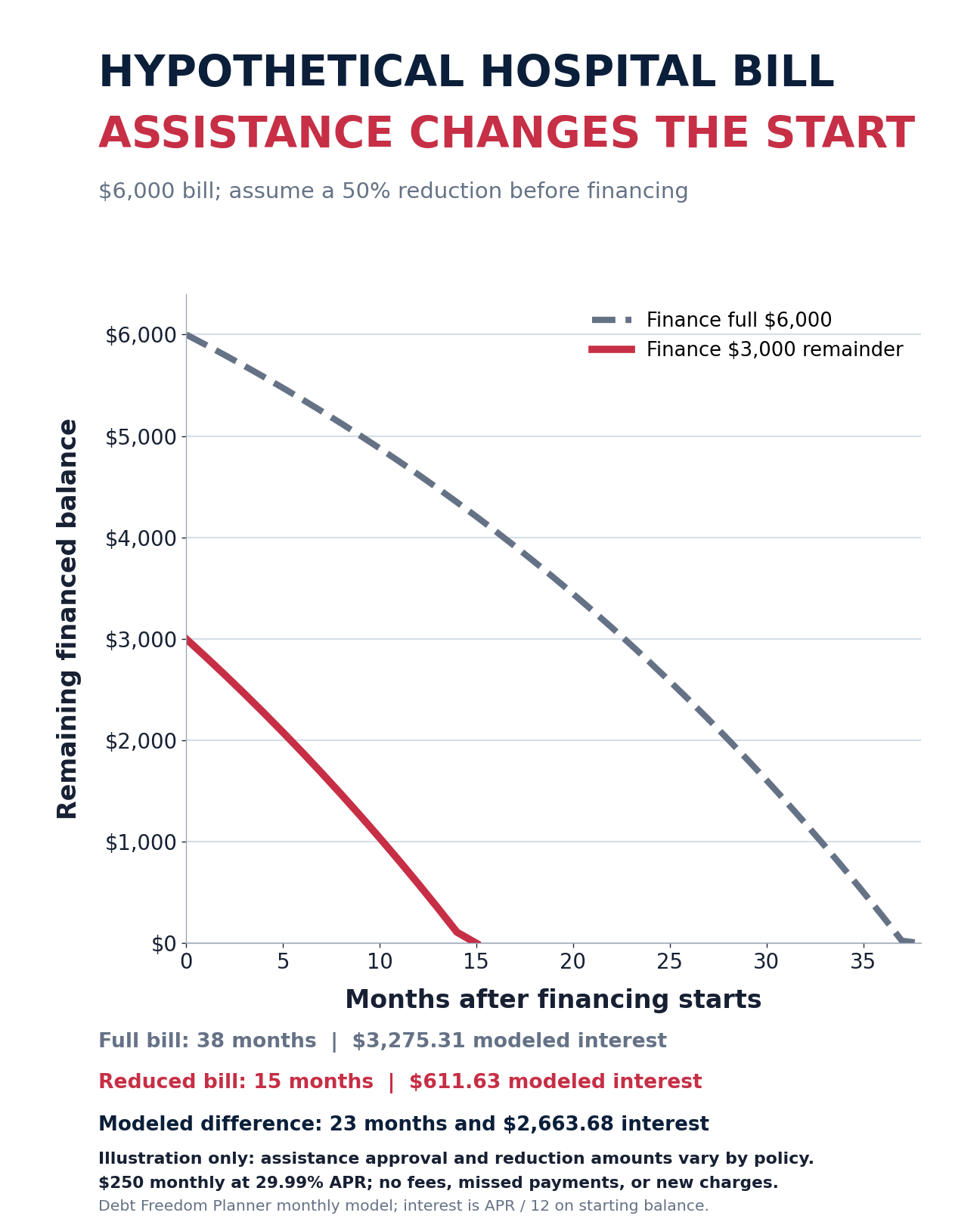
Hypothetical only: $6,000 bill, assumed 50% assistance, 29.99% APR, $250 monthly, and no fees, missed payments, or new charges. The graph uses Debt Freedom Planner's monthly payoff engine.
When should you compare financing offers?
Compare offers after you know the confirmed balance. Put each option on one page and record:
| Term to verify | Why it matters |
|---|---|
| Amount financed | It should match the final bill, not an earlier estimate. |
| APR | A temporary 0% label can hide deferred-interest conditions. |
| Required payment | A low minimum may not clear the balance by the promotional deadline. |
| Promotion end date | Missing it may change the cost dramatically. |
| Fees | Processing, late, or account fees can change the comparison. |
| Credit reporting | Medical financing can become ordinary credit debt. |
| Early-payoff terms | Confirm whether extra payments reduce the balance without a penalty. |
If a provider offers a true interest-free payment plan directly, compare it separately from a third-party medical credit card. If you also carry high-interest credit-card debt, the next payoff priority is a different question; see our guide to a 0% medical payment plan versus credit-card debt.
What if the bill is already in collections?
Do not ignore it, but do not rush to put it on a card without checking the amount and your rights. Tell the hospital and collector that you are seeking financial assistance, ask whether collection activity can pause, and keep copies of every submission and response.
The CFPB says debt collection or credit reporting involving charges above amounts permitted by the No Surprises Act may violate federal law. If you believe a debt is wrong, dispute it promptly and consider qualified legal help. This article cannot determine whether a specific bill is valid or what law applies in your state.
Where Debt Freedom Planner fits
Debt Freedom Planner does not decide financial-assistance eligibility, negotiate with a hospital, or read a card agreement for you. It becomes useful after the balance and terms are verified.
You can enter the remaining balance, APR, and required payment, then compare snowball, avalanche, or a custom payoff order. You can also see how an affordable extra monthly payment changes the projected payoff date and modeled interest. Start a Debt Freedom Planner roadmap when you have the confirmed numbers.
Bottom line
Hospital financial assistance and a medical credit card are not equal alternatives. Assistance asks whether the bill can be reduced; financing asks how you will repay what remains. Check the bill, apply for assistance, get the final balance in writing, and then compare financing terms against the rest of your household debt plan.
Debt Freedom Planner provides educational payoff projections, not financial, legal, tax, medical, credit-repair, or bankruptcy advice. Hospital policies, state protections, lending terms, and individual circumstances vary. Verify documents with the hospital, insurer, lender, and an appropriate qualified professional before acting.
0 comments
Ask a question, add context, or share what worked for your household.
Create a free account or sign in to comment, reply, and vote on blog posts.