

IRS Automatic Penalty Relief in 2026: What It Changes If You Owe Tax Debt
IRS Automatic Exemption from Penalty can remove eligible penalties, but tax and interest may remain. Learn who may qualify and how to rebuild a payoff plan.
Short answer: The IRS's new Automatic Exemption from Penalty can prevent eligible failure-to-file, failure-to-pay, and failure-to-deposit penalties from being assessed. It does not erase the underlying tax, stop interest on unpaid tax, or guarantee every return qualifies. If you receive an AEP notice, confirm the balance that remains, protect the IRS due date or payment-plan terms, and rebuild your household payoff plan around that verified number.

Automatic penalty relief can lower the cost of a tax mistake, but it does not turn an unpaid tax balance into free financing. Verify the IRS notice first, then plan the remaining balance.
What changed with IRS automatic penalty relief in 2026?
The IRS began transitioning to Automatic Exemption from Penalty, or AEP, in summer 2026. Under the IRS administrative penalty relief guidance, an eligible taxpayer who files or pays late can avoid certain penalties when IRS records show a timely compliance history for the same return type.
AEP covers three common categories:
- failure to file;
- failure to pay; and
- failure to deposit.
The key change is timing. First Time Abate generally required a taxpayer to contact the IRS after a penalty was assessed. AEP is applied when an eligible original return completes processing, so the covered penalty is not assessed in the first place. The IRS sends a notice explaining that the relief was applied.
The July 8, 2026 IRS announcement says AEP will replace First Time Abate for eligible returns with original due dates on or after January 1, 2027. During the transition, some taxpayers who appear eligible may still receive a penalty notice and may need to contact the IRS.
Who may qualify for AEP?
The IRS says AEP begins with eligible 2025 tax-year returns and 2026 quarterly returns, then continues for later periods. Eligible return series include Forms 1040, 1065, 1120, 940, 941, 943, 944, 945, and CT-1.
For an individual Form 1040 filer, the practical starting test is:
- This is an eligible original return.
- The same return type was filed on time for the prior three years.
- The IRS did not assess a disqualifying penalty during that history, except an estimated-tax penalty, or the prior penalty was later removed for reasonable cause or IRS error.
Quarterly filers generally look back over 12 consecutive quarters. Business returns also have additional conditions, especially for repeated failure-to-deposit relief and electronic-deposit avoidance.
| Question | Why it matters | What to verify |
|---|---|---|
| Is this an eligible original return? | AEP does not apply to every filing | Return type and tax period on the notice |
| Was the same return type timely for the lookback period? | Timely compliance is the central test | IRS transcripts or account history |
| Did the IRS send an AEP letter? | It confirms the covered penalty was not assessed | Letter title, tax period, and balance |
| Does a penalty still appear? | Transition cases may need follow-up | Compare the notice with current IRS guidance |
| Is tax or interest still due? | AEP does not erase those amounts | Current IRS online-account balance or notice |
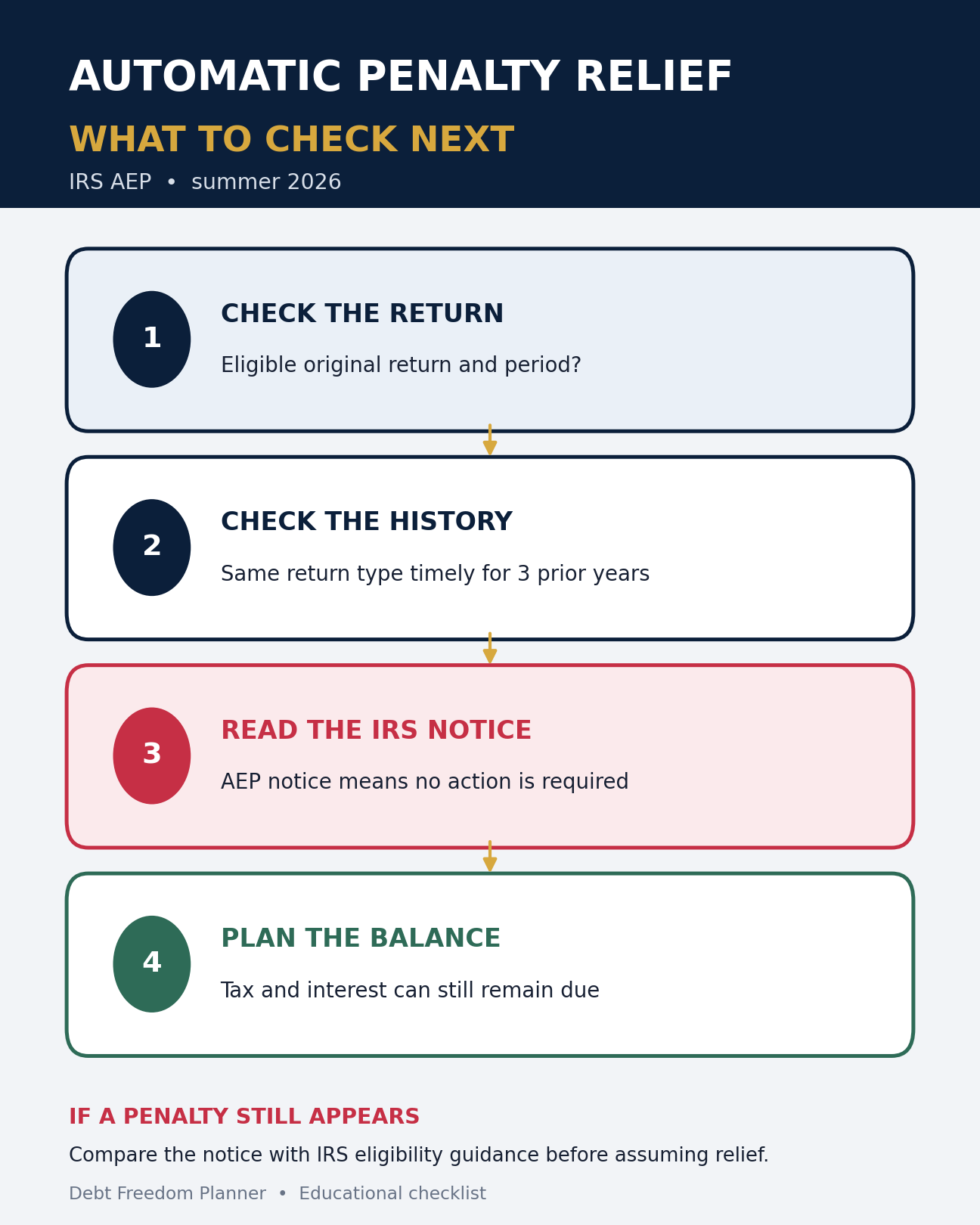
Use the notice as the pivot point: verify eligibility and the amount of relief before changing the payment plan. If a penalty still appears, do not assume it will disappear without checking.
What AEP does not remove
AEP is penalty relief, not debt cancellation. The IRS guidance says you remain liable for:
- the unpaid tax;
- interest on the unpaid tax; and
- penalties that are not eligible for AEP.
That boundary matters. The IRS failure-to-pay penalty page says the ordinary failure-to-pay penalty is generally 0.5% of unpaid tax for each month or part of a month, capped at 25%. For an individual who filed on time and has an approved payment plan, the rate is generally reduced to 0.25% per month while the agreement is in effect. In an eligible AEP case, the covered failure-to-pay penalty does not accrue and is not assessed, but interest on unpaid tax continues.
Interest is not a fixed forever rate. The IRS quarterly rate table lists a 7% underpayment rate for individuals in the third quarter of 2026. The IRS compounds interest daily and may change the rate each quarter. Your notice and IRS account, not a blog calculator, determine the actual balance.
Worked example: a $6,000 balance after AEP
Suppose a household receives an IRS notice confirming that AEP removed the failure-to-pay penalty, but $6,000 of tax remains due. For a transparent budgeting illustration, assume:
- starting balance: $6,000;
- APR held constant at 7.00%;
- no failure-to-pay penalty because the example assumes AEP eligibility;
- no new assessments, fees, or missed payments; and
- monthly interest in the planner model, not the IRS's official daily calculation.
Debt Freedom Planner's payoff engine produces this comparison:
| Monthly amount | Modeled payoff time | Modeled interest | Modeled total paid |
|---|---|---|---|
| $500 | 13 months | $238.84 | $6,238.84 |
| $650 | 10 months | $186.01 | $6,186.01 |
Adding $150 per month shortens the model by three months and reduces modeled interest by $52.83. The numbers are not an IRS quote. They show the planning point: penalty relief can improve the starting position, but paying faster can still reduce interest while the balance remains.
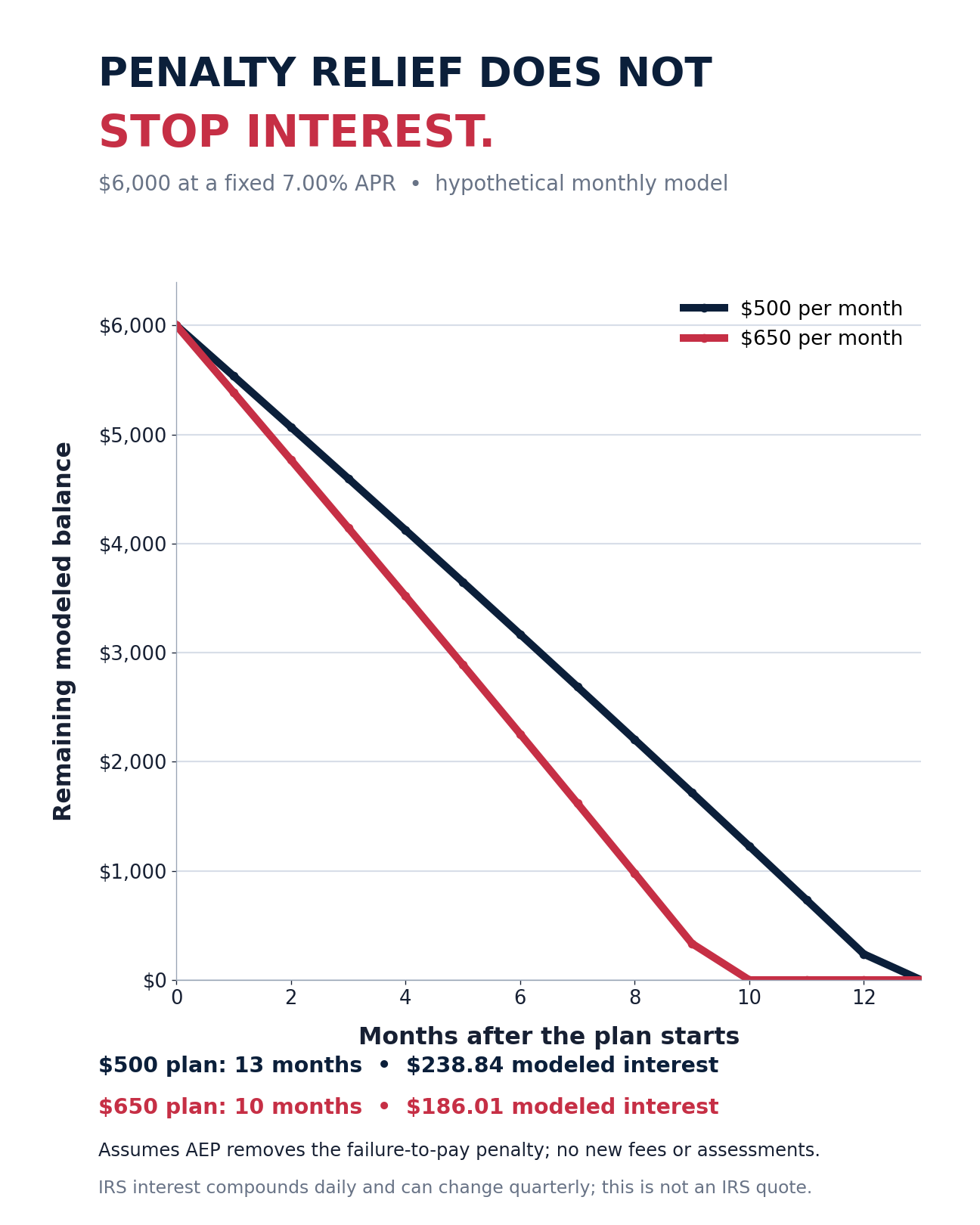
Hypothetical monthly model: $6,000 at a fixed 7.00% APR, with AEP assumed to remove the failure-to-pay penalty. IRS interest compounds daily and rates can change quarterly, so use the graph for household budgeting—not as a tax-balance calculation.
How to rebuild your payoff plan after an AEP notice
1. Confirm the exact relief
Read the letter for the return type, tax period, and penalty it addresses. AEP may remove one category without changing tax, interest, or another penalty. If the notice still shows a penalty you believe should qualify, the IRS says to contact the agency.
2. Pull the current balance
Use the amount on the newest notice or in your IRS online account. Do not subtract a penalty from an older balance on your own. Interest may have changed since that document was issued.
3. Protect the official payment terms
If you cannot pay in full, review the official IRS payment-plan options. A short-term plan and a long-term installment agreement have different eligibility rules, fees, and timelines. Interest and applicable penalties can continue while a plan is active.
4. Separate the required amount from the target amount
Your required IRS payment or due date is the safety floor. A higher payoff target is the amount you hope to send when cash flow allows. Never lower the required payment because an informal calculator shows a smaller number.
5. Compare the tax balance with other debts carefully
A high-APR credit card may be more expensive mathematically, but tax notices, collection risk, lien issues, and payment-plan defaults can change the priority. Keep the IRS agreement current first. If the right order is unclear, ask an enrolled agent, CPA, tax attorney, or qualified nonprofit counselor who can review the actual notices.
Where Debt Freedom Planner fits
Debt Freedom Planner can help organize the household side after the IRS amount is verified. You can enter the confirmed tax balance as an “other debt,” add a current rate only as a planning estimate, include other cards or loans, and compare snowball, avalanche, or custom payoff orders.
Because the planner uses a monthly payoff model, it will not reproduce IRS daily interest, quarterly rate changes, tax-law calculations, penalty rules, or collection procedures. Update the plan whenever the IRS balance, rate, required payment, or agreement changes.
Try Debt Freedom Planner with your verified balances to see how a steady monthly amount and an extra-payment scenario could change the household timeline.
A practical AEP checklist
- Keep the AEP notice with the affected return.
- Verify the return type and tax period.
- Confirm the prior three-year or 12-quarter compliance history.
- Check the current IRS balance after the relief posts.
- Continue every required payment until the IRS says otherwise.
- Recalculate your household plan using the verified balance.
- Recheck the IRS rate and account when a new quarter or notice arrives.
- Get professional help before changing a formal tax resolution strategy.
Bottom line
Automatic Exemption from Penalty can be meaningful: an eligible taxpayer avoids covered penalties without first requesting abatement. But the remaining tax and interest still need a plan. Treat the IRS letter as a verified update to your starting balance, keep official payment terms protected, and use payoff projections only to test what your household cash flow can support.
This article provides general educational information, not individualized tax, legal, financial, credit-repair, or bankruptcy advice. IRS eligibility, balances, interest, penalties, and collection options depend on the taxpayer's facts and official account records. Consult the IRS or a qualified tax professional about your situation.
0 comments
Ask a question, add context, or share what worked for your household.
Create a free account or sign in to comment, reply, and vote on blog posts.