

IRS Short-Term Payment Plan vs. Installment Agreement: Which Fits Your Budget?
Compare the IRS 180-day plan with a monthly installment agreement using current fees, a $12,000 worked example, and a sustainable-budget test.
If you can pay your verified IRS balance within 180 days without missing rent, utilities, food, insurance, or another required debt payment, the short-term payment plan is usually the cleaner fit because it has no setup fee. If that six-month pace would break your household budget, a long-term installment agreement can lower the monthly amount, but setup fees may apply and interest plus applicable penalties continue until the balance is paid. The right plan is the shortest one you can actually complete while staying current on new taxes.

A shorter deadline can reduce added cost, but only if the payment fits alongside essential household expenses.
Short-term versus long-term: the practical difference
The IRS describes a short-term payment plan as extra time—up to 180 days—to pay the balance in full. Individual taxpayers may qualify to apply online when they owe less than $100,000 in combined tax, penalties, and interest. The short-term plan has a $0 setup fee, although interest and applicable penalties continue while the balance remains unpaid.
A long-term payment plan, also called an installment agreement, uses monthly payments. Individuals may qualify to apply online when they owe $50,000 or less in combined tax, penalties, and interest and have filed all required returns. Other taxpayers may still have options, but the application process and financial documentation can differ. Start with the current IRS payment-plan eligibility and fee page, then follow the instructions on your notice.
| Question | Short-term payment plan | Long-term installment agreement |
|---|---|---|
| Payoff window | Up to 180 days | Monthly payments over a longer period |
| Online individual balance limit | Less than $100,000 | $50,000 or less |
| Setup fee | $0 | Often $22 online with direct debit or $69 online without direct debit |
| Interest and applicable penalties | Continue until paid | Continue until paid |
| Best fit | You can safely finish within six months | The six-month target is not sustainable |
Those dollar limits and fees can change. Qualified low-income taxpayers may receive a waiver or reimbursement under IRS rules. Verify the current terms before choosing a payment method.
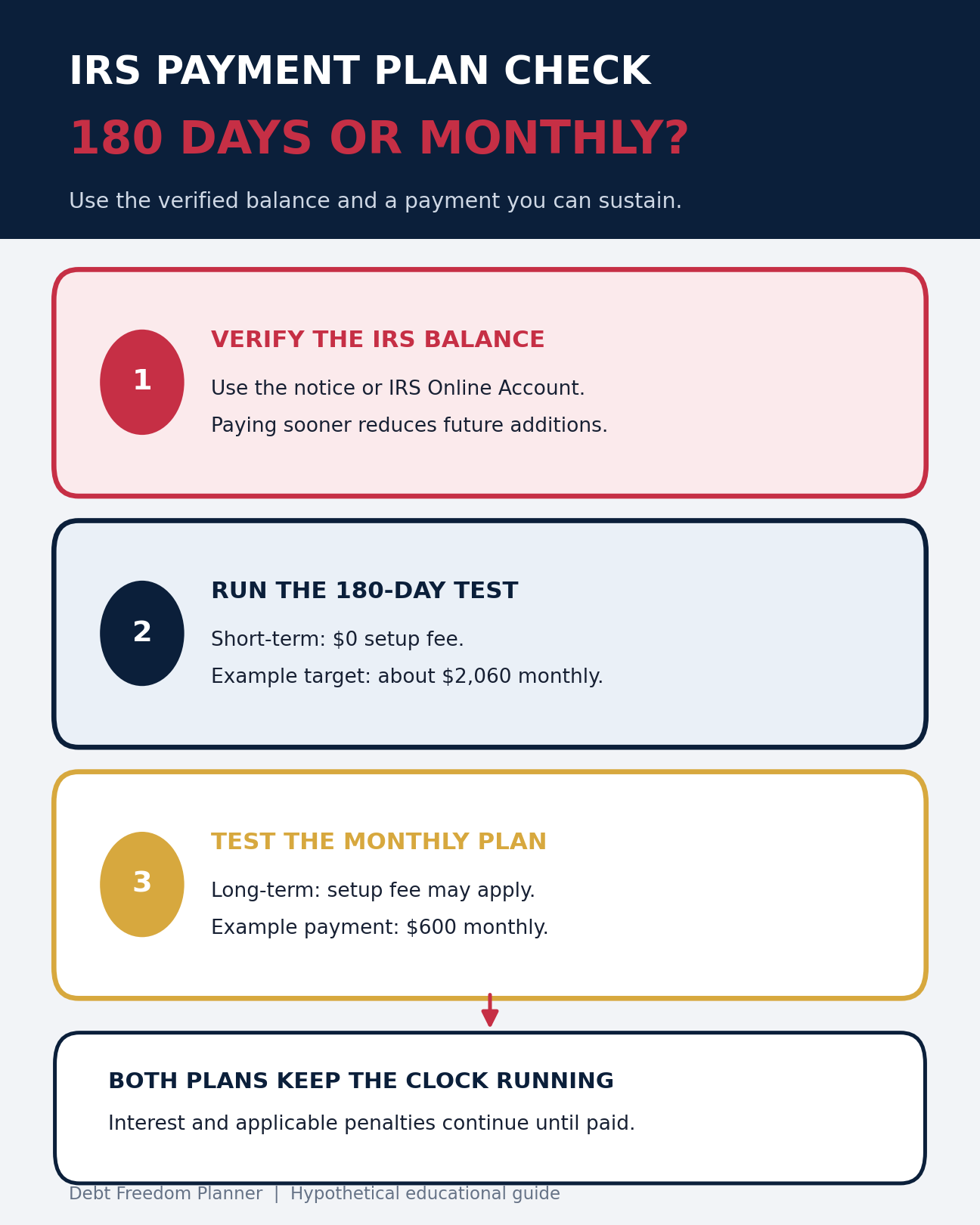
Use the verified IRS balance—not a remembered return amount—to test both payment paths.
The decision starts with one monthly number
Take the current balance from your IRS notice or IRS Online Account and divide it by six. That is a useful first estimate for the short-term monthly pace:
Verified balance ÷ 6 = starting 180-day payment target
It is only a starting target because interest and applicable penalties continue. A $12,000 balance divided by six is $2,000, but a payment somewhat above $2,000 may be needed to absorb additions during the payoff period.
Now compare that target with the money actually available after:
- housing, utilities, food, transportation, insurance, and medicine;
- every required debt minimum;
- current-year withholding or estimated-tax needs; and
- a modest buffer for normal surprises.
If the target works only by skipping another obligation or draining the cash needed for essentials, the 180-day option does not fit. A longer agreement with a payment you can sustain is safer than an aggressive promise that is likely to fail.
Worked example: a hypothetical $12,000 IRS balance
Suppose a household has a verified $12,000 balance and is comparing two planning payments:
- $2,060 per month, intended to finish within six months; and
- $600 per month, intended to create more room in the monthly budget.
For a transparent Debt Freedom Planner illustration, the model uses a 10.00% planning APR. That combines the IRS's 7% individual underpayment rate for the third quarter of 2026 with a 3% annualized approximation of a 0.25% monthly failure-to-pay penalty. The engine calculates monthly interest as APR divided by 12.
The IRS does not calculate a balance this way. IRS interest compounds daily, the rate can change each quarter, penalty treatment depends on the account, and the IRS notice or Online Account controls the real amount due. This approximation is for household cash-flow planning only.
| Hypothetical payment pace | App-engine payoff time | Modeled added cost | App-engine total paid |
|---|---|---|---|
| $2,060 monthly | 6 months | $352.27 | $12,352.27 |
| $600 monthly | 22 months | $1,181.85 | $13,181.85 |
| Difference | 16 months | $829.58 | $829.58 |
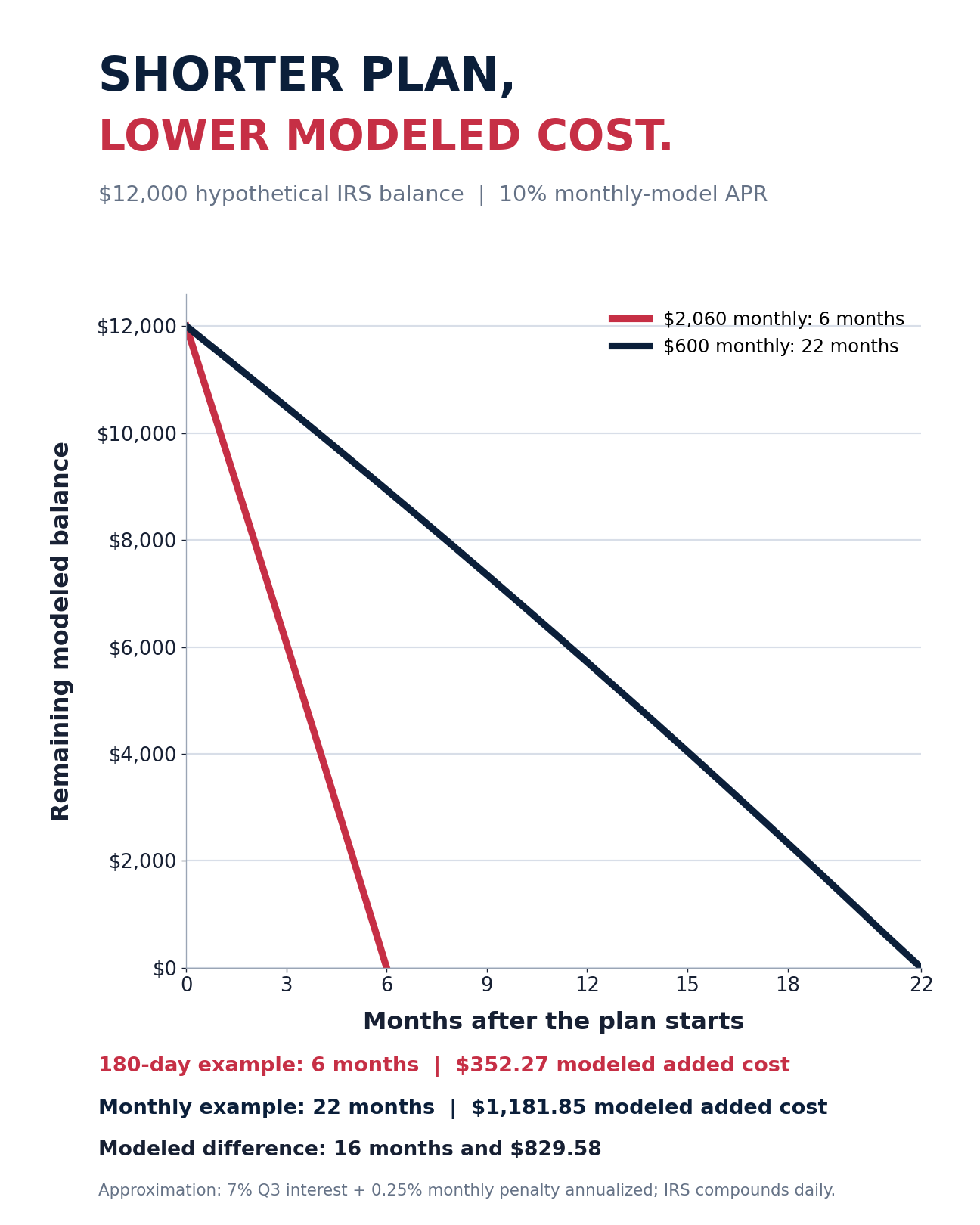
Hypothetical app-engine comparison: $12,000 at a 10% monthly-model APR, no new tax added, and setup fees excluded. This is not an IRS payoff quote.
The faster example produces $829.58 less modeled carrying cost. If the longer plan uses the current $22 online direct-debit setup fee, its modeled cost beyond principal becomes $1,203.85. The short-term option still wins on modeled cost—but only if $2,060 is a realistic payment for six consecutive months.
Interest and penalties do not stop when a plan starts
The IRS filed-but-unpaid guidance updated August 3, 2026 says the failure-to-pay penalty is generally 0.5% of unpaid tax for each month or part of a month, up to 25%. For an individual who filed on time, that rate is generally reduced to 0.25% per month while an approved payment plan is in effect.
That reduction does not make the balance interest-free. The IRS's Topic 202 payment guidance tells taxpayers to pay as much as possible because interest and penalties keep adding to the account. Paying sooner usually reduces those future additions.
Do not subtract expected penalty relief, a future refund, or an unprocessed payment from the planning balance until the IRS account reflects it. If you received Automatic Exemption from Penalty or another relief notice, verify which penalty and tax period it covers. Relief may change the starting balance, but it does not automatically remove unpaid tax or interest.
Protect the plan from default
Before applying, check these four items:
1. File every required return
The IRS requires filing compliance before approving many installment agreements. A missing return can delay the request or change the amount due.
2. Keep new taxes current
If you are self-employed or otherwise make estimated payments, budget for current-year tax separately from the old balance. Adding a new unpaid liability can put an existing agreement at risk.
3. Choose a due date that follows income
For a monthly agreement, the IRS generally asks for a payment date from the 1st through the 28th. Put the due date shortly after a dependable paycheck or income deposit, not immediately before it.
4. Keep paying even when a refund is applied
Future federal refunds may be applied to the tax debt. That does not necessarily replace the scheduled monthly payment. Follow the agreement and current IRS instructions unless the IRS confirms a change.
The IRS revised its internal installment-agreement manual on July 20, 2026. The current manual emphasizes filing and payment compliance and notes that penalties and interest continue while balances remain. It is written for IRS personnel, but the household lesson is plain: a payment plan works only when old debt and new tax obligations are managed together.
When neither standard option fits
Do not force a six-month or ordinary monthly payment if either would prevent you from meeting basic living expenses. The IRS lists other possible resolutions, including an offer in compromise for eligible taxpayers or a temporary delay in collection when payment would create financial hardship. These are not automatic, and documentation may be required. Use the IRS Tax Debt Help tool or the contact information on your notice rather than paying a company that promises guaranteed settlement.
If you are in bankruptcy, facing a levy deadline, disputing the amount, or dealing with multiple years and business taxes, get qualified help promptly. Those situations go beyond a simple payoff comparison.
Try both payments in Debt Freedom Planner
Debt Freedom Planner can help you test whether the 180-day target fits your household cash flow. Enter the verified tax balance as one debt, use a clearly labeled planning APR, and compare the six-month payment with a lower monthly amount. The planner will show a modeled payoff month, total added cost, and month-by-month balance path.
Keep setup fees outside the modeled balance unless the IRS account actually adds them. Re-run the plan when the IRS posts a payment, changes the balance, or announces a new quarterly interest rate. The planner does not connect to the IRS, interpret notices, determine eligibility, or calculate official daily interest.
Bottom line
Choose the short-term IRS plan when the full balance can be paid within 180 days without destabilizing the household. Choose a long-term installment agreement when the six-month amount is not sustainable, then pay more than the required monthly amount when the budget safely allows. In either case, verify the balance, keep all required returns and new taxes current, and use the shortest reliable payoff pace—not the shortest optimistic one.
This article provides general educational information and hypothetical payoff estimates. It is not financial, legal, tax, credit-repair, or bankruptcy advice. IRS rules, rates, fees, and account balances can change; verify current information with the IRS or a qualified tax professional.
0 comments
Ask a question, add context, or share what worked for your household.
Create a free account or sign in to comment, reply, and vote on blog posts.