

Medical Bill vs. Explanation of Benefits: What to Check Before Starting a Payment Plan
Compare the EOB and provider bill first, resolve unexplained differences, and see how financing a $500 mismatch can raise total repayment.
Before you start a payment plan for an insured medical bill, compare the bill with your explanation of benefits (EOB), confirm the patient-responsibility amount, and ask about any line that does not match. An EOB is not a bill. It is the health plan's explanation of how a claim was processed, and it can help you avoid building a payoff plan around a charge that is duplicated, missing an insurance payment, or still under review.

Original editorial artwork created for Debt Freedom Planner. The documents contain no real patient, insurer, provider, or account information.
Medical bill vs. EOB: the short answer
The provider sends the medical bill and asks you to pay. Your health plan sends the EOB and shows how it handled the claim.
The Centers for Medicare & Medicaid Services explains that an EOB shows the total charges, what the health plan covers, and what you may pay. CMS also states plainly that the EOB is not a bill. Its patient-balance figure may still need context: the EOB does not necessarily show a payment you already made to the provider, and a later adjustment or appeal can change the claim.
Use the two documents together:
| Document | Who sends it | What it is for | What to check |
|---|---|---|---|
| Explanation of benefits | Health plan | Explains claim processing | Provider, service date, service description, billed charge, allowed charge, insurer payment, patient balance, denial or remark code |
| Medical bill | Provider or facility | Requests payment | Account and service dates, itemized charges, insurance adjustments, prior payments, amount due, due date, payment instructions |
Do not assume the EOB is automatically right or that every difference proves the bill is wrong. A mismatch is a reason to ask questions and reconcile the records before choosing how to pay.
Read these EOB fields before looking at the amount due
CMS's EOB guide identifies the core fields that make the comparison useful. Start with the basics:
- Patient and health plan: Make sure the document belongs to the right covered person and plan.
- Provider and date of service: Match the clinician, facility, lab, or other provider to the bill.
- Claim number: Keep this reference handy when calling the health plan.
- Provider charge: This is what the provider submitted, not necessarily what the plan recognizes as payable.
- Allowed charge: This is the amount the provider will be paid under the claim processing shown on the EOB. It can differ from the original charge.
- Paid by insurer: Confirm that the provider bill reflects the health plan's payment or adjustment.
- What you owe or patient balance: Compare this with the provider's amount due and subtract any amount you already paid.
- Remark or denial code: Read the explanation. It may point to a coverage issue, missing information, or another action.
CMS says the provider bill should not be higher than the EOB's patient balance. If it is, contact the provider. Also contact the health plan when you do not understand how the claim was processed or believe a covered service was handled incorrectly.
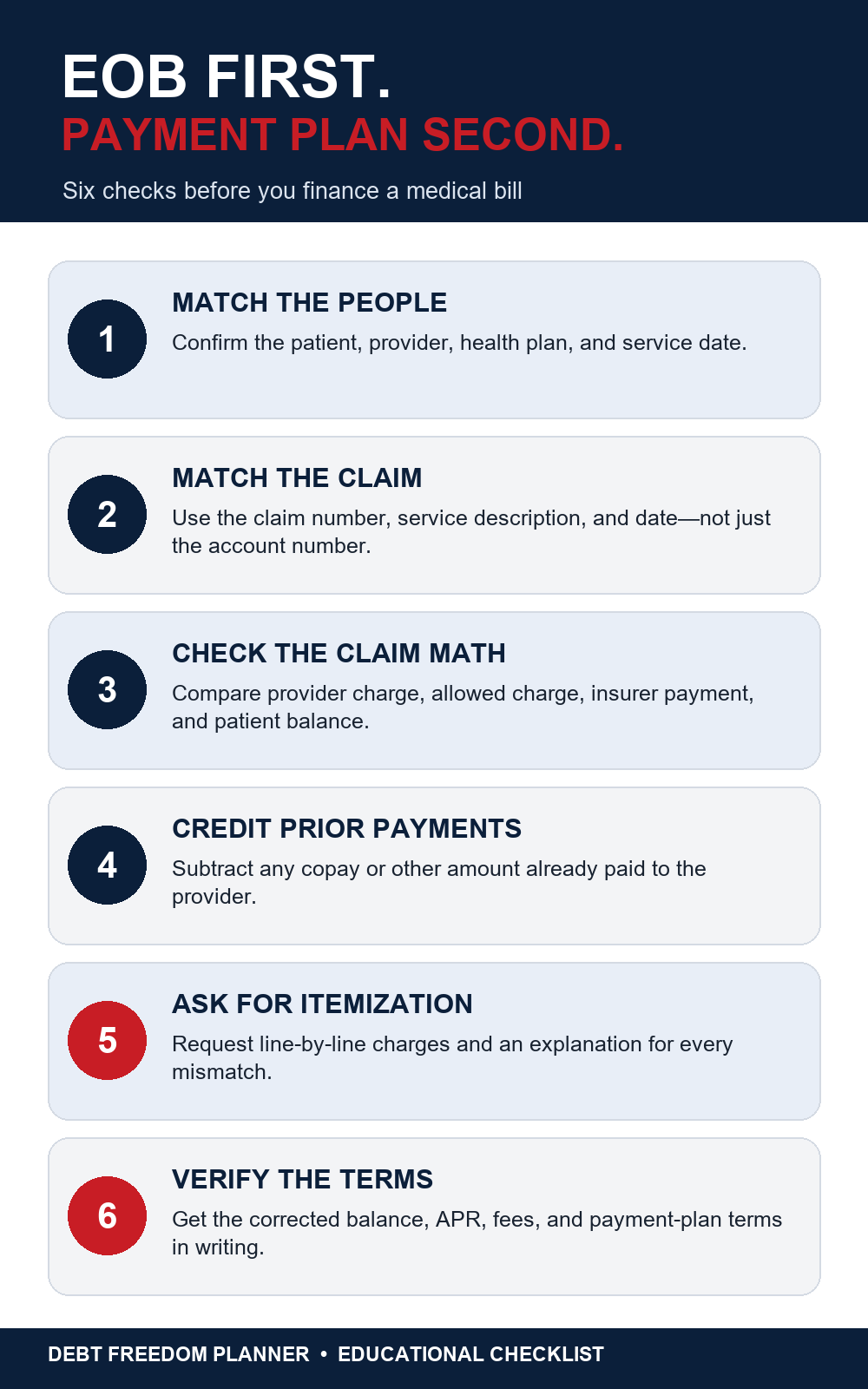
The six checks move from identity and service details to claim math and next actions. A payment plan comes after the documents agree or the remaining difference is explained.
A practical six-step comparison
1. Match the person, provider, and service date
Similar provider names and separate facility, clinician, imaging, anesthesia, and lab bills can make one visit look like a duplicate. Confirm that each bill represents a real service and that you are not comparing two different providers from the same visit.
2. Match the claim to the bill
Use the service description, date, and charge—not only the account number. A provider may use one account number while the insurer uses a separate claim number.
3. Compare the original and allowed charges
The original provider charge can be much higher than the allowed amount. The difference is not automatically your responsibility. Look for the insurer payment, contractual adjustment, copayment, deductible, coinsurance, and any noncovered amount.
4. Credit payments you already made
An EOB can show what the plan says you owe without knowing that you paid a copay at the appointment. Check receipts, card statements, and the provider ledger before paying the same amount again.
5. Ask for an itemized bill when the total is unclear
The Consumer Financial Protection Bureau recommends checking that a medical bill is yours, confirming the charges, and requesting an itemized list when something does not look right. Ask whether the bill reflects insurance payments and the provider's understanding of coverage. Record the date, representative, reference number, and promised next step for every call.
6. Resolve the mismatch before financing it
Ask the provider to place the account on hold while a correction, insurance review, or appeal is pending, but do not assume a hold exists until the provider confirms it. Get the corrected balance and any payment arrangement in writing. Keep following the provider's and health plan's deadlines; questioning a bill does not automatically pause collection activity.
Worked example: a $500 mismatch before financing
Suppose an insured household receives an EOB and a provider bill for the same outpatient visit.
| Hypothetical claim field | Amount |
|---|---|
| Provider charge submitted | $6,400.00 |
| Health plan allowed charge | $3,800.00 |
| Health plan payment | $2,850.00 |
| EOB patient balance | $950.00 |
| Provider bill amount due | $1,450.00 |
| Unexplained difference | $500.00 |
The household should not simply pay the EOB, ignore the provider bill, or declare the extra $500 invalid. It should ask the provider and health plan to explain the difference. Maybe the provider bill was produced before the insurance payment posted. Maybe the EOB was later adjusted. Maybe the bill includes a separate service. The documents must be reconciled.
For a transparent payoff illustration, assume the provider confirms the correct balance is $950 and offers a 0% plan at $100 per month. Compare that with putting the original $1,450 bill on a hypothetical 24.99% APR card and paying the same $100 per month.
| Debt Freedom Planner result | Verified provider plan | Original bill financed on card |
|---|---|---|
| Starting balance | $950.00 | $1,450.00 |
| Modeled APR | 0% | 24.99% |
| Monthly payment | $100.00 | $100.00 |
| Modeled payoff time | 10 months | 18 months |
| Modeled interest | $0.00 | $294.39 |
| Modeled total paid | $950.00 | $1,744.39 |
Under those assumptions, financing before reconciliation creates $794.39 more total repayment: the unexplained $500 plus $294.39 of modeled card interest. That is not a prediction or a promise that a provider will correct a bill or offer a no-interest plan. It shows why the verified balance, APR, and payment terms should come before the payoff schedule.
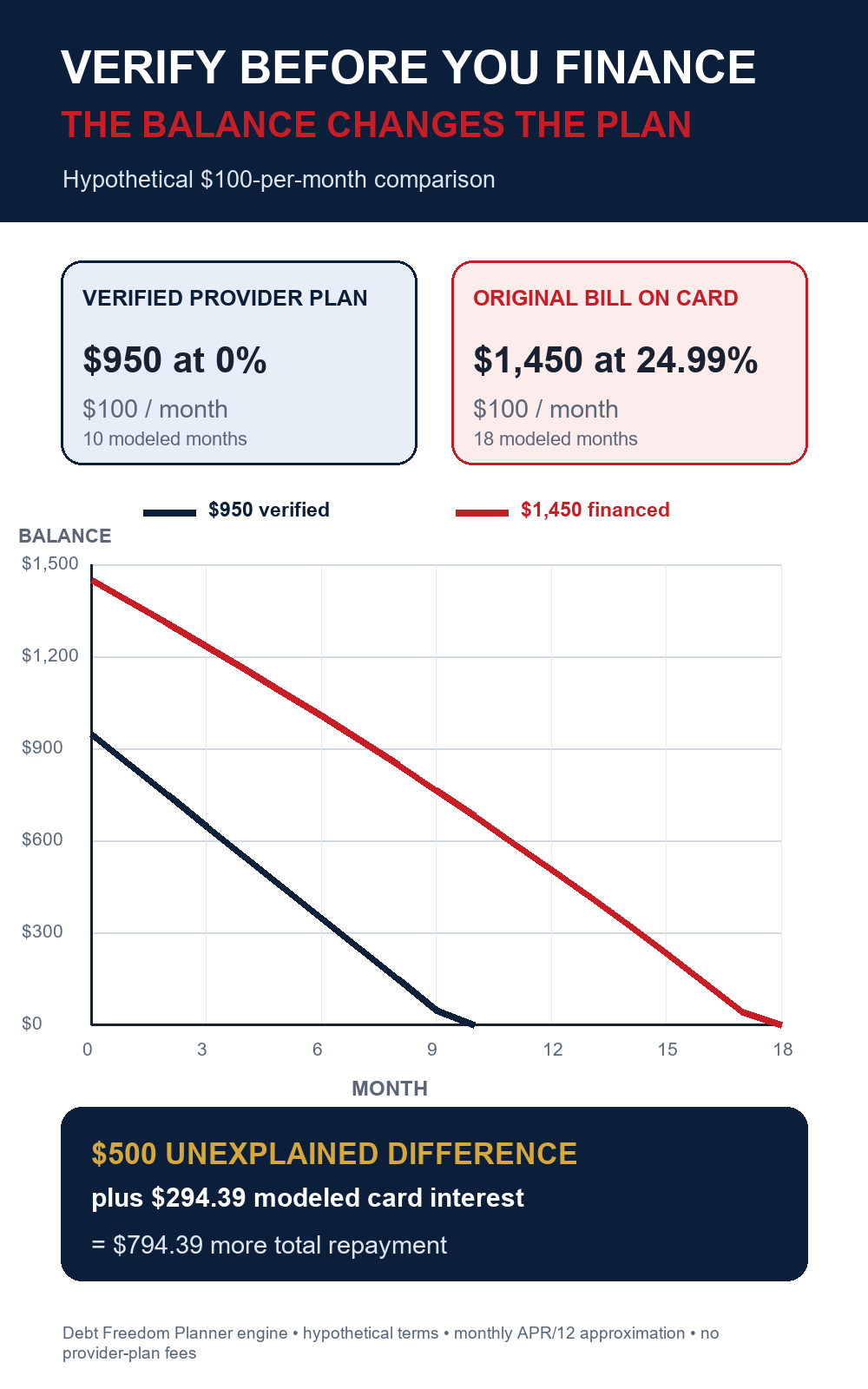
Hypothetical Debt Freedom Planner engine output starting in August 2026. Interest is approximated monthly as balance × APR ÷ 12 and rounded to cents. The provider plan is assumed to charge no interest or fees; actual provider and card terms vary.
Ask about assistance before turning the bill into card debt
Even an accurate patient balance may be unaffordable. The CFPB notes that financial assistance or charity care may reduce what a patient owes and recommends checking eligibility before paying. Ask the provider for:
- its financial-assistance policy and application;
- an itemized bill;
- the corrected balance after insurance and prior payments;
- a written payment-plan offer, including interest and fees; and
- the consequences of a late or missed payment.
A medical credit card or general-purpose credit card can turn a provider balance into a separate credit obligation. Before using one, read the APR, promotional terms, minimum payment, late fees, and any deferred-interest deadline. Confirm whether accepting financing affects assistance eligibility or the provider's willingness to correct the original account.
Know which dispute path fits the problem
An insured EOB mismatch and a surprise bill for an uninsured or self-pay patient are not the same process. CMS's federal patient-provider dispute process generally applies when a person did not use insurance, received a good faith estimate, has an initial bill dated within 120 days, and a provider or facility charged at least $400 more than the estimate.
CMS says people who used insurance do not qualify for that particular process. For an insured claim, start with the provider and health plan, follow the plan's appeal instructions when applicable, and use the complaint or consumer-assistance path that matches the facts. State protections and deadlines can differ.
Build the payoff plan only from verified terms
Once the remaining balance and payment terms are clear, enter the debt into Debt Freedom Planner using the verified balance, APR, and required monthly payment. If the provider plan charges 0%, enter 0%—do not invent an interest rate. If you used a card, enter the card's actual APR and minimum payment, then compare a realistic extra-payment scenario.
Try Debt Freedom Planner with the balance and terms you verified. The planner can model a payoff timeline and compare strategies. It cannot decide whether a medical bill is valid, interpret coverage, file an appeal, negotiate assistance, or provide legal advice.
Bottom line
Treat the EOB as a claim-processing explanation and the provider statement as the request for payment. Match the patient, provider, service, claim math, insurance payment, prior payments, and patient balance. Ask for an itemized bill and resolve unexplained differences before accepting financing or committing to a long payment plan.
Debt Freedom Planner provides educational payoff projections, not individualized financial, medical, insurance, legal, tax, credit, or debt-collection advice. Coverage, billing rights, assistance programs, dispute procedures, and deadlines vary; contact the provider, health plan, appropriate agency, or a qualified professional for guidance about your situation.
0 comments
Ask a question, add context, or share what worked for your household.
Create a free account or sign in to comment, reply, and vote on blog posts.