

Can a Nonprofit Hospital Start Collections While Financial Assistance Is Pending?
Use the 120-day and 240-day nonprofit-hospital rules to document a pending financial-assistance application before building a payoff plan.
A nonprofit hospital may keep sending ordinary bills or making routine collection contacts while a financial-assistance application is pending, but federal tax rules limit when it may use extraordinary collection actions. If you submit a complete application during the 240-day application period, the hospital must suspend those extraordinary actions while it decides whether you qualify. Do not ignore the bill: confirm the hospital is nonprofit, document the first post-discharge statement date, complete the application, and ask the hospital and any collector in writing to pause collection activity while the review is underway.

A pending financial-assistance application is a documentation problem before it is a payoff problem. Keep the policy, application, bill, and proof of delivery together.
“Collections” and “extraordinary collection actions” are not the same
The word collections can describe everything from another billing statement to a lawsuit. The federal nonprofit-hospital rule does not promise that every phone call, statement, or request for payment will stop. It focuses on extraordinary collection actions, usually called ECAs.
The IRS Section 501(r)(6) billing-and-collections guidance lists ECAs that include:
- selling the debt unless a narrow set of protections is built into the sale;
- reporting adverse information to a consumer reporting agency;
- deferring or denying medically necessary care, or requiring payment before that care, because of an old covered bill; and
- actions requiring a legal or judicial process, such as a lawsuit, wage garnishment, bank-account seizure, or certain property liens.
The hospital is also accountable for ECAs taken by a collection agency or debt buyer acting on its account. That matters when the letterhead changes but the underlying hospital bill does not.
Routine billing can still be stressful, but it is important to identify what actually happened. A statement marked “past due” is not automatically a lawsuit or credit report. A collector asking for payment is not automatically proof that the hospital completed the required financial-assistance review. Save the communication and ask what action is planned, who owns the debt, and whether the hospital has recorded your application.
Start the 120-day and 240-day clocks with the first post-discharge bill
For a tax-exempt hospital facility, both federal periods generally begin on the date it provides the first billing statement after the patient has received the care and left the facility.
| Period | What the federal rule generally requires |
|---|---|
| First 120 days | The hospital must refrain from initiating ECAs while providing notice about financial assistance |
| 240-day application period | A complete application triggers a required eligibility decision; an incomplete application triggers notice of what is missing and a reasonable opportunity to finish it |
| At least 30 days before an ECA | The hospital must provide written notice identifying the intended ECA and a deadline, include a plain-language financial-assistance summary, and make a reasonable effort at oral notice |
These are not simple countdowns that erase a bill. The 120-day rule is a floor before ECAs may begin. The 240-day period protects the opportunity to apply and have a timely complete application processed. The application period can extend beyond 240 days when the required ECA notice timing pushes the deadline later, and a hospital may choose to accept applications after the federal period.
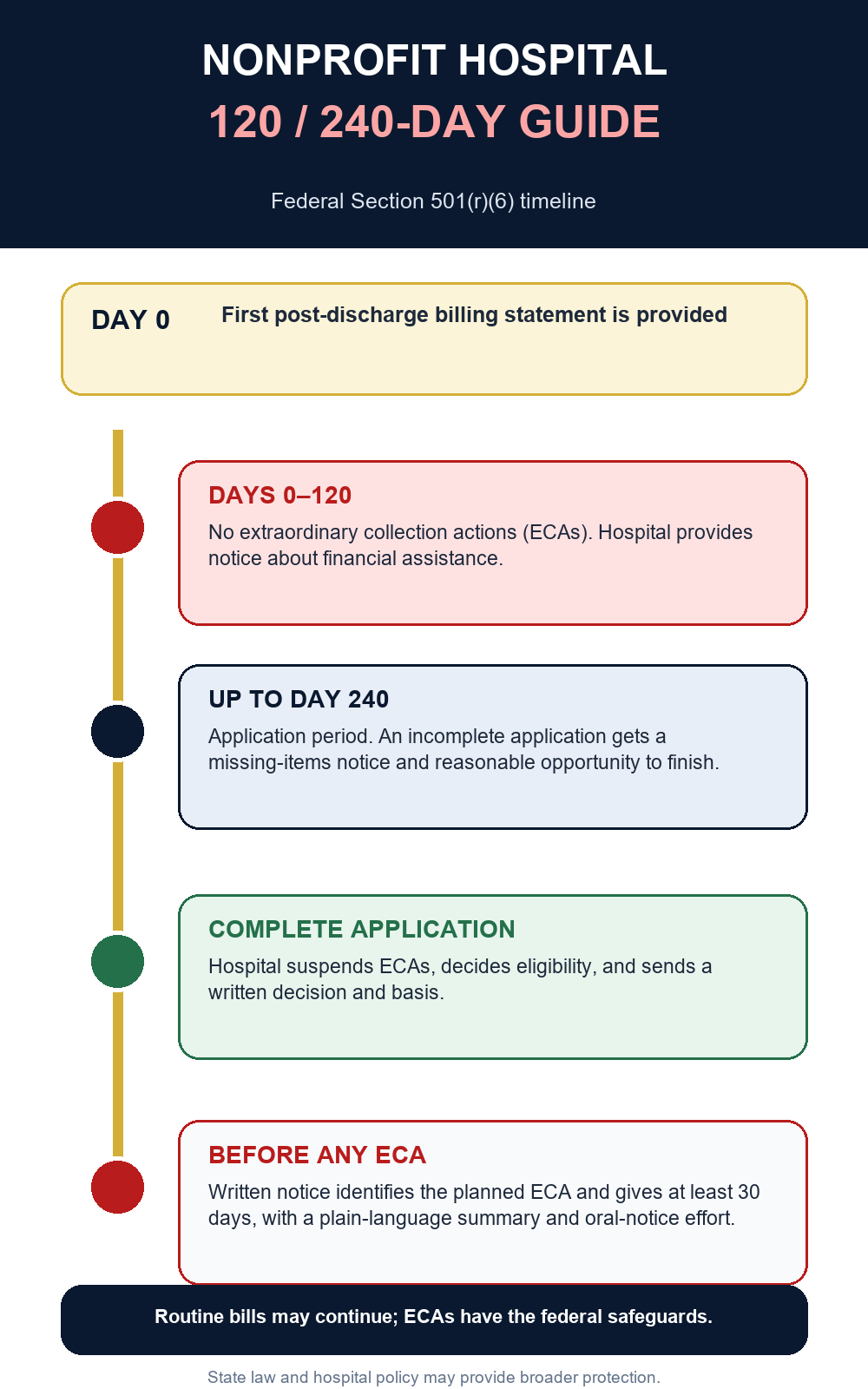
The federal clocks begin with the first post-discharge statement, not necessarily the date of care. Hospital policies and state protections may provide more time or broader safeguards.
What changes when the application is complete?
Completeness is the practical hinge. Under the IRS guidance, when a hospital receives a complete financial-assistance-policy application during the application period, it must timely:
- suspend ECAs being used to obtain payment for that care;
- make an eligibility determination; and
- notify the applicant in writing of the decision and its basis.
The hospital may not initiate or resume ECAs for the care at issue until it makes that eligibility determination. If the hospital believes the applicant may qualify for Medicaid, it may postpone its financial-assistance decision while the Medicaid application is processed, but the ECA restriction continues during that postponement.
An incomplete application has a different path. During the application period, the hospital must tell the applicant how to complete it and provide a reasonable opportunity to do so. A missing pay stub, unsigned form, or unclear household-size answer can therefore be decisive. Ask for a written list of every missing item and a new receipt when you deliver it.
If the hospital determines that you qualify, it must adjust the amount to the assistance-policy result. The IRS guidance also describes refunds of excess payments above the amount for which an eligible patient is responsible, subject to a small-dollar exception, and reasonable measures to reverse covered ECAs already taken.
What should you do if a collector contacts you while the review is pending?
1. Verify the hospital and the account
Section 501(r) applies to tax-exempt hospital organizations on a facility-by-facility basis. It does not automatically govern every physician group, laboratory, ambulance company, for-profit hospital, or other provider that may appear on the same episode of care. Ask which facility owns the bill and whether its financial-assistance policy covers the specific service.
2. Send proof of the application
Give the hospital billing office and collector the application date, confirmation number, delivery proof, and current status. Ask whether the hospital considers the application complete. If not, request the missing-items notice in writing.
The CMS medical-bill financial-assistance guide recommends checking how long the review takes, what happens to the bill in the meantime, and asking a collector to pause collections while financial help is being considered.
3. Name the action you want paused
Do not rely on the sentence “my application is pending” by itself. Ask whether the account has been referred, sold, reported, placed for suit, or scheduled for another ECA. Request written confirmation that ECAs are suspended while the complete application is decided.
4. Check the amount before agreeing to a payoff plan
A collector cannot accurately build a final payoff schedule if the amount may change after assistance. The CFPB's medical-debt collection guidance explains that federal debt-collection and credit-reporting laws may apply, including accuracy requirements and restrictions on misrepresenting the amount or legal status of a debt.
Ask for an itemized bill, insurance explanation of benefits when applicable, the financial-assistance decision, and the adjusted patient responsibility. If the collector sends a validation notice, preserve your dispute rights and deadlines. State law may add stronger medical-debt protections.
5. Protect necessities while you wait
Do not promise a payment that takes money from housing, food, medicine, utilities, transportation, insurance, or a basic emergency cushion. If you can make a payment safely, ask how it will be credited and whether excess payments will be returned if assistance is approved. If you cannot pay, say so plainly and keep the application moving.
Worked example: a $4,800 bill with a hypothetical 40% reduction
Assume a household has a $4,800 nonprofit-hospital bill. For illustration only, assume the balance has no interest or fees, the household can pay $200 per month after the final amount is confirmed, and the hospital's policy approves a 40% reduction. The adjusted balance would be $2,880.
| Hypothetical starting balance | Monthly payment | Payoff time | Modeled interest | Modeled total paid |
|---|---|---|---|---|
| Full $4,800 bill | $200 | 24 months | $0 | $4,800 |
| $2,880 after assumed 40% assistance | $200 | 15 months | $0 | $2,880 |
| Modeled difference | — | 9 months | $0 | $1,920 |
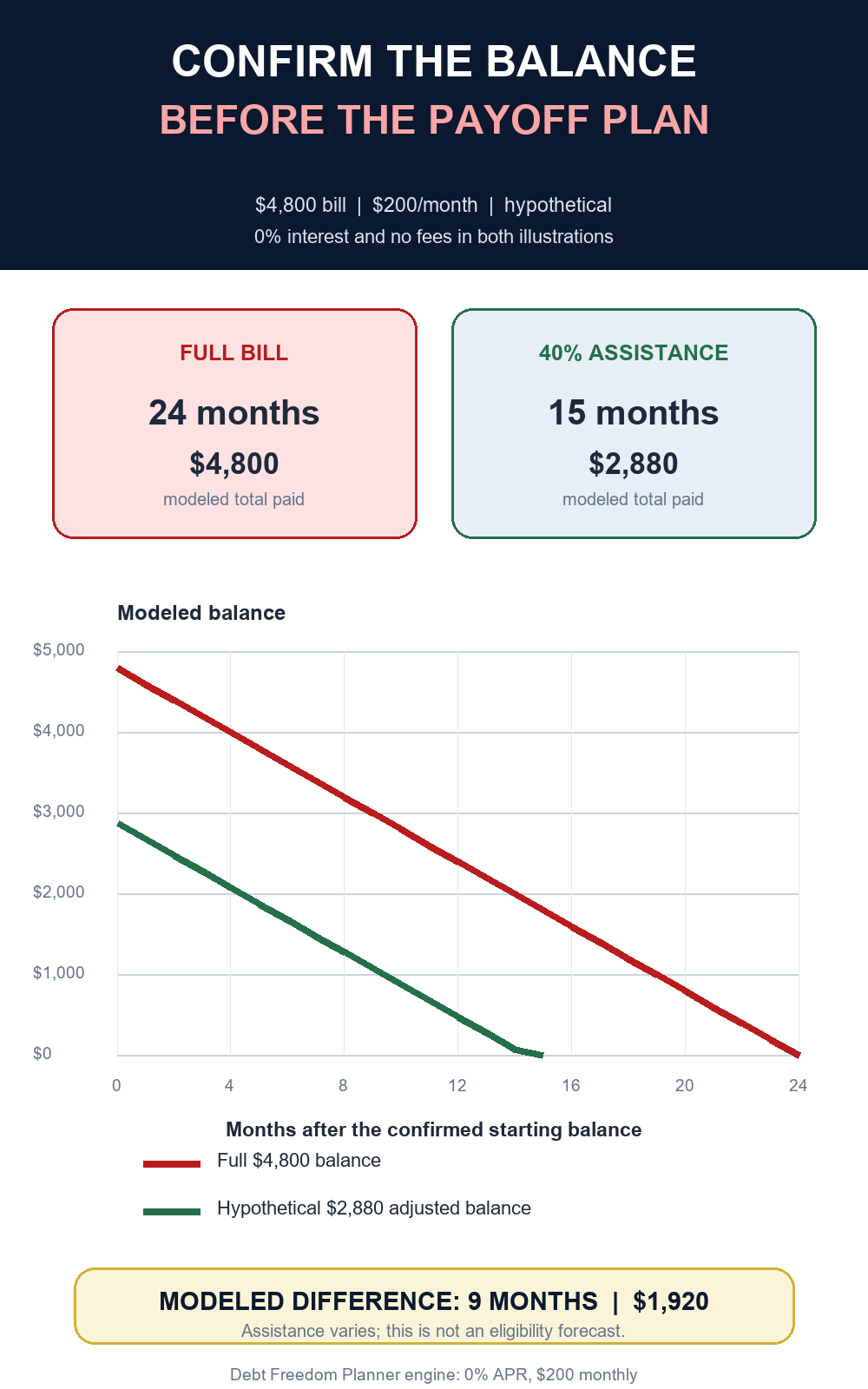
Debt Freedom Planner engine example: two zero-interest starting balances with the same $200 monthly payment. The 40% reduction is hypothetical, not a forecast of eligibility or a typical hospital award.
This graph does not advise withholding a required payment, predict that assistance will be approved, or assume every medical bill is interest-free. A real policy may provide free care, a different discount, or no assistance. A collector or provider may claim fees or interest under specific terms and law. The point is narrower: confirm the legally and contractually correct balance before treating a collection demand as a settled payoff target.
How to use Debt Freedom Planner after the amount is confirmed
Once the hospital issues its written decision and adjusted balance, use the verified figures in Debt Freedom Planner:
- Enter the adjusted patient-responsibility balance.
- Use the actual interest rate and required payment, including zero only when the bill's terms truly support it.
- Add any other debts competing for the same monthly cash.
- Compare snowball, avalanche, or a custom order without changing the underlying bills.
- Update the plan if the provider corrects the bill, insurance reprocesses a claim, or assistance changes the amount.
Debt Freedom Planner does not determine financial-assistance eligibility, contact a hospital, pause collections, validate a debt, interpret Section 501(r), or give legal advice. It models the balances, APRs, minimums, and extra payments you enter so you can see how a confirmed balance fits with the rest of the household plan.
Bottom line
A nonprofit hospital does not necessarily have to stop every routine billing contact while financial assistance is pending. But it must follow the Section 501(r)(6) process before using extraordinary collection actions, and a complete application submitted during the 240-day application period requires ECAs to be suspended while eligibility is determined. Focus on four pieces of evidence: the first post-discharge statement date, the hospital's policy, proof that the application is complete, and written confirmation of the collection status.
This article provides educational information, not individualized financial, legal, medical, tax, credit-reporting, debt-collection, bankruptcy, or insurance advice. Hospital tax status, financial-assistance policies, application deadlines, state law, account ownership, and bill facts vary. Consult the hospital, insurer, a patient advocate, or a qualified professional for guidance on your situation.
0 comments
Ask a question, add context, or share what worked for your household.
Create a free account or sign in to comment, reply, and vote on blog posts.