

Should You Pay Accrued Student Loan Interest Before It Capitalizes?
Verify the capitalization event first, protect required payments and cash, then compare the future interest saved by paying accrued student-loan interest early.
Paying accrued student-loan interest before a confirmed capitalization event can reduce future interest-on-interest, but it is not automatically the best use of cash. First verify that capitalization is actually scheduled, the exact amount and deadline, and which loan will be affected. Then protect required payments and essential cash needs before deciding whether to pay all, part, or none of the accrued interest.

Capitalization is a change in how an existing interest balance is classified. A pre-event payment can keep that amount out of principal, but the decision should still fit the household's cash flow.
What does student-loan interest capitalization mean?
Federal Student Aid defines interest capitalization as adding unpaid interest to a loan's principal balance. After that happens, future interest can grow on the larger principal. The already-accrued interest does not disappear if you pay it before capitalization; the potential benefit is avoiding additional interest on that interest.
Keep three numbers separate when you review a statement:
| Number | What it means | Why it matters |
|---|---|---|
| Principal balance | The amount currently treated as principal | Future interest is generally calculated from this base |
| Accrued interest | Interest already charged but not yet added to principal | A payment may reduce this amount before a verified capitalization event |
| Current payoff amount | What the servicer says would satisfy the loan on a specific date | It may include principal, accrued interest, and other permitted amounts |
Do not assume that every growing interest balance is about to capitalize. The CFPB's current federal-loan guidance says interest that accrues during school, the post-school grace period, or forbearance is no longer capitalized for Federal Direct Loans in many circumstances. It identifies capitalization after deferment on an unsubsidized loan and certain Income-Based Repayment events, while older federal loans and private loans may follow different rules.
The practical first question is therefore not “How fast can I pay this interest?” It is “Is there a real capitalization event, and what written information supports it?”
When can paying before capitalization help?
It can help when all four of these statements are true:
- Your servicer confirms that a specific amount of accrued interest is scheduled to be added to principal.
- You know the event and deadline—for example, the end of a qualifying deferment on an unsubsidized loan or a consolidation that will include unpaid interest.
- The payment will be applied to accrued interest before the event.
- Making the payment will not cause you to miss a required bill, use high-cost credit for essentials, or drain cash you need for a near-term emergency.
Federal Student Aid explains that a borrower may pay interest as it accrues during a deferment or allow it to be added to principal at the end. Its federal-loan consolidation guidance also warns that unpaid interest can be included in the new principal balance, increasing the amount on which interest grows.
Private student loans are controlled by the note, lender policy, and applicable law. The CFPB's capitalization overview says private loans commonly capitalize at points such as the end of a grace period, deferment, or forbearance, but you should confirm the actual contract and servicer instructions rather than rely on a general rule.
Five checks before sending an optional interest payment
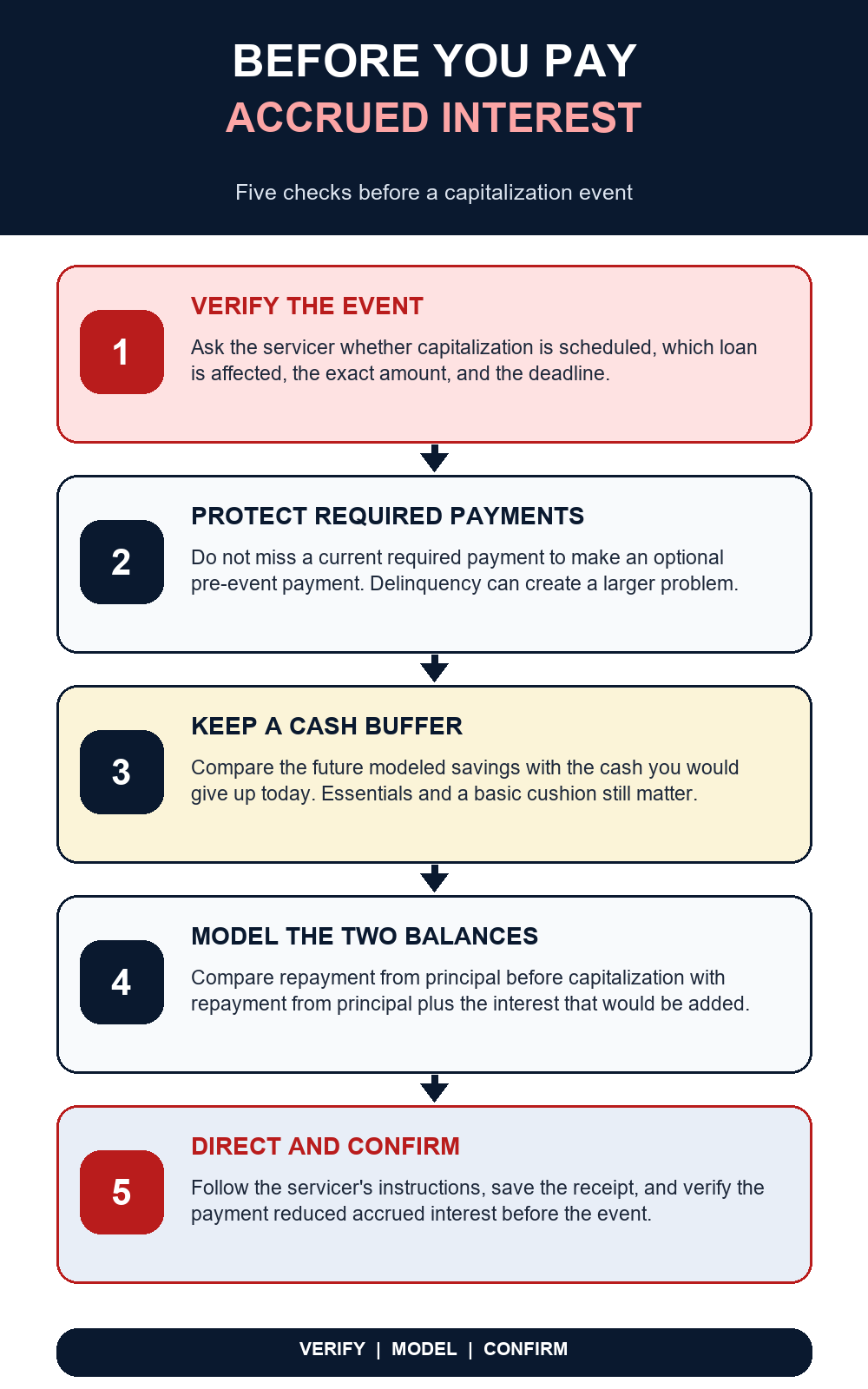
Verify the event first. The useful comparison is not merely “pay or do not pay”; it is future savings versus the cash you would give up today.
1. Get the event in writing
Ask the servicer:
- What exact event will cause capitalization?
- Which loan or loan group is affected?
- How much interest is currently accrued?
- How much is expected to capitalize?
- What is the last date a payment can be received and applied first?
- Will the servicer send confirmation after the payment posts?
A dashboard label alone may not explain timing. Save a secure message, letter, or statement that connects the amount, loan, and date.
2. Keep current obligations current
An optional pre-event payment should not replace a required monthly payment unless the servicer explicitly says it will satisfy that payment. The CFPB explains that student-loan payments generally go to fees, then interest, then principal. Payment allocation and “paid ahead” treatment can vary, so provide instructions and confirm the result.
3. Protect essential cash flow
Paying $1,500 today to avoid future interest can be mathematically favorable and still be a poor household decision if it leaves no money for housing, food, medicine, transportation, insurance, or the next required payment. Compare the modeled benefit with the liquidity you lose. Avoid moving the interest to a higher-rate credit card merely to keep it from capitalizing on a lower-rate student loan.
4. Model principal before and after the event
Use the same APR and monthly payment in both paths. In the first path, start from principal after the accrued interest payment. In the second, add the amount that would capitalize. This isolates the future interest-on-interest effect.
5. Verify the posted result
After paying, save the receipt and check both the accrued-interest and principal fields. If the payment was spread across loans, advanced a due date, or posted after the capitalization event, the result may differ from what you intended. Ask for a correction promptly if the application does not match the instructions and governing terms.
Worked example: $1,500 of accrued interest on a $25,000 loan
Assume a hypothetical borrower has:
- $25,000 of principal;
- $1,500 of accrued interest that the servicer confirms will capitalize;
- a fixed 6.50% APR; and
- a planned $300 monthly payment after the event.
Path A pays the already-owed $1,500 before the event, so the modeled repayment balance remains $25,000. Path B makes no pre-event payment, so the modeled starting principal becomes $26,500. Debt Freedom Planner then applies the same $300 monthly payment to both paths.
| Hypothetical path | Cash paid before event | Modeled starting principal | Payoff time | Future modeled interest | Total cash from now |
|---|---|---|---|---|---|
| Pay accrued interest before capitalization | $1,500 | $25,000 | 112 months | $8,341.11 | $34,841.11 |
| Let the $1,500 capitalize | $0 | $26,500 | 121 months | $9,652.73 | $36,152.73 |
| Modeled difference | — | $1,500 | 9 months | $1,311.62 | $1,311.62 |
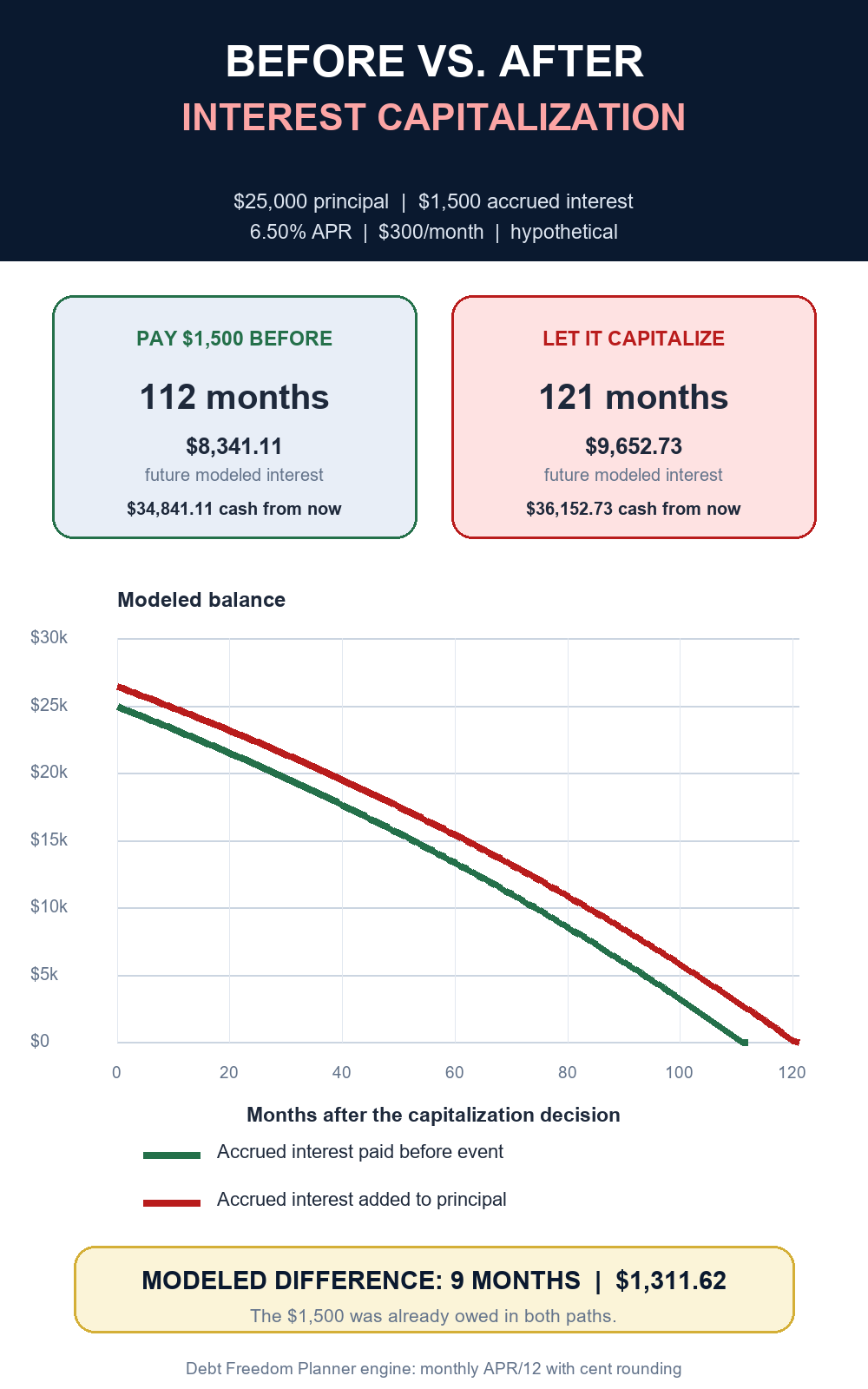
Debt Freedom Planner engine example: $25,000 principal, $1,500 accrued interest, 6.50% APR, and $300 monthly. The engine models monthly interest as APR divided by 12 with cent rounding. Actual student loans often accrue interest daily and may use different payment-allocation rules.
The $1,311.62 is not the amount of accrued interest “saved.” The borrower owes the $1,500 in both paths. It is the model's additional future interest created by carrying that $1,500 inside principal over the remaining payoff period. Paying before capitalization also shortens this simplified schedule by nine months because the same $300 payment starts against a smaller principal balance.
This result depends heavily on time and rate. A smaller accrued-interest amount, lower APR, shorter remaining term, or larger monthly payment would reduce the difference. A larger amount, higher rate, or longer repayment period could increase it.
What if you can pay only part of the accrued interest?
A partial payment can still reduce the amount added to principal if the servicer applies it before the event. If $1,500 is scheduled to capitalize and a verified $600 payment reduces accrued interest, the modeled post-event principal would be $25,900 rather than $26,500.
Do not divide cash arbitrarily across loan groups. Ask how the servicer will allocate the payment and whether you can target the loan with the highest APR or the nearest capitalization event. Keep written instructions and compare them with the posted transaction.
When might keeping the cash be more important?
Consider holding some or all of the cash when:
- you would otherwise miss a required loan or household payment;
- the payment would eliminate a basic emergency cushion;
- you would need to borrow again at a higher rate;
- the servicer cannot confirm that capitalization is scheduled;
- the interest will not capitalize under the applicable loan rules;
- you are evaluating a federal repayment, consolidation, discharge, or forgiveness path whose consequences you do not yet understand; or
- the payment would interfere with resolving delinquency or default.
This is a sequencing decision, not a moral test. The goal is to avoid creating a more expensive or urgent problem while chasing a smaller projected saving.
How to test the payoff effect in Debt Freedom Planner
After you verify the servicer's figures, build two simple scenarios in Debt Freedom Planner:
- Enter the principal that would remain if accrued interest is paid before capitalization.
- Enter the principal that would exist after the confirmed amount is added.
- Use the same APR, minimum payment, and extra monthly payment in both scenarios.
- Compare payoff months, total modeled interest, and the month-by-month schedule.
- Add the upfront interest payment to the first scenario's total cash when comparing the two paths.
The planner does not connect to a servicer, verify capitalization rules, direct a payment, reproduce daily student-loan interest, calculate forgiveness, or interpret a promissory note. It models the balances, APRs, and payments you enter so you can see the payoff tradeoff clearly.
Bottom line
Paying accrued student-loan interest before it capitalizes can reduce future interest and shorten a payoff schedule, but only when the event, amount, deadline, and payment application are real and verified. Protect required payments and essential cash first. Then compare the same loan before and after capitalization, count the upfront payment honestly, and confirm the servicer posted it as intended.
This article provides educational information, not individualized financial, legal, tax, student-aid, credit-repair, or debt-relief advice. Loan terms, capitalization events, payment application, federal program rules, private contracts, and daily interest calculations vary. Confirm current details with your loan servicer and official program materials, and consult a qualified professional when appropriate.
0 comments
Ask a question, add context, or share what worked for your household.
Create a free account or sign in to comment, reply, and vote on blog posts.