

Should You Pay a Debt Collector Before Getting a Validation Notice? Verify These Details First
Pause before paying: verify the collector, debt, amount, dispute window, and written terms, then plan with confirmed numbers.
Usually, do not rush to pay a debt collector before you have enough validation information to identify the collector, the creditor, the account, and the amount. Pause long enough to verify that the contact is legitimate and that the debt is yours. If the information is wrong or unfamiliar, use the written dispute process promptly. If the debt is accurate, then compare payment or settlement terms and get the agreement in writing before sending money.

A collection call creates urgency, but verification should come before a payment decision.
The quick answer: verify first, then decide how to pay
A legitimate obligation does not become optional just because a collector contacts you. But a caller's demand is not enough proof that the caller is legitimate, the balance is correct, or the debt belongs to you.
The Federal Trade Commission's current advice is direct: confirm the debt is actually yours before paying. Under the federal debt collection rule, a collector generally must provide validation information in the initial communication or within five days. Regulation F also permits the required information to be provided orally in the initial communication, so the practical question is not merely whether a paper letter has arrived. It is whether you have enough reliable information to check the debt.
There is also an important timing detail: Regulation F says a collector does not have to send the later validation notice if the consumer pays before that notice would otherwise be due. Paying during the first pressured call can therefore remove an opportunity to review the normal written notice before money leaves your account.
What validation information should tell you
The Consumer Financial Protection Bureau explains that a validation notice generally includes:
- a statement that the communication is from a debt collector;
- your name and mailing information and the collector's name and mailing address;
- the creditor's name and an account number, if there is one;
- an itemization showing the balance, interest, fees, payments, and credits from a stated date;
- the current amount claimed; and
- a date marking the end of the 30-day dispute period, plus instructions for responding.
See the CFPB's full validation-information checklist and the current Regulation F validation-notice rule.
The original creditor and current creditor may differ because an account can be placed with or sold to another company. That difference is not automatically proof of a scam, but it is something to match against old statements, account records, correspondence, and your credit reports.
A six-step pause-before-payment check
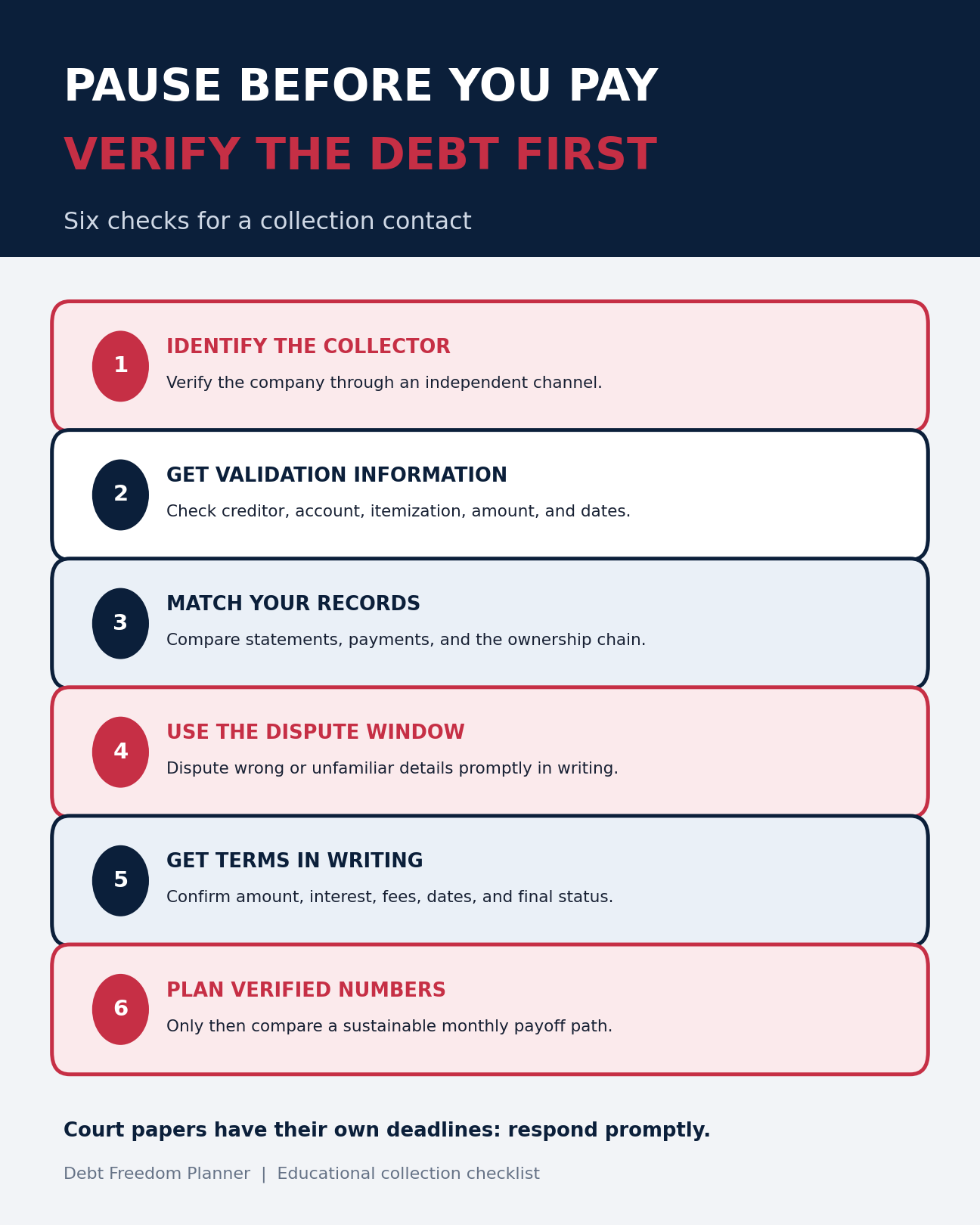
Use the validation period to check identity, ownership, amount, and terms before building a payment plan.
1. Identify the collector without volunteering sensitive information
Ask for the company name, mailing address, callback number, current creditor, and original creditor. Do not confirm a full Social Security number, bank account number, card number, or online-banking password to an unexpected caller. Look up the company independently rather than relying only on a link or number in a text message.
The FTC lists warning signs of a fake collector, including a caller who refuses to provide a mailing address or phone number, demands payment for an unfamiliar debt, or threatens arrest or law-enforcement action. Review the FTC's fake and abusive debt collector guidance.
2. Match the account and the amount
Compare the creditor, account digits, itemization date, starting amount, interest, fees, payments, and credits with your own records. If the collector says the debt was sold, look for a chain that connects the original account to the current creditor.
Do not assume a familiar creditor name proves the caller is real. Scammers can use real company names. Verification requires matching details through a trustworthy channel.
3. Decide whether to dispute all or part of the debt
If the debt is not yours, was already paid, or shows the wrong amount, send a written dispute promptly. The CFPB says that when a written dispute or request for original-creditor information is submitted within the validation period, the collector generally must pause collection of the disputed amount until it responds as required. The current Regulation F dispute rule recognizes mail, the response form, an accepted email or portal, or in-person delivery as possible written methods.
Keep a copy and proof of delivery. The CFPB recommends preserving letters, documents, dates, conversation notes, and evidence that the dispute was sent. Its paid-or-not-mine guidance also warns against sending original documents.
Missing the 30-day window does not itself create a legal admission that you owe the debt, but it can affect the rule's specific pause-and-verify protections. If a deadline is near, act quickly and consider legal help.
4. Check whether the debt may be too old to sue on
The time limit for a collection lawsuit depends on the debt and applicable state law. The FTC warns that, in some states, making a payment or acknowledging an old debt in writing can restart the limitations period. Do not make a small “good faith” payment on an old account merely to stop a call before understanding the legal effect where you live.
This is a legal issue, not a payoff-calculator issue. A consumer-law attorney or legal-aid organization can advise on a specific debt and state law.
5. If the debt is accurate, get the payment deal in writing
Before paying, confirm:
- the exact amount the collector will accept;
- whether it is payment in full, a settlement, or the first payment in a plan;
- whether interest or fees will continue;
- due dates and payment method;
- what happens after a missed plan payment; and
- how the account will be described after the agreement is completed.
Do not rely on a verbal promise that a smaller payment will settle the entire account. Keep the written agreement and every payment confirmation.
6. Pay through a controlled method and keep records
Use a payment channel you verified independently. Avoid giving an unexpected caller open-ended access to a bank account. Save the agreement, receipt, confirmation number, and final balance statement. Check later that the collector credited the payment as promised.
Worked example: plan only after the debt and terms are confirmed
Assume a hypothetical consumer receives validation information and confirms all of the following in writing:
- the debt belongs to the consumer;
- the current balance is $4,800;
- the agreement permits 8.00% APR with no new fee in the model;
- the required payment is $150 per month; and
- paying more is allowed without a penalty.
Starting in September 2026, the Debt Freedom Planner engine's monthly approximation gives these results:
| Hypothetical payment path | Months to payoff | Modeled payoff month | Modeled interest |
|---|---|---|---|
| Pay $150 monthly | 37 | September 2029 | $616.89 |
| Pay $250 monthly | 21 | May 2028 | $353.53 |
| Difference | 16 months sooner | 16 months sooner | $263.36 less |
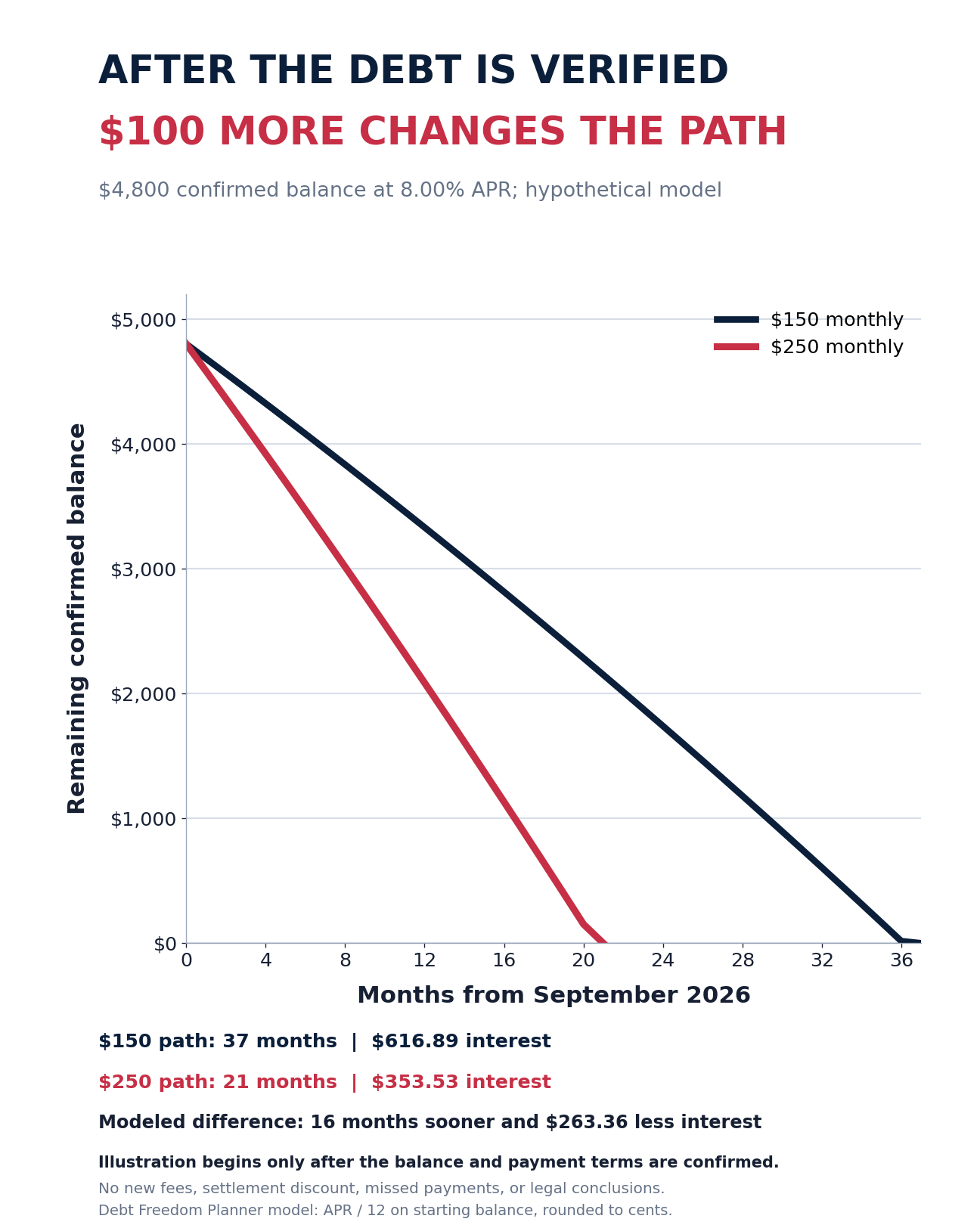
Hypothetical monthly model after validation: $4,800 at 8.00% APR, starting September 2026, with no new fees. Actual collection terms and interest rules may differ.
The graph is not a prediction of what a collector must accept, whether the debt is enforceable, how the account will be reported, or what a settlement might do. It isolates one household question after validation: if both payment amounts are permitted, what does an extra $100 per month do to the modeled payoff path?
Where Debt Freedom Planner fits—and where it does not
Debt Freedom Planner can help after the account facts are confirmed. Enter the verified balance, APR, required payment, and a sustainable extra amount, then compare that obligation with your other debts using snowball, avalanche, or a custom order.
You can start a Debt Freedom Planner roadmap to see the monthly tradeoff. Keep required minimums and essential household needs safe before assigning extra money.
The planner does not validate a debt, identify a scammer, interpret a collection agreement, determine a statute of limitations, negotiate a settlement, or provide legal advice. It models the numbers you enter. Bad or unverified inputs can produce a precise-looking but unsafe plan.
Do not confuse validation with a court response
A collection letter and a lawsuit are not the same thing. If you receive court papers, follow the court instructions and deadline even while you review the debt. The FTC says the most important step after a debt-collection lawsuit is to respond; ignoring the case can allow it to proceed without your side being heard.
Similarly, do not ignore a debt that may be yours. Verification is a short fact-checking step, not a strategy for hiding from legitimate obligations. Once the collector, debt, amount, legal posture, and terms are clear, make a deliberate decision about payment, settlement, dispute, or professional help.
Bottom line
Do not let a surprise call turn into an unverified payment. Get and review the validation information, match it to your records, use the dispute window when appropriate, and understand the effect of paying an old debt. If the obligation and terms check out, put the agreement in writing and then build a payoff plan around the verified numbers.
This article is for educational information only and is not individualized financial, legal, tax, credit-repair, or bankruptcy advice. Federal protections may depend on the type of collector and debt, state laws differ, and court deadlines require prompt attention. For advice about a specific collection account, lawsuit, or time-barred debt, contact a qualified consumer-law attorney or legal-aid organization.
0 comments
Ask a question, add context, or share what worked for your household.
Create a free account or sign in to comment, reply, and vote on blog posts.