

How Do You Pay Off a Closed Credit Card That Still Has a Balance?
A closed card still needs scheduled payments and can keep charging interest. Use the statement, protect the due date, and set a fixed payoff amount.
A closed credit card with a balance is still a debt you must repay. Keep making at least the minimum payment by the due date, expect interest to continue, and stop trying to use the account. You usually do not have to pay the entire balance immediately just because the card closed. The practical goal is to protect the account from new late payments, verify the terms that still apply, and choose a fixed monthly amount that pays the balance down on a schedule your household can sustain.

A closed card can stop new borrowing, but the existing balance still needs an organized monthly payoff plan.
What closing the card changes - and what it does not
Closing normally ends your ability to make new purchases. It does not erase the balance, stop the statement cycle, or automatically stop interest. The Consumer Financial Protection Bureau says that when an account is closed with a balance, you must pay the balance on schedule and the issuer may continue charging interest.
That is true whether you asked to close the card or the issuer closed it. The reason for closure still matters, however. A voluntary closure, an issuer's risk decision, an opt-out from changed terms, and a closure after delinquency can produce different notices and account options. Read the actual closure notice and current cardholder agreement instead of assuming every closed account follows the same payment formula.
Here is the simple dividing line:
| Closed-card question | Practical answer |
|---|---|
| Can you make new purchases? | Generally no; move recurring charges elsewhere. |
| Do you still owe the balance? | Yes, until payments bring it to zero. |
| Is the full balance immediately due only because of closure? | Usually no; continue paying on schedule unless your notice says otherwise. |
| Can interest continue? | Yes, while a balance remains. |
| Should you stop checking statements? | No; statements are the source for the current balance, APR, minimum, and due date. |
The CFPB separately confirms that a closed account can still require at least the minimum payment until the balance is paid. Treat the card as closed for spending but open for repayment.
Do these five things first
1. Verify the closure and its reason
Save the issuer's letter, secure message, or email. Confirm the effective date, whether the account is fully closed or only suspended, and whether any automatic-payment instructions changed. If the notice is unclear, call the number on the statement or the back of the physical card and ask for an explanation in writing.
2. Capture the four planning numbers
From the latest statement, write down:
- current balance;
- APR for each balance category;
- minimum payment; and
- due date.
Do not substitute the old credit limit for the balance or use a remembered minimum. If the account has purchases, cash advances, or promotional balances at different APRs, keep those categories visible. Many issuers calculate interest daily using an average daily balance, and the statement must show the balance subject to each APR. The CFPB's credit-card interest explainer describes how those categories and payment-allocation rules can affect what you owe.
3. Protect the due date
Keep paying at least the required minimum on time. If autopay was already active, verify that it remains active after closure rather than assuming it survived. If you set up a new bank bill payment, allow enough processing time and confirm the first payment posted.
Minimum-payment safety and payoff speed are two different jobs. The minimum protects the account from another missed payment. A fixed amount above the minimum is what creates a clearer payoff date.
4. Move every recurring charge
Review recent statements for subscriptions, insurance, utilities, memberships, app stores, and other card-on-file merchants. Update those merchants directly. A declined renewal can interrupt an essential service, while a delayed or adjusted transaction may still appear after closure depending on timing and the agreement. Keep checking statements until the balance is zero and the final statement is settled.
5. Rebuild the payoff plan around one fixed amount
Choose a monthly payment that is at least the current minimum and still leaves room for housing, utilities, food, insurance, transportation, and other required minimums. Put that fixed amount into the household plan instead of letting a falling minimum quietly reduce the payment.
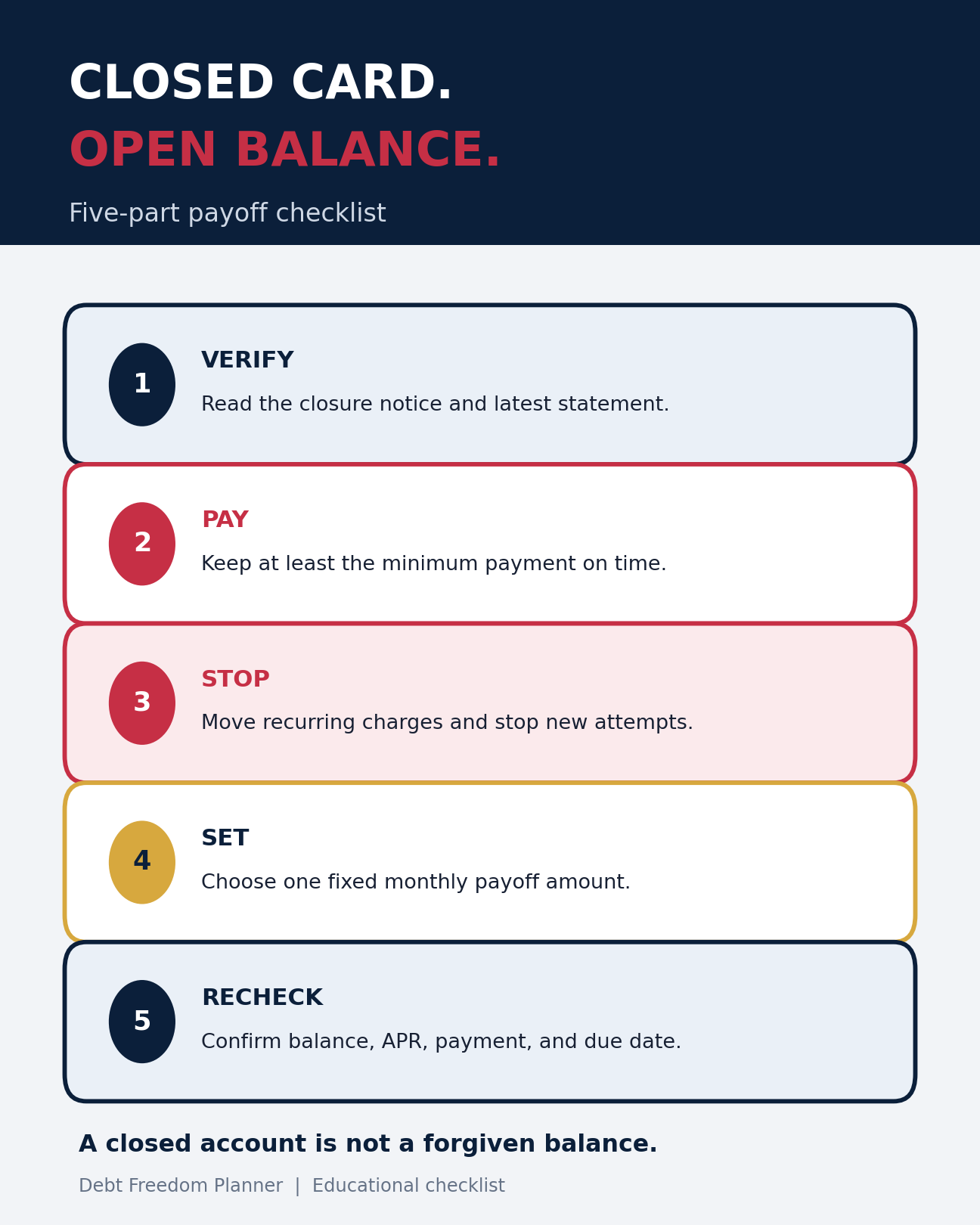
Use the closure notice and current statement to build the plan; do not treat “closed” as “finished.”
Worked example: a hypothetical $6,500 closed card
Suppose a household has a closed credit card with these verified inputs:
- balance: $6,500;
- APR: 24.99%;
- no new purchases or fees; and
- a current payment that the household can hold at $200 per month.
The household is considering adding $150, bringing the fixed monthly payment to $350. Debt Freedom Planner's payoff engine produces this comparison:
| Hypothetical monthly payment | App-engine payoff time | Modeled interest | App-engine total paid |
|---|---|---|---|
| $200 | 55 months | $4,460.66 | $10,960.66 |
| $350 | 24 months | $1,804.19 | $8,304.19 |
| Difference | 31 months sooner | $2,656.47 less | $2,656.47 less |
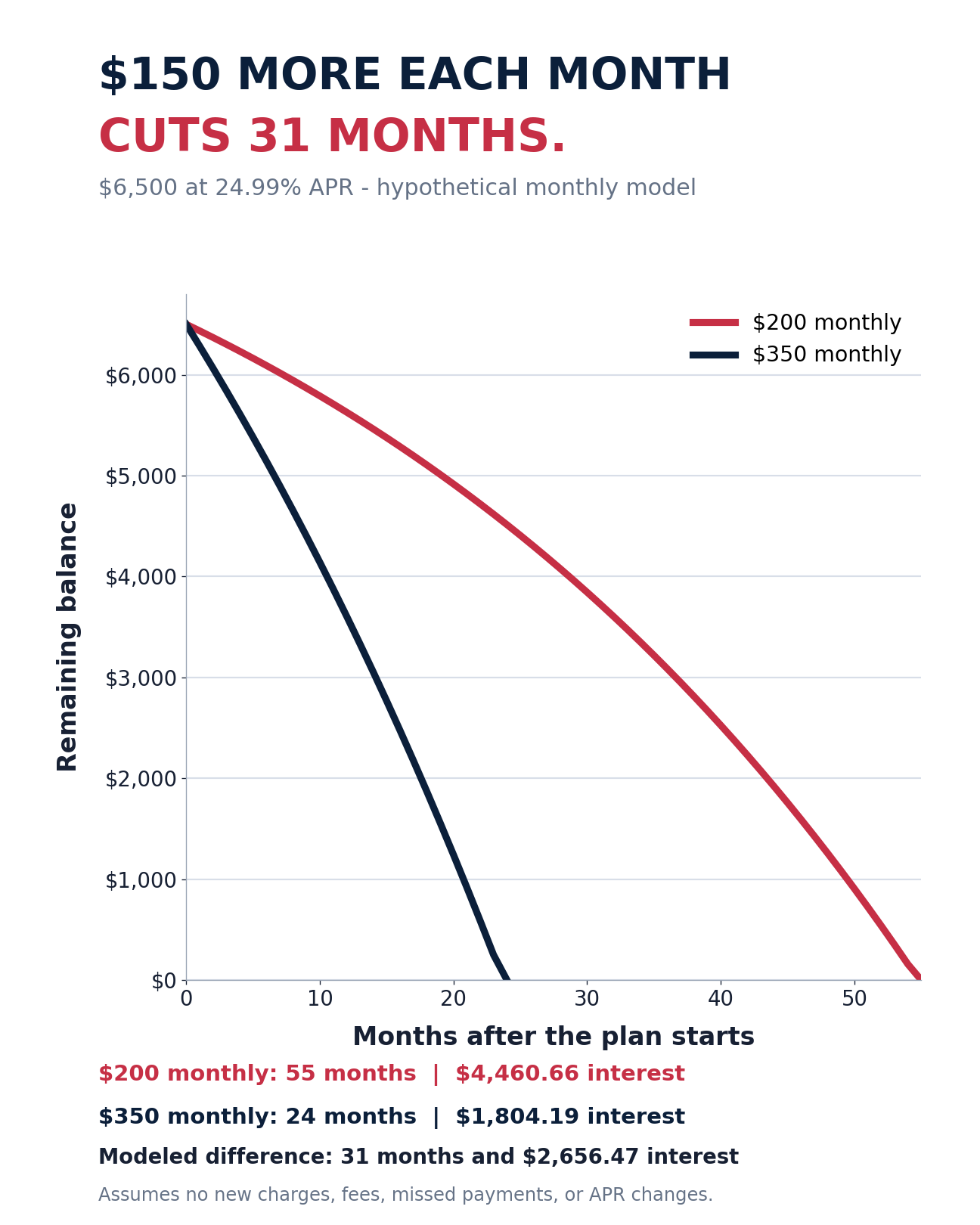
Hypothetical app-engine comparison: $6,500 at 24.99% APR, no new charges, fees, missed payments, or APR changes. The model uses APR divided by 12; an issuer may calculate interest daily.
The added $150 cuts the modeled payoff time from 55 months to 24 months and reduces modeled interest by $2,656.47. That does not mean every closed card will produce those exact results. The engine uses a monthly interest approximation, while many card issuers use a daily periodic rate and average daily balance. The statement and issuer's payoff amount control the real account.
Use the example for the decision it illustrates: a payment that remains fixed as the balance falls can make the payoff date far more predictable than following a shrinking minimum.
What if the minimum payment or APR changes?
Do not assume closure freezes every term. Federal rules generally restrict rate increases on existing balances, but exceptions can apply, including a variable-rate index change, expiration of a promotional rate, a payment more than 60 days late, or terms of a hardship arrangement. The CFPB summarizes those existing-balance APR exceptions.
The minimum may also change. In one specific situation - when a consumer opts out of certain changed terms and the issuer closes the account - the CFPB explains that the repayment method can be adjusted within federal limits. Its account-terms guidance says the new payment cannot exceed the amount needed to pay the balance in five years or double the prior minimum periodic payment, whichever is higher. That is not a universal minimum formula for every closure; it is a reason to read your notice.
Whenever the balance, APR, or required minimum changes, update the plan. Do not reduce your chosen fixed payment merely because the required minimum falls, unless the household budget needs the relief.
Use the statement's payoff disclosure as a reality check
Credit-card statements generally show how long the current balance could take to repay if you make no new charges and pay only the minimum. They also show an estimated payment for paying the statement balance in 36 months. The CFPB explains the three-year payoff disclosure and notes that paying more than the minimum generally reduces time and interest.
Compare that disclosure with your fixed-payment scenario. Differences are not automatically an error: the statement uses the issuer's account data and required assumptions, while the planner uses the numbers you enter and a monthly model. If the gap is large, recheck the APR, balance, payment, fees, and whether the card has multiple balance categories.
What happens to your credit?
Do not make the repayment plan depend on a predicted credit-score change. Closing a card can reduce available revolving credit and increase utilization, which may lower a score, but the effect varies with the rest of the credit file. The CFPB cautions that closing a credit card can affect utilization.
The controllable priority is simpler: keep the payment current, reduce the balance, and check credit reports for reporting errors. If you closed the account but a report still lists it as open, or it shows a late payment you made on time, use the dispute instructions on the report and keep supporting records.
If you cannot afford the minimum
Call the issuer immediately - before the due date if possible. Explain why the payment does not fit, how much you can pay, when normal payments might resume, and what temporary amount you are requesting. The CFPB's guidance for unaffordable credit-card bills says many issuers may work with consumers facing a financial emergency.
Ask specifically about a hardship or loss-mitigation program, the APR, the required payment, fees, the program length, and how the account will be reported. Get the arrangement in writing before changing what you pay. Avoid a company that tells you to stop communicating with the issuer or stop making payments while it collects fees.
If the account is already charged off, in collections, subject to a lawsuit, or tied to a bankruptcy, this simple closed-card payoff workflow is not enough. Verify who legally owns or services the debt and consider qualified legal or nonprofit credit-counseling help before sending money or making an agreement.
Try the fixed payment in Debt Freedom Planner
Debt Freedom Planner can turn the four statement numbers into a modeled payoff path. Enter the closed card's current balance, APR, and minimum payment. Then compare the current payment with a fixed amount that includes the extra cash your household can reliably contribute.
The planner will show a modeled payoff month, total interest, and month-by-month balance path. It does not connect to the issuer, receive closure notices, know the card's daily-balance method, or change the account. Re-run the plan after each statement if the APR, required minimum, balance, or household payment changes.
Bottom line
Pay a closed credit card as an active balance, not as a forgotten account. Keep at least the minimum current, move recurring charges, verify the statement and closure notice, and hold a fixed monthly payment when the budget allows. The card may be closed to new spending, but the payoff is complete only when the issuer confirms a zero balance and any final interest has cleared.
This article provides general educational information and hypothetical payoff estimates. It is not financial, legal, tax, credit-repair, or bankruptcy advice. Credit-card agreements, hardship programs, interest methods, and account reporting vary; verify current terms with the issuer and qualified professionals when needed.
0 comments
Ask a question, add context, or share what worked for your household.
Create a free account or sign in to comment, reply, and vote on blog posts.