

Can You Make Extra Principal Payments on a Personal Loan? Check These Terms First
Extra personal-loan payments can save time and interest—but only if the contract allows them and the lender applies the money as intended.
Yes, you can often make extra payments on a personal loan, but do not assume the lender will treat every extra dollar as an immediate principal reduction. Before sending more than the scheduled amount, check the prepayment section of your contract, confirm whether a fee can apply, ask how the lender applies extra money, and verify that your next regular payment is still due. If the loan uses a simple-interest structure and the extra payment reduces principal promptly, paying extra can shorten the term and reduce interest.

Review the agreement and payment instructions before treating an extra transfer as a principal payment.
The short answer: extra payments help only when they reduce the balance correctly
An extra payment is useful when it reaches principal sooner than the original schedule requires. A lower principal balance generally leaves less balance on which future simple interest can be calculated. But the words “extra payment” do not settle how the transaction will be handled.
The controlling documents are your loan agreement, Truth in Lending disclosures, and the lender's current payment instructions. The current version of Regulation Z section 1026.18 requires applicable closed-end consumer-credit disclosures to address prepayment. For finance charges calculated by applying a rate to the unpaid principal balance, the disclosure must state whether a charge may be imposed for paying all or part of principal early. For other finance-charge structures, it must state whether prepayment can produce a finance-charge rebate.
That disclosure is why “check the contract” is not a throwaway warning. The prepayment terms can materially change the result.
Check these three terms before paying extra
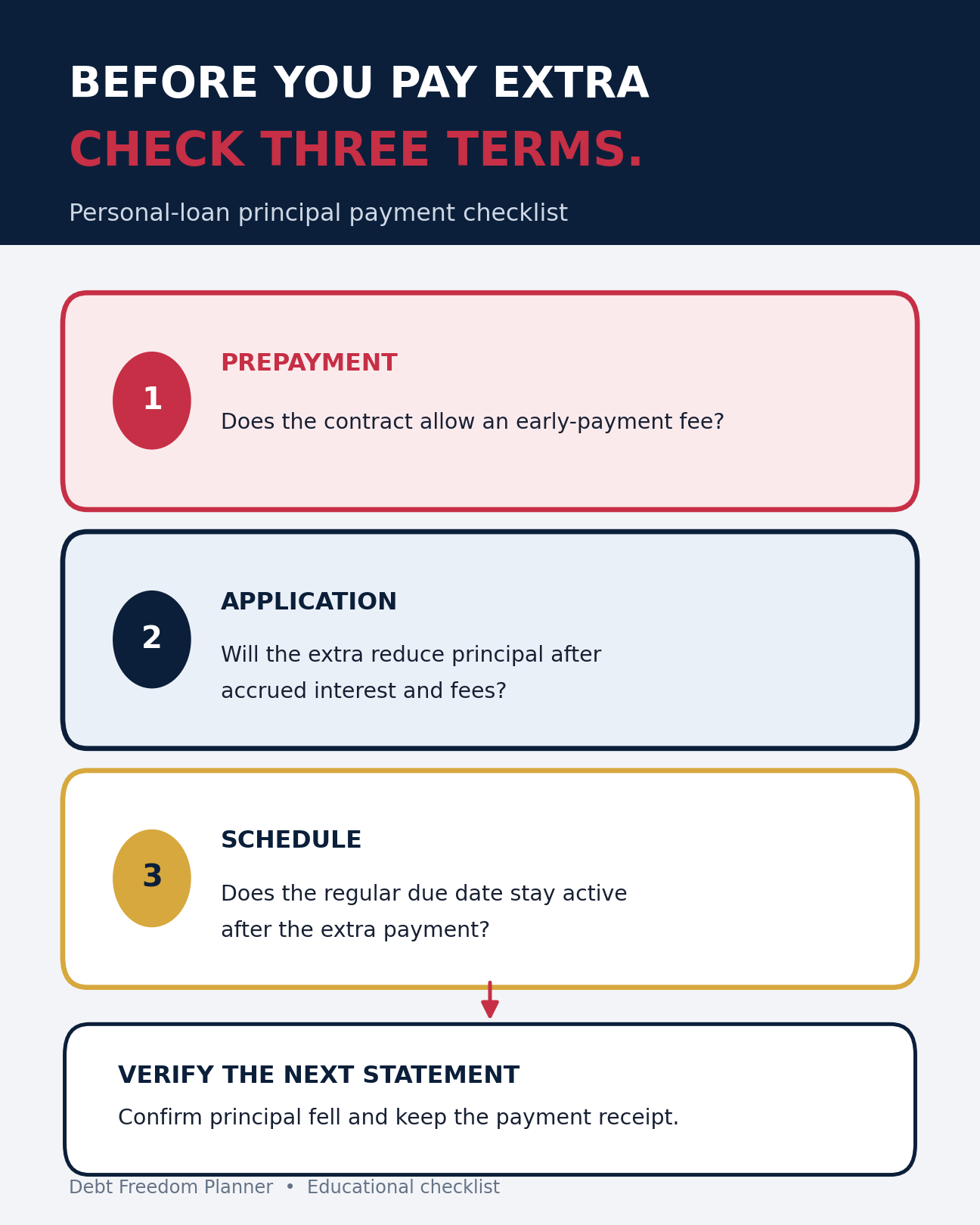
Use this three-part check before sending an extra personal-loan payment, then verify the next statement.
1. Prepayment charge or early-payoff fee
Search the agreement and disclosures for prepayment, early payoff, finance charge rebate, and penalty. You are looking for a direct answer to two questions:
- Can the lender charge a fee if you pay part of the principal early?
- Can it charge a fee if you pay the entire loan off early?
The answer can depend on the contract, the loan structure, and state law. The CFPB's auto-loan prepayment guidance is specific to auto loans, not personal loans, but it illustrates the same disciplined habit: review the contract and Truth in Lending disclosures rather than assuming early payoff is free.
If the language is unclear, ask the lender to identify the exact contract paragraph that controls. Do not rely only on a verbal “there should not be a fee.”
2. How the lender applies money above the scheduled payment
Ask the lender, in writing if possible:
If I pay $150 above my scheduled payment, after any accrued interest and permitted fees are satisfied, will the remaining amount reduce principal immediately?
The phrase principal-only payment is useful shorthand, but your lender's system may use different wording. Some payment systems can also treat an overpayment as paying a future installment early or advancing the due date. That may still reduce the balance, but it is not safe to assume the effect is identical to a principal reduction followed by continued monthly payments.
The CFPB warns about this issue in its student-loan additional-payment guidance: a servicer may place an account in “paid ahead” status rather than handle the payment as the borrower expected. Personal loans are different products, so that page does not dictate your lender's process. It is a useful reminder to confirm application instructions and retain transaction records.
3. Whether your regular due date and automatic payment remain active
Do not skip the next scheduled payment just because an online account shows a later due date. Confirm whether the lender advanced the due date, whether automatic payment will still draft, and whether you must keep making the normal monthly payment to get the payoff result you modeled.
A strong instruction is: apply the extra according to the contract, keep my regular payment schedule active, and do not reduce my next scheduled payment unless I request it. Ask whether the lender can honor that instruction before you transfer the money.
Simple interest versus a precomputed finance charge
The worked example below assumes a fixed-rate, simple-interest-style loan in which the model calculates monthly interest on the remaining balance. Under that assumption, reducing principal earlier lowers future modeled interest.
Do not apply that conclusion mechanically to every installment contract. Regulation Z distinguishes between finance charges calculated by applying a rate to unpaid principal and other finance-charge structures. If your disclosure discusses a rebate of finance charges rather than straightforward principal-based interest, ask the lender for an early-payment illustration and a current payoff quote.
Also ask whether interest accrues daily. Many real loans do not wait for a clean monthly calculation. The amount due on an actual payoff date can change from the amount shown on the prior statement because interest continues to accrue under the agreement.
Worked example: adding $150 to a $12,000 personal loan
Here is a transparent Debt Freedom Planner model:
- Starting balance: $12,000
- APR: 14.99%
- Scheduled monthly payment: $285
- Comparison payment: $435, which is $285 plus $150 extra
- No new borrowing, fee, or prepayment penalty
- Extra money reduces remaining principal in the same modeled monthly cycle
- Interest is approximated monthly as APR divided by 12
| Hypothetical plan | Monthly amount | Payoff time | Modeled interest | Modeled payoff month |
|---|---|---|---|---|
| Scheduled payment only | $285 | 61 months | $5,137.26 | August 2031 |
| Add $150 each month | $435 | 35 months | $2,804.81 | June 2029 |
| Difference | — | 26 months sooner | $2,332.45 less | — |
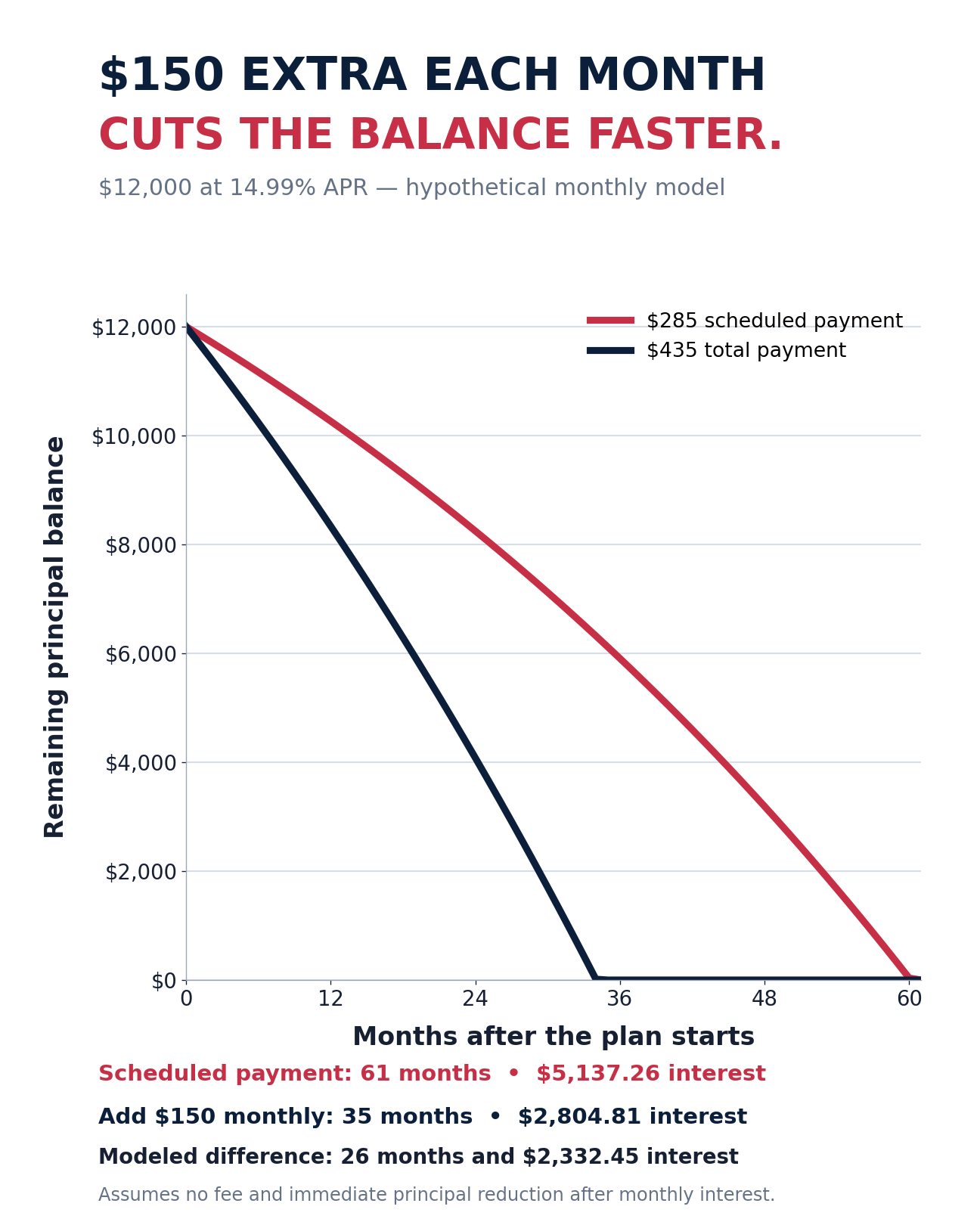
Hypothetical app-engine result: $12,000 at 14.99% APR, no fee, no new borrowing, and immediate modeled principal reduction after monthly interest. Actual lender calculations and daily interest may differ.
The example shows why payment application matters. The modeled savings do not come from the label “extra.” They come from the balance falling sooner while the borrower continues the larger monthly amount.
How to make an extra payment without losing the paper trail
Use a simple verification routine:
- Save the agreement and disclosure. Keep the pages that describe interest, payment application, late fees, and prepayment.
- Ask for the lender's exact instruction. Confirm the payment channel, memo, or online option needed for an additional principal payment.
- Make the scheduled payment on time. An extra payment is not a substitute for staying current unless the lender confirms otherwise.
- Save the receipt or confirmation number. Record the amount and date.
- Check the next statement. Compare prior principal, interest charged, payment applied, new principal, and next due date.
- Request a payoff quote for a final lump sum. The account balance displayed online may not equal the amount required to close the loan on a specific date.
If the posted transaction does not match the lender's written instructions, contact the lender promptly and document the response. When direct resolution fails, the CFPB provides a consumer complaint process.
When another use of the extra money may come first
Paying a personal loan faster is not automatically the best first move. Consider pausing the extra payment when:
- you cannot cover every required minimum by its due date;
- the transfer would drain the cash buffer needed for a normal emergency;
- a credit card or other debt has a meaningfully higher APR and no deadline or protection changes the order;
- the personal-loan agreement imposes a fee that could erase the expected savings;
- your income is unstable and the larger fixed commitment would push you back into borrowing; or
- you are relying on a payoff calculation that does not match the lender's interest method.
The CFPB's debt-reduction guidance explains the basic tradeoff between attacking the highest-interest debt and using the snowball method. Highest-interest-first can reduce total cost, while smallest-balance-first can produce a faster visible win. Either way, minimum payments on all debts remain the safety floor.
Try the payment in Debt Freedom Planner before sending it
Debt Freedom Planner can turn the proposed extra payment into a planning comparison before money leaves your account. Enter the current personal-loan balance, APR, and scheduled minimum, then compare the baseline with an extra monthly amount. You can see the modeled payoff month, total interest, and month-by-month balance path.
Use the result as a planning estimate, then compare it with the lender's contract and payment instructions. Debt Freedom Planner does not interpret your agreement, calculate a lender's daily payoff quote, or guarantee that an overpayment will be applied in a particular way.
Bottom line
Extra personal-loan payments can save time and interest when the agreement allows them and the lender applies them to the balance as intended. Check the prepayment disclosure, confirm how the extra amount is applied, keep the regular schedule active, and verify the next statement. The useful payment is not merely the one you send—it is the one that actually reduces principal under your loan's terms.
This article provides general educational information and hypothetical payoff estimates. It is not financial, legal, tax, credit-repair, or bankruptcy advice. Review your loan agreement and consider a qualified professional for guidance about your circumstances.
0 comments
Ask a question, add context, or share what worked for your household.
Create a free account or sign in to comment, reply, and vote on blog posts.