

Simple Interest vs. Precomputed Interest on an Auto Loan: Will Extra Payments Save Money?
Extra auto-loan payments usually save interest on simple interest, but precomputed loans require contract checks and a payoff quote.
Short answer: Extra payments usually save interest on a simple-interest auto loan when the servicer applies the extra money to principal promptly. They may save less—or work very differently—on a precomputed-interest loan because the interest was calculated at the start and an early payoff may depend on a contract-specific rebate of “unearned” interest. Before sending extra money, identify the interest method, check for a prepayment penalty, confirm how extra payments are applied, and request a dated payoff quote. Debt Freedom Planner can model the simple-interest scenario, but it cannot calculate a precomputed-loan rebate from APR alone.

The most important payoff input may not be the APR. It is whether the contract uses simple or precomputed interest and how the lender applies an early payment.
Simple interest vs. precomputed interest in plain English
The Consumer Financial Protection Bureau’s auto-loan guidance describes simple interest as the more common method. Interest is calculated from the outstanding balance on a daily or monthly basis. As the principal falls, later interest charges generally fall too.
With precomputed interest, the total interest is calculated when the loan begins and built into the payment schedule. The CFPB says making extra payments does not reduce the principal or interest owed in the same direct way, although an early payoff may produce a refund or rebate of some unearned interest.
| Question | Simple-interest loan | Precomputed-interest loan |
|---|---|---|
| What drives future interest? | Remaining principal over time | Interest calculated when the loan begins |
| Can faster principal reduction lower later interest? | Usually, if extra is applied to principal promptly | Not in the same direct way |
| Can early payoff still reduce the amount paid? | Usually, subject to timing and contract terms | Possibly, through an unearned-interest rebate |
| Can APR alone predict exact savings? | A useful estimate, not a lender payoff quote | No |
“Precomputed” does not automatically mean unlawful or that early payoff never helps. It means you should not assume that a normal amortization calculator reproduces the contract. The exact result can depend on the rebate method, state law, any penalty, and the payoff date.
How to tell which kind of auto loan you have
Start with the retail installment contract, Truth in Lending disclosures, or promissory note—not a memory of what the salesperson said. Search for terms such as:
- simple interest, daily simple interest, or interest computed on the unpaid principal balance;
- precomputed interest, finance charge earned, unearned interest, or rebate;
- Rule of 78s or another named rebate method; and
- prepayment, early payoff, or prepayment penalty.
If the language is unclear, ask the lender or servicer these questions in writing:
- Is this loan simple interest or precomputed interest?
- If I pay more than the amount due, will the extra reduce principal immediately?
- Could the extra be treated as an early future payment instead?
- Is there a prepayment penalty or early-payoff fee?
- What is today’s payoff amount, and through what date is it valid?
The CFPB’s prepayment-penalty guidance says the contract and state law determine whether you can pay an auto loan early without a penalty. Do not treat “no penalty” and “maximum interest savings” as the same question. A loan can have no penalty and still use a precomputed-interest rebate that differs from a simple-interest model.
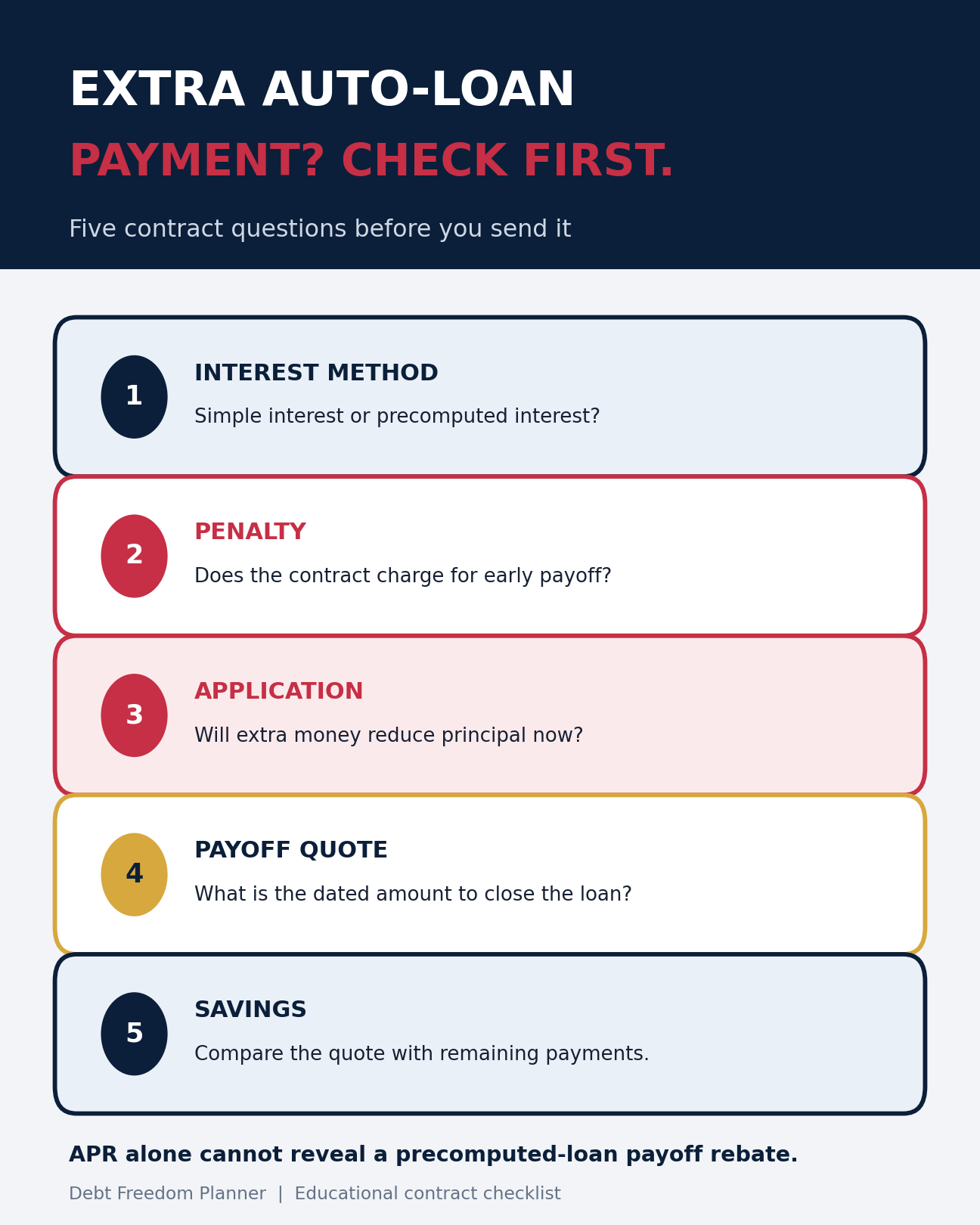
Check the interest method, penalty, payment application, dated payoff amount, and real savings before committing extra household cash.
Worked example: what $100 extra can do on simple interest
Consider a hypothetical simple-interest auto loan modeled in Debt Freedom Planner:
- Current principal: $20,000
- APR: 10.00%
- Scheduled monthly payment: $425
- Faster monthly target: $525
- No late fees, skipped payments, add-on balances, or prepayment penalty
- Extra money applied to principal in the same modeled month
| Simple-interest scenario | Modeled payoff time | Modeled payoff month | Modeled interest |
|---|---|---|---|
| Pay $425 monthly | 60 months | July 2031 | $5,495.40 |
| Pay $525 monthly | 47 months | June 2030 | $4,162.05 |
| Difference | 13 months sooner | — | $1,333.35 less |
This monthly approximation shows why extra principal can be valuable on a simple-interest loan: the balance falls faster, leaving less principal on which later interest can accrue.
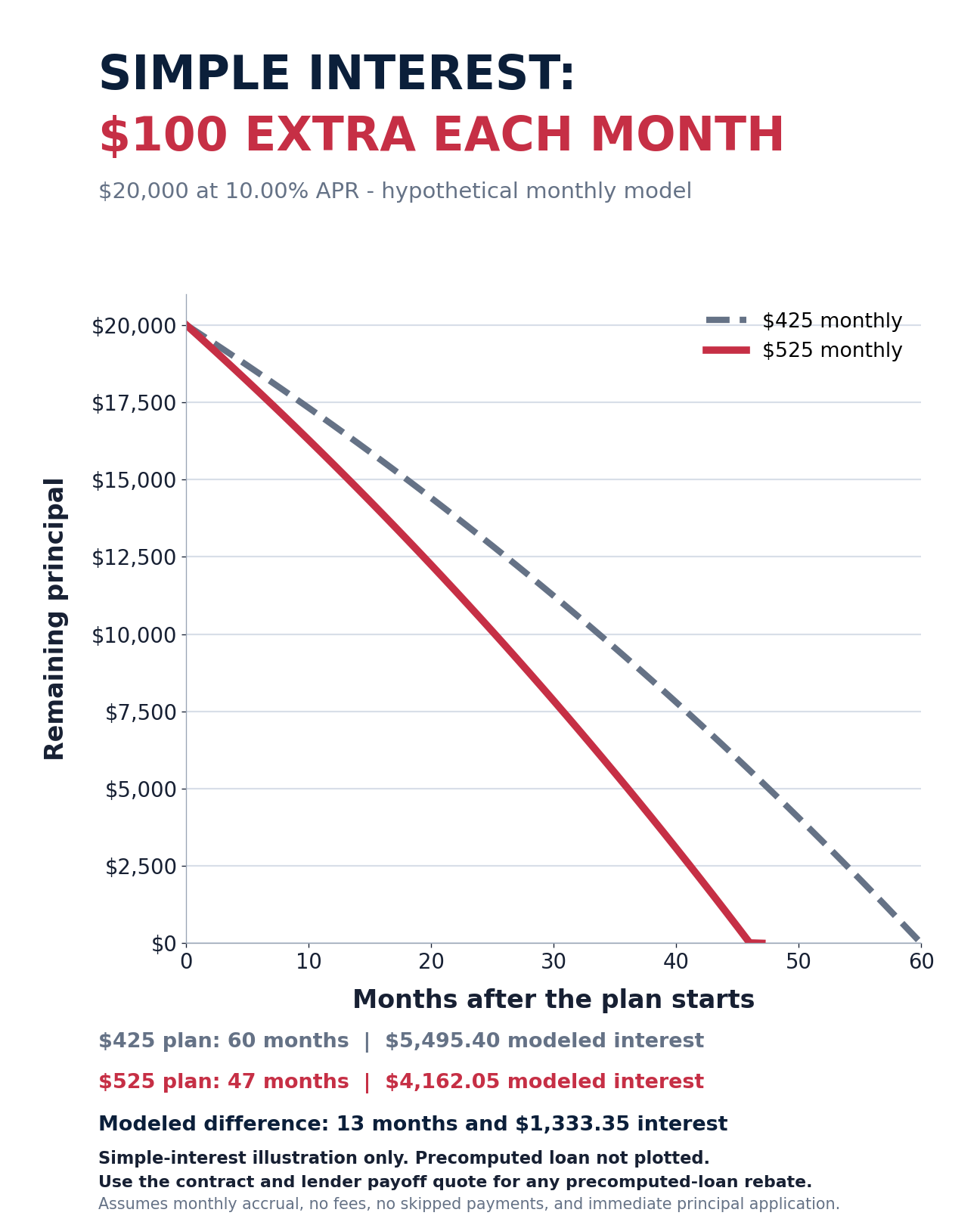
Hypothetical Debt Freedom Planner result for a $20,000 balance at 10.00% APR. The model uses monthly interest and immediate principal application. A real auto loan may accrue daily, apply payments on different dates, or include fees and contract terms that change the result.
Why the same graph does not prove savings on a precomputed loan
It would be misleading to copy the $1,333.35 modeled savings onto a precomputed-interest contract. The CFPB explains that precomputed interest is calculated at the beginning and that early payoff may create a refund of some unearned interest. The amount of that refund is not determined by APR and remaining months alone.
For a precomputed loan, compare two real numbers:
- the total of the remaining scheduled payments; and
- the lender’s dated payoff quote, including any rebate, fee, and per-day change after the quote date.
The difference is the useful early-payoff estimate for that date. Ask the lender to explain any rebate or penalty you do not understand. Keep the quote and the final paid-in-full confirmation.
Make sure the extra payment actually reduces principal
Even on a simple-interest loan, payment handling matters. The CFPB’s auto-loan payment-application guidance says payments generally go to fees first, then interest due, then principal. It also advises checking the loan documents and monthly statement to confirm how a payment was applied.
After making an extra payment:
- save the confirmation number or receipt;
- check the next statement’s principal balance;
- look for a “paid ahead” or advanced due date that you did not expect;
- verify that required payments are still due on their normal schedule; and
- contact the servicer promptly if the application does not match the instructions or contract.
Continue paying at least the required amount by each due date. An extra-principal strategy is separate from the minimum-payment obligation that protects the account from delinquency.
A decision rule for household cash flow
Use extra cash on the auto loan only after three gates pass:
- The contract gate: You know the interest method, penalty, and application rules.
- The savings gate: A simple-interest model or actual payoff quote shows a meaningful benefit.
- The cash-flow gate: The payment does not drain money needed for essential bills, required debt minimums, or the emergency cushion your household relies on.
If those gates pass, choose a repeatable monthly amount. A sustainable $100 can be more useful than one aggressive payment followed by missed obligations. If the loan is precomputed, a lump-sum payoff quote may be more informative than experimenting with scattered extra payments.
How Debt Freedom Planner fits
Open Debt Freedom Planner after confirming that your loan uses simple interest and that extra money will reduce principal. Enter the current balance, APR, required monthly payment, and the extra amount your household can maintain. Compare the payoff month and total modeled interest with and without the extra amount.
The planner does not connect to your lender, read your contract, calculate a precomputed-interest rebate, or know how a servicer will apply an unusual payment. Use it as a transparent simple-interest scenario—not as a substitute for the lender’s dated payoff statement.
Bottom line
Extra payments generally save interest on a simple-interest auto loan when they reduce principal promptly. A precomputed-interest loan requires more homework: the contract, rebate method, state-law limits, any penalty, and a dated payoff quote control the answer. Identify the method first, verify payment application, and model only what the available numbers can honestly support.
Debt Freedom Planner provides educational payoff projections, not individualized financial, legal, tax, credit-repair, or bankruptcy advice. Auto-loan contracts, state laws, interest accrual, rebate methods, fees, and payment application vary. Confirm account-specific terms and payoff amounts with the lender or servicer.
0 comments
Ask a question, add context, or share what worked for your household.
Create a free account or sign in to comment, reply, and vote on blog posts.