

Can You Stop an Automatic Debt Payment Without Canceling What You Owe?
Stop the automatic debit, not the obligation: revoke authorization, notify your bank, protect the due date, and make a documented replacement payment.
Yes. You can generally stop a company from automatically debiting your bank account without canceling the debt itself. The key is to treat these as two separate jobs: revoke or stop the debit authorization, then arrange another valid way to make every required payment on time. Stopping the withdrawal does not erase a loan, change its due date, or prevent late fees and other consequences if you do not replace the payment.

Turning off an automatic debit is a payment-method change, not a debt cancellation. Keep the obligation, due date, and replacement method visible while you make the switch.
First, identify which kind of recurring payment you use
The phrase “automatic payment” can describe two different arrangements:
| Arrangement | Who starts each payment? | Where to change it first |
|---|---|---|
| Company-initiated automatic debit | The lender, collector, servicer, or other company pulls money from your checking account or debit card under your authorization | The company that received your authorization, then your bank or credit union |
| Recurring bank bill pay | Your bank or credit union sends money under instructions you created in online banking | Your bank or credit union's bill-pay controls |
The CFPB's automatic-payment guide explains this distinction. It matters because deleting a recurring bill-pay instruction at your bank is not the same process as revoking a lender's authority to pull funds.
Review the original authorization, recent bank descriptions, and the creditor's payment page. If you still cannot tell which arrangement you have, ask both institutions who originates the transfer and what identifier appears on the debit.
How do you stop a company-initiated automatic debit?
Use a documented two-sided approach:
- Tell the company you revoke authorization. Call the creditor or servicer, state that it may no longer take preauthorized debits from the account, and ask when the change becomes effective. Follow up through a durable channel such as a secure message, email, or letter. Be precise: say whether you are ending only automatic debits or also exercising a separate right under the underlying contract.
- Tell the bank or credit union. State that the company's authorization is revoked and ask what form or evidence the institution needs to block future transfers. Keep the case number, employee name, date, and delivery proof.
- Ask whether a stop-payment order is also appropriate. The bank may use a stop-payment order for a named payee or series of transfers and may charge a fee. Confirm how long the order lasts and whether it covers re-presented or differently coded debits.
- Set up the replacement payment before the due date. Use a method the creditor accepts and allow for processing time. Do not wait for a stopped debit to prove successful before planning the next valid payment.
- Monitor both accounts. Confirm the old debit did not occur and the replacement payment was actually received and credited.
The CFPB's step-by-step stopping guide recommends contacting both the company and the financial institution, following up in writing, and keeping close track of requests and dates.
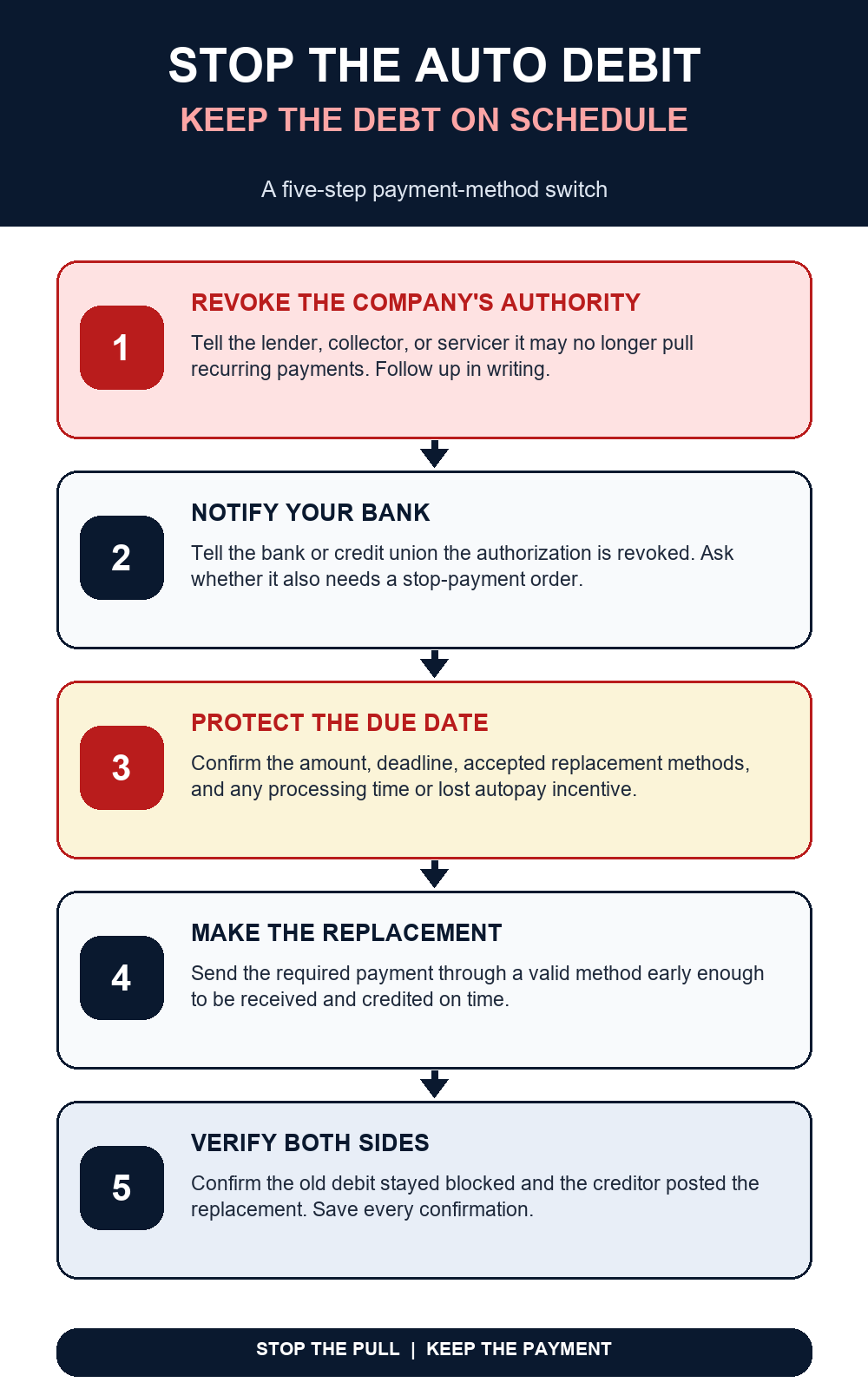
Revoke the pull, confirm the bank block, preserve the due date, make a replacement payment, and verify both sides. The debit and the debt are separate.
What does the three-business-day rule mean?
For a covered preauthorized electronic fund transfer from a consumer account, current Regulation E says a consumer may stop payment by notifying the financial institution orally or in writing at least three business days before the scheduled transfer.
That is a legal timing rule for the stop-payment notice; it is not a promise that waiting until the last minute will be operationally easy. Contact the company and bank as early as practical, ask what cutoffs apply, and do not count weekends or holidays casually. Your institution may ask for written confirmation after an oral request. Regulation E permits that confirmation requirement and says the oral order can cease to bind after 14 days if the required written confirmation is not provided.
Save the confirmation in a form you can retrieve later. A useful record includes:
- the company and bank names;
- the account or loan identifier, with sensitive digits masked in your notes;
- the date and amount of the next scheduled debit;
- the date, time, and channel of each notice;
- the exact future transfers covered;
- any written-confirmation deadline; and
- the replacement payment method and confirmation number.
Does stopping automatic payment cancel the loan or settlement?
No. Stopping the bank withdrawal changes how money moves; it does not by itself cancel the agreement that says money is owed. The CFPB expressly warns that if you stop an automatic loan payment, you still must pay the loan another way.
That distinction is especially important with a loan, debt-collection payment plan, workout agreement, or settlement schedule. Missing a required payment could trigger interest, a late fee, loss of a discount or incentive, default consequences, or a broken settlement—depending on the agreement and applicable law. Ask the creditor in writing:
- What amount is required next?
- What is the exact due date and time cutoff?
- Which replacement methods are accepted?
- How long does each method take to post?
- Does turning off autopay change an interest-rate discount or other incentive?
- Will the creditor send written confirmation that automatic debit is disabled?
Do not assume a bank stop-payment order updates the creditor's records. The creditor may still show autopay as active until it processes your revocation.
Worked example: the cost comes from missing the replacement, not from the switch
Assume a hypothetical household owes $7,500 on one debt at 18.50% APR and intends to pay $240 every month. There are no new charges or fees. Debt Freedom Planner models interest monthly as APR divided by 12 with cent rounding.
In the first path, the household stops the automatic debit but sends a manual $240 payment that still reaches the creditor in the scheduled cycle. The payoff math is unchanged. In the second path, the automatic debit stops and no replacement arrives during that cycle; $240 payments resume one cycle later.
| Hypothetical path | Payoff time from scheduled switch | Modeled interest | Total paid |
|---|---|---|---|
| Manual replacement arrives in the same cycle | 43 months | $2,811.90 | $10,311.90 |
| One cycle has no payment; $240 then resumes | 45 months | $3,038.44 | $10,538.44 |
| Difference | 2 months | $226.54 | $226.54 |
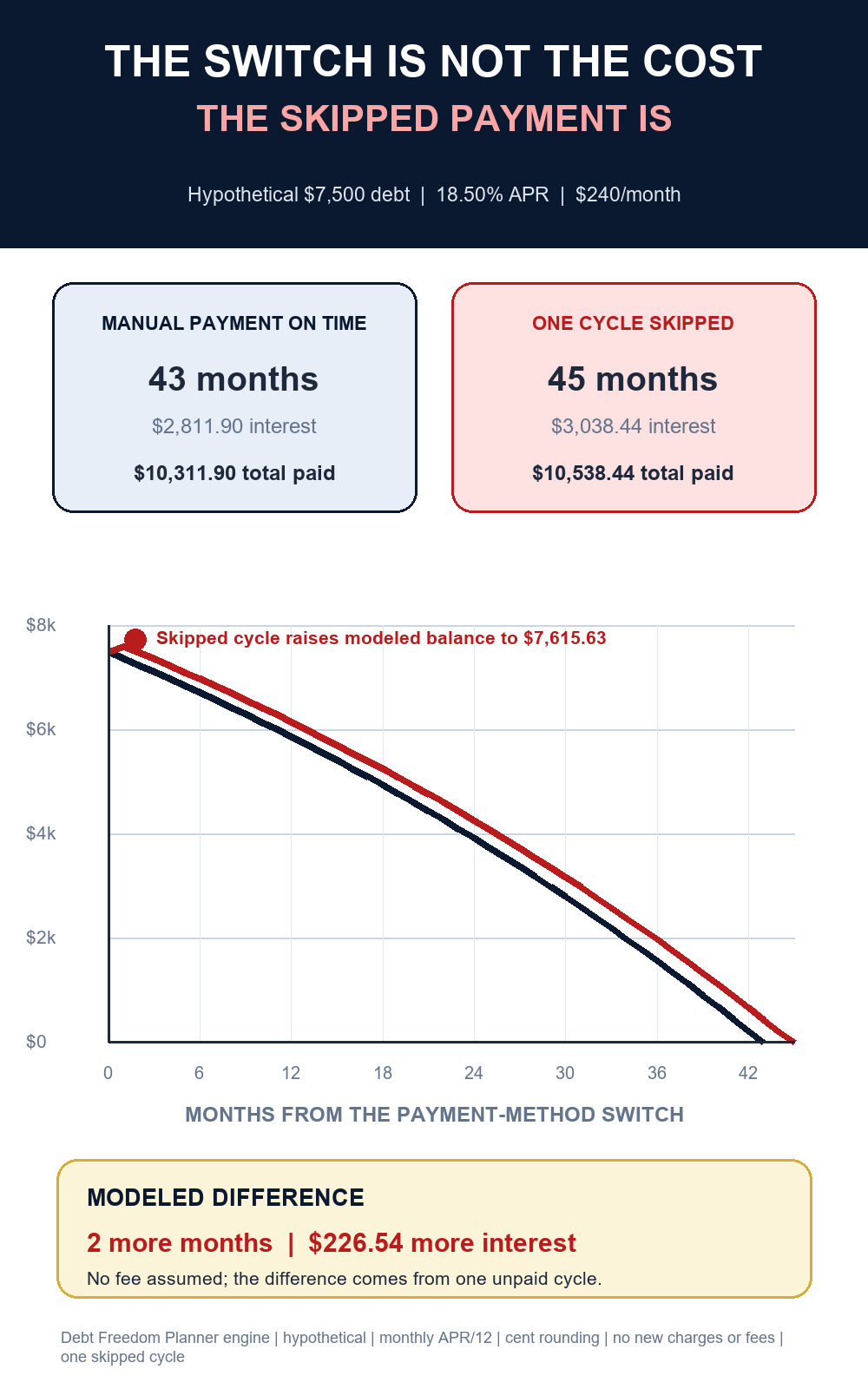
Debt Freedom Planner engine example: $7,500 at 18.50% APR with $240 monthly. The delayed path assumes one cycle with no payment and no fee, then $240 payments resume. Actual contracts may use daily interest, fees, and different timing rules.
The skipped cycle adds $115.63 of modeled interest before payments resume, raising the modeled balance to $7,615.63. The point is not that stopping autopay itself costs $226.54. If a valid replacement arrives on time, the modeled schedule does not change. The cost in this example comes from letting a payment cycle pass without a payment.
What if another debit happens after you revoked authorization?
Contact the bank or credit union immediately and identify the transaction, your earlier revocation, and the date you sent it. The CFPB says a debit initiated after the company and bank have been told that authorization was revoked can be treated as an error, subject to the facts and applicable rules.
Regulation E's error-resolution section includes unauthorized and incorrect electronic fund transfers as errors. It generally requires notice no later than 60 days after the institution sends the statement first reflecting the alleged error. That outer window is not a reason to wait: prompt reporting protects cash flow, evidence, and the ability to fix the replacement payment plan.
Ask the bank what written confirmation is required, what investigation timeline applies, and whether provisional credit will be provided. Keep monitoring because a payee may use more than one transaction description or payment rail. If the disputed debit causes another required payment to fail, contact that creditor too; the bank dispute does not automatically repair a separate missed payment.
How should you update your debt payoff plan?
Once the old debit is stopped and the replacement method is confirmed, update the plan with what will actually happen:
- Enter the verified current balance, not a balance that assumes an unposted payment.
- Use the APR currently shown for the modeled debt.
- Enter the required minimum and the monthly amount you can reliably deliver through the new method.
- Move the payment date earlier if the replacement channel needs more processing time.
- Recalculate if an autopay discount ends, a fee posts, or a payment cycle was missed.
You can enter those verified numbers in Debt Freedom Planner to compare snowball and avalanche order, test a sustainable extra payment, and review the projected payoff date, total interest, and month-by-month schedule. The planner does not stop transfers, contact lenders, move money, interpret contracts, or resolve bank errors. It models the debts and payments you enter.
A short switch-over checklist
Before the next due date, confirm all seven items:
- The company received your revocation.
- The bank or credit union recorded the block or stop-payment instruction.
- Any required written confirmation was delivered on time.
- You know whether a stop-payment fee applies.
- The creditor told you the valid replacement methods and posting cutoff.
- The replacement payment was received and credited.
- The old account and creditor account were monitored after the scheduled debit date.
Bottom line
You can stop a preauthorized automatic debit without canceling what you owe, but the safest switch keeps the payment obligation moving on a parallel track. Revoke the company's authority, notify the bank, satisfy any written-confirmation requirement, arrange a replacement before the creditor's deadline, and verify both accounts. The protection is not merely stopping money from leaving; it is stopping the wrong payment method without creating a missed payment.
This article provides educational information, not individualized financial, legal, tax, credit-repair, or banking advice. Regulation E coverage, account procedures, contracts, fees, incentives, and state law vary. Confirm current instructions with the company and your financial institution, and consult a qualified professional when needed.
0 comments
Ask a question, add context, or share what worked for your household.
Create a free account or sign in to comment, reply, and vote on blog posts.